£5959 Attendance Allowance 2026: If you have seen headlines about a £5,959 Attendance Allowance payment, here is the confirmed, current fact: this is the correct annual figure for the 2026/27 tax year, not a new or one-off payment. Attendance Allowance 2026/27 is paid at two weekly rates, £76.70 for people who need help during the day or at night, and £114.60 for those who need help both day and night or who are terminally ill, following a 3.8 percent uprating that took effect on 6 April 2026 in line with September 2025 inflation. At the higher rate, that works out to exactly £5,959.20 a year, paid every four weeks, completely tax-free, and with no effect whatsoever on your State Pension or savings. Around 1.86 million people across the UK currently claim it, yet the Department for Work and Pensions and independent researchers estimate roughly one million more pensioners are eligible but have never applied, often wrongly assuming their savings or existing pension income rule them out. We’ll be updating this article monthly as new DWP rates and eligibility guidance are confirmed.
This article walks through exactly how the current 2026/27 rates were calculated, who genuinely qualifies regardless of income or savings, how Attendance Allowance can unlock a further Severe Disability Addition worth £86.05 a week through Pension Credit, how the benefit works differently in Scotland under its new name, and the exact steps to apply or check an existing claim. Every figure below is drawn directly from the official DWP Benefit and Pension Rates 2026 to 2027 publication and confirmed government guidance.
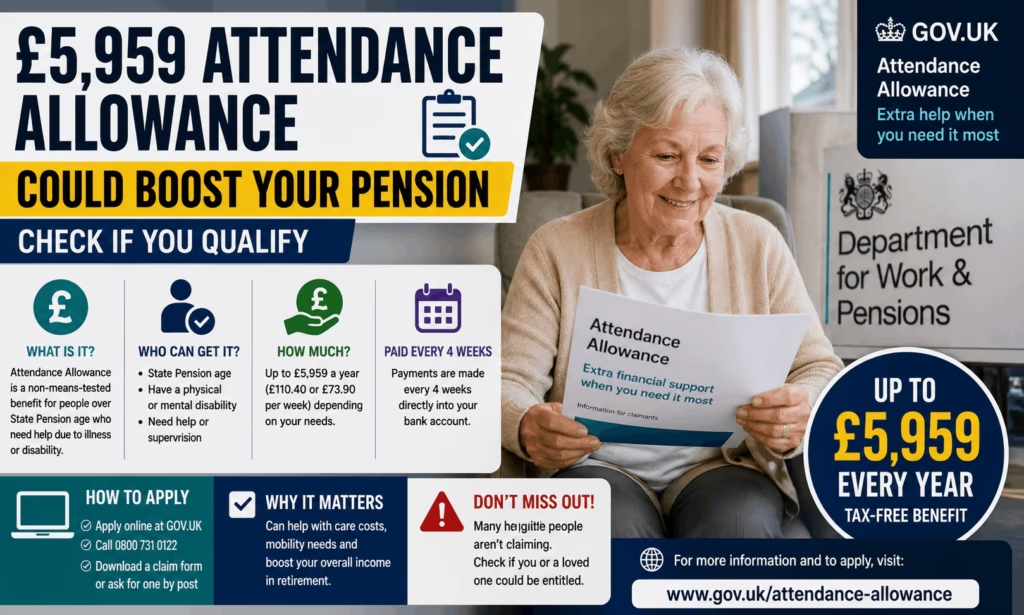
£5959 Attendance Allowance Key Highlights
| Detail | Current Figure (2026/27) |
|---|---|
| Lower weekly rate | £76.70 |
| Higher weekly rate | £114.60 |
| Higher rate annual total | £5,959.20 |
| Lower rate annual total | £3,988.40 |
| Increase applied from | 6 April 2026 |
| Uprating percentage | 3.8%, based on September 2025 CPI |
| Payment frequency | Every 4 weeks, in arrears |
| Is it means-tested? | No, income and savings are irrelevant |
| Is it taxable? | No, fully tax-free |
| Current number of claimants | Approximately 1.86 million |
| Estimated eligible non-claimants | Approximately 1 million |
| Pension Credit Severe Disability Addition (single) | £86.05 per week |
| Pension Credit Severe Disability Addition (couple, both qualify) | £172.10 per week |
| Carer’s Allowance rate (2026/27) | £86.45 per week |
| Carer’s Allowance earnings limit | £204 per week |
| Scotland equivalent | Pension Age Disability Payment (PADP), via Social Security Scotland |
What is £5959 Attendance Allowance 2026?
Attendance Allowance is a tax-free, non-means-tested weekly benefit paid by the Department for Work and Pensions to people who have reached State Pension age, currently 66, and who need help with personal care or supervision because of a physical or mental health condition. It is not restricted to any specific diagnosis or list of qualifying conditions. Instead, the DWP assesses how much help a person genuinely needs with everyday tasks such as washing, dressing, eating, moving around the home, or staying safe, rather than looking at what condition caused that need.
Crucially, you do not need to already have a carer, live with someone, or receive any existing care to qualify. The assessment is based entirely on the level of help you reasonably require, whether or not you are currently receiving that help. If you are under State Pension age, the equivalent benefit is Personal Independence Payment (PIP) rather than Attendance Allowance.
$1600 Property Tax Credit 2026 Fact Check, Eligibility, Dates & How to Apply
Trump’s $100000 H-1B Visa Fee 2026: Current Legal Status After the Court’s Latest Ruling
The Current 2026/27 Rates Explained
From 6 April 2026, Attendance Allowance pays £76.70 a week at the lower rate, up from £73.90 in 2025/26, and £114.60 a week at the higher rate, up from £110.40 the previous year. This reflects a 3.8 percent increase, in line with the Consumer Prices Index recorded in September 2025, and matches the standard annual uprating pattern the DWP applies each April to most working-age and disability benefits.
Paid every four weeks, the lower rate works out to £306.80 per payment, or £3,988.40 across a full year, while the higher rate pays £458.40 every four weeks, totalling £5,959.20 a year. Anyone already receiving Attendance Allowance had their rate increased automatically on 6 April 2026 and does not need to take any action to receive the uplift. These figures remain fixed until the next annual uprating in April 2027.
The lower rate applies where a claimant needs frequent help or supervision either during the day or at night, but not both. The higher rate applies where help or supervision is needed during both the day and the night, or where the claimant is terminally ill and not expected to live more than 12 months, in which case the higher rate is awarded automatically under the Special Rules.
Who Qualifies for Attendance Allowance
Eligibility for Attendance Allowance rests on three core requirements. First, the claimant must have reached State Pension age. Second, they must have a physical disability, mental health condition, learning difficulty, or a combination, that has caused a genuine need for help or supervision. Third, that need must have existed for at least six months, unless the claim is made under the Special Rules for a terminal illness, in which case the six-month rule does not apply and the claim is typically processed on a faster basis.
There is no official list of qualifying conditions, since the DWP does not assess a diagnosis, it assesses functional need. Conditions commonly associated with successful claims include arthritis, Parkinson’s disease, dementia, stroke recovery, chronic pain conditions, sight or hearing loss, and mental health conditions such as anxiety or depression that affect a person’s ability to manage daily tasks safely. Income, savings, property ownership, and existing pension income have no bearing whatsoever on eligibility, which is the single most common misconception preventing eligible pensioners from applying.
How Attendance Allowance Can Boost Your Pension Credit
One of the most significant, and most commonly missed, effects of an Attendance Allowance award is its potential to unlock a Severe Disability Addition within Pension Credit. If a claimant already receives, or subsequently becomes entitled to, the Guarantee Credit element of Pension Credit, and also receives Attendance Allowance, lives alone or is treated as living alone, and no one is separately paid Carer’s Allowance for looking after them, they can qualify for this additional amount.
For 2026/27, the Severe Disability Addition is worth £86.05 a week for a single claimant, or £172.10 a week where both partners in a couple separately qualify. Added to the Pension Credit standard minimum guarantee, which rose to £238.00 a week for a single person and £363.25 for a couple in April 2026, this addition can meaningfully increase total weekly income for pensioners who were previously unaware they qualified. Anyone already receiving Pension Credit who is then awarded Attendance Allowance should contact the Pension Service directly to request a recalculation, since this adjustment is not always applied automatically.
Beyond Pension Credit, an Attendance Allowance award can also increase entitlement to Housing Benefit through a disability premium, and can support a stronger case for Council Tax Reduction, both assessed separately by local authorities.
Attendance Allowance in Scotland: What Has Changed
Residents of Scotland should note an important structural difference. Attendance Allowance has been progressively replaced in Scotland by the Pension Age Disability Payment (PADP), administered by Social Security Scotland rather than the DWP. The weekly rates under PADP are aligned with Attendance Allowance rates in the rest of the UK, so the £76.70 and £114.60 figures apply equally, but the application process differs, with claims made through mygov.scot rather than the standard DWP claim line or paper form.
Anyone in Scotland who already receives Attendance Allowance from before the transition does not need to reapply, as existing awards continue and are migrated automatically, but new claimants in Scotland should apply for PADP rather than Attendance Allowance directly.
Canada Immigration Language Test Scrutiny 2026: IRCC’s New Fraud Verification Rules Explained
Free TSA PreCheck 2026: Who Actually Qualifies for No-Cost or Reimbursed Enrollment
How Carer’s Allowance Connects to Your Claim
If someone provides you with at least 35 hours of care a week and you are receiving Attendance Allowance at either rate, that carer may separately qualify for Carer’s Allowance, worth £86.45 a week in 2026/27, provided their own net earnings do not exceed £204 a week after allowable deductions. This earnings limit rose from £196 in 2025/26, marking the first time it has passed £200 a week since the benefit’s introduction in 1976.
It is worth understanding one important interaction here. If the person who cares for you claims Carer’s Allowance, this can in some cases affect your own eligibility for the Severe Disability Addition described above, since that addition generally requires that no one is being paid Carer’s Allowance for looking after you. Households in this situation should check the combined effect on both benefits before assuming both can be claimed in full simultaneously, since in some cases one household member’s claim may reduce the other’s entitlement.
How to Apply for Attendance Allowance
Applying for Attendance Allowance involves completing a claim form, known as the AA1 form, either online through GOV.UK or by requesting a paper copy through the Attendance Allowance helpline. The form asks detailed questions about the help you need with washing, dressing, eating, moving around, managing medication, and staying safe, both during the day and at night, and it is generally advisable to be thorough and specific about difficulties on your worst days rather than your best days, since assessors rely entirely on the written information provided alongside any supporting medical evidence.
If your claim is approved, payment is backdated to the date the DWP received your original claim form, not the date of the decision itself, which is one reason applying as promptly as possible matters, since decisions can take a number of weeks to process. Claims made under the Special Rules for terminal illness are typically fast-tracked and do not require the standard six-month qualifying period.
Common Reasons Eligible Pensioners Miss Out
Several recurring misconceptions explain why an estimated one million eligible pensioners have never claimed. Many assume that having savings, owning their home, or receiving a private or workplace pension automatically disqualifies them, when in fact none of these factors are considered at all. Others believe they need a formal diagnosis or a doctor’s letter confirming a specific condition before applying, when the assessment instead focuses on the functional impact of a condition on daily life. Some pensioners also mistakenly believe they must already have a carer in place to qualify, when the benefit is designed to help fund exactly that kind of support, not to reward support that already exists.
Official Resources and Useful Links
| Resource | Purpose | Link |
|---|---|---|
| GOV.UK, Attendance Allowance | Official eligibility rules, claim forms, and rates | gov.uk/attendance-allowance |
| GOV.UK, Attendance Allowance Claim Form (AA1) | Download or request the official claim form | gov.uk/attendance-allowance/how-to-claim |
| GOV.UK Account (Login and Claim Tracking) | Check the status of an existing benefits claim | gov.uk (GOV.UK One Login) |
| Social Security Scotland, Pension Age Disability Payment | Scotland-specific claim portal and guidance | mygov.scot (Pension Age Disability Payment) |
| GOV.UK, Pension Credit | Check eligibility and apply for the Severe Disability Addition | gov.uk/pension-credit |
| GOV.UK, Carer’s Allowance | Eligibility and earnings limit details for carers | gov.uk/carers-allowance |
People Also Ask
How much is Attendance Allowance in 2026? Attendance Allowance pays £76.70 a week at the lower rate and £114.60 a week at the higher rate in the 2026/27 tax year, meaning the higher rate totals £5,959.20 a year.
Does Attendance Allowance affect my State Pension or savings? No. Attendance Allowance is not means-tested and has no effect on your State Pension, savings, or other income. It is also completely tax-free.
Do I need a carer to claim Attendance Allowance? No. You do not need to already have a carer or live with anyone to qualify. The DWP assesses the level of help you need, not the help you currently receive.
Can Attendance Allowance increase my Pension Credit? Yes. If you receive Attendance Allowance, live alone, and qualify for Pension Credit’s Guarantee Credit element, you may be entitled to the Severe Disability Addition, worth £86.05 a week for a single claimant in 2026/27.
Is Attendance Allowance different in Scotland? Yes. In Scotland, Attendance Allowance has been replaced by the Pension Age Disability Payment, administered by Social Security Scotland, though the weekly rates remain aligned with the rest of the UK.
FAQs
What is the £5,959 Attendance Allowance?
It refers to the annual total for the higher rate of Attendance Allowance in the 2026/27 tax year, calculated as £114.60 a week paid over 52 weeks. It is not a one-off payment or a new benefit, but the confirmed current annual value of an existing weekly benefit.
Who is eligible for Attendance Allowance?
Anyone who has reached State Pension age and has needed help or supervision because of a physical or mental health condition for at least six months, or who has a terminal illness, may qualify. There are no income, savings, or property restrictions.
How is Attendance Allowance paid?
It is paid every four weeks in arrears, directly into a bank, building society, or credit union account, or to a nominated representative if the claimant is unable to manage their own finances.
Can I get Attendance Allowance if I already have Personal Independence Payment (PIP)?
No. Attendance Allowance is specifically for people who have reached State Pension age. If you were already receiving PIP before reaching that age, you generally continue receiving PIP rather than switching to Attendance Allowance, though you should confirm your specific situation with the DWP.
Will claiming Attendance Allowance reduce any of my other benefits?
No. Attendance Allowance does not reduce your State Pension, Pension Credit, Housing Benefit, or Council Tax Reduction. In several cases, being awarded Attendance Allowance can actually increase your entitlement to these other benefits.
How long does an Attendance Allowance claim take to process?
Processing times vary, but if approved, payment is backdated to the date your claim form was received by the DWP, not the date of the final decision, so applying promptly is important even while a decision is pending.
Conclusion
The £5,959 Attendance Allowance figure circulating online is accurate for the 2026/27 tax year, reflecting the higher weekly rate of £114.60 following April 2026’s 3.8 percent uprating. With roughly one million eligible pensioners still not claiming, often due to mistaken assumptions about savings, existing pensions, or the need for a formal diagnosis, this remains one of the most significantly underclaimed benefits in the UK system. Beyond the weekly payment itself, an award can unlock further support through Pension Credit’s Severe Disability Addition, Housing Benefit, and Council Tax Reduction, making it worth checking eligibility even for pensioners who assume they would not qualify. This article will be updated monthly as new DWP rates and eligibility guidance are confirmed.
Also Read
Social Security Changes 2026: New Rules, COLA Increase & What Changed This Year
Stimulus Check 2026: Fact-Checking Every Viral Payment Claim (Tracker)
2027 Social Security COLA Forecast: Latest Estimate, Medicare Offset & What Retirees Can Expect
$5280 CRA My Account Breach Claims 2026: How Affected Canadians Could Qualify for Compensation