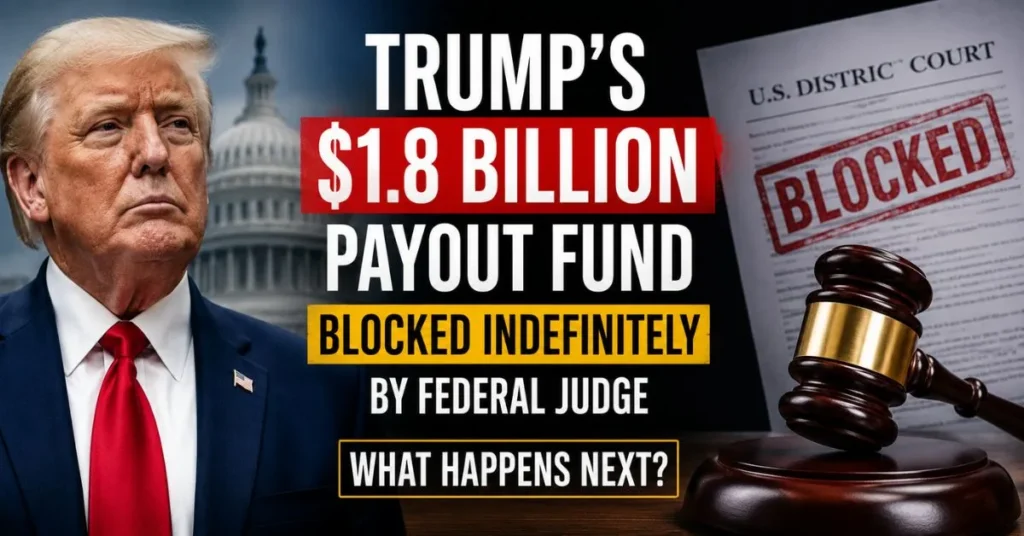
A federal judge has indefinitely blocked the Trump administration’s controversial $1.8 billion payout fund, dealing a significant setback to one of the administration’s most debated initiatives. The decision comes after weeks of legal challenges, bipartisan criticism, and concerns about how taxpayer money would be distributed under the program.
The ruling, issued by U.S. District Judge Leonie Brinkema in Virginia, prevents the administration from moving forward with the so-called “Anti-Weaponization Fund,” a program designed to compensate individuals who claim they were unfairly targeted by government investigations, prosecutions, or other actions. The court order will remain in effect while the court continues to examine the legality of the initiative.
What Is the $1.8 Billion Payout Fund?
The proposed fund was created as part of a settlement linked to a lawsuit involving former President Donald Trump and the Internal Revenue Service (IRS). The administration argued that the fund would provide financial relief to individuals who believed they had suffered because of what Trump and his supporters described as the “weaponization” of federal agencies against political opponents. According to administration officials, eligible applicants could potentially receive compensation if they demonstrated that government actions had caused them financial, professional, or personal harm.
Supporters of the plan claimed it would help restore trust in federal institutions and provide justice to those who believed they had been unfairly targeted. However, critics quickly raised concerns that the program lacked transparency and could disproportionately benefit Trump allies, political supporters, and individuals involved in highly controversial investigations.
Judge Questions Government’s Commitment to Ending the Fund
The latest ruling followed a hearing in which administration lawyers argued that the fund was effectively no longer moving forward. Acting Attorney General Todd Blanche reportedly told lawmakers that the administration had stepped away from the proposal. Judge Brinkema, however, expressed skepticism. During court proceedings, she noted that public statements and verbal assurances were not sufficient legal guarantees that the fund had been permanently abandoned. Instead, she demanded formal, sworn declarations from senior officials confirming that the program would not be revived.
The judge emphasized that official government actions carry legal weight, while political statements do not. As a result, she extended the court order blocking the fund until the administration provides legally binding assurances regarding its future.
Why Opponents Challenged the Program
Several advocacy groups, former government officials, legal experts, and public-interest organizations filed lawsuits seeking to halt the fund. Their primary argument was that the executive branch lacked clear legal authority to establish and distribute such a large compensation program without congressional approval. Opponents also argued that the initiative created the risk of political favoritism. They claimed the program could effectively become a mechanism for rewarding supporters of the president rather than serving a broader public purpose.
Legal advocacy groups described the fund as an unprecedented use of taxpayer money and warned that it could set a troubling precedent for future administrations. Critics contended that allowing any president to create compensation programs for political allies could undermine public confidence in government accountability.
Bipartisan Criticism Emerges
One of the most striking aspects of the controversy is that opposition has not been limited to Democrats. Some Republican lawmakers also expressed concerns about the fund’s structure, oversight mechanisms, and potential political implications. Questions were raised about who would determine eligibility, how claims would be verified, and whether sufficient safeguards existed to prevent abuse.
Critics worried that taxpayers could ultimately be responsible for financing compensation payments based on subjective or politically charged claims. The bipartisan nature of the criticism increased pressure on the administration and contributed to growing uncertainty about whether the program could survive legal scrutiny.
The Legal Questions at the Center of the Case
At the heart of the dispute lies a fundamental constitutional issue: does the executive branch possess the authority to create and operate a multi-billion-dollar compensation fund without direct authorization from Congress? Plaintiffs argue that federal spending must generally be approved through the legislative process. They maintain that bypassing Congress in this case would violate constitutional principles regarding the separation of powers and federal appropriations.
The administration, meanwhile, has defended the legality of the settlement arrangement and argued that the fund was established through lawful government procedures. Officials have suggested that similar mechanisms have been used in other contexts to resolve legal disputes involving the federal government. The court’s eventual ruling could have significant implications for future administrations and their ability to establish similar programs.
No Money Has Been Distributed
One important fact in the case is that no payments have been made from the fund. Reports indicate that the government had not yet accepted claims or begun distributing money before the court intervened. Because the program remained in its early stages, the judge concluded that extending the court order would not create substantial harm for the government.
Conversely, allowing the fund to proceed before resolving legal questions could create complications if the court later determined that the program was unlawful. This reasoning played a major role in the decision to maintain the block while litigation continues.
Political Ramifications for Trump
The controversy arrives at a politically sensitive time for President Trump. The proposed fund has become a flashpoint in broader debates over government accountability, political investigations, and the role of federal institutions. Supporters of the administration argue that many Americans were unfairly targeted by politically motivated investigations and deserve compensation. They view the fund as an effort to correct perceived injustices and hold government agencies accountable.
Critics, however, see the initiative as a politically motivated effort to reward allies and reinforce claims that federal law enforcement agencies were systematically biased against Trump supporters. They argue that such allegations should be addressed through established legal channels rather than through a large taxpayer-funded compensation program. The legal battle is therefore likely to remain closely intertwined with broader political debates throughout the remainder of the year.
Administration Faces Growing Pressure
The administration now faces increasing pressure to clarify its position. While some officials have indicated that the fund is effectively dead, critics note that no formal action has been taken to permanently dismantle the program. Judge Brinkema specifically highlighted this contradiction. She noted that if the administration truly intends to abandon the initiative, providing sworn statements should be straightforward.
Until such assurances are provided, the court appears unwilling to assume that the fund has been permanently withdrawn. This cautious approach reflects the judge’s concern that future officials could potentially revive the program without additional legal review.
What Happens Next?
The immediate future of the fund remains uncertain. The court has ordered administration officials to provide formal declarations regarding the program’s status. If those declarations satisfy the judge, the legal dispute could narrow significantly. However, if questions remain about the administration’s intentions, the litigation may continue for months. Additional hearings could explore constitutional issues, spending authority, and the legality of using settlement agreements to establish large compensation funds.
Legal experts believe the outcome could influence future executive actions involving federal settlements and compensation programs. The case may also serve as an important test of judicial oversight over executive branch spending decisions.
Fact Check:
A federal court has extended its block on the Trump administration’s proposed $1.8 billion fund, preventing the program from moving forward while legal challenges are reviewed. The fund was designed to compensate individuals who claimed they had been harmed by what supporters described as the “weaponization” of government agencies. Court records indicate that no payments had been distributed before the judge issued the court order. The central legal dispute focuses on whether the executive branch has the authority to establish and administer such a large compensation fund without explicit approval from Congress. As the litigation continues, the case remains unresolved, and the final legal outcome has yet to be determined.
Disclaimer:
This article is intended for informational and news-reporting purposes only. The information presented is based on publicly available reports, court proceedings, and statements available at the time of publication. Legal cases are subject to ongoing developments, and future court rulings or government actions may alter the circumstances described in this article. Readers should consult official court documents and government sources for the most current information. The article does not constitute legal, financial, or political advice.