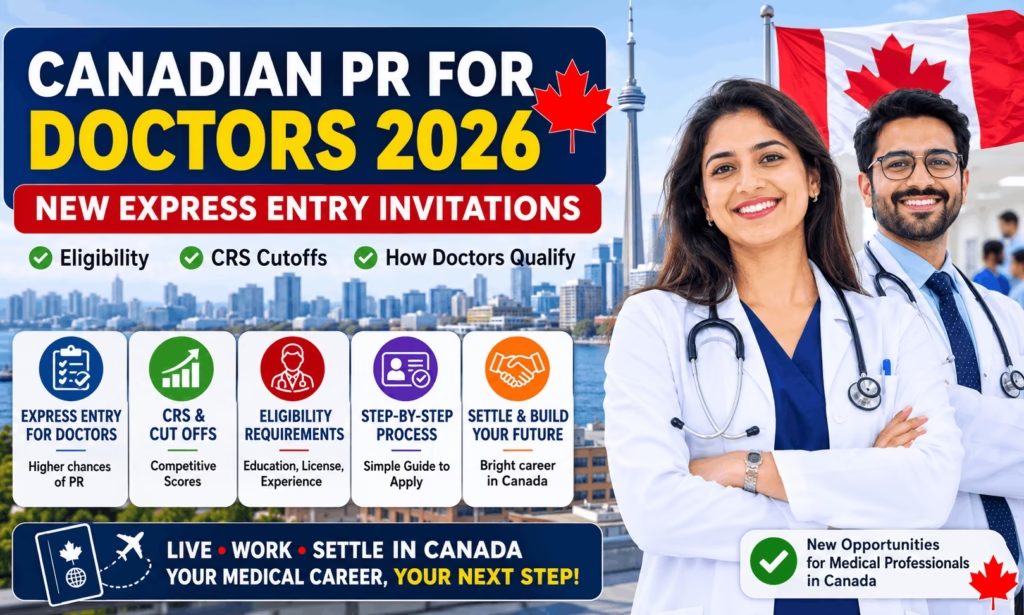
Canadian PR for Doctors 2026: Canada has quietly opened one of the fastest routes to permanent residence in its entire immigration system, and it is built specifically for physicians. Since Immigration, Refugees and Citizenship Canada (IRCC) created a dedicated Express Entry category for doctors in December 2025, the agency has run targeted draws that invited foreign-trained and Canadian-experienced physicians at Comprehensive Ranking System (CRS) cutoffs so low they broke program records. The very first physician-only draw, held on February 19, 2026, invited 391 doctors at a CRS score of just 169, the lowest cutoff ever recorded in the history of Express Entry. For doctors who have spent years watching general draws sit far out of reach, this is the clearest signal yet that Ottawa is prioritizing healthcare talent over almost every other profession.
A second physician-specific round followed on June 24, 2026, issuing 271 additional invitations at a cutoff of 223, still dramatically lower than the roughly 500-point average score sitting in the general Express Entry pool. Together with a broader Healthcare and Social Services category that has already run two large draws in 2026, these invitations form the backbone of Canada’s answer to a healthcare staffing crisis that has left more than 5.7 million Canadians without regular access to a family doctor. We’ll be updating this article monthly as new draws are announced, so check back for the latest CRS cutoffs and eligibility changes.
Canadian PR for Doctors 2026 Key Highlights
| Detail | Information |
|---|---|
| Category name | Physicians with Canadian Work Experience |
| Added to Express Entry | December 8, 2025 |
| First physician-only draw | February 19, 2026 — 391 ITAs at CRS 169 (record low) |
| Second physician-only draw | June 24, 2026 — 271 ITAs at CRS 223 |
| Minimum Canadian work experience required | 12 months, gained within the previous 3 years |
| Eligible NOC codes | 31100 (clinical/laboratory medicine specialists), 31101 (specialist surgeons), 31102 (general practitioners and family physicians) |
| Related category | Healthcare and Social Services (nurses, pharmacists, physicians, social workers, and more) |
| 2026 healthcare category draws | Feb 20 (4,000 ITAs, CRS 467) and June 25 (4,000 ITAs, CRS 475) |
| Total 2026 Express Entry draws (as of late July) | 42 rounds, 104,000+ total invitations issued |
| Express Entry pool size | 231,533 candidates (as of July 19, 2026) |
| Managing authority | Immigration, Refugees and Citizenship Canada (IRCC) |
Why Canada Created a Dedicated Immigration Pathway for Doctors
The shortage driving this policy is not abstract. Healthcare administrators across the country have warned for years that Canada does not have enough licensed physicians to meet demand, particularly in family medicine and rural or semi-rural communities. Internationally trained doctors already working inside Canadian hospitals and clinics — often on temporary work permits — represented an obvious, underused solution: people who had already proven themselves in the Canadian system but had no fast, dependable route to permanent residency.
That is exactly the gap the new Express Entry category for physicians was designed to close. Rather than forcing doctors to compete against software engineers, accountants, and general skilled workers in the main CRS pool — where cutoffs regularly sit above 500 points — IRCC now runs category-based draws that pull directly from the pool of physicians who already meet the occupational and experience requirements. This is part of a larger 2026 shift toward occupation-based immigration, which now includes ten active categories, five of them introduced this year alone, covering everything from senior managers to skilled trades to French-language proficiency.
How the Physicians Express Entry Category Actually Works
Eligible Occupations and NOC Codes
The physicians category targets doctors classified under Canada’s National Occupational Classification system, primarily NOC 31100 (specialists in clinical and laboratory medicine), NOC 31101 (specialists in surgery), and NOC 31102 (general practitioners and family physicians). If your Canadian work experience falls under one of these codes, you may be eligible for category-specific draws even if your general CRS score would never clear a standard round.
The 12-Month Canadian Experience Requirement
To qualify, a physician must have accumulated at least 12 months of full-time (or equivalent part-time) work experience in Canada within the three years before applying, working under one of the eligible NOC codes. This requirement was tightened in early 2026 — IRCC raised the minimum experience threshold for related healthcare categories from six months to a full year as of February 18, 2026, a change that also affects the broader healthcare and social services stream.
Record-Low CRS Cutoffs Explain the Opportunity
The February 2026 physicians draw invited candidates at a CRS score of 169 — a number so low it startled even experienced immigration consultants, since it meant nearly any eligible physician in the pool with a completed profile received an invitation. The June draw raised that bar to 223, still far below the 500+ points typically needed in Canadian Experience Class rounds. This pattern tells eligible doctors two things: first, that the physician pool remains relatively small compared to other occupational categories, and second, that simply having a complete, accurate Express Entry profile in the pool is often enough to secure an invitation once a physician-specific round opens.
COVID Tax Refunds: Who Might Still Qualify, What The Kwong Ruling Means, And Your Options Now
Canada Asylum Rules 2026: What Changed, What’s Next?
Canada’s High-Wage Occupation Proposal: Who Could Benefit Most
Healthcare and Social Services Category: The Broader Safety Net
Doctors who don’t immediately qualify for the narrower physicians category can often still benefit from Canada’s wider Healthcare and Social Services category, which covers roughly three dozen occupations including registered nurses, pharmacists, medical technologists, and social workers alongside physicians. This category has run two major draws in 2026 — 4,000 invitations at CRS 467 in February and another 4,000 at CRS 475 in June — with cutoffs that, while higher than the physician-only draws, remain well below general Express Entry thresholds.
Provincial Nominee Programs: A Parallel Fast Track for Physicians
Express Entry is not the only door open to internationally trained doctors. Several provinces continue to run their own Provincial Nominee Program (PNP) healthcare streams, and reporting throughout 2026 has pointed to reserved nomination spaces specifically for physicians, paired with expedited 14-day work permit processing for nominated doctors — a dramatic cut from the months-long waits that used to be standard. Once nominated by a province, a physician’s Express Entry profile receives an automatic 600-point CRS boost, which functionally guarantees an invitation in the very next eligible round. For doctors outside Canada who haven’t yet accumulated the 12 months of local experience needed for the federal physicians category, a provincial nomination often remains the fastest realistic path in.
What This Means If You’re a Doctor Working Toward Canadian PR
If you are a physician currently working in Canada on a temporary permit, the practical steps are straightforward but time-sensitive. Keep your Express Entry profile active and complete at all times, since category-based draws are announced without advance notice and candidates need a live profile to be considered. Document your Canadian clinical experience carefully — employment letters, pay stubs, and licensing records will all matter when it comes time to apply after receiving an invitation. If you’re approaching your 12-month experience milestone, start preparing now rather than waiting for the exact date to pass, since draws can occur at any time and timing has repeatedly mattered for physicians who just missed a cutoff window.
For internationally trained doctors still outside Canada, the more realistic starting point is usually a provincial nomination combined with a job offer or letter of support from a Canadian healthcare employer, since the federal physicians category specifically requires experience already gained inside the country.
25 States Sue Trump Administration Over New Tariffs on Trading Partners
Official Resources for Physicians Pursuing Canadian PR
| Resource | Purpose | Official Link |
|---|---|---|
| IRCC Express Entry Portal | Create or update your Express Entry profile | canada.ca/en/immigration-refugees-citizenship/services/immigrate-canada/express-entry.html |
| Express Entry Login (GCKey/Sign-In Partner) | Log in to your existing profile | canada.ca/en/immigration-refugees-citizenship/services/application/account.html |
| Application Status Check | Track your PR application progress | canada.ca (Check application status) |
| National Occupational Classification (NOC) Search | Confirm your correct NOC code | noc.esdc.gc.ca |
| Provincial Nominee Program Overview | Explore province-specific physician streams | canada.ca/en/immigration-refugees-citizenship/services/immigrate-canada/provincial-nominees.html |
| IRCC Express Entry Rounds of Invitations | See official draw history and cutoffs | canada.ca (Express Entry rounds of invitations) |
FAQs: Canadian PR for Doctors Through Express Entry
What is the lowest CRS score ever accepted for a physicians Express Entry draw?
The lowest was 169 points, recorded in the first-ever physicians-only draw on February 19, 2026 — the lowest cutoff score of any category in Express Entry’s history.
Do I need to already be working in Canada to qualify for the physicians category?
Yes. The federal Physicians with Canadian Work Experience category specifically requires at least 12 months of Canadian clinical work experience gained within the previous three years. Doctors outside Canada typically need to pursue a work permit or provincial nomination route first.
How is the physicians category different from the Healthcare and Social Services category?
The physicians category targets only doctors under specific NOC codes, and has historically run at far lower CRS cutoffs. The Healthcare and Social Services category is broader, covering nurses, pharmacists, and other health professions, and typically runs at higher cutoffs, generally between 460 and 510 points.
Can a provincial nomination help me become a doctor immigrating to Canada faster?
Yes. A provincial nomination adds 600 points to your CRS score, which almost guarantees an invitation in the next Express Entry round, and some provinces offer expedited 14-day work permit processing for nominated physicians.
How often does IRCC run physician-specific draws?
There is no fixed schedule. IRCC ran two physician-only draws in the first half of 2026 (February and June), and immigration experts anticipate additional rounds throughout the year as more doctors reach the 12-month Canadian experience threshold, but IRCC does not announce draw dates in advance.
What documents should I prepare before a physician Express Entry draw?
Keep your medical licensing documentation, Canadian employment letters, pay stubs, language test results (IELTS or CELPIP), and educational credential assessment (ECA) ready, since applications must typically be submitted within 60 days of receiving an Invitation to Apply.
Does this new pathway apply to all types of doctors?
It primarily covers family physicians, general practitioners, specialist surgeons, and specialists in clinical or laboratory medicine, based on the applicable NOC codes. Doctors in other specialized fields should confirm their correct NOC classification before assuming eligibility.
Conclusion
Canada’s decision to carve out a dedicated Express Entry category for physicians marks one of the most significant immigration policy shifts of 2026, turning what used to be a years-long, uncertain process into a realistic, fast-moving pathway for doctors already contributing to Canadian healthcare. With CRS cutoffs as low as 169 points and provincial programs offering parallel fast tracks with expedited work permits, the message from Ottawa is unmistakable: physicians willing to build a career in Canada now have one of the clearest routes to permanent residence available anywhere in the immigration system. As IRCC continues running category-based draws throughout 2026, doctors who keep their Express Entry profiles current and their documentation ready stand the best chance of being among the next group invited to apply.
Missouri SNAP Food Ban Delayed: What’s Banned & Latest Status
Hawaii SNAP Soda Ban Delayed to 2027: What Will Be Banned & Status
Florida SNAP Junk Food Ban 2026: What’s Banned, Court Update, EBT Rules & Latest Status
Nevada SNAP Food Ban: What’s Banned & Start Date Explained