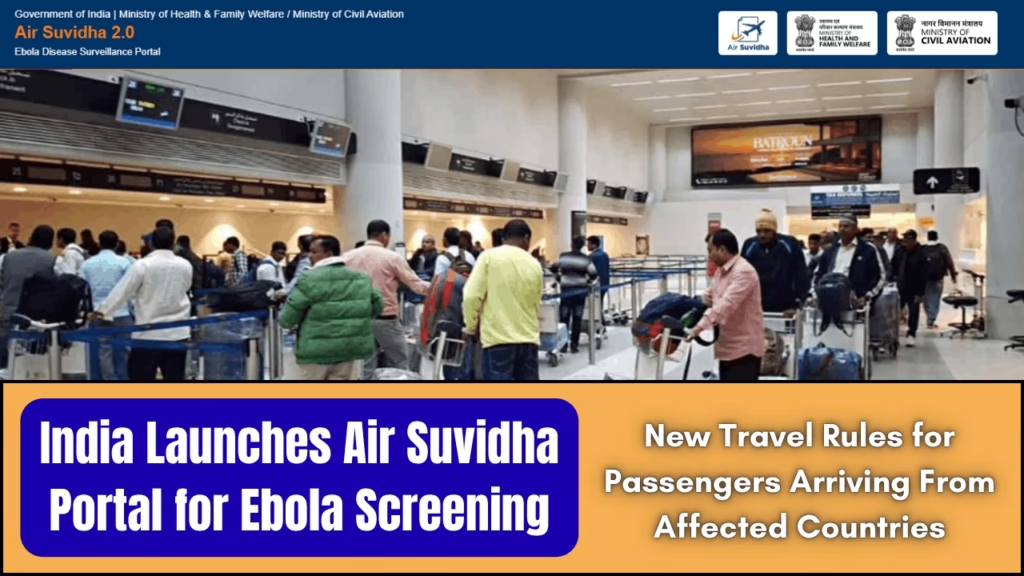
AIR SUVIDHA 2.0 is not an entirely new system it builds directly on the original Air Suvidha portal, which gained widespread recognition during the COVID-19 pandemic as India’s primary tool for screening international arrivals. This newly upgraded version has been developed in close collaboration with the Directorate General of Health Services (DGHS) under the Ministry of Health and Family Welfare, specifically tailored to address the unique surveillance needs posed by the current Ebola outbreak.
International travellers heading to India now face a new layer of health screening at the country’s airports. On June 25, 2026, the Ministry of Civil Aviation, working alongside Delhi International Airport Limited (DIAL), officially launched AIR SUVIDHA 2.0 an upgraded, fully contactless health self-declaration portal designed specifically to strengthen disease surveillance amid the ongoing Ebola outbreak in parts of Africa. For anyone flying into India from or through affected regions, understanding these new requirements isn’t optional it’s now a mandatory part of the travel process.
What the Self-Declaration Requires
Under the new system, all international passengers arriving in India are required to submit an online Health Self-Declaration before clearing immigration. The declaration specifically captures:
- The passenger’s 21-day travel history
- Any relevant exposure history to confirmed or suspected cases
- Related symptoms, if applicable
A Critical Timing Detail: Complete It Before You Fly
One of the most practically important details for travellers is timing. According to officials, the Air Suvidha Self-Declaration Form (SDF) can and should be completed up to 24 hours before arrival in India. Authorities have specifically requested that all international travellers complete their self-declaration accurately and well in advance, framing this as being in the direct interest of both passenger safety and broader public health.
Why This Is Happening Now: The WHO’s Emergency Declaration
The launch of AIR SUVIDHA 2.0 is a direct response to a major global health development. On May 17, 2026, the World Health Organization (WHO) formally declared the Ebola/Bundibugyo virus disease outbreak in the Democratic Republic of the Congo (DRC) and Uganda a Public Health Emergency of International Concern (PHEIC), invoking its authority under the International Health Regulations (IHR) 2005.
According to Indian government officials, the current outbreak has been specifically confirmed as Bundibugyo virus disease (BVD) — a distinct strain within the broader Ebolavirus family. Countries sharing borders with the DRC and Uganda, including South Sudan, have been formally classified by the WHO as high-risk areas for potential cross-border transmission, prompting heightened vigilance not just regionally, but globally.
The Scale of the Outbreak
Earlier reporting on the outbreak indicated the situation had already grown serious by the time broader international travel measures began ramping up, with over 900 suspected cases and notably high fatality rates associated with this strain. Compounding the urgency, health experts have pointed to the absence of any approved vaccine or treatment specific to this outbreak, a factor that has significantly heightened the urgency behind strict border health measures worldwide, including India’s renewed focus on airport-level surveillance.
How the System Works: Real-Time, Multi-Agency Data Sharing
What sets AIR SUVIDHA 2.0 apart from a simple paper form is its integrated, real-time data-sharing architecture. Once a passenger submits their declaration, the information is shared instantly across multiple government agencies, including:
- The Airport Health Officer
- The Bureau of Immigration
- The Integrated Disease Surveillance Programme (IDSP)
- State Surveillance Officers
According to officials, this integrated data-sharing mechanism is specifically designed to help authorities rapidly identify travellers who may be at risk, ensuring timely referral, monitoring, and any necessary public health intervention — all while keeping the experience for the vast majority of unaffected travellers as smooth and contactless as possible.
Eliminating Physical Paperwork
A central design goal behind this upgrade was removing the need for physical declaration forms upon arrival, a process that previously required in-person handling of paperwork at immigration counters. By shifting the process fully online and contactless, the system reduces unnecessary physical contact points at exactly the kind of high-traffic environment where disease transmission risk tends to be highest.
Physical Screening Measures at Airports
The Air Suvidha declaration represents just one layer of India’s broader response. The Directorate General of Civil Aviation (DGCA) has separately mandated a series of physical screening protocols specifically for airlines operating flights from Ebola-affected countries, including the DRC and Uganda.
Onboard and Arrival Protocols
According to reported government directives, airlines flying from affected regions must now:
- Collect self-declaration forms from passengers as part of standard procedure
- Conduct thermal screenings to detect elevated body temperature, a key symptom indicator
- Isolate any suspected cases onboard, following a specific containment protocol
That containment protocol is notably detailed: airlines are required to relocate symptomatic passengers to the rear of the aircraft, while keeping the three surrounding rows vacant to create a buffer zone. Designated crew members wearing personal protective equipment (PPE) are assigned to manage these cases throughout the remainder of the flight.
Post-Landing Procedures
Once an aircraft carrying a suspected case lands, the aircraft itself must undergo disinfection, and any suspected cases are handed directly to health teams for quarantine and further medical evaluation — a process designed to minimize any further exposure risk to ground staff, other passengers, or the broader public.
Major Airports Have Upgraded Their Screening Infrastructure
In preparation for measures like these, major Indian airports have upgraded to non-contact thermal screening systems, paired with the mandatory health declaration requirement now formalized through AIR SUVIDHA 2.0. Health experts note that while airport screening alone cannot catch every case — since incubation periods mean some infected travellers may not yet show symptoms upon arrival it remains a critical early-warning tool when combined with downstream measures like quarantine, testing, and contact tracing.
Supporting Containment at the Source
India’s response to this outbreak has not been limited to border screening alone. Union Health Minister JP Nadda announced that India is providing USD 10 million in support toward Ebola preparedness, response, and recovery efforts, a commitment made during a Virtual Summit organized by the African Union, chaired by the AU Chairperson and President of Burundi, Évariste Ndayishimiye.
According to Nadda, India has already delivered 45 tonnes of medical supplies to affected regions, and has pledged further assistance including medical and laboratory supplies, diagnostic materials, essential medicines, and nutritional support, alongside technical collaboration with African health institutions working to contain the outbreak at its source.
This dual-track approach strengthening domestic border surveillance while simultaneously supporting outbreak containment efforts in Africa reflects a broader public health philosophy that experts widely endorse: stopping disease spread at its origin is ultimately more effective than relying solely on downstream screening at international entry points.
What International Travellers to India Should Do Now
Given these new requirements, anyone planning travel to India — particularly from or through Africa, or with any international transit connections in affected regions — should take the following steps:
- Check your specific itinerary for any transit through the DRC, Uganda, South Sudan, or other countries classified by the WHO as high-risk for this outbreak.
- Complete your Air Suvidha Self-Declaration Form online, ideally well before the 24-hour pre-arrival window, to avoid last-minute complications.
- Provide accurate travel and exposure history, including your full 21-day travel history, since incomplete or inaccurate declarations could delay your processing at immigration.
- Expect thermal screening upon arrival, even if you are asymptomatic, as this remains a standard part of the broader entry protocol.
- Be prepared for possible isolation and testing if thermal screening detects elevated temperature or other relevant symptoms — this is a standard precaution, not an indication of guilt or wrongdoing.
- Monitor official updates from the Ministry of Civil Aviation and Ministry of Health and Family Welfare, since protocols tied to evolving outbreaks can change with relatively short notice as the situation develops.
A Familiar Playbook, Refined by Past Experience
For frequent travellers, the structure of AIR SUVIDHA 2.0 will likely feel familiar and that’s by design. The original Air Suvidha portal proved effective during the COVID-19 pandemic, and Indian health officials have explicitly built this upgraded version on those lessons learned, aiming for a system that balances rigorous public health surveillance with a smooth, low-friction passenger experience. Whether this balance holds up in practice particularly at smaller airports with more limited IT infrastructure — remains an open question that public health experts and frequent travellers alike will be watching closely in the weeks ahead.
The launch of AIR SUVIDHA 2.0 marks a significant, proactive step in India’s public health response to a serious international Ebola outbreak, combining contactless digital declarations, real-time multi-agency data sharing, and physical airport screening measures into a single, coordinated system. For travellers, if your journey to India involves any connection to an Ebola-affected country, completing your Air Suvidha declaration accurately and in advance is now a mandatory part of your trip not an optional courtesy. Staying informed through official government channels remains the best way to avoid delays and ensure a smooth arrival experience as this situation continues to develop.