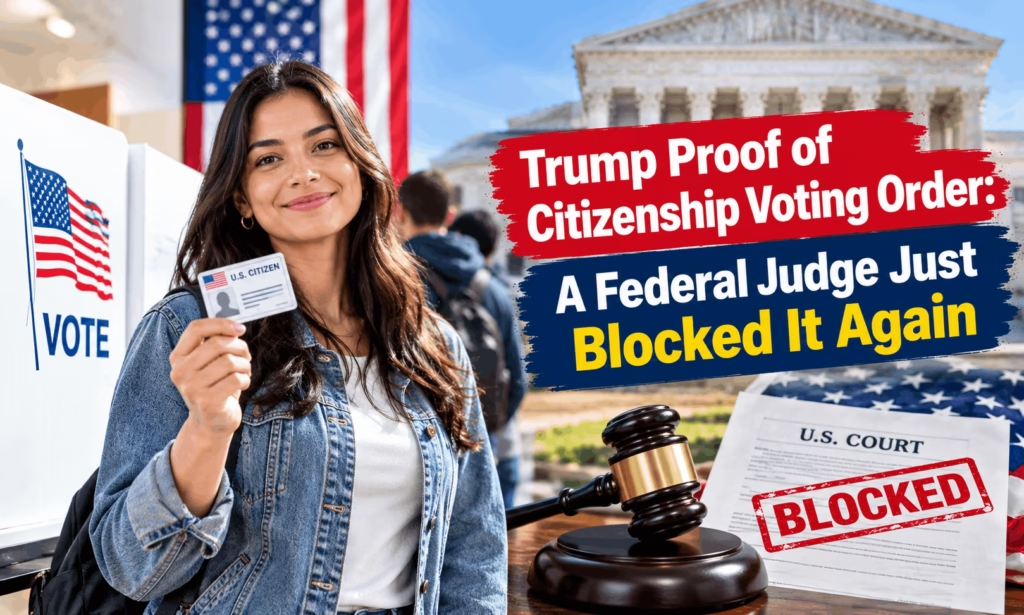
Trump Proof of Citizenship Voting Order: The legal fight over the Trump proof of citizenship voting order took another sharp turn this week. A federal judge in Boston issued a fresh preliminary injunction blocking the U.S. Postal Service from carrying out new mail ballot rules tied to President Trump’s election order, just days after the Supreme Court had cleared a path for those same rules to move forward. U.S. District Judge Indira Talwani ruled that the Postal Service’s final regulation, published in late August, would risk disenfranchising millions of voters if it took effect less than seventy days before the November 2026 midterms, and she found no evidence in the record to justify such a rushed rollout.
This back and forth has become the defining pattern of Trump’s proof of citizenship voting order since he first signed it in March 2025. Courts have blocked it, an appeals court has upheld those blocks, the Supreme Court has partially reversed one of them on a technical timing question, and a lower court has now responded with a new ruling of its own. With ballots for the midterm elections scheduled to go out beginning September 4, election officials, voters, and both political parties are watching every move in real time. This article will be updated monthly as new court rulings and federal agency actions come in.
What Is the Trump Proof of Citizenship Voting Order?
The Trump proof of citizenship voting order refers to a pair of related executive actions signed by President Donald Trump aimed at overhauling how federal elections are administered. The first order, signed March 25, 2025, and titled Preserving and Protecting the Integrity of American Elections, directed the federal voter registration form to require documentary proof of citizenship, such as a passport or birth certificate, and instructed states to stop counting mail ballots received after Election Day even if postmarked on time.
A second, related order followed on March 31, 2026, called Ensuring Citizenship Verification and Integrity in Federal Elections. This directive went further, instructing the Department of Homeland Security and the Social Security Administration to compile a nationwide list of verified U.S. citizens over the age of 18 and share it with state election officials, and ordering the U.S. Postal Service to build a system limiting mail ballot delivery to people confirmed on that list. Both orders rest on the same core claim from the administration, that noncitizen voting and mail ballot fraud represent serious threats to election integrity, a claim that independent election researchers and multiple federal judges have repeatedly said is not backed by evidence in the record.
Trump Voting Order Legal Battle Key Dates
| March 25, 2025 | Trump signs first executive order requiring citizenship proof and an Election Day mail ballot deadline |
| April 24, 2025 | Federal court temporarily blocks the citizenship proof provision in League of Women Voters v. Trump |
| June 2025 | Judge Denise Casper issues a preliminary injunction blocking the order in Massachusetts v. Trump |
| March 31, 2026 | Trump signs second order (Executive Order 14399) creating a national citizen list and USPS mail ballot restrictions |
| June 2026 | Judge Indira Talwani blocks key parts of the second order for 23 states and D.C. |
| June 24, 2026 | Judge Casper makes her injunction against the first order permanent |
| July 26, 2026 | 1st Circuit Court of Appeals upholds the block on the national voter list order |
| August 24, 2026 | Supreme Court lifts one of two injunctions in a 6-3 ruling, citing timing, not the order’s legality |
| Late August 2026 | USPS publishes its finalized mail ballot rule |
| September 2026 | Judge Talwani issues a new preliminary injunction blocking the finalized USPS rule for the midterms |
The Supreme Court’s Role: A Narrow Win on Timing, Not Legality
The most consequential recent development came on August 24, 2026, when the Supreme Court voted 6-3 to lift a lower court injunction that had blocked parts of the second Trump election order. The unsigned ruling did not decide whether the president’s mail ballot restrictions are constitutional. Instead, the majority found that the states suing had acted too early, since the Postal Service had only issued a proposed rule at the time, not a final one. The court wrote that federal courts review final rules, not proposed rules or internal directives, meaning the states would need to challenge the actual final regulation once it existed.
Justice Sonia Sotomayor, joined by Justice Elena Kagan, dissented, warning that the executive order was already causing real harm to states and that the dispute deserved a decision on the merits rather than being pushed back on a technicality. Justice Ketanji Brown Jackson wrote a separate dissent accusing the majority of adding to electoral confusion just weeks before voting began. Crucially, the Supreme Court itself noted that its ruling did not guarantee any future implementation step would be lawful, writing that “on that score, time will tell.”
SSDI Pay Chart: The Least Amount You Can Get Per Month and the Most Common Disabilities
IRS Identity Protection PIN: How to Get One and Stop Tax Fraud
Why the Postal Service Rule Got Blocked Again Just Days Later
The Supreme Court’s ruling assumed the fight would move to the next stage once the Postal Service finalized its regulation, and that is exactly what happened. Days after the ruling, USPS published a final rule requiring states to submit ballot envelope designs and mail ballot data to the Postal Service for advance approval before ballots could be mailed to voters. Democratic-led states and voting rights groups immediately went back to court, and Judge Talwani agreed with them, finding that requiring election officials to redesign ballots and comply with new federal approval steps with voting already underway in some states created a serious risk of disenfranchising voters who had followed existing rules for years.
Talwani’s ruling makes clear that her injunction applies specifically to the 2026 midterm elections rather than permanently, noting that the government’s rushed implementation timeline, not the underlying policy goal, was the central problem. She also declined the Justice Department’s request to pause her order while it appeals, meaning the block remains in effect for now even as the administration returns to the same appellate track that produced the earlier Supreme Court ruling.
What Happened to the Original Citizenship Proof Requirement?
While the mail ballot fight has dominated recent headlines, the original documentary proof of citizenship requirement from Trump’s first 2025 order has already met a more decisive fate. On June 24, 2026, Judge Denise Casper issued a 59 page ruling making her earlier preliminary injunction permanent, effectively ending the administration’s ability to enforce a citizenship documentation mandate on the federal voter registration form. Casper wrote plainly that while the Constitution gives the president executive power and a duty to enforce laws faithfully, it does not grant him any specific authority over how elections are run, a power the Constitution instead assigns to states and Congress.
California Attorney General Rob Bonta and New York Attorney General Letitia James, who both joined the multistate lawsuit, welcomed the ruling as a defense of voting rights heading into the midterms, while also warning that the administration’s broader push to reshape election rules was continuing on other fronts. The White House and Justice Department did not immediately respond to requests for comment following the ruling, according to multiple outlets covering the decision.
The Numbers Behind the Debate Over Citizenship Documentation
Supporters of the citizenship documentation requirement argue it closes a loophole, since the existing federal voter registration form only requires voters to attest to their citizenship under penalty of felony charges rather than show physical proof. Opponents point to research from the Brennan Center for Justice estimating that roughly nine percent of U.S. citizens of voting age, about 21.3 million people, do not have ready access to a passport or certified birth certificate that would satisfy a documentary proof requirement. Civil rights groups have also warned that database driven citizenship verification efforts have a history of mistakenly flagging naturalized citizens as noncitizens, a concern that featured prominently in multiple court rulings against the order.
Noncitizen voting in federal elections, meanwhile, remains both illegal and extremely rare according to available state and federal data, a point several judges specifically cited when rejecting the administration’s justification for the order.
The SAVE Act Connection
Trump’s second election order arrived in the middle of an active Senate debate over the Safeguard American Voter Eligibility Act, known as the SAVE Act, a Republican-backed bill that would write a documentary proof of citizenship requirement directly into federal law rather than relying on an executive order alone. The order also proposed tying federal election funding to whether individual states complied with the administration’s new voter verification standards, a leverage point that has drawn its own separate legal scrutiny from state election officials who argue Congress, not the president, controls federal election spending conditions.
How to Check Your Voter Registration and Mail Ballot Status?
Given the shifting legal landscape, voters are being encouraged by election officials to confirm their own registration and mail ballot status directly rather than relying on news coverage alone.
- First, visit your state’s official secretary of state or election division website to confirm your current voter registration status, since state systems, not the federal order, currently determine registration rules while litigation continues.
- Second, if you vote by mail, check with your state or county election office directly about mail ballot deadlines for the November 2026 election rather than assuming a uniform national rule applies, since Judge Talwani’s injunction currently blocks the new USPS requirements specifically for this election cycle.
- Third, sign up for ballot tracking through your state’s official portal where available, which lets you confirm your ballot was mailed, received, and counted independent of any federal rule changes still working through the courts.
- Fourth, if you receive any communication claiming your registration is affected by a new federal citizenship verification list, verify it directly with your state election office before taking any action, since Judge Casper’s permanent injunction currently blocks enforcement of the citizenship documentation mandate nationwide.
Express Entry Draw Update: CEC Cut-Off Falls To 521, Physicians Round Drops To 198 CRS
Canada Counter-Tariffs Worker Support Package: $7.5 Billion in Relief Confirmed
StayNJ Income Cap Drops From $500,000 to $200,000: Why Your Check Already Got Smaller
New York POWER Rebate Checks: $100 to $200 Payments Begin Landing in Mailboxes This Fall
Processing Time for Related Litigation
Cases challenging both Trump election orders have moved through the courts on an unusually compressed schedule because of the approaching midterm elections. The permanent injunction against the first order took more than a year from initial filing to final ruling, moving from an April 2025 temporary block to a June 2026 permanent one. The fight over the second order has moved far faster, with the Supreme Court’s timing based ruling arriving less than five months after the order was signed, and Judge Talwani’s newest injunction following within roughly two weeks of the Supreme Court’s decision. Legal experts tracking the case, including UCLA election law professor Rick Hasen, have predicted the dispute could return to the Supreme Court again within days or weeks given how quickly each ruling has triggered an appeal.
What This Means for the November 2026 Midterms
For now, the practical effect of the ongoing litigation is that mail voting procedures for the 2026 midterms remain governed largely by existing state rules rather than the new federal requirements Trump’s orders attempted to impose. Judge Talwani’s most recent ruling explicitly limits its own scope to this election cycle, meaning the underlying legal question, whether a president can direct the Postal Service and federal agencies to set nationwide election administration rules, remains unresolved for future elections. Election officials in the 23 states plus the District of Columbia that sued over the order have said they lack the time, money, and system capacity to implement new ballot design and verification requirements while ballots are already being prepared for a September 4 mailing start date.
Official Resources for Voters
| Resource | Official Website |
|---|---|
| U.S. Election Assistance Commission | eac.gov |
| Vote.gov | vote.gov |
| USPS official election mail page | usps.com |
| Federal Register, Executive Order 14399 | federalregister.gov |
| SCOTUSblog case tracker | scotusblog.com |
New Canada Prescription Drug Rules October 2026: What Every Patient and Pharmacy Needs to Know
October 15 Tax Deadline Is Final — What Happens If You Still Don’t File
VA Benefits Lawyer: For Which Claims Do You Need One, and How Much Can They Cost?
Green Card Sponsors Face New Scrutiny: USCIS Can Now Pull Your Credit Report
FAQs About Trump Proof of Citizenship Voting Order
Is Trump’s proof of citizenship voting order currently in effect?
No. The original 2025 order requiring documentary proof of citizenship on the federal voter registration form is permanently blocked nationwide following Judge Casper’s June 2026 ruling, and the related mail ballot restrictions from the 2026 order are also blocked for the current midterm election cycle under Judge Talwani’s most recent injunction.
What did the Supreme Court actually decide about the voting order?
The Supreme Court ruled 6-3 that a lower court had blocked the order too early because the Postal Service had not yet finalized its rule, but the justices did not rule on whether the order itself is constitutional, leaving that question for future litigation.
Can the president require proof of citizenship to vote?
Multiple federal judges have ruled that the Constitution gives states and Congress, not the president, authority over election administration, so an executive order alone cannot impose a nationwide proof of citizenship requirement.
Why does Trump say a citizenship verification order is needed?
The administration argues the order prevents noncitizen voting and mail ballot fraud, though courts reviewing the order have repeatedly found no evidence in the record supporting claims of widespread illegal voting.
Will mail-in voting rules change before the November 2026 election?
For now, no. Judge Talwani’s newest injunction blocks the finalized USPS mail ballot rule specifically for the 2026 midterms, so existing state mail voting procedures remain in place for this election.
What is the SAVE Act and how does it relate to this order?
The SAVE Act is a Senate bill that would write a citizenship documentation requirement into federal law, and Trump’s second executive order was signed while that legislation was under active Senate debate.
How many Americans lack easy access to citizenship documents?
Brennan Center for Justice research estimates about 21.3 million U.S. citizens of voting age, roughly nine percent, do not have a passport or certified birth certificate readily available to satisfy a documentary proof requirement.
What happens next in the legal fight over the voting order?
The Trump administration is expected to appeal Judge Talwani’s newest ruling, and election law experts anticipate the dispute could return to the Supreme Court again within days or weeks given how quickly each prior ruling has been challenged.
Conclusion
The Trump proof of citizenship voting order has produced one of the most closely watched legal battles of the current term, with courts, the Postal Service, and the Supreme Court all weighing in within a matter of months. The original citizenship documentation mandate has been struck down for good, while the newer mail ballot restrictions remain in a legal holding pattern that could shift again before Election Day. For voters, the immediate takeaway is that existing state rules govern registration and mail voting for the 2026 midterms, but the broader question of how much control a president can exert over federal elections is far from settled and will likely keep working its way through the courts well beyond this November.
Trump Accounts Dell $250 Grant: Did Deposits Actually Start Monday? Here’s Who’s Actually Been Paid
2027 Social Security COLA Forecast: Latest 3.6% Estimate and How Much Retirees Could Get
$2000 Stimulus Payment September 2026 Fact-Check: Is It Really Coming?