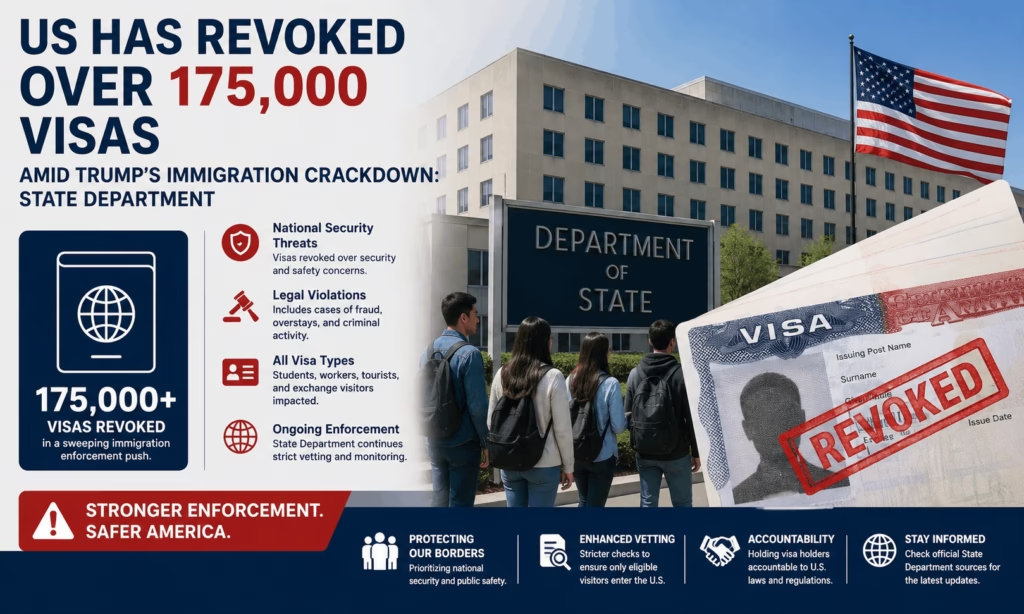
US Has Revoked Over 175,000 Visas Amid Trump’s Immigration Crackdown: The State Department confirmed on August 10, 2026 that it has revoked more than 175,000 visas from foreign nationals since President Trump returned to office, marking a sharp escalation from the 100,000 figure the department reported just seven months earlier in January. In an official fact sheet, the department said the revocations targeted people who violated the terms of their visas, committed crimes, called for violence against US citizens, defrauded Americans, abused the immigration system, or endangered national security, describing the effort as part of its continuous vetting operations.
According to the department, the majority of these 175,000 visas revoked under Trump were tied to law enforcement encounters, with assault, driving under the influence, theft, and drug crimes cited as the leading causes, alongside a smaller but notable share tied to reckless driving, sexual assault, child abuse, fraud, and embezzlement. The pace of revocations has also accelerated meaningfully in 2026, now averaging more than 10,000 per month, compared with roughly 8,000 per month over the course of 2025. This article breaks down exactly what the State Department disclosed, how the number climbed from 80,000 to over 175,000 across the past year, and what current visa holders should understand about how this enforcement effort actually works. We’ll be updating this article monthly as the State Department releases further visa revocation figures.
What the State Department Actually Announced
The August 10, 2026 announcement came in the form of an official fact sheet released by the Office of the Spokesperson, stating plainly that under President Trump, the department has revoked more than 175,000 visas from foreign nationals for a defined set of reasons. The department framed the effort as an extension of its continuous vetting operations, which it says are designed to ensure that visa recipients abide by the terms of their visa and do not endanger Americans. Secretary of State Marco Rubio’s department reiterated that a US visa is treated as a privilege rather than a right, and stated it will continue to identify, investigate, and revoke visas from individuals it considers a threat to public safety.
Among the specific categories the department cited were foreign nationals who arranged illegal birth tourism schemes, who posed a danger to American citizens, or who endorsed violence against Americans. The announcement did not provide a detailed nationality-by-nationality or visa-category-by-visa-category breakdown of the full 175,000 figure, though earlier disclosures throughout 2025 and 2026 offered partial breakdowns for specific categories like student visas.
How the Number Climbed: A Timeline of Escalating Revocations
The scale of visa revocations under the Trump administration has grown steadily and been publicly disclosed in stages throughout 2025 and 2026. In November 2025, a senior State Department official said the administration had revoked around 80,000 non-immigrant visas since the January 20, 2025 inauguration, with driving under the influence, assault, and theft accounting for roughly half of that total. By January 12, 2026, the department reported the figure had crossed 100,000, describing it as a new record and a more than 150 percent increase in revocations compared to 2024, and specifically citing about 8,000 student visas and 2,500 specialized visas revoked over law enforcement encounters. At that point, the department had also launched a Continuous Vetting Center specifically tasked with ensuring visa holders already inside the country continue to comply with US law.
By the time of the August 10, 2026 announcement, the total had climbed past 175,000, representing roughly 75,000 additional revocations in the seven months since the January figure was released, a pace that works out to more than 10,000 revocations per month during 2026, up from an average of roughly 8,000 per month across all of 2025.
Leading Causes Behind the Visa Revocations
According to the State Department’s own breakdown, the majority of the 175,000 revocations stemmed from law enforcement encounters involving criminal activity, with four categories identified repeatedly across the department’s disclosures throughout the past year: assault, driving under the influence, theft, and drug-related crimes. Beyond these leading categories, the department also cited a significant share of revocations tied to reckless driving, sexual assault, child abuse, and fraud or embezzlement.
The department also highlighted a smaller number of cases involving national security or public conduct concerns rather than criminal convictions, including individuals whose visas were revoked after they were found to have endorsed or celebrated violence against Americans. Immigration attorneys have specifically flagged this category as one of the more legally contested aspects of the crackdown, since it can be based on statements or social media activity rather than a criminal charge or conviction.
Continuous Vetting: More Than 55 Million Visa Holders Under Review
A central mechanism behind this enforcement effort is the department’s continuous vetting program, which State Department officials have said now covers all more than 55 million foreign nationals who currently hold a valid US visa, not just new applicants. Under this system, the department reviews law enforcement records and any other information that comes to light after a visa has already been issued, looking for indicators of overstays, criminal activity, threats to public safety, or connections to terrorist activity. When a potential ineligibility is identified, the department can revoke the visa, and if the individual is already inside the United States, they may become subject to removal proceedings.
This represents a structural shift from a system that historically focused vetting primarily at the point of application, toward a model of ongoing, continuous review that can flag and act on a visa holder’s conduct at any point during the life of their visa, not solely when they first apply or renew.
Weekly Jobless Claims Report: 199,000 Filings Signal Labor Market Cooling
Federal Employee RIF Rules 2026: What the New OPM Regulations Actually Change
IRS Releases New Details on the Saver’s Match Program: Up to $1,000 for Your Retirement Account
IRS SSA Advanced Leave Suspension: What Federal Employees Need to Know
Small Personal Loans for Bad Credit USA: Direct Lenders With Same-Day Approval and Funding
Best Life Insurance Policy for Seniors USA in 2026: Top Policies for Ages 60, 70 & 80 Compared
Criticism From Immigration Lawyers and Rights Advocates
The scale and pace of the revocations have drawn criticism from immigration attorneys and human rights groups. Some immigration lawyers have raised concern that the State Department appears to be revoking visas in connection with minor law enforcement encounters or charges that never proceeded through the judicial process to a conviction, arguing that a mere arrest or citation should not automatically be treated as equivalent to proven wrongdoing. Separately, rights advocates and human rights experts have criticized the administration’s expanded social media screening efforts as part of continuous vetting, arguing the practice functions similarly to surveillance and risks chilling free expression among visa holders who may fear that ordinary online activity could be scrutinized.
The administration has consistently defended the program on public safety grounds, with State Department officials repeating that a US visa is a privilege rather than a guaranteed right, and that the department intends to keep using every available tool to identify and remove individuals it views as a threat to American communities.
Visa Revocation Timeline at a Glance
| Date Announced | Total Visas Revoked | Key Details |
|---|---|---|
| November 2025 | Approximately 80,000 | DUI, assault, and theft accounted for nearly half of revocations |
| January 12, 2026 | More than 100,000 | 150%+ increase from 2024; roughly 8,000 student visas and 2,500 specialized visas included; Continuous Vetting Center launched |
| August 10, 2026 | More than 175,000 | Assault, DUI, theft, and drug crimes cited as leading causes; over 10,000 revocations per month pace in 2026 |
What This Means If You Currently Hold a US Visa
If you currently hold a valid US visa, continuous vetting means your eligibility can be reassessed at any point, not only when you apply, renew, or seek reentry at a port of entry. Any law enforcement encounter, including an arrest that has not yet resulted in a conviction, can potentially trigger a review under the department’s current approach, along with certain public conduct or social media activity the department considers a threat indicator. Visa holders who are contacted by consular officials, or who become aware that questions have been raised about their status, should consult a qualified immigration attorney promptly rather than assuming a revocation requires an underlying criminal conviction. It also remains important to understand that a visa revocation is a distinct legal action from deportation or removal, though a revocation while inside the United States can lead directly into removal proceedings depending on individual circumstances.
Official Resources and Where to Verify Your Status
| Resource | Purpose | Link |
|---|---|---|
| State Department official announcement | Full text of the August 2026 visa revocation fact sheet | state.gov/releases |
| US Visas official information | General visa rules, categories, and requirements | travel.state.gov |
| Check your visa status | Verify visa validity through consular records | ceac.state.gov |
| USCIS official site | Immigration status and adjustment of status information | uscis.gov |
| Find a US embassy or consulate | Contact information for consular assistance | usembassy.gov |
FAQs
How many visas has the Trump administration revoked so far?
More than 175,000, according to the State Department’s official announcement on August 10, 2026, up from more than 100,000 reported in January 2026 and roughly 80,000 reported in November 2025.
What are the most common reasons visas are being revoked?
According to the State Department, the leading causes are assault, driving under the influence, theft, and drug crimes, with additional revocations tied to reckless driving, sexual assault, child abuse, fraud, embezzlement, and national security or public conduct concerns.
Does an arrest automatically mean my visa will be revoked?
Not necessarily, but immigration attorneys have noted that some revocations appear tied to law enforcement encounters that did not result in a formal conviction, which has raised concern among legal advocates about how strictly the standard is being applied.
What is continuous vetting, and does it affect visa holders who already have a valid visa?
Yes. Continuous vetting is an ongoing review process the State Department says now applies to all more than 55 million people who currently hold a valid US visa, not only new applicants, meaning eligibility can be reassessed at any point after a visa is issued.
Can my visa be revoked over something I post on social media?
The State Department has indicated that public conduct, including statements endorsing or celebrating violence against Americans, can factor into a revocation decision. Rights groups have specifically criticized this aspect of the continuous vetting program as raising free speech concerns.
Is a visa revocation the same as deportation?
No. A visa revocation removes your authorization to hold that visa, but it is a separate legal action from removal or deportation proceedings, which are a distinct process that can follow a revocation depending on your specific immigration circumstances.
How can I check if my visa has been affected?
You can check your visa status through the Consular Electronic Application Center at ceac.state.gov, or contact the nearest US embassy or consulate directly for confirmation, and consult a qualified immigration attorney if you have concerns about your status.
Conclusion
The State Department’s confirmation that more than 175,000 visas have now been revoked under the Trump administration marks a significant escalation from the 100,000 figure reported just seven months earlier, reflecting both a broader continuous vetting program covering all current US visa holders and an accelerating monthly pace of enforcement throughout 2026. While the administration frames the effort squarely around public safety and national security, immigration attorneys and rights groups have raised real questions about how consistently the underlying standard, ranging from serious criminal convictions to lesser encounters and public conduct, is being applied. Current visa holders should understand that their status can be reassessed at any time under this system, and should seek qualified legal guidance promptly if their eligibility is ever called into question.
Social Security $200 Monthly Increase 2027: Which Seniors Qualify for the Biggest Raise?
H-1B 60-Day Grace Period Elimination: What US Visa Workers Should Know
450,000 Borrowers Student Debt Erased: How to Check If You Qualify?
Can You Change Your Social Security Payment Date? Here’s the SSA Answer