
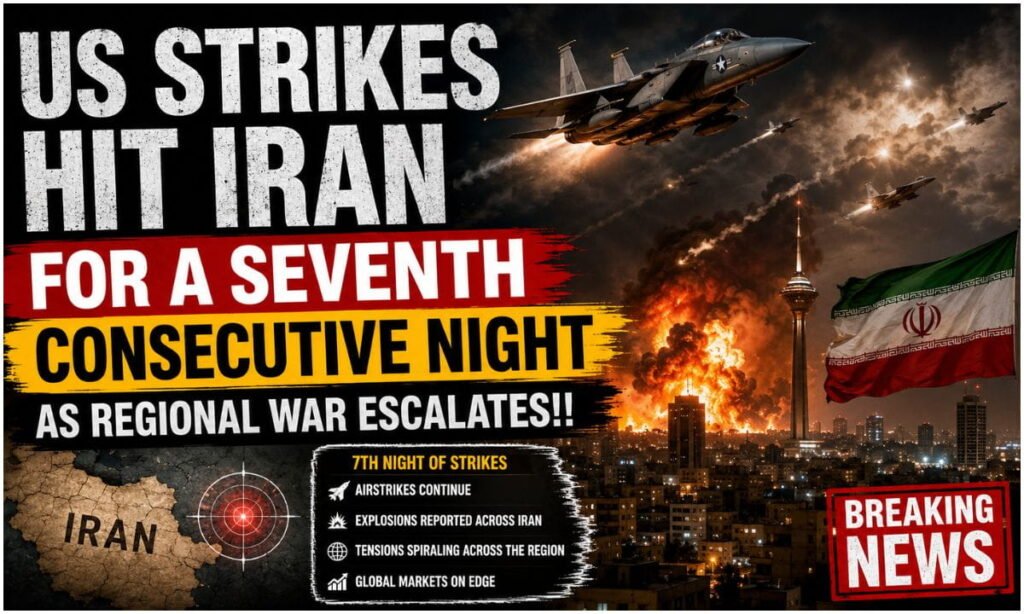
US Strikes Hit Iran for a Seventh Consecutive Night: The United States military carried out its seventh consecutive night of airstrikes against Iran late on Friday, July 17, 2026, deepening a conflict that has reignited across the Middle East despite a ceasefire agreement signed barely a month earlier. According to US Central Command, the latest wave of strikes concluded just after 9:30 p.m. Eastern time, following a campaign that began at 7:00 p.m. GMT, roughly 10:30 p.m. local time in Iran. In a statement posted to social media, CENTCOM said the operation was intended to keep degrading Iran’s military capabilities on the direct orders of the commander in chief.
The US Strike mark the latest and most sustained escalation in what has become known as the 2026 Iran war, a conflict that first erupted in February and has now cycled through a fragile truce, a collapsed diplomatic process, and a return to nightly bombardment. What began as a single night of joint US-Israeli strikes in late February has, over the following months, evolved into a grinding campaign in which Washington and Tehran trade blows across the Gulf, the Strait of Hormuz, and multiple third-party countries hosting American forces.
What CENTCOM Says It Hit ?
In its public statements, CENTCOM has described the seventh night’s targets in broad categories rather than a detailed target list. The command said its forces struck surveillance sites, military logistics infrastructure, underground weapons storage facilities, and maritime capabilities. To carry out the US Strike, the US employed a mixed package of fighter aircraft, aerial drones, and warships, along with other unspecified assets. Locations reported to have been targeted during this phase of the campaign include Jask, Sirik, Bushehr, Bandar Abbas, Qeshm Island, Ahvaz, and Yazd, a spread that stretches from Iran’s southern coastline along the Strait of Hormuz to cities further inland.
CENTCOM has repeatedly framed the US Strike as necessary to protect shipping and to prevent Iran from rebuilding capabilities that could be used against commercial vessels or American forces stationed in the region. The command has also said it is continuing to enforce a naval blockade against Iranian ports, a posture that resumed earlier in the week alongside the intensified air campaign. A CENTCOM statement said the command continues to hold Iran accountable at the direction of the commander in chief while fully enforcing the blockade, and noted that more than fifty thousand American service members are currently operating across the Middle East.
Iran, for its part, has consistently disputed the US characterization of the US Strike as narrowly military in scope. Tehran has accused Washington of hitting civilian infrastructure alongside military sites, though it has not always specified which locations it considers civilian in nature. That dispute over the true nature and toll of the bombing campaign has become one of the recurring flashpoints of the conflict, with each side offering a different account of what has actually been destroyed.
Iran’s Retaliation Across the Gulf
Iran has not absorbed the US Strike passively. Tehran’s response on this occasion, as in previous nights, has come primarily through attacks on US-linked assets and allied nations across the Gulf rather than direct US Strike on the American homeland or forces inside Iran’s immediate vicinity. The Islamic Revolutionary Guard Corps said it struck a depot housing American unmanned aerial vehicles in Bahrain late on Friday, though Washington had not confirmed that attack as of the following morning. Iran’s regular army separately said it had struck US assets in three countries hosting American military infrastructure: Bahrain, Jordan, and Kuwait.
Iranian state media, through the Tasnim news agency, reported that missiles had targeted an aircraft hangar, a parking area, and fuel tanks at the Sheikh Isa Air Base in Bahrain, along with several other coalition-linked sites. Several Gulf states appeared to come under fire in the early hours of Saturday, with air raid sirens sounding and authorities urging residents to take shelter. Kuwaiti air defense forces said they were actively engaging incoming threats, underscoring how the conflict has widened well beyond a bilateral exchange between Washington and Tehran to draw in the smaller Gulf monarchies that host US bases.
This pattern of Iranian retaliation against third countries rather than direct engagement with US forces has been consistent since the ceasefire first began to fray in early July. Earlier attacks in the current escalation saw Iran strike Jordan in addition to Kuwait and Bahrain, part of what analysts and officials have described as a deliberate strategy of imposing costs on Washington’s regional partners rather than escalating directly against American assets in ways that might invite an even heavier retaliatory response.
The Human and Physical Toll
The human cost of the renewed campaign has continued to mount. Iran’s Health Ministry said on Saturday that US airstrikes inside the country have killed at least fifty people and wounded more than five hundred others since July 6, the approximate date when the most recent phase of intensified strikes began. That toll reflects only the current round of escalation and does not include casualties from the initial February war, which was considerably more destructive and included the killing of senior Iranian officials.
Earlier in the week, US Strike were reported to have widened in both geographic scope and target selection. On one night, US forces reportedly hit ninety targets in a single operation, according to CENTCOM, expanding the air campaign to include the southern and northeastern parts of the country. Iran’s Ministry of Foreign Affairs said that strikes on that occasion had hit two bridges, a claim that fed into Tehran’s broader argument that the campaign has moved beyond narrowly military objectives. Separately, officials in Bushehr Province reported that a US projectile had struck an area near Iran’s Bushehr nuclear power plant, damaging boats at a fishing pier in the town of Banood, according to the province’s deputy governor.
These reports of US Strike near a nuclear facility and on infrastructure like bridges have heightened international concern about the trajectory of the conflict, even as both the Pentagon and CENTCOM maintain that their targeting remains focused on degrading Iran’s military capacity rather than its civilian infrastructure or nuclear program broadly.
| OFFICIAL SOURCE | CLICK HERE |
| US DEPARTMENT OF WAR | CLICK HERE |
Warnings of a Full-Scale Offensive
As the seventh night of US Strike concluded, a military adviser to Iran’s supreme leadership issued a stark warning that Tehran could launch a full-scale offensive if the American bombing campaign continued into the following days. The warning represents an escalation in rhetoric from Iranian officials, who had previously focused public statements on justifying retaliatory strikes against US allies rather than threatening a broader campaign.
Iran has also warned that it may target key ports in Persian Gulf states in response to the US destruction of a surveillance tower near the Strait of Hormuz, according to Iran’s semi-official Fars news agency. Such a threat, if carried out, would mark a significant expansion of the conflict’s economic dimension, since Gulf ports handle a substantial share of the region’s trade and energy exports. The threat also illustrates how each side’s escalatory steps have prompted proportional or greater threats from the other, a dynamic that has characterized the conflict since its earliest days in February.
It remains unclear whether Iran’s reference to a full-scale offensive refers to an intensification of the same pattern of strikes on US allies and shipping, or something more sweeping, such as direct attacks on American forces in the region or a renewed missile campaign against Israel, which was a central feature of the war’s opening phase. Iranian officials have not offered further public detail on what such an offensive might entail.
Strain on the Strait of Hormuz
Much of the conflict’s economic significance runs through the Strait of Hormuz, the narrow waterway between Iran and the Arabian Peninsula through which a large share of the world’s seaborne oil trade passes. Shipping through the strait has faced repeated disruption throughout the current escalation, and the strait has again emerged as what one report described as the primary flashpoint of the conflict between continued strikes and continued peace talks.
Data from MarineTraffic indicated that only six vessels transited the strait in the twenty-four hours surrounding the seventh night of strikes, a marked drop that reflects the increasing strain on one of the world’s busiest maritime passageways. That figure stands in contrast to earlier points in the crisis; during a previous flare-up in early July, MarineTraffic data showed at least thirteen commercial vessels transiting the strait in a single day, suggesting that traffic through the waterway has become increasingly erratic as the conflict has worn on, rising and falling depending on the intensity of US Strike on any given day.
Iran has claimed responsibility for intercepting several shipping vessels in recent days, and has previously said it disabled two tankers it described as “rogue supertankers” during an earlier phase of the current escalation. The reopening of the Strait of Hormuz to normal shipping traffic was one of the central objectives that the United States had said it achieved through the memorandum of understanding signed with Iran in mid-June, making the strait’s renewed closure a particularly visible sign of how far the ceasefire has unraveled.
Oil Markets React
The renewed hostilities have rattled global energy markets, which have closely tracked the conflict’s escalations and de-escalations since February. West Texas Intermediate crude futures with August delivery gained 4.5 percent to settle at $82.49 a barrel as the seventh night of US Strike unfolded, with both WTI and the international Brent benchmark reaching their highest levels since mid-June. Over the course of the week, both benchmarks gained roughly 16 percent, with Brent on track for a third consecutive weekly gain and WTI set for its second.
That surge builds on an earlier spike during the prior week of fighting, when WTI jumped about 9.4 percent in a single day to settle at $78.14 a barrel, its biggest one-day increase since early April 2026. Even with the renewed climb, oil prices remain well below the peaks seen during the most intense phase of the February war, when benchmarks rose above $110 a barrel. The pattern illustrates how markets have come to treat the conflict as a recurring risk factor rather than a single shock, with prices rising and falling in step with the US Strike rather than remaining at a sustained crisis level.
The market’s sensitivity to the conflict also reflects the practical reality that a significant share of global oil supply moves through the Strait of Hormuz, meaning that any disruption to shipping there has an outsized effect on global prices regardless of whether production itself is affected.
How the Ceasefire Collapsed ?
To understand how the conflict reached a seventh consecutive night of US Strike, it is necessary to look back at how the current phase of the war began and how the truce that briefly interrupted it came apart. The broader 2026 Iran war traces back to February 28, when the United States and Israel launched joint airstrikes against Iran, opening what President Donald Trump described as major combat operations. Those initial strikes targeted Iranian officials, military commanders, and military assets, and resulted in the killing of Iran’s supreme leader along with numerous other officials, a level of decapitation strike that marked a significant departure from previous confrontations between the two countries.
Iran responded to the February US Strike with missile and drone attacks against Israel, American bases, and US-allied countries throughout the Middle East, and by closing the Strait of Hormuz entirely, a move that severely disrupted global trade. In the war’s early days, Trump signaled an uncompromising stance, writing in early March that there would be no deal with Iran except what he called unconditional surrender.
Despite that rhetoric, the two sides eventually moved toward a truce. In April, the United States and Iran agreed to a two-week ceasefire, which drew a cautious welcome from international bodies including the United Nations. UN Secretary-General Antonio Guterres welcomed the announcement while urging all parties to work toward a durable peace in the region, according to a statement from his spokesperson.
That initial ceasefire gave way to further negotiations, culminating in a more substantial memorandum of understanding signed by the United States and Iran in mid-June. The memorandum initiated a sixty-day window intended for talks aimed at resolving the conflict’s more complicated underlying issues, including the future of the Strait of Hormuz and the fate of Iran’s nuclear program. Trump described the memorandum at the time as an agreement that accomplished everything the United States had set out to achieve, including ending the conflict, reopening the strait, and preventing Iran from acquiring a nuclear weapon.
The truce, however, proved fragile almost from the outset. Only two rounds of direct talks took place under the memorandum’s framework, although lower-level technical negotiations continued for a time even as tensions began to resurface. By early July, the ceasefire had begun to crumble in earnest. On July 9, following a fresh round of US strikes and Iranian retaliation against American positions in Kuwait and Bahrain, Trump declared that the ceasefire was, in his words, over, adding that he did not want to continue dealing with Iranian leadership. He nonetheless said he would permit US negotiators to keep talking with their Iranian counterparts, while expressing skepticism that further talks would accomplish anything.
The following days saw a rapid intensification of hostilities. US Strike widened in geographic scope and intensity, at one point hitting ninety targets in a single night and expanding into new regions of the country. Iran, meanwhile, escalated its own responses, striking Jordan in addition to its earlier targets in Kuwait and Bahrain, and claiming to have disabled tanker vessels transiting the Strait of Hormuz. By July 13, Trump had further undercut the memorandum’s standing, describing it in a radio interview as not meaning much once one side failed to honor its terms, even as he maintained that the document had initially represented a comprehensive resolution to the conflict.
A senior US official was quoted describing the memorandum as performance-based, arguing that Iran’s failure to fully reopen the Strait of Hormuz and its strikes on shipping during a NATO summit constituted a failure to meet its obligations under the agreement. The United States moved in parallel to reimpose sanctions on Iranian oil exports, rolling back a temporary waiver that had allowed Tehran to sell crude during the ceasefire period as part of the memorandum’s terms; that waiver had originally been set to run until August 21.
International Reactions
The renewed fighting has drawn a mixed set of reactions from governments and international institutions, generally falling along the same lines that have characterized responses to the conflict since February. Countries aligned with the United States and Israel have largely supported the strikes as necessary responses to Iranian provocations, while Iran’s traditional partners and a number of other governments have condemned the American and Israeli campaign. Still others have criticized attacks from both sides or called generally for de-escalation.
NATO Secretary-General Mark Rutte offered explicit backing for the American strikes during the alliance’s summit in Ankara, telling reporters that the US response was necessary given Iran’s attacks on commercial vessels and describing the action as warranted. That endorsement came even as Turkey’s president used the same summit to repeatedly accuse Israel of undermining the memorandum of understanding between Washington and Tehran, illustrating the divisions even among nominally allied governments over how to handle the crisis.
The dispute over the memorandum has also become entangled with unrelated regional friction, including a disagreement over the potential sale of advanced F-35 fighter jets to Turkey, a transaction that Trump had floated during the same NATO gathering and that Israel has voiced concern over. In a television interview, Israeli Prime Minister Benjamin Netanyahu criticized Turkish President Recep Tayyip Erdoğan’s reliability as a US partner, reflecting how the broader diplomatic fallout from the Iran conflict has strained relationships across the alliance.
Elsewhere in the region, the conflict’s effects have rippled into Lebanon, where Israel’s ongoing operations against Hezbollah, despite a separate US-brokered ceasefire there, have remained a persistent irritant in broader peace efforts. Lebanese President Joseph Aoun has linked his country’s continued participation in talks with Israel to the start of an Israeli military withdrawal from occupied areas in southern Lebanon, with further rounds of negotiations reportedly planned to continue in Washington and Rome.
What Comes Next ?
As the conflict enters its second week of intensified nightly strikes, the trajectory remains uncertain. The memorandum of understanding that briefly paused the fighting in June has not been formally declared dead by either government, but its practical authority appears to have eroded substantially, with both Trump and Iranian officials treating it as functionally suspended even as lower-level contacts reportedly continue behind the scenes. Iran has not publicly stated whether it considers the ceasefire or the broader interim agreement to be formally over, leaving open at least the possibility that both sides could step back from further escalation without having to explicitly abandon the diplomatic framework built in June.
At the same time, the warnings issued by Iranian officials of a potential full-scale offensive, combined with threats against Gulf ports and continued disruption to shipping in the Strait of Hormuz, suggest that the risk of further escalation remains substantial. The Gulf states hosting American forces, including Bahrain, Kuwait, and Jordan, have found themselves repeatedly drawn into the exchange of strikes despite not being direct parties to the underlying dispute between Washington and Tehran, a dynamic that has added a further layer of instability to a region already strained by the parallel conflicts in Lebanon and Gaza.
For now, both sides appear locked in a familiar cycle: American strikes aimed at degrading Iranian military capacity, followed by Iranian retaliation against US-linked targets across the Gulf, punctuated by public warnings from Tehran and public justifications from Washington. Energy markets, shipping companies, and the governments of smaller Gulf states are left to absorb the consequences of a conflict whose diplomatic off-ramp, so carefully negotiated in mid-June, has so far failed to hold.
Whether the seventh consecutive night of strikes proves to be a peak in this latest round of fighting or simply another step in a longer escalation will likely depend on decisions made in the coming days, both in Washington’s assessment of whether its campaign has achieved its stated aims and in Tehran’s calculation of how far it is willing to go in response. Until then, the pattern that has defined the past week, and much of the past five months since the war’s outbreak in February, appears set to continue: strikes at night, retaliation across the Gulf, and diplomacy that remains, for now, mostly rhetorical.
Frequently Asked Questions :-
Why did the US strike Iran for the seventh consecutive night?
The US states that the objective of these strikes is to degrade military capabilities and respond to ongoing security threats in the region. These sustained operations reflect efforts to manage escalating tensions and prevent further attacks against US interests and allies.
How has Iran responded to the recent US strikes?
Iran has condemned the strikes and warned that it reserves the right to retaliate. Iranian officials have indicated that continued military action could trigger further counter-responses, raising concerns about a broader regional conflict.
Which areas have been affected by the recent strikes?
Reports indicate that the strikes have targeted military-linked facilities, missile infrastructure, and strategic locations. Both governments and independent observers are assessing the specific locations and extent of the damage.
What impact could the escalating conflict have on the Middle East and global markets?
A prolonged conflict could disrupt regional security, drive up energy prices, and impact global financial markets. Investors are closely monitoring developments, particularly any threats to major oil shipping routes like the Strait of Hormuz.
Could this conflict expand beyond the US and Iran?
Yes. Security analysts warn that continued military exchanges could draw in regional allies and armed groups, increasing the risk of a large-scale conflict in the Middle East. Diplomatic efforts are underway, but the situation remains highly volatile.
Also Read :-
Trump Account vs 529 Plan: Which Is Better for Your Kid?
Trump Accounts by State and ZIP Code: Who Qualifies for the Extra $250 Dell Grant?
Trump’s 25% Brazil Tariff 2026: Why Now, What Triggered It, and What Happens Next?