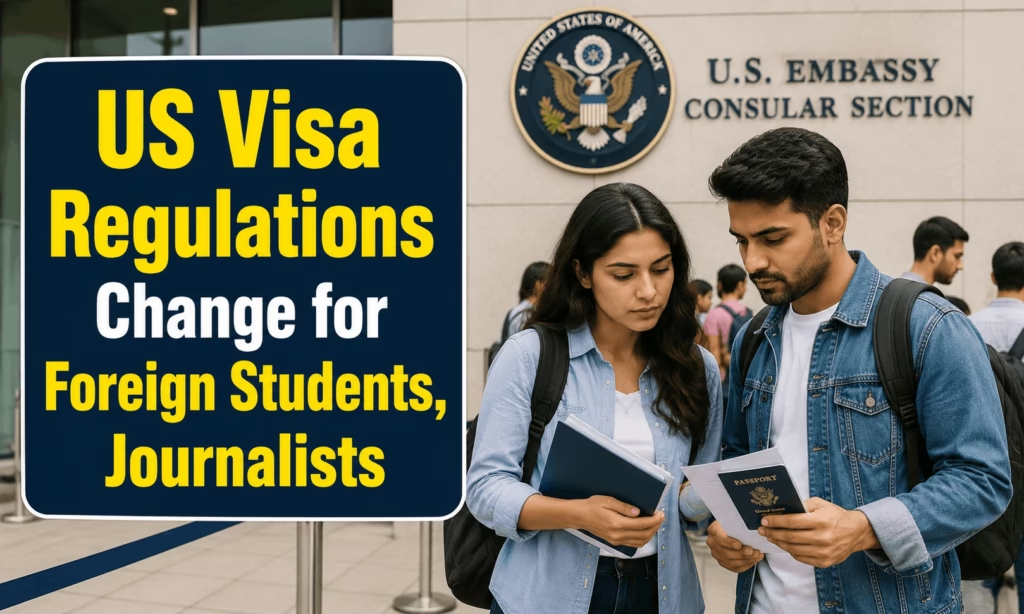
US Visa Regulations Change for Foreign Students, Journalists: International students, exchange visitors, and foreign correspondents working in the United States are facing the most significant change to their visa framework in decades, and it takes effect in a matter of days. The Department of Homeland Security has confirmed that its final rule ending “Duration of Status” (D/S) for F-1 student visas, J-1 exchange visitor visas, and I visas for foreign media representatives becomes effective on September 15, 2026. For the first time, hundreds of thousands of students, scholars, and journalists currently living and working in the U.S. under an open-ended status will instead be admitted for a fixed period with a specific expiration date, printed directly on their Form I-94.
This is not a proposal still working through the regulatory process. DHS published the final rule in the Federal Register on July 17, 2026, and while it remains formally classified as a major rule subject to congressional review, legal experts tracking the process currently assess the odds of a delay as low. The change affects an enormous population. In 2023 alone, more than 1.6 million F-1 students, over 500,000 J exchange visitors, and roughly 32,470 I visa holders were admitted to the United States under the system now being replaced. This article breaks down exactly what changes for students, exchange visitors, and journalists, what the new grace periods look like, who is protected by transition provisions, and what everyone affected needs to do before and after the effective date. We’ll be updating this article monthly as USCIS, ICE, and the State Department release further implementation guidance.
What Is Changing in US Visa Regulations for Students and Journalists
For decades, most F-1 international students and J-1 exchange visitors were admitted to the United States for “Duration of Status,” commonly abbreviated D/S. Under this framework, a visa holder could remain in the country indefinitely, without any fixed expiration date, as long as they continued meeting the requirements of their academic program or exchange activity. I visa holders, representing foreign media organizations, operated under a similar open-ended structure tied to their employment assignment.
DHS has now eliminated that framework entirely for new and existing F, J, and I nonimmigrants. Going forward, every affected visa holder receives a specific “Admit Until Date” (AUD), printed on their Form I-94, rather than the letters “D/S.”
US Visa Regulation Change Key Highlights
| Detail | Information |
|---|---|
| Official rule title | Establishing a Fixed Time Period of Admission and an Extension of Stay Procedure for Nonimmigrant Academic Students, Exchange Visitors, and Representatives of Foreign Information Media |
| Federal Register publication | July 17, 2026 |
| Federal Register citation | 90 FR 44976 |
| Effective date | September 15, 2026 |
| Issuing agency | Department of Homeland Security (DHS), via U.S. Immigration and Customs Enforcement (ICE) |
| Regulatory status | Classified as a major rule, subject to congressional review |
| Visa categories affected | F (students), J (exchange visitors), I (foreign media representatives) |
| Framework being eliminated | Duration of Status (D/S) |
| New framework | Fixed period of admission with an Admit Until Date (AUD) |
| Maximum admission period, F and J | Up to 4 years, tied to program end date |
| ESL student admission cap | 24 months |
| Journalist (I visa) admission period | Up to 240 days |
| Journalist (I visa) admission period, Chinese nationals | Up to 90 days |
| F-1 post-completion grace period | Reduced from 60 days to 30 days |
| Extension mechanism | Extension of Stay (EOS) application filed with USCIS |
| Estimated annual economic impact | Approximately $448.6 million per year |
| 2023 population affected | 1.6 million F-1 students, over 500,000 J visitors, roughly 32,470 I visa holders |
Why DHS Is Making This Change
DHS has framed this rule as a matter of national security and program integrity. In its formal rulemaking documents, the department stated that the open-ended D/S framework “does not afford immigration officers enough predetermined opportunities to directly verify that aliens are engaging only in authorized activities.”
The department cited specific evidence to justify the change, including having identified over 2,100 individuals who first entered the United States as F-1 students between 2000 and 2010 and who remained in active F-1 status as of April 2025, decades after their original enrollment. DHS also pointed to the dramatic overall growth in these visa categories as straining its oversight capacity, noting the volume “poses a challenge to DHS’s ability to monitor and oversee these nonimmigrants while they are in the United States.”
The new fixed-period structure is also intended to align F, J, and I nonimmigrants with most other visa classifications, which are already admitted for a defined period rather than an open-ended one.
$200 Extra Social Security Payment: When Is It Being Approved, and Who Can Get It?
VA Benefits Lawyer: For Which Claims Do You Need One, and How Much Can They Cost?
How the New Rule Affects F-1 International Students
This is the category affecting the largest number of people, and the changes touch nearly every part of the international student experience.
Fixed Admission Period for F-1 Students
- F-1 students, along with F-2 dependents, will now be admitted for the length of their academic program, not to exceed four years, as reflected on their Form I-20
- Students enrolled in English as a Second Language (ESL) programs face a shorter cap of 24 months
- If a program legitimately requires longer than four years, such as certain doctoral programs, students must file for an Extension of Stay (EOS) with USCIS before their admission period expires
Reduced Grace Period After Program Completion
One of the most consequential changes for students is the shortened departure window. The post-completion grace period has been reduced from 60 days to 30 days for students entering or reentering the United States on or after September 15, 2026. This is the window students have historically used to prepare for departure, transition to a new immigration status, or begin employment authorization such as Optional Practical Training (OPT). A shorter window means considerably less flexibility for students finishing their programs.
New Restrictions on Academic Mobility
The final rule also restricts a student’s ability to change plans mid-program:
- Undergraduate students are prohibited from transferring schools or changing their major during their first academic year
- Graduate students face restrictions on changing their program or transferring schools once admitted under the new framework
How the New Rule Affects J-1 Exchange Visitors
J-1 exchange visitors, who participate in work- and study-based cultural exchange programs, and their J-2 dependents, are subject to the same fixed-period structure as F-1 students.
- J-1 visitors will be admitted for the length of their program as listed on their Form DS-2019, up to a maximum of four years
- As with F-1 students, any need to remain beyond the fixed period requires filing an Extension of Stay application with USCIS
- The rule applies the same general oversight rationale to J-1 programs as it does to F-1 students, citing the need for more regular, predetermined verification points
How the New Rule Affects Foreign Journalists on I Visas
This is the category drawing the sharpest international reaction, particularly from journalists and media organizations covering the United States from abroad.
- I visa holders, representing foreign media organizations, will be admitted for up to 240 days, a dramatic reduction from a status that could previously last years without a fixed end date
- Chinese nationals working under an I visa face an even shorter maximum admission period of up to 90 days
- Journalists needing to remain longer than their fixed period must apply for an extension through the same DHS process available to other affected categories
China’s foreign ministry has publicly objected to the shorter period applied specifically to Chinese nationals, describing the distinction as discriminatory. DHS has not walked back this specific provision as part of its final rule.
OAS Payment Increase September 2026: Confirmed Amounts, Payment Date, and the Annual GIS Reset !
Ohio SNAP Food Ban starts October 1, 2026: What’s Banned, Court Update & Rules
What Happens If You Are Already in the US Under Duration of Status
This is the question generating the most anxiety among current visa holders, and the answer depends heavily on transition provisions built into the rule specifically to avoid disrupting people already inside the country.
The Transition Framework
- Individuals admitted for Duration of Status before September 15, 2026 generally continue under their existing D/S admission and are not required to take immediate action when the rule takes effect
- A student in a multi-year program, such as a Ph.D. candidate who has already been in F-1 status for more than four years, does not need to apply for an Extension of Stay simply because the new four-year cap exists, as long as they were admitted under the legacy D/S system before the effective date
- These transition-group students and exchange visitors will retain their legacy 60-day grace period, even after the new rule takes effect, unless one of the triggering events below occurs
What Triggers the New Rules for Someone Already in the US
A person admitted under the old D/S framework moves into the new fixed-period system, including the shorter 30-day grace period, if either of the following happens on or after September 15, 2026:
- They travel outside the United States and are readmitted
- They file for and receive an Extension of Stay approved by USCIS
Until one of these events occurs, current D/S holders can generally continue their existing program under the transition provision without interruption.
US Visa Category Comparison: Before and After the Rule
| Visa Category | Before Rule | After Rule (September 15, 2026) |
|---|---|---|
| F-1 students | Duration of Status, no fixed end date | Fixed period, up to 4 years, tied to I-20 program end date |
| F-1 post-completion grace period | 60 days | 30 days |
| J-1 exchange visitors | Duration of Status, no fixed end date | Fixed period, up to 4 years, tied to DS-2019 end date |
| I visa (foreign media) | Duration of assignment, could last years | Up to 240 days |
| I visa (Chinese nationals) | Duration of assignment, could last years | Up to 90 days |
| ESL students | Duration of Status | Capped at 24 months |
| Extensions | Not typically required under D/S | Formal Extension of Stay (EOS) application required through USCIS |
How to Apply for an Extension of Stay Under the New Rule
For F, J, and I nonimmigrants who need to remain in the United States beyond their new fixed admission period, DHS has created a formal Extension of Stay (EOS) process.
- Confirm your Admit Until Date (AUD) as shown on your most recent Form I-94, since this determines your filing deadline.
- File Form I-539, Application to Extend/Change Nonimmigrant Status, with USCIS before your current admission period expires.
- Submit biometrics as required, since the new EOS process includes a biometrics requirement that did not apply under the prior D/S framework.
- Continue your authorized activities while the EOS application remains pending. DHS has stated the rule includes provisions allowing F-1 and J-1 nonimmigrants to continue their program activities during EOS processing, specifically to prevent interruptions to study or exchange programs.
- Avoid international travel while an EOS application is pending, if possible, since departing and reentering the country can itself trigger transition into the new rules for those still covered by legacy D/S protections.
- Consult your school’s international student office or a qualified immigration attorney well before your admission period ends, given how tight some of the new timelines are compared to the flexibility of the old system.
$400 Inflation Refund Checks 2026: New York’s Real Program, Fact-Checked
Stimulus Check 2026: Fact-Checking Every Viral Payment Claim (Tracker)
Social Security SSI Payment Date September 2026 Confirmed by SSA- Check Full Schedule here!
Processing Time for Extension of Stay Applications
Because this Extension of Stay process is newly created specifically for F, J, and I nonimmigrants under this rule, historical processing time data specific to this exact filing type is limited. However, based on standard USCIS processing patterns for comparable Form I-539 filings:
- Standard Form I-539 processing has historically ranged from a few months to over six months, depending on the specific service center and category
- USCIS is expected to issue further implementation guidance clarifying processing expectations specifically for F, J, and I extension filings under the new rule ahead of the September 15, 2026 effective date
- Given the shortened grace periods, particularly the reduced 30-day post-completion window for F-1 students, applicants are strongly advised to file well in advance of their Admit Until Date rather than waiting until close to expiration
Key Dates and Compliance Schedule
| Date | Event |
|---|---|
| August 28, 2025 | Proposed rule published in the Federal Register for public comment |
| July 17, 2026 | Final rule published in the Federal Register (90 FR 44976) |
| September 15, 2026 | Effective date; fixed admission periods begin applying to new admissions |
| Ongoing after September 15, 2026 | Existing D/S holders transition to fixed periods upon reentry or approved EOS |
There is no recurring monthly or quarterly schedule associated with this rule. It is a one-time structural change to how admission periods are calculated, not a benefit or payment program with a periodic disbursement calendar.
How to Check Your Current Visa Status and Admit Until Date
- Retrieve your most recent Form I-94 directly through the official U.S. Customs and Border Protection I-94 website, which shows your current admission classification and, after September 15, 2026, your specific Admit Until Date rather than “D/S.”
- Review your Form I-20 or DS-2019 for your program end date, since this determines your maximum fixed admission period under the new rule.
- Contact your Designated School Official (DSO) if you are an F-1 student, or your program sponsor if you are a J-1 exchange visitor, to confirm how the transition provisions apply to your specific case.
- Monitor the Federal Register directly for any follow-up notice from DHS, since the department has stated it will publish an additional document if the congressional review process changes the effective date or terminates the rule.
- Check official USCIS and Study in the States guidance for updated Frequently Asked Questions as the effective date approaches.
Official US Visa Regulation Resources
| Resource | Purpose | Official Link |
|---|---|---|
| Federal Register Final Rule | Full official text of the rule | federalregister.gov/documents/2026/07/17/2026-14439 |
| Study in the States (DHS) | Official DHS resource for F and M student visa holders | studyinthestates.dhs.gov |
| USCIS Form I-539 | Extension of Stay application form and instructions | uscis.gov/i-539 |
| CBP I-94 Official Website | Retrieve your current Form I-94 and Admit Until Date | i94.cbp.dhs.gov |
| USCIS Case Status Online | Track a filed Extension of Stay application | egov.uscis.gov/casestatus |
| ICE Student and Exchange Visitor Program (SEVP) | Official SEVP guidance for F and M students | ice.gov/sevis |
| U.S. Department of State, Exchange Visitor Program | Official J-1 program information | j1visa.state.gov |
FAQs About US Visa Regulations Change for Foreign Students, Journalists
When does the new US visa rule for students and journalists take effect?
The rule takes effect September 15, 2026, though it remains classified as a major rule subject to congressional review, meaning the date could still shift if Congress or litigation intervenes before then.
Does this rule affect students already in the United States?
Students and exchange visitors admitted under Duration of Status before September 15, 2026 generally continue under their existing admission without immediate action required, thanks to transition provisions built into the rule. New rules apply once they travel and reenter, or once an Extension of Stay is approved.
How long can F-1 students stay in the US under the new rule?
F-1 students will generally be admitted for the length of their academic program, up to a maximum of four years, tied to their Form I-20. Longer programs require filing an Extension of Stay application.
How long can foreign journalists stay in the US on an I visa now?
Foreign media representatives will be admitted for up to 240 days, or up to 90 days specifically for Chinese nationals, replacing a system that previously allowed I visa holders to remain for the duration of their assignment, sometimes for years.
What happens to the F-1 grace period after graduation?
The post-completion grace period is reduced from 60 days to 30 days for students entering or reentering under the new rule on or after September 15, 2026. Students already covered by legacy Duration of Status retain their 60-day grace period unless they trigger the new rules by traveling or filing an extension.
Can F-1 students still transfer schools or change their major?
Undergraduate students cannot transfer schools or change their major during their first academic year under the new rule. Graduate students face similar restrictions on changing programs or transferring schools.
What is an Extension of Stay and who needs to file one?
An Extension of Stay (EOS) is a formal application filed with USCIS using Form I-539, required for F, J, or I nonimmigrants who need to remain in the United States beyond their new fixed admission period.
Is this rule final, or could it still change?
The rule has been formally published as final in the Federal Register, but it remains classified as a major rule subject to congressional review under the Congressional Review Act. DHS has stated it will publish a follow-up Federal Register notice if that review changes the effective date or terminates the rule.
Conclusion
The shift away from Duration of Status for F-1 students, J-1 exchange visitors, and I visa journalists represents the most structural change to these visa categories in decades, replacing decades of open-ended admission with fixed, trackable expiration dates and a formal extension process. For the millions of students, scholars, and media professionals currently in the United States, the good news is that transition provisions largely protect those already admitted under the old system, at least until they travel internationally or file for an extension. The less forgiving reality is a considerably shorter runway after program completion, down to 30 days for F-1 graduates, and a dramatically compressed admission period for foreign journalists, particularly those from China. Anyone affected by this rule should confirm their Admit Until Date the moment it appears on their Form I-94, coordinate closely with their school’s international office or employer, and avoid unnecessary international travel while any extension application remains pending. We’ll continue updating this article monthly as DHS, USCIS, and the State Department finalize implementation guidance ahead of and following the September 15, 2026 effective date.
Trump Accounts Dell $250 Grant: Did Deposits Actually Start Monday? Here’s Who’s Actually Been Paid
2027 Social Security COLA Forecast: Latest 3.6% Estimate and How Much Retirees Could Get
$2000 Stimulus Payment September 2026 Fact-Check: Is It Really Coming?