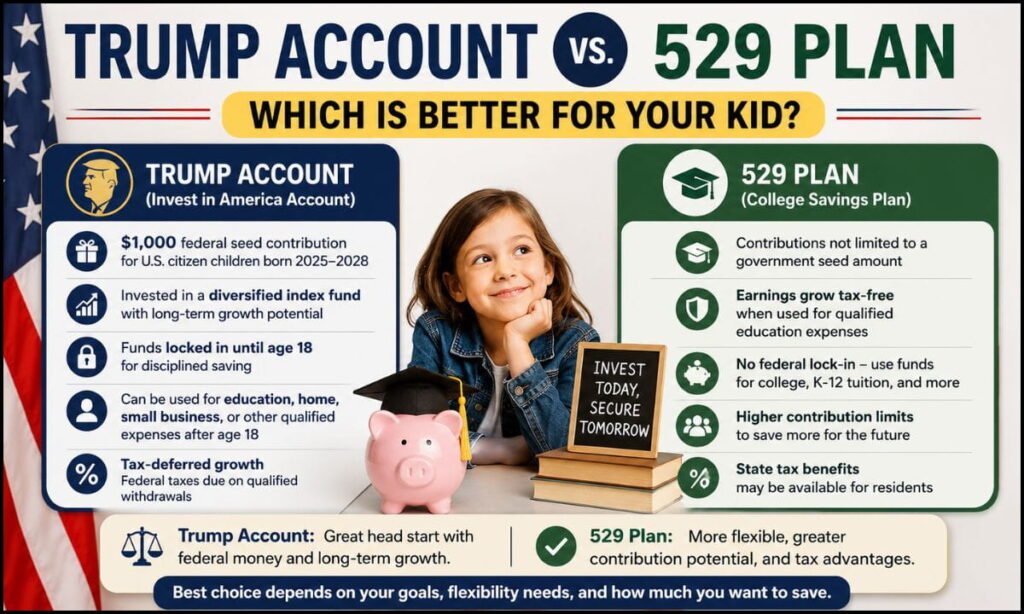
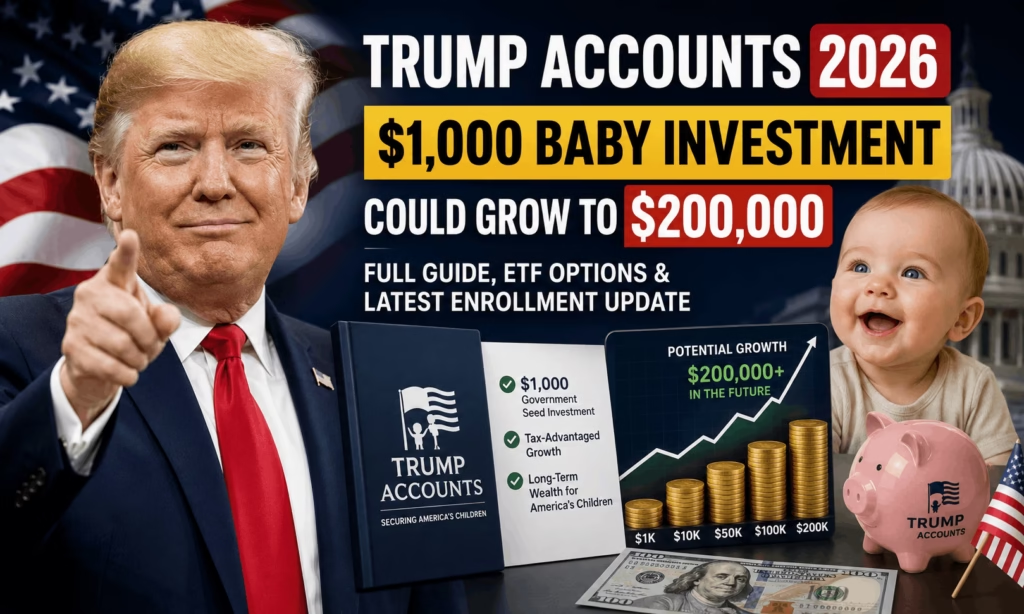
Trump Accounts are a new federal savings program that deposits a one-time $1,000 seed payment into a tax-advantaged investment account for eligible American newborns, and new analysis from Bloomberg Intelligence shows just how powerful that head start could become. According to ETF analyst Eric Balchunas, if a family contributes the full $5,000 annual maximum every year and the account earns an average 7% annual return, a child’s Trump Account could grow to roughly $200,000 by age 18 — turning a one-time government deposit into a genuine long-term wealth-building tool. As of the latest Treasury figures, more than 6.5 million children have already been enrolled, though only around 1.4 million currently qualify for the $1,000 deposit itself.
This guide brings together every verified detail on Trump Accounts 2026 into one accurate, non-duplicated resource — the official ETF investment options the government has approved, how the $200,000 growth projection actually works, the newest SSA hospital-enrollment process, contribution rules, and the broader debate over what mass stock ownership through this program could mean for the U.S. economy. All figures are cross-checked against Treasury, SSA, and Bloomberg Intelligence reporting through July 2026. We’ll be updating this article monthly as new enrollment and investment data are released.
Trump Accounts 2026 Key Highlights
| Detail | Information |
|---|---|
| Program Name | Trump Accounts (legally, 530A savings accounts) |
| Official Launch Date | July 4, 2026 |
| Federal Seed Deposit | $1,000, one-time, per eligible child |
| Eligible Birth Window | January 1, 2025 – December 31, 2028 |
| Total Accounts Opened (July 10, 2026) | ~6.5 million |
| Children Confirmed Eligible for $1,000 | ~1.4 million (about 39%) |
| Annual Private Contribution Cap | $5,000 per child |
| Default Investment | State Street SPDR Portfolio S&P 500 ETF (SPYM) |
| Approved ETF Options | SPYM, IVV, ITOT, VTI, SPTM |
| Projected Value at Age 18 (max contributions, 7% avg. return) | ~$200,000 |
| Access Age | Funds locked until child turns 18 |
| Account Conversion at 18 | Automatically becomes a traditional IRA |
| Official Website | trumpaccounts.gov |
What Are Trump Accounts?
A Trump Account functions like an IRA built for children — a tax-deferred investment account opened at birth, managed by a parent or guardian, that automatically converts into a standard traditional IRA once the beneficiary turns 18. Unlike a 529 college plan, the money isn’t restricted to education costs, and unlike every other IRA-style account, it requires no earned income to qualify — a feature unique to this program. The government selected the custodial structure specifically to keep fees low and growth predictable over an 18-year horizon, capping management costs at 0.10% annually.
The Approved ETF Options: What Parents Can Actually Invest In
One of the most useful new details clarified this month is exactly which investments are available inside a Trump Account. Every dollar — whether it’s the government’s $1,000 seed deposit or private family contributions — must go into one of five pre-approved, low-cost, passively managed U.S. stock ETFs. There is no option for individual stock-picking or actively managed funds while the child is a minor.
| ETF Type | Ticker Options | What It Tracks |
|---|---|---|
| Default investment | SPYM (SPDR Portfolio S&P 500 ETF) | Large U.S. companies (S&P 500) |
| S&P 500 alternative | IVV | Large U.S. companies (S&P 500) |
| Total U.S. market | ITOT | Large, mid, and small U.S. companies |
| Total U.S. market | VTI | Large, mid, and small U.S. companies |
| Total U.S. market | SPTM | Large, mid, and small U.S. companies |
Families essentially face one meaningful decision: an S&P 500-focused fund (SPYM or IVV) versus a broader total-market fund (ITOT, VTI, or SPTM) that also captures mid- and small-cap companies. Bloomberg Intelligence’s Eric Balchunas notes that historically, the long-term returns of these two approaches have tracked each other closely, so the choice matters far less than simply staying invested and contributing consistently over the full 18 years.
How a $1,000 Trump Account Could Grow to $200,000
This is the headline finding driving new interest in the program. According to Balchunas’s modeling, if a family contributes the full annual maximum of $5,000 every single year from birth through age 17, and the account earns an average annual return of about 7% (roughly in line with long-run historical U.S. stock market performance), the account balance could reach approximately $200,000 by the time the child turns 18.
It’s important to understand what this projection assumes and what it doesn’t guarantee:
- It assumes maximum contributions every year. Most families won’t contribute the full $5,000 annually, so actual balances for a typical account will be substantially lower than $200,000.
- It assumes a 7% average annual return, which is a reasonable long-term historical assumption for diversified U.S. stock ETFs, but markets don’t grow in a straight line — some years will show losses, and an 18-year window can include extended downturns.
- The $1,000 government deposit alone, left untouched with no additional contributions, would grow to a far smaller amount over the same period — the $200,000 figure reflects the seed deposit plus consistent maximum family contributions, not the seed deposit in isolation.
- Funds cannot be accessed before age 18, unlike some other savings vehicles that allow early withdrawals under specific circumstances — this is a strict, non-negotiable feature of Trump Accounts.
Why the Government Restricted Trump Accounts to Passive U.S. Stock ETFs
Some financial commentators have suggested the program should allow international stock exposure or actively managed funds as additional options. Balchunas has pushed back on this idea, pointing out that historical data suggests these alternatives are unlikely to outperform low-cost U.S. stock index ETFs over an 18-year holding period. The restriction to five specific, passively managed funds also keeps the program simple for millions of first-time parent-investors and prevents the kind of high-fee, actively managed products that have historically eaten into small investors’ long-term returns.
What This Means for U.S. Stock Ownership
Beyond individual family finances, Balchunas argues Trump Accounts could meaningfully reshape stock ownership nationwide. Currently, about 58% of Americans own stocks — already one of the highest ownership rates in the world — and he believes that figure could climb to 70–80% as Trump Accounts mature and more children grow into adult account holders. Wider stock ownership, in his view, could help narrow the wealth gap over time, since more families would directly benefit whenever the broader market grows.
However, Balchunas also flagged a real risk: greater national dependence on stock market performance for retirement security. He compared the market’s growing importance to essential public infrastructure like the electric grid — something the country increasingly can’t function without. Stocks remain inherently risky and can go through extended periods of losses, and if tens of millions more Americans hold wealth through Trump Accounts, there could be significantly greater political pressure on future governments to intervene and support markets during serious downturns.
Who Is Eligible for the $1,000 Trump Accounts Deposit?
- Anyone can open an account: Any U.S. child under 18 with a valid Social Security number can have a Trump Account opened, regardless of family income, and can receive private or employer contributions.
- Only a specific birth window qualifies for the $1,000 seed deposit: Children must be U.S. citizens with a valid, work-authorized Social Security number, born between January 1, 2025, and December 31, 2028.
- Children born 2016–2024 don’t qualify for the $1,000 deposit but may still receive a separate $250 charitable contribution from the Michael & Susan Dell Foundation in lower- and middle-income ZIP codes.
- One account per child — duplicate elections for the same beneficiary are automatically rejected.
Latest Update: SSA Hospital Enrollment for Newborns
Since July 3, 2026, the Social Security Administration has been rolling out hospital-based Trump Account enrollment for newborns, folding it directly into standard birth registration through the existing Enumeration at Birth (EAB) system — the same process that has issued Social Security numbers to babies since 1987. This removes the need for many parents to separately file IRS Form 4547, though families can still enroll independently through trumpaccounts.gov or the Trump Accounts app if they prefer to manage the process themselves.
Contribution Rules
| Contribution Source | Annual Limit |
|---|---|
| Family/individual contributions | Counts toward combined $5,000/year cap |
| Employer contributions | Up to $2,500/year, counts toward the $5,000 cap |
| Government/charitable contributions | Not subject to the $5,000 cap |
| Federal pilot seed deposit | One-time $1,000, does not count against the annual cap |
Private, after-tax contributions build tax “basis” that won’t be taxed again on withdrawal. The government’s $1,000 seed deposit, employer contributions, and charitable deposits do not create basis and will be taxable, along with investment earnings, when eventually withdrawn.
Trump Accounts Enrollment: Latest Verified Numbers
| Date | Verified Figure |
|---|---|
| March 31, 2026 | 4 million+ signed up; 1 million+ covered by $1,000 pilot elections |
| June 23, 2026 | 6 million+ signed up; 1.4 million (39%) confirmed eligible |
| July 3, 2026 | SSA launches hospital-based auto-enrollment support |
| Early July 2026 | 500,000+ children received their first $1,000 deposit |
| July 10, 2026 | 6.5 million accounts opened; ~$125 million in family contributions |
Even with 6.5 million sign-ups, this remains a minority of the roughly 14.3 million children projected to be born within the eligible 2025–2028 window, meaning outreach — not funding — remains the program’s biggest current bottleneck.
Withdrawal Rules: Before and After Age 18
Before the beneficiary turns 18, withdrawals are restricted to qualified rollovers to another Trump Account, qualified ABLE rollovers at age 17 for eligible disabled beneficiaries, return of excess contributions, or distribution upon the beneficiary’s death. There are no hardship withdrawals. Once the child turns 18, the account automatically converts into a traditional IRA, and standard IRA rules apply — including a 10% early-withdrawal penalty before age 59½, with exceptions for education, a first home purchase, or birth/adoption costs.
Trump Accounts Links
| Official Portal (Registration & Login) | trumpaccounts.gov |
| Web App | trumpaccount.com |
| IRS Form 4547 (Election Form) | irs.gov |
| SSA Newborn Enrollment Info | ssa.gov |
| Customer Support | 1-866-USA-4547 |
| Home Page | https://govtschemes.org/ |
FAQs
Can a Trump Account really grow to $200,000?
Under a best-case scenario modeled by Bloomberg Intelligence — maximum $5,000 annual contributions every year plus an average 7% annual return — an account could reach roughly $200,000 by age 18. Typical accounts with lower or no additional contributions will grow far less.
What ETFs can I choose for a Trump Account?
Five options: SPYM and IVV (S&P 500-focused), and ITOT, VTI, and SPTM (broader U.S. total-market funds). SPYM is the default if no selection is made.
Can I invest in international stocks through a Trump Account?
No. The program currently restricts investments to five passive U.S. stock ETFs; international and actively managed fund options are not available.
Who qualifies for the $1,000 Trump Account deposit?
U.S. citizen children born between January 1, 2025, and December 31, 2028, with a valid Social Security number and an opened Trump Account.
When can my child access the money in a Trump Account?
Not until they turn 18, at which point the account automatically converts into a traditional IRA with standard IRA withdrawal rules.
How much can I contribute to my child’s Trump Account each year?
Up to $5,000 per year combined from family and employer sources, with employer contributions capped at $2,500 within that total.
Is every eligible child automatically enrolled?
No — as of July 2026, only about 1.4 million of the 6.5 million enrolled children are confirmed eligible for the $1,000 deposit, though the SSA’s new hospital-based enrollment process is expanding automatic sign-ups for newborns.