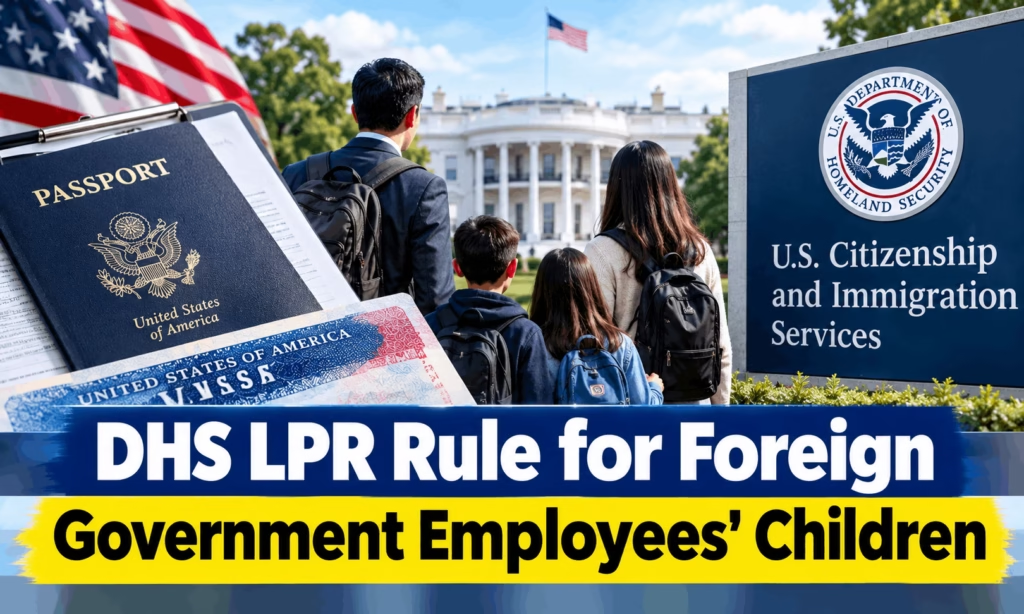
DHS LPR Rule for Foreign Government Employees’ Children: The Department of Homeland Security has opened a new path to permanent residence for a group of children who, until this month, had almost no way to fix their immigration status while living in the country of their birth. On September 4, 2026, DHS quietly rewrote a decades old regulation that used to apply only to children of accredited diplomats, and turned it into a much broader registration option covering children born in the United States to a wide range of foreign government employees. The change lets these children voluntarily file for a green card and, if approved, have their permanent residence backdated to the day they were born. We’ll be updating this article monthly as USCIS releases new guidance, as the related court case develops, and as processing data comes in, so bookmark this page if your family may be affected.
The timing matters. The rule arrived two days after a federal judge in Maryland blocked a related executive order for a large group of families, and it takes effect only for children born on or after September 4, 2026, not for anyone born earlier. That single date is now the dividing line between two very different sets of rules, and it is already confusing families who assumed the older, narrower diplomat only rule still applied. This guide breaks down exactly who the DHS LPR rule for foreign government employees children covers, what forms are involved, what the process costs, how the ongoing lawsaffects real applications, and how to actually file, using the same source documents that immigration attorneys are currently working from.
What Is the New DHS LPR Rule for Children of Foreign Government Employees?
For years, federal regulations allowed one narrow group of children born on U.S. soil to skip birthright citizenship and instead register for lawful permanent resident status: children of accredited foreign diplomatic officers. The reasoning was straightforward. Because diplomats and their immediate household enjoy diplomatic immunity, their children are traditionally treated as not fully “subject to the jurisdiction” of the United States under the Fourteenth Amendment, so they did not automatically become U.S. citizens at birth the way most other children born here do. Instead, those children could later apply to register as green card holders under a decades old provision found in the Code of Federal Regulations.
The interim final rule issued on September 4, 2026, and published in the Federal Register on September 9, 2026, replaces the old “foreign diplomatic officer” language with a much wider term: foreign government employee. DHS says this change flows from President Trump’s Executive Order 14418, which directed federal agencies to tighten how they interpret who counts as “subject to United States jurisdiction” at birth. In practical terms, the rule extends the old diplomat only registration option to a new, larger pool of children whose parents work for foreign governments or certain international organizations, even if those parents never held formal diplomatic accreditation.
Who Qualifies Under the Expanded Rule?
DHS defines a qualifying foreign government employee as falling into one of four categories at the time of the child’s birth. Simply having a parent who works for a foreign government is not enough on its own; the parent’s specific role must match one of these categories:
- An accredited foreign diplomatic officer serving in the United States
- A foreign embassy or consulate employee who is a national of the country that employs them
- A person employed by a foreign government in an official capacity
- An employee of an international organization that carries international organization immunity in the United States
Alongside the employment test, two more conditions must both be true. First, the child must be born inside the United States. Second, neither parent can be a U.S. citizen at the time of the child’s birth. If one parent already holds U.S. citizenship, the child is a U.S. citizen at birth regardless of the other parent’s job, and this registration process is not needed at all. DHS has also been explicit that the rule only reaches children born on or after September 4, 2026. A child born even a day earlier, to the exact same parents in the exact same job, keeps whatever citizenship status they already have under the rules that existed at their birth.
Eligibility
| Requirement | What DHS Requires |
|---|---|
| Place of birth | Child must be born in the United States |
| Date of birth | On or after September 4, 2026 |
| Parents’ citizenship | Neither parent is a U.S. citizen at time of birth |
| Qualifying parent | Diplomat, embassy or consular staff, official foreign government employee, or immune international organization staff |
| Application type | Voluntary, not automatic |
| Filing form | Form I-485, Application to Register Permanent Residence or Adjust Status |
| Effective date of status if approved | Backdated to the child’s date of birth |
2027 Social Security Benefits Changes: COLA Increase, Possible Cuts, and New Bills
Stimulus Check 2026: Fact-Checking Every Viral Payment Claim (Tracker)
Trump $5000 Dividend Check: Latest Update on Cost, Eligibility and Payment Date
Key Dates and Developments Timeline
| Date | Development |
|---|---|
| January 2025 | Executive Order on birthright citizenship first signed, later blocked nationally |
| June 27, 2025 | Supreme Court limits nationwide injunctions in Trump v. CASA, Inc. |
| August 6, 2026 | President signs Executive Order 14418, targeting a narrower set of birth categories |
| September 2, 2026 | Judge Deborah Boardman issues a preliminary injunction in Casa Inc. v. Trump for a certified class of families |
| September 4, 2026 | DHS interim final rule becomes effective; applies to children born on or after this date |
| September 9, 2026 | Rule formally published in the Federal Register, with a request for public comments |
| September 10, 2026 | DHS issues a correction to the published rule text regarding Form I-508 requirements |
What Actually Changed From the Old Rule?
The core mechanics of the registration process are not new. What changed is who can use them. Under the old regulation, only children of accredited diplomats could file. Under the new one, DHS is amending 8 CFR sections 101.3, 101.4 and 264.2 so that embassy staff, consular workers who are nationals of their home country, general foreign government officials, and staff of certain international organizations with immunity are all folded into the same registration pathway.
DHS is also updating the paperwork itself. Form I-485 is being revised so that the category once labeled “Individuals Born in the United States Under Diplomatic Status” now reads “Individuals Born to a Foreign Government Employee in the United States.” Form G-325R, the biographic information form used for this registration category, is being updated too, partly to track children who do not acquire citizenship at birth and who choose not to register under the new option, since those children may instead fall under standard alien registration requirements in the Immigration and Nationality Act.
One technical but important fix came a day after the main rule published. DHS corrected the regulatory text at 8 CFR 264.2(c)(2)(v) and (vi) to clarify that children of foreign government employees who are not full diplomatic officers may not need to file Form I-508, Waiver of Rights, Privileges, Exemptions, and Immunities, the way diplomats’ children traditionally did. Instead, these applicants must submit evidence of the parent’s foreign government employment rather than proof of formal diplomatic classification. That distinction matters because Form I-508 involves formally giving up diplomatic style protections, something that does not cleanly apply to embassy support staff or international organization employees who never had full diplomatic immunity in the first place.
The Legal Fight That Is Already Shaping the Rule
This rule did not arrive in a vacuum. It is one piece of a much larger, ongoing legal battle over birthright citizenship that has been playing out since early 2025. The Supreme Court’s 2025 ruling in Trump v. CASA, Inc. did not decide whether restricting birthright citizenship is constitutional; it only limited how broadly lower courts can block federal policy while that question is litigated. That procedural ruling opened the door for the administration to keep pushing narrower versions of its birthright citizenship policy, which is how Executive Order 14418 and this DHS rule came about.
Two days before the DHS rule took effect, Judge Deborah Boardman in the District of Maryland issued a preliminary injunction in Casa Inc. v. Trump, blocking enforcement of the underlying executive order against a certified class of affected families. DHS has acknowledged this directly in its own rule text, stating that it will not apply the expanded “foreign government employee” definition to members of that protected class unless and until the government wins relief from the injunction. In other words, some families who might otherwise fall under the new rule are, for now, shielded from it, and their children’s existing citizenship status is not affected.
Legal experts quoted in recent coverage argue the real significance of the rule is not that it changes how diplomats’ children are treated, since that group was already covered. Instead, the debate centers on whether DHS can lawfully decide that a much broader group, including ordinary embassy staff and international organization employees who do not carry full diplomatic immunity, are not “subject to the jurisdiction” of the United States for citizenship purposes. Critics argue this stretches a legal concept far beyond its traditional meaning; the administration argues it is a reasonable reading consistent with the executive order. That dispute is likely headed for further litigation, and the outcome could reshape how broadly, or narrowly, this rule ends up applying in practice.
How to Apply?
Filing under this rule is voluntary, not automatic, and there is no deadline that forces a family to apply immediately. Here is the general process based on the interim final rule and current USCIS guidance.
- Confirm eligibility first. Check the child’s exact date of birth against September 4, 2026, confirm neither parent is a U.S. citizen, and confirm the parent’s job matches one of the four qualifying employment categories.
- Gather evidence of the parent’s foreign government employment. This typically includes an employment letter, diplomatic or embassy identification, or documentation from the international organization confirming immunity status, rather than proof of formal diplomatic accreditation for non-diplomat categories.
- Complete Form I-485, Application to Register Permanent Residence or Adjust Status, using the updated version that references “Individuals Born to a Foreign Government Employee in the United States.”
- Complete Form G-325A, Biographic Information, along with the child’s birth certificate.
- Determine whether Form I-508, Waiver of Rights, Privileges, Exemptions, and Immunities, applies. Full diplomatic officers’ children generally still need it; children of embassy staff, consular employees, or international organization staff without full immunity generally do not, based on DHS’s September 10 correction.
- Pay the applicable USCIS filing fee, either online through a USCIS account or by mail with the paper form.
- Submit the application and track its status through USCIS’s online case status tool or the applicant’s USCIS online account.
- Attend any biometrics appointment or interview USCIS schedules, respond promptly to any request for evidence, and wait for a decision.
If approved, the child’s lawful permanent resident status is recognized retroactively, effective from the date of birth rather than the date of approval.
SNAP Benefits October 2026 Increase: New Amounts, Eligibility and Calculator
PROMISE Act Social Security Deadline: What the September 17 Trigger Actually Means for Your Benefits
US Russia Sanctions Bill 2026: 100% Tariff Threat to India Explained
Processing Time and What to Expect
USCIS has not yet published a category specific processing time for this exact registration pathway since it is brand new, but it runs through the same Form I-485 pipeline used for other adjustment and registration cases. Historically, comparable I-485 registration filings for U.S.-born children of diplomats have moved faster than typical employment or family based green card cases, since there is no visa bulletin wait involved and no separate underlying petition to approve first. Even so, expect several months from filing to decision once the current backlog and any request for evidence are factored in, and expect timelines to shift as USCIS works through the first wave of applications filed under the newly expanded category.
Payment Schedule and Filing Fees
The filing fee structure follows the standard USCIS fee schedule for Form I-485, since this registration uses the same base form as other adjustment of status cases.
| Filing Item | Standard Fee | Notes |
|---|---|---|
| Form I-485 (applicant age 14 or older) | 1,440 dollars by mail, 1,375 dollars if filed online | Biometrics services are included, no separate charge |
| Form I-485 (applicant under age 14) | 950 dollars | Reduced fee applies to young children |
| Form I-765, Employment Authorization (optional) | 520 dollars | Rarely needed for young children in this category |
| Form I-131, Advance Parole travel document (optional) | 630 dollars | Rarely needed for young children in this category |
| Form I-508, Waiver of Rights (when required) | No separate USCIS fee | Required for children of full diplomatic officers |
These are government filing fees only and do not include attorney fees, translation costs, or courier charges some families choose to pay separately. Fee waivers are generally not available for this category, so families should budget the full amount before filing. Because most applicants in this category are young children who are not working or traveling independently, many families choose to file Form I-485 on its own, without the optional work permit or travel document add-ons, to keep costs down.
Use the Free Eligibility and Fee Calculator
Because eligibility here hinges on a few narrow, date sensitive facts, we built a simple interactive calculator that walks through the child’s date of birth, birthplace, parents’ citizenship, and the qualifying parent’s exact job category, then estimates whether the child likely falls under the new rule, the older rule, or neither, along with an estimated USCIS filing fee. It also flags whether the family may currently be shielded by the Casa Inc. v. Trump injunction. The calculator is for general guidance only and does not replace a case specific review by a qualified immigration attorney.
DHS LPR Eligibility & Fee Calculator
Official Resources and Where to File
| Resource | What It’s For | Official Link |
|---|---|---|
| USCIS newsroom alert on this rule | Official DHS/USCIS announcement | uscis.gov/newsroom/alerts |
| Federal Register interim final rule | Full legal text of the regulation | federalregister.gov |
| Form I-485 information page | Instructions, current edition, and filing tips | uscis.gov/i-485 |
| USCIS online filing account | File Form I-485 online and pay the discounted fee | myaccount.uscis.gov |
| USCIS case status tool | Track a pending application | egov.uscis.gov/casestatus |
| USCIS fee calculator | Confirm current filing fees before paying | uscis.gov/feecalculator |
| USCIS Policy Manual | Underlying policy guidance for adjudicators | uscis.gov/policy-manual |
Why This Rule Matters Beyond the Paperwork
On the surface, this looks like a narrow procedural update affecting a small population of children. In practice, it sits at the center of one of the most closely watched immigration disputes in the country right now. Every time DHS redefines who counts as “subject to the jurisdiction” of the United States, it edges closer to the core constitutional question still working through the courts: how far can the executive branch go in reinterpreting birthright citizenship without new legislation or a Supreme Court ruling on the merits. Immigration attorneys are advising affected families not to assume either outcome, full enforcement or full injunction, will hold for long, since both the underlying executive order and this rule remain contested in active litigation.
For the families directly affected, the practical advice is simpler. If a child was born on or after September 4, 2026, to parents who are foreign government employees and not U.S. citizens, it is worth getting a same day legal consultation to confirm whether the child is impacted, whether the family falls inside the protected class covered by the Maryland injunction, and whether registering for permanent residence now, while the underlying citizenship question is unresolved, is the right strategic move. Because the injunction and the rule can both change with little notice, timing decisions carefully with updated legal advice matters more than usual in this specific situation.
Conclusion
The DHS LPR rule for foreign government employees’ children widens a narrow, decades old registration option into a much larger pathway covering embassy staff, consular workers, general foreign government officials, and immune international organization employees, not just accredited diplomats. It only applies to children born in the United States on or after September 4, 2026, to parents who are not U.S. citizens, and it remains voluntary rather than automatic. At the same time, a federal court injunction is already limiting how DHS can apply the broader policy behind the rule to certain families, and further litigation is expected. Anyone who thinks their child might be covered should review the eligibility checklist above, use Form I-485 with the updated instructions, and confirm current fees and forms directly on USCIS’s official website before filing, since this is an active, evolving area of immigration policy.
Medicaid Work Requirements 2026: New Rule Rollout, State Start Dates and Who Is Exempt
ABLE Account Eligibility 2026: Who Qualifies Now, New Age Limit and Calculator
$354 Canada Disability Benefit September 2026: Full dates, Eligibility & Calculator
FAQs
What is the DHS LPR rule for foreign government employees’ children?
It is an interim final rule, effective September 4, 2026, that lets certain children born in the United States to foreign government employees, not just diplomats, voluntarily register for lawful permanent resident status using Form I-485.
Who qualifies for the new DHS green card rule for children of foreign government employees?
A child qualifies if they were born in the U.S. on or after September 4, 2026, neither parent is a U.S. citizen, and the qualifying parent is an accredited diplomat, embassy or consular staff member, an official foreign government employee, or an employee of an immune international organization.
Does this rule apply to children born before September 4, 2026?
No. The rule applies prospectively only. Children born earlier are governed by whatever rules were in effect on their date of birth, which for most non-diplomat families meant no registration option existed at all.
Is filing Form I-485 under this rule mandatory?
No, registration is voluntary. A family can choose not to file, though DHS notes that children who do not acquire citizenship at birth and do not register may become subject to standard alien registration requirements under the Immigration and Nationality Act.
How much does it cost to file Form I-485 under this category?
As of September 2026, the standard fee is 1,440 dollars by mail or 1,375 dollars if filed online for applicants 14 or older, and 950 dollars for applicants under 14, not including any optional work permit or travel document fees.
How does the Casa Inc. v. Trump injunction affect this rule?
A Maryland federal judge blocked the underlying executive order for a certified class of families two days before this rule took effect. DHS has said it will not apply the new “foreign government employee” definition to that protected class while the injunction remains active.
How long does it take to get a decision after filing?
USCIS has not published a specific processing time for this exact category yet since it is new, but it is expected to move through the standard Form I-485 pipeline, with several months being a realistic estimate once the case volume settles.
Can a family appeal or challenge a denial under this rule?
Yes, standard USCIS appeal and motion procedures apply to a denied Form I-485, the same as with other adjustment of status filings, and a consultation with an immigration attorney is strongly recommended given how new and contested this category is.
Ontario Rent Rules Changing September 21, 2026: The 7-Day N4 Notice and Six More Confirmed Updates
$354 Canada Disability Benefit September 2026: Full dates, Eligibility & Calculator