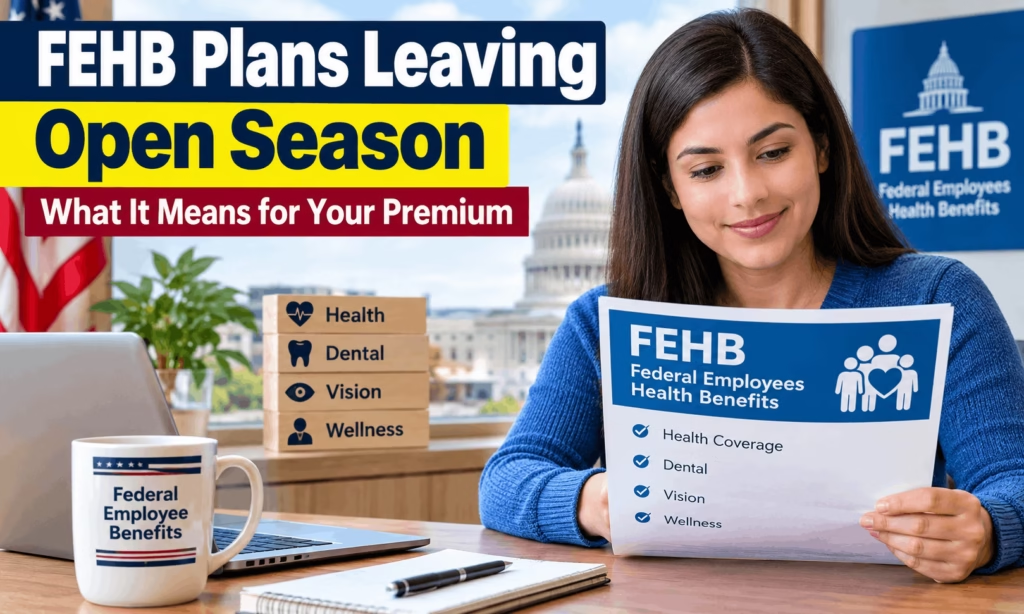
FEHB Plans Leaving Open Season: Federal employees and retirees checking their FEHB plans leaving Open Season this year are running into a confusing timeline. Eight plan options from six carriers were dropped from the Federal Employees Health Benefits program for the current 2026 plan year, and the fallout is still showing up in paychecks and annuity statements right now. Roughly 32,000 enrollees, most of them tied to National Association of Letter Carriers plans, were pushed toward a new carrier this year, and many who did nothing during Open Season are only now noticing a much bigger deduction on their pay stub. Separately, the Office of Personnel Management has already told carriers what it expects for the next plan year, and the next Open Season is expected to open in November, which means the window to react to any new exits is closer than most people think. We’ll be updating this article monthly as OPM releases fresh guidance and 2027 plan details.
If you’re one of the federal employees or annuitants affected by a discontinued plan, the number that matters most is your new premium, not just the name of the carrier that vanished. Auto-enrollment into the government’s designated backup plan, GEHA Benefit Plan High Option, can mean paying two to three times what you paid before, especially if your old plan was a low-cost regional HMO or the NALC Consumer Driven Health Plan. This piece breaks down exactly which FEHB and PSHB plans left the program, why OPM chose GEHA High Option as the fallback instead of the cheapest nationwide plan, how the math on your new premium actually works, and what early signals suggest about the next round of plan changes. A built-in calculator further down lets you plug in your own numbers and see the gap for yourself.
FEHB Plans Leaving Open Season Key Highlights
| Item | Detail |
|---|---|
| Total FEHB carriers, current plan year | 47 carriers, 132 plan options |
| Total PSHB carriers, current plan year | 17 carriers, 75 plan options |
| FEHB plan options discontinued | 8 options across 6 carriers |
| Enrollees affected by discontinued FEHB plans | Approximately 32,000, mostly NALC members |
| Average enrollee premium increase | 12.3 percent (second straight double-digit hike) |
| Default auto-enrollment plan, FEHB | GEHA Benefit Plan High Option |
| Default auto-enrollment plan, PSHB | BCBS Service Benefit Plan, FEP Blue Focus |
| Plans discontinued from PSHB | GEHA Elevate and GEHA Elevate Plus |
| Next Open Season (expected) | November 9 to December 14, 2026, for plan year 2027 |
Why Some FEHB Plans Are Leaving This Open Season
A quick clarification before we go further. The Open Season that actually removed these plans ran from November 10 to December 8, 2025, and the changes have already been in effect since January 1, 2026. If you searched for FEHB plans leaving Open Season expecting news about a season currently underway, this recap covers exactly which plans exited and what changed for the plan year you’re living in right now, and the final section below covers what’s shaping up for the next Open Season this coming November.
Most of the plans that left were small, regional carriers that could no longer compete on cost or enrollment numbers. The one nationwide exit that affected the most people was NALC, which pulled its High Option and Consumer Driven Health Plan (CDHP) entirely out of the FEHB program, though both plans remain available through PSHB for postal employees and annuitants. NALC’s decision alone displaced close to 29,000 enrollees who had to either actively pick a new plan or accept automatic placement into GEHA High Option.
FEHB plans discontinued for the current plan year
| Carrier and plan | Plan type | States or region affected |
|---|---|---|
| NALC Health Benefit Plan, CDHP | Consumer Driven Health Plan | Nationwide (FEHB only, remains in PSHB) |
| NALC Health Benefit Plan, High Option | Fee-for-service | Nationwide (FEHB only, remains in PSHB) |
| Health Alliance HMO Standard | HMO | Regional |
| AvMed Health Plan, HDHP | High Deductible Health Plan | Florida |
| AvMed Health Plan, Standard | HMO | Florida |
| Independent Health, High Option | HMO | Western New York |
| Blue Care Network of Michigan, High Option | HMO | Michigan |
| Priority Health, High Option | HMO | Michigan |
PSHB and FEDVIP plans that also exited
GEHA Elevate and GEHA Elevate Plus, the two newer PSHB-only options, were discontinued for postal employees and annuitants. Anyone in either plan needed to actively choose a replacement PSHB plan or was defaulted into BCBS FEP Blue Focus, the lowest-cost nationwide PSHB option. On the dental side of FEDVIP, the Health Partners Dental Plan exited the program entirely, and its roughly small but affected enrollee base had to pick a new dental carrier since FEDVIP has no automatic backup plan the way FEHB and PSHB do.
Two new options also joined FEHB this cycle. Kaiser Permanente launched a Prosper plan for the Fresno, California market, and Baylor Scott and White added a Value plan in select Texas markets, giving federal employees in those regions at least a partial offset to the exits happening elsewhere.
Overall, the FEHB program shrank slightly in size this cycle, dropping from 146 total plan options to 132 across its 47 participating carriers. That’s a smaller marketplace than federal employees have seen in recent years, and it reflects a broader trend of smaller regional carriers exiting government health programs as administrative costs and reinsurance requirements climb. PSHB, by contrast, is still a relatively new program, having launched with the current generation of postal employees and annuitants in January 2025 under the 2022 Postal Service Reform Act, and its lineup of 17 carriers and 75 plan options actually held fairly steady this cycle outside the two GEHA Elevate exits.
How Premiums Changed for the Current Plan Year
Even setting aside the discontinued plans, this was already a costly Open Season. The average enrollee share of FEHB premiums rose 12.3 percent, marking the second consecutive year of double-digit increases after a 13.5 percent jump the year before. The total premium, including the government’s contribution, rose a more modest 10.2 percent, but that gap matters because the government’s share is capped rather than proportional. Out of all FEHB plans, 57 increased below the average and 49 increased above it, while for PSHB, premiums rose 11.3 percent on average, with 13 plans actually seeing a premium decrease and one staying flat.
OPM and outside analysts point to a few consistent drivers behind the increases: mandatory GLP-1 weight-loss drug coverage across all FEHB and PSHB plans, an aging enrollee population with more chronic conditions, and rising specialty drug and hospital costs generally. Several plans also raised out-of-pocket costs alongside premiums, including higher catastrophic limits in 29 plans, so a lower headline premium increase doesn’t always mean lower total costs for the year.
- $2000 Stimulus Payment September 2026 Fact-Check: Is It Really Coming?
- Trump $5000 Dividend Check: Latest Update on Cost, Eligibility and Payment Date
- Alberta Referendum On October 19, 2026 Puts 10 Questions To Voters, Including One On Independence, Here Is What Each Question Means And The Latest Polling
Government contribution caps for the current plan year
| Coverage tier | Biweekly maximum government contribution |
|---|---|
| Self Only | $324.76 |
| Self Plus One | $711.17 |
| Self and Family | $778.03 |
The government pays the lesser of 75 percent of your specific plan’s total premium or 72 percent of the program-wide weighted average premium, whichever is smaller. That formula is why premium increases hit enrollees harder in high-cost plans. In some regional plans, the government’s actual share drops as low as 27 percent of the total premium, leaving the enrollee to cover the other 73 percent.
What Happens If You Do Nothing: The Auto-Enrollment Problem
This is where the current Open Season created real financial shock for tens of thousands of people. In past years, OPM automatically moved enrollees from a discontinued plan into the lowest-cost nationwide FEHB option. This year, OPM used a different authority and instead defaulted everyone into GEHA Benefit Plan High Option, which is not the cheapest available plan. An OPM spokesperson told Federal News Network only that the agency determined this was “in the best interest of the program,” without detailing the reasoning further.
GEHA High Option biweekly premiums, current plan year (employees)
| Coverage tier | Biweekly premium |
|---|---|
| Self Only | $195.29 |
| Self Plus One | $432.95 |
| Self and Family | $525.18 |
GEHA High Option monthly premiums, current plan year (retirees and annuitants)
| Coverage tier | Monthly premium |
|---|---|
| Self Only | $423.13 |
| Self Plus One | $938.06 |
| Self and Family | $1,137.89 |
To put the impact in real terms, a family that was on the NALC CDHP paid $146.26 biweekly for Self and Family coverage. Auto-enrolled into GEHA High Option without making an active choice, that same family’s biweekly premium jumped to $525.18, an increase of roughly 260 percent overnight. That is not a rounding error or a minor plan tweak. It’s a household budget problem that many enrollees only discovered once their first 2026 paycheck arrived.
If your plan was discontinued and you did not actively select a replacement during the Open Season window, you are locked into whatever plan you were defaulted to until the next Open Season this coming November, unless you experience a qualifying life event such as marriage, birth of a child, or loss of other coverage in the meantime.
How to Choose a Replacement Plan If Yours Was Discontinued
If you’re still sitting in the default GEHA High Option because your original plan disappeared, don’t assume you’re stuck with the highest-cost path forward. Start by pulling up OPM’s official plan comparison tool and filtering by your zip code, since regional HMOs and lower-tier fee-for-service options are often available even in areas where your old plan was dropped. Compare not just the biweekly premium but the deductible, out-of-pocket maximum, and whether your current doctors and prescriptions are in-network, since a cheaper premium can still cost more overall if your regular providers fall outside the plan’s network.
It’s also worth checking whether a Consumer Driven Health Plan or High Deductible Health Plan makes sense for your household if you were previously in a low-deductible option. These plans typically carry lower premiums and include an employer-funded health reimbursement arrangement or the ability to pair with a Health Savings Account, which can offset the higher deductible for enrollees who don’t expect heavy medical use in a given year. For 2026, the Health Care Flexible Spending Account contribution limit rose to $3,400 with a $680 carryover allowance into the following year, while the Dependent Care FSA limit held steady at $5,000 with no carryover, so factor those tax-advantaged accounts into your overall math before assuming GEHA High Option is your only realistic path.
FEHB Premium Impact Calculator
Use the calculator below to estimate how your own premium may have shifted, whether you’re comparing a standard 12.3 percent average increase against your old premium, or checking the exact jump if you were auto-enrolled into GEHA High Option from a discontinued plan. Paste this HTML block into any page or post to embed it.
FEHB Premium Impact Calculator
How to Apply or Switch Plans
Switching FEHB or PSHB plans outside a discontinued-plan scenario requires an active Open Season election. Current federal employees make changes through their agency’s self-service payroll portal, most commonly Employee Express or a similar agency-specific system. Retirees and annuitants use OPM’s Retirement Services Online. FEDVIP dental and vision changes are handled separately through BENEFEDS. Outside of Open Season, you generally need a qualifying life event, such as marriage, divorce, birth or adoption of a child, or loss of other health coverage, to make a plan change, and you typically have 60 days from the event to submit it.
Processing Time for Plan Changes
Elections made during Open Season take effect on January 1 of the new plan year, and there’s no separate approval step, your selection is processed automatically once submitted correctly through the appropriate system. Qualifying life event changes made outside Open Season are usually effective the first day of the pay period following the event, though this can vary slightly depending on the specific event and your employing agency’s payroll cycle. If you don’t see your new plan reflected within one to two pay periods after Open Season closes, contact your agency’s benefits office or OPM’s retirement call center to confirm your election was processed correctly.
FEHB Premium Payment Schedule
Current employees pay their share of FEHB and PSHB premiums through biweekly payroll deductions, taken out before taxes in most cases, which lowers your taxable income slightly compared to paying premiums after tax. Retirees and annuitants pay monthly, with the premium deducted directly from the monthly annuity payment. If you’re a reemployed annuitant or in a leave-without-pay status, you become responsible for paying your premium directly, and missed payments during LWOP periods are billed later through the National Finance Center once you return to pay status.
What’s Coming for the Next Open Season
This is the part worth watching closely if you want to stay ahead of the next round of FEHB plans leaving Open Season. OPM released its 2027 call letter to carriers on March 31, 2026, setting expectations for benefit and rate proposals due back from carriers by May 31, 2026. The letter’s headline theme is “well care,” with OPM pushing carriers toward prevention, digital health tools, and site-of-care optimization programs designed to reduce total cost of care rather than just shifting costs onto enrollees.
A few specific changes are already locked in for the next plan year regardless of which individual plans stay or go. All FEHB and PSHB plans must continue covering at least one GLP-1 anti-obesity medication plus two oral weight-management options. Coverage for pediatric gender-affirming surgeries and hormone treatments remains excluded, continuing a policy that began with the current plan year. The call letter also references a new functional and lifestyle medicine pilot tied to a broader administration health initiative, though participation details for FEHB carriers specifically are still being worked out.
Separately, a new law is changing how Open Season itself works starting this cycle. Under the FEHB Protection Act of 2025, agencies must now verify 100 percent of Open Season elections that add a family member to a policy, up from the previous 10 percent minimum standard. OPM notified agency benefits offices of this requirement in July 2026, and it applies to both the upcoming Open Season and any qualifying life event additions made since July 4, 2026. Expect more paperwork if you’re adding a spouse or dependent this time around.
As of mid-September 2026, OPM had not yet officially confirmed exact Open Season dates for the next plan year, though industry trackers widely expect a November 9 to December 14, 2026 window based on the standard one-month cycle following carrier finalization. OPM also brought in new leadership for its Healthcare and Insurance Division in early September, with Mathew Kiley succeeding Shane Stevens, a change that could shape how plan changes and enrollee communications are handled this cycle. We’ll update this section as soon as OPM confirms the official dates and publishes the list of plans leaving for the next plan year.
Official FEHB and PSHB Resources
| Resource | Purpose | Link |
|---|---|---|
| OPM Open Season hub | Official dates, guidance, and announcements | opm.gov/healthcare-insurance/open-season |
| OPM Plan Comparison Tool | Compare premiums, benefits, and networks side by side | opm.gov/healthcare-insurance/healthcare/plan-information/compare-plans |
| Employee Express | Active employee enrollment and plan changes | employeeexpress.gov |
| OPM Retirement Services Online | Retiree and annuitant enrollment and plan changes | servicesonline.opm.gov |
| BENEFEDS | FEDVIP dental and vision enrollment | benefeds.com |
| GEHA plan details | Review High Option and Standard Option brochures and rates | geha.com |
FAQs About FEHB Plans Leaving Open Season
Which FEHB plans are leaving the program this year?
Eight FEHB plan options exited for the current plan year: both NALC plans (CDHP and High Option), Health Alliance HMO Standard, AvMed HDHP and Standard, Independent Health High, Blue Care Network of Michigan High, and Priority Health High. On the PSHB side, GEHA Elevate and GEHA Elevate Plus were discontinued.
What happens if I do nothing after my FEHB plan is discontinued?
You get automatically enrolled in GEHA Benefit Plan High Option if you were in FEHB, or BCBS FEP Blue Focus if you were in PSHB. This is not necessarily the lowest-cost option, so your premium could rise sharply compared to your old plan.
Can I switch out of GEHA High Option if I was auto-enrolled?
Not until the next Open Season, unless you have a qualifying life event such as marriage, a new child, or loss of other coverage that lets you make a mid-year change.
Why did FEHB premiums go up so much this year?
The main drivers cited by OPM and outside analysts are mandatory GLP-1 weight-loss drug coverage, an aging enrollee population with more chronic health needs, and rising overall healthcare and prescription drug costs.
Is NALC still available to anyone?
Yes, both NALC plans remain available through PSHB for USPS employees and annuitants, they were only removed from the general FEHB program used by non-postal federal employees.
When is the next FEHB Open Season?
It has not been officially confirmed by OPM as of mid-September 2026, but a November 9 to December 14, 2026 window is widely expected based on the standard scheduling pattern and carrier finalization deadlines.
How much of my FEHB premium does the government pay?
The government pays the lesser of 75 percent of your specific plan’s premium or 72 percent of the program-wide weighted average, so your actual government share depends heavily on which plan you choose.
Will more plans leave FEHB next year?
OPM has not yet published a list of plan exits for the next plan year. Carriers submitted their proposals by May 31, 2026, and OPM typically announces final plan offerings and any withdrawals in the fall ahead of Open Season.
Is FEHB going away?
No, the FEHB program itself is not being eliminated. Individual carriers and specific plan options leave or join the program each year based on their own business decisions and OPM negotiations, but the overall program continues to serve millions of federal employees, retirees, and their families.
How do I know if my FEHB plan is being discontinued?
Your carrier is required to send you a formal notice if your specific plan option is leaving the program. You can also check the plan status directly on OPM’s plan comparison tool or in Section 2 of your plan’s official brochure, which outlines all changes for the new plan year.
What is the cheapest FEHB plan for a family?
The cheapest option changes yearly and by region, so the only reliable way to find it is through OPM’s official plan comparison tool, which lets you filter by coverage tier, location, and premium.
Does FEHB cover weight loss drugs?
Yes, all FEHB and PSHB plans are required to cover at least one GLP-1 medication for weight management, along with oral weight-management medication options, though cost-sharing and specific drug formularies vary by carrier.
Can retirees change their FEHB plan every year?
Yes, retirees and annuitants have the same annual Open Season rights as active employees and can switch plans, change coverage tiers, or add or remove family members during that window, or sooner with a qualifying life event.
Conclusion
The FEHB plans leaving Open Season this cycle created real financial consequences for tens of thousands of federal employees and retirees, and the sharpest impact fell on anyone who let auto-enrollment make the decision for them. If you’re still sitting in GEHA High Option after being defaulted there from a discontinued plan, it’s worth reviewing your options now rather than waiting until the last minute of the next Open Season. With OPM’s 2027 call letter already pushing carriers toward new wellness requirements and a stricter family-member verification law now in place, the next Open Season is likely to bring its own set of changes worth watching closely as the November window approaches.