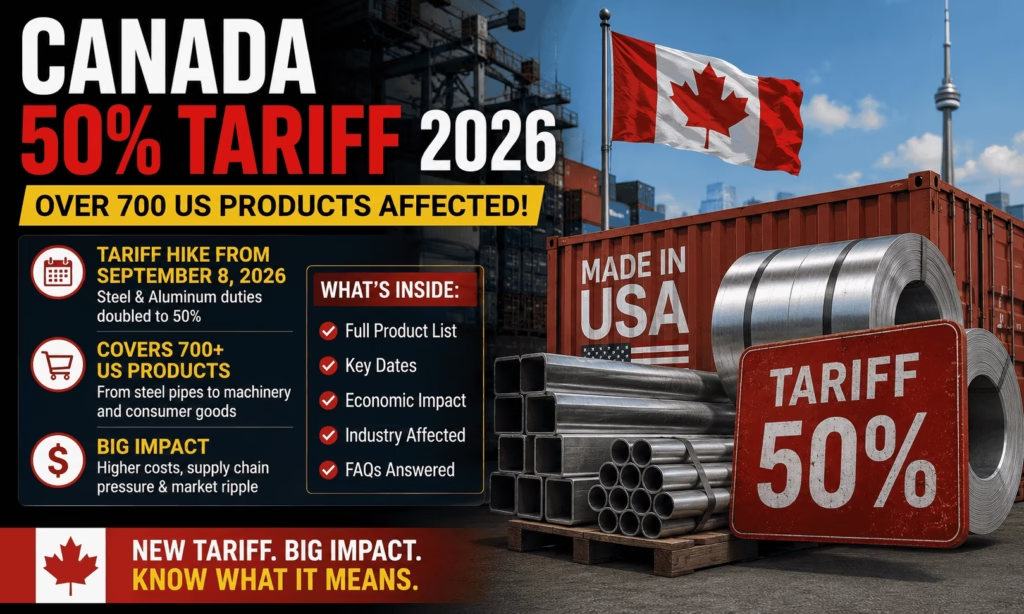
Canada 50% Tariff 2026 has moved from threat to official policy, with Ottawa confirming on August 25, 2026 that more than 700 American products will face new import duties of 15, 25 or 50 percent starting September 8, 2026. Finance Minister Francois-Philippe Champagne released a detailed, nearly 100-page list at a press conference in Ottawa, doubling existing tariffs on American steel and aluminum to 50 percent and adding fresh levies on goods ranging from fish, cheese and smartphones to furniture, tools and appliances. The retaliation package under Canada 50% Tariff 2026 is valued at roughly 20 billion US dollars, matching dollar for dollar the 50 percent tariffs Washington imposed on Canadian goods just days earlier. We’ll be updating this article monthly as new tariff data, product lists and trade figures are released.
This is the sharpest escalation yet in a trade war that has been building since early 2025. The Canadian announcement came less than a week after President Donald Trump’s own 50 percent tariffs on roughly 20 billion dollars of Canadian goods took effect on August 22, 2026, following the collapse of trade talks between Washington and Ottawa. Champagne said the goal of Canada’s countermeasures is not to raise government revenue but to protect Canadian industries and reduce reliance on US imports in sectors most exposed to American tariffs. “When the United States asked too much and offered too little, we chose to stand up for Canadians,” Champagne told reporters, framing the retaliation as a direct, calculated response rather than an open-ended trade war.
Canada 50% Tariff 2026: Latest Update on the Full 700-Product Retaliation List
As of August 26, 2026, the most current development in this dispute is Ottawa’s official release of its complete counter-tariff list. Canada’s retaliatory tariffs will apply to more than 700 separate American product categories, drawn largely from the same sectors the United States targeted under its own Section 338 and Section 232 tariff actions. The new duties, effective at 12:01 a.m. ET on September 8, 2026, will carry three different rates depending on the product: 15 percent, 25 percent or 50 percent. Canada’s tariffs on many of these American products will double from the existing 25 percent rate to 50 percent, with steel and aluminum products absorbing the largest share of the increase.
Canadian officials have been explicit that the strategy is about protecting domestic industry rather than generating tariff revenue. They pointed to early results from the existing 25 percent Canadian tariff on American steel, noting that US steel imports into Canada have already fallen roughly 30 percent since that measure was introduced, and that the new 50 percent rate is expected to push that decline even further. The list also includes a narrow but important exemption: goods that are already in transit to Canada on September 8, 2026 will not be subject to the new duties, giving businesses a small buffer to complete shipments already underway.
Key Highlights: Canada 50% Tariff 2026 at a Glance
| Data Point | Detail |
|---|---|
| Number of US products targeted | More than 700 tariff line items |
| Tariff rates applied | 15 percent, 25 percent or 50 percent, depending on product |
| Total value of Canada’s countermeasures | Approximately 20 billion US dollars (C$27.6 billion) |
| Effective date | 12:01 a.m. ET, September 8, 2026 |
| Steel and aluminum tariff rate | Doubled from 25 percent to 50 percent |
| Length of official product list | Approximately 99 pages |
| Exemption | Goods already in transit to Canada on September 8, 2026 |
| Drop in US steel imports since 25 percent tariff | Approximately 30 percent |
| Canada’s 2024 steel exports to the US | Approximately 7.1 billion US dollars |
| Canada’s 2024 aluminum exports to the US | Approximately 9.4 billion US dollars |
| Share of US steel imports from Canada | 23 percent |
| Share of US primary aluminum consumption from Canada | More than 50 percent |
| Canadian worker support fund announced alongside tariffs | C$7.5 billion |
| US tariffs on Canadian goods, effective date | August 22, 2026 |
| US threat on Canadian autos, trucks, parts and steel | 50 percent, effective January 1, 2027 |
| Number of Canadian products already covered by US tariffs | More than 550 tariff line items |
This data reflects the most recent figures confirmed by Canadian and US officials as of late August 2026 and will be revised as fresh government data is released.
Trump-Carney Trade War: How Canada’s Tariffs On US Goods Can Put Nearly $900 Billion At Risk
2027 VA Disability COLA Increase: How Much Could Benefits Rise Under the Latest Projection
What Products Are Included in Canada’s Retaliation List
Canada’s countermeasures deliberately mirror many of the same categories the United States targeted in its own tariff proclamations, a design choice officials say is meant to maximize pressure on American exporters in the sectors most affected by US trade action. The list spans a wide mix of consumer and industrial goods.
Steel and Aluminum Products Take the Biggest Hit
Steel and aluminum make up the largest single share of Canada’s new measures, with tariffs doubling from 25 percent to a full 50 percent. This matters enormously given the scale of cross-border trade in these metals. Canada exported approximately 7.1 billion US dollars worth of steel and 9.4 billion US dollars worth of aluminum to the United States in 2024, figures that made Canada the source of roughly 23 percent of all US steel imports and more than half of total US primary aluminum consumption. Around 90 percent of Canada’s steel exports flow to American buyers, meaning the sector is deeply intertwined between the two economies, and a sustained 50 percent tariff regime on both sides could meaningfully reshape supply chains built up over decades.
Food, Seafood and Agricultural Goods
Live and frozen fish, crustaceans, oysters, mussels and a range of other seafood products appear on Canada’s list, alongside select dairy and agricultural items. These categories were chosen partly because they represent politically significant US export sectors with concentrated production in specific American states, giving Ottawa leverage similar to what Washington has used against Canadian dairy and alcohol producers in its own proclamations.
Electronics, Appliances and Consumer Goods
Smartphones, household appliances, furniture and clothing also appear on the list, reflecting a deliberate attempt to spread economic pressure across a broad swath of American manufacturing and consumer goods exporters rather than concentrating it narrowly on one or two industries. Tools and construction-related hardware round out several of the higher-value categories facing the steepest 50 percent rate.
Why Canada Chose These Specific Sectors
Canadian officials, including Finance Minister Champagne, Industry Minister Melanie Joly, Jobs Minister Patty Hajdu and Artificial Intelligence Minister Evan Solomon, gathered together in Ottawa to present the retaliation package as a coordinated, whole-of-government response. They explained that the sectors selected, steel, dairy, appliances, agricultural equipment, pulp and paper, and electronics, were those judged to be most heavily affected by the US tariffs that took effect August 22, 2026. The intent is to concentrate retaliatory pressure precisely where American exporters are most exposed to Canadian buyers, rather than spreading tariffs thinly across categories with little strategic impact.
This targeted approach also reflects lessons from earlier rounds of the trade dispute dating back to 2018 and again through 2025, when broader, less-targeted retaliation was seen by some economists as less effective at shifting US policy. By concentrating on integrated cross-border industries like steel and aluminum, where intermediate goods often cross the border multiple times during a single production cycle in sectors like HVAC, automotive parts and construction materials, Canada’s tariffs compound at each stage, meaning the real economic cost to manufacturers on both sides is often higher than the nominal tariff rate alone would suggest.
Canada’s C$7.5 Billion Worker Support Fund
Alongside the tariff announcement, Champagne unveiled a C$7.5 billion worker support fund, described as the largest such package Canada has rolled out during the ongoing trade dispute. The fund is designed to cushion Canadian workers and businesses in the industries most exposed to the tariff standoff, particularly steel, aluminum, automotive and forestry-linked manufacturing, where early 2026 export data had already shown signs of weakness even before this latest round of measures took effect. The scale of the fund signals that Ottawa expects the trade war to have real, lasting economic consequences domestically, even as it proceeds with retaliation.
How This Fits Into the Broader US-Canada Trade War
This latest round of Canada retaliatory tariffs did not emerge in isolation. It follows the collapse of trade negotiations between Washington and Ottawa on the night of August 21, 2026, after Canadian Prime Minister Mark Carney said the United States had proposed terms that were “uneconomic” and “unfair” in the final hours of talks. Hours later, at 12:01 a.m. ET on August 22, 2026, US tariffs of 50 percent on approximately 20 billion dollars worth of Canadian goods, covering automobiles-linked items, alcohol, dairy, cement and hundreds of other categories, formally took effect under Section 338 of the Tariff Act of 1930, a rarely used authority that applies regardless of USMCA or CUSMA compliance.
Trump escalated further on August 24, 2026, threatening to raise tariffs on Canadian cars, trucks, auto parts and steel to 50 percent starting January 1, 2027, a move that would hit one of the most tightly integrated manufacturing sectors in North America. As of late August 2026, no new trade talks are scheduled between the two governments, leaving both sides positioned for a prolonged standoff rather than a near-term resolution.
$994 SNAP Benefit: New Work Rules Hit Millions as SNAP E&T Program Explained
CRS Score Distribution 2026: 5 Trends Shaping the Next Express Entry Draw
New Canada LMIA Rules August 2026: What Employers and Foreign Workers Need to Know
Processing Time and Key Dates Businesses Need to Track
Companies with exposure to the more than 700 targeted product categories have a narrow operational window before the new rules take hold. The September 8, 2026 effective date is a hard deadline, not a phased rollout, meaning businesses need to plan shipments, customs paperwork and pricing adjustments well in advance rather than waiting for last-minute clarity.
How to Apply the New Tariff Rates as a Business
Canadian importers should classify their US-origin goods against the official 99-page tariff list released by Finance Canada to confirm whether a specific product falls under the 15, 25 or 50 percent rate category. Because the binding legal text is the exact Harmonized Tariff Schedule subheading listed in the government’s published annex, businesses are strongly advised to confirm classification with a licensed customs broker rather than relying on general category summaries, since minor differences in product specification can shift which rate applies.
Payment and Cost Pass-Through Considerations
As with the earlier US tariffs, the new Canadian counter-tariffs are paid by Canadian importers bringing US-origin goods across the border, not by American exporters directly. Importers will need to decide whether to absorb the added cost, renegotiate pricing with American suppliers, or pass the increase on to Canadian consumers, a decision likely to vary significantly by sector depending on how easily a product category can be substituted with domestic or third-country alternatives.
Economic Impact: Who Feels the Pressure First
Industries with deeply integrated, multi-crossing supply chains are expected to feel the compounding effect of tariffs most acutely. Because intermediate goods in sectors such as automotive parts, HVAC equipment and construction materials frequently cross the Canada-US border several times during production before reaching a finished state, a 50 percent tariff applied at each crossing can meaningfully exceed the nominal headline rate in cumulative cost terms. This dynamic is expected to hit manufacturers with cross-border production models harder than companies that source and sell entirely within one country.
For everyday consumers on both sides of the border, categories most likely to see visible price increases include steel and aluminum-based goods, appliances, furniture, and select food and dairy products, since these are harder to substitute quickly compared to more easily sourced consumer electronics or apparel. Early 2026 trade data had already shown weakness in tariff-exposed manufacturing sectors, particularly motor vehicles and parts, steel and aluminum products, and downstream forestry industries, suggesting the economic strain predates this latest round of measures and is likely to deepen as both sets of tariffs take full effect.
Official Sources and Government Resources
| Resource | Purpose | Official Link |
|---|---|---|
| Department of Finance Canada | Official counter-tariff product list and policy announcements | https://www.canada.ca/en/department-finance.html |
| Global Affairs Canada | Canada’s trade policy and diplomatic response updates | https://www.international.gc.ca |
| Canada Border Services Agency (CBSA) | Tariff classification, duty rates and import compliance | https://www.cbsa-asfc.gc.ca |
| Office of the US Trade Representative | Official US tariff actions and proclamations | https://ustr.gov |
| US Customs and Border Protection | US import tariff classification and compliance guidance | https://www.cbp.gov |
| The White House | Official US presidential proclamations on tariffs | https://www.whitehouse.gov |
| Bank of Canada | Economic impact analysis and monetary policy updates | https://www.bankofcanada.ca |
Businesses and consumers should always confirm current tariff rates and effective dates directly through these official government channels, since product classifications and exemption details can be updated with limited advance notice.
FAQs
How many US products are covered by Canada’s retaliatory tariffs?
Canada’s retaliatory tariffs cover more than 700 American product categories, spanning sectors including steel, aluminum, seafood, dairy, electronics, appliances, furniture and tools, as confirmed by Finance Minister Francois-Philippe Champagne on August 25, 2026.
When do Canada’s new tariffs on US goods take effect?
The new Canadian counter-tariffs take effect at 12:01 a.m. ET on September 8, 2026, with the only exemption being goods already in transit to Canada on that date.
What are the tariff rates under Canada’s retaliation package?
Canada’s countermeasures apply three tariff rates, 15 percent, 25 percent or 50 percent, depending on the specific product category, with steel and aluminum facing the steepest increase, doubling from 25 percent to 50 percent.
Why did Canada double tariffs on US steel and aluminum?
Canada doubled steel and aluminum tariffs to 50 percent after data showed US steel imports had already fallen roughly 30 percent under the earlier 25 percent tariff, prompting officials to increase pressure further to protect Canadian producers.
Is there a worker support fund tied to Canada’s tariff response?
Yes, Canada announced a C$7.5 billion worker support fund alongside the tariff list, aimed at cushioning industries and workers most exposed to the ongoing trade dispute, particularly steel, aluminum, automotive and forestry sectors.
Are Canada and the US currently holding new trade talks?
As of late August 2026, no new trade talks are scheduled between Washington and Ottawa, and both governments appear positioned for a prolonged tariff standoff rather than a near-term resolution.
Conclusion
Canada 50% Tariff 2026 marks a decisive shift from rhetoric to concrete retaliation in the Trump-Carney trade dispute, with more than 700 American products now facing tariffs of up to 50 percent. With steel and aluminum duties doubling, a C$7.5 billion worker support fund in place, and no new negotiations currently scheduled, both economies are heading into September 2026 with real, dollar-for-dollar consequences rather than open threats. For businesses on either side of the border, the September 8, 2026 deadline is now a fixed operational reality that demands immediate classification checks, supply chain review and pricing decisions. This article will be reviewed and updated monthly as Canada, the United States and independent economists release new data on the scale and impact of this expanding trade war.