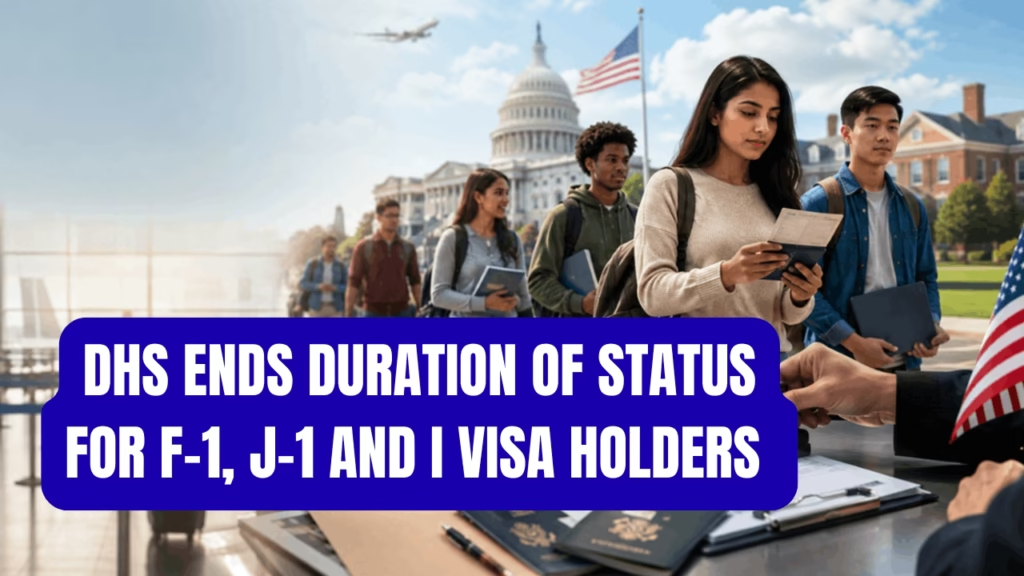
DHS Ends Duration of Status for F-1, J-1 and I Visa Holders: The Department of Homeland Security has officially ended one of the longest-standing rules in American student visa policy, and the change will touch nearly every international student, exchange visitor, and foreign media representative currently living in the United States. On July 17, 2026, DHS published a final rule eliminating Duration of Status, known as D/S, the nearly fifty year old framework that let F-1 students, J-1 exchange visitors, and I visa media representatives stay in the country for as long as they kept meeting their program requirements, with no fixed expiration date on their paperwork. Starting September 15, 2026, that open-ended system disappears.
In its place, DHS is introducing fixed admission periods, up to four years for F-1 and J-1 holders and up to 240 days for I visa holders, along with a formal extension of stay process through USCIS for anyone who needs more time. DHS Secretary Markwayne Mullin called the old system outdated and said it had created conditions ripe for immigration fraud, while university international offices across the country are now scrambling to explain the change to hundreds of thousands of students before the effective date arrives. We will be updating this article monthly as USCIS and SEVP issue further implementation guidance.
What the Duration of Status F-1 J-1 Rule Actually Changes
For almost fifty years, F-1 students and J-1 exchange visitors were admitted to the United States for Duration of Status, a system where their Form I-94 arrival record simply said D/S instead of listing a specific expiration date. As long as a student remained enrolled and made normal academic progress, or a scholar continued their approved exchange program, their legal status did not expire on a fixed calendar date.
The new rule replaces that entirely. Going forward, F-1 and J-1 nonimmigrants will be admitted for a fixed period tied to their program, capped at four years, while I visa holders, typically foreign journalists and media representatives, will be capped at 240 days. Anyone who needs to remain in the United States beyond their new fixed end date will have to file a formal extension of stay application with U.S. Citizenship and Immigration Services, submit biometrics, and demonstrate they remain eligible, a process that did not previously exist for most D/S holders.
Why DHS Says It Is Ending Duration of Status
According to the Department of Homeland Security’s official announcement, the rule is meant to close what officials describe as a decades-old loophole. The agency argues that open-ended status made it difficult to track whether students and exchange visitors were actually still enrolled or participating in their programs, and that regular fixed-date checkpoints will allow for better oversight and vetting.
DHS also pointed to broader immigration enforcement priorities behind the change, framing it as part of a wider effort to tighten the student and exchange visitor visa system. A fixed period of admission is already standard for most other nonimmigrant visa categories, and DHS says this brings F, J, and I visas in line with how the rest of the immigration system already operates.
Key Dates and Provisions in the New Rule
The rule includes a mix of hard deadlines and transition provisions that current visa holders need to track carefully depending on when they were admitted and whether they travel internationally before the effective date.
| Date or Provision | Detail |
|---|---|
| Rule published | July 17, 2026 |
| Effective date | September 15, 2026 |
| Maximum fixed admission period for F-1 and J-1 | Up to four years |
| Maximum fixed admission period for I visa holders | Up to 240 days |
| F-1 departure grace period | Reduced from 60 days to 30 days if the student travels internationally on or after September 15, 2026 |
| J-1 departure grace period | 30 days regardless of travel |
| Outer transition deadline for F-1 students already in D/S | No later than November 14, 2030 |
| Outer transition deadline for J-1 scholars already in D/S | No later than October 15, 2030 |
| First academic year major or program change restriction | F-1 undergraduates generally cannot change university, major, or degree level during their first academic year without an SEVP exception |
| Congressional Review Act status | Classified as a major rule; DHS will issue updated notices if congressional review changes the effective date |
How Current F-1 and J-1 Students Are Affected
Students and scholars who are already in the United States under D/S and properly maintaining their status on September 15, 2026 will not have their Form I-94 automatically corrected to show a specific date on that day. Instead, DHS has built in a transition period. These individuals can generally remain in the country until the later of two dates: the expiration date listed on their Employment Authorization Document, if they have one, or the program end date shown on their current Form I-20 or Form DS-2019, whichever comes later, but never beyond four years from the effective date.
That means the absolute outer limit for most F-1 students already in the country is November 14, 2030, once the additional 60-day departure grace period is added, and October 15, 2030 for most J-1 scholars, after their 30-day grace period. Anyone approaching those dates will still need to file for an extension of stay if their academic or exchange program is not yet complete.
SNAP Soda and Candy Ban by State: Full List, Dates, and Rules for 2026
IRS-ICE Data Sharing Ruling: What Immigrants and Green Card Holders Need to Know
Social Security Payment August 12, 2026: Who Gets Paid Today and When Is Your Next Check?
Fast-Track Deportation Ruling: Could It Affect Indian Immigrants?
Students on OPT and STEM OPT Need to Watch International Travel Closely
One detail immigration attorneys are flagging heavily involves students currently working under Optional Practical Training or STEM OPT extensions. If a student remains continuously inside the United States without international travel on or after September 15, 2026, their existing approved OPT or STEM OPT period stays valid under the old rules, and their original 60-day grace period still applies.
However, if that same student travels internationally and re-enters the United States on or after September 15, 2026, re-entry will convert their record to a fixed-date I-94 that matches their Employment Authorization Document end date, plus a shortened 30-day grace period instead of 60. For students weighing a trip home or an international conference this fall, that distinction could meaningfully shorten how long they are legally allowed to remain in the country afterward.
New Restrictions on Changing Majors and Transferring Schools
Beyond the fixed admission periods themselves, the rule also tightens the academic flexibility F-1 students have traditionally had. Undergraduate F-1 students generally cannot change their university, degree major, or education level during their first full academic year of study, unless they qualify for a specific exception granted by the Student and Exchange Visitor Program, such as a school closure or an extended natural disaster disruption. After completing one full academic year, undergraduates can change majors or programs with standard SEVP approval.
Graduate students face tighter restrictions on switching programs than undergraduates do. Immigration law firms tracking the rule expect this specific provision to reduce the number of international graduate applicants willing to commit to a U.S. program, since students who discover a poor academic fit will have far less room to adjust course than they did under the old D/S system.
What Employers and Universities Should Do Now
Employers who sponsor F-1 workers on OPT or STEM OPT, along with J-1 exchange visitor program sponsors, are being urged by immigration counsel to begin monitoring individual I-94 expiration dates closely rather than assuming open-ended status continues indefinitely. DHS has confirmed that H-1B cap-gap protections for F-1 students transitioning to H-1B status are preserved under the new rule, but attorneys note the fixed timelines add new pressure to coordinate OPT and STEM OPT timing, extension of stay filings, and H-1B sponsorship earlier in the employment process than universities and employers are used to.
University international student offices, including those at major research universities, have already begun issuing guidance pages explaining the transition rules to their current F-1 and J-1 populations, and many are recommending that scholars who already know they will need a program extension begin that process well before the September 15 deadline, since a formal government extension application will otherwise be required once the rule takes effect.
ACA Subsidy Cliff 2026: Why Experts Warn of Astronomical Tax Bills?
FAQs
What is Duration of Status and why is DHS ending it?
Duration of Status, or D/S, was a policy that allowed F-1 students, J-1 exchange visitors, and I visa holders to remain in the United States without a fixed expiration date as long as they kept meeting their program requirements. DHS is ending it effective September 15, 2026, saying the open-ended system made oversight and fraud prevention difficult.
When does the new fixed admission period rule take effect?
The rule was published on July 17, 2026 and becomes effective September 15, 2026, though it remains subject to congressional review under the Congressional Review Act, which could still change the timeline.
Will I lose my student status immediately on September 15, 2026?
No. F-1 and J-1 students already properly maintaining D/S status will not automatically receive a new fixed-date I-94 on that day. Transition provisions allow most current students and scholars to remain until the later of their EAD expiration or their current program end date, capped at four years from the effective date.
Does traveling internationally after September 15, 2026 change my status?
Yes. If a student on OPT or STEM OPT travels internationally and re-enters the U.S. on or after September 15, 2026, their record converts to a fixed-date I-94 matching their EAD end date, along with a shortened 30-day grace period instead of the standard 60 days.
Can F-1 students still change their major or transfer schools under the new rule?
Undergraduate students generally cannot change universities, majors, or degree levels during their first academic year without an approved SEVP exception. After one full academic year, standard program changes are allowed. Graduate students face stricter limitations throughout their program.
Do I need to apply for an extension of stay before my new admission period ends?
Yes. Anyone whose program will run beyond their new fixed admission date must file a formal extension of stay application with USCIS, including biometrics, before their authorized period expires.
Official Resources
| Resource | Purpose | Official Link |
|---|---|---|
| DHS official rule announcement | Full text and background on the final rule | dhs.gov/news |
| USCIS extension of stay filing | File Form I-539 for extension of nonimmigrant status | uscis.gov/i-539 |
| SEVP official updates | Student and Exchange Visitor Program guidance | ice.gov/sevis |
| USCIS case status check | Track a pending extension or status application | egov.uscis.gov/casestatus/landing.do |
| USCIS online account | Manage immigration filings and documents | myaccount.uscis.gov |
| Federal Register final rule text | Official published regulation text | federalregister.gov |
Conclusion
The end of Duration of Status marks one of the most significant changes to U.S. student and exchange visitor policy in decades, moving nearly a million F-1, J-1, and I visa holders from an open-ended system to a calendar built around fixed admission dates and formal extension filings. While current students and scholars get a multi-year transition window, the practical effect starting September 15, 2026 is that international students, universities, and employers alike now need to track hard deadlines that simply did not exist before. Anyone approaching a program end date, planning international travel, or considering a change of major should speak with their school’s international student office or an immigration attorney well ahead of the deadline. This article will be updated monthly as USCIS, SEVP, and the Department of State release further implementation guidance.
IRS Warns of New IRS Phishing Schemes Targeting Tax Professionals
Public Charge Rule Rescinded 2026: New Green Card Eligibility Rules
Federal Funds Rate 3.62% Today: Mortgage and Credit Card Impact
SNAP Enrollment Drop 2026: Why 5 Million People Lost Benefits?