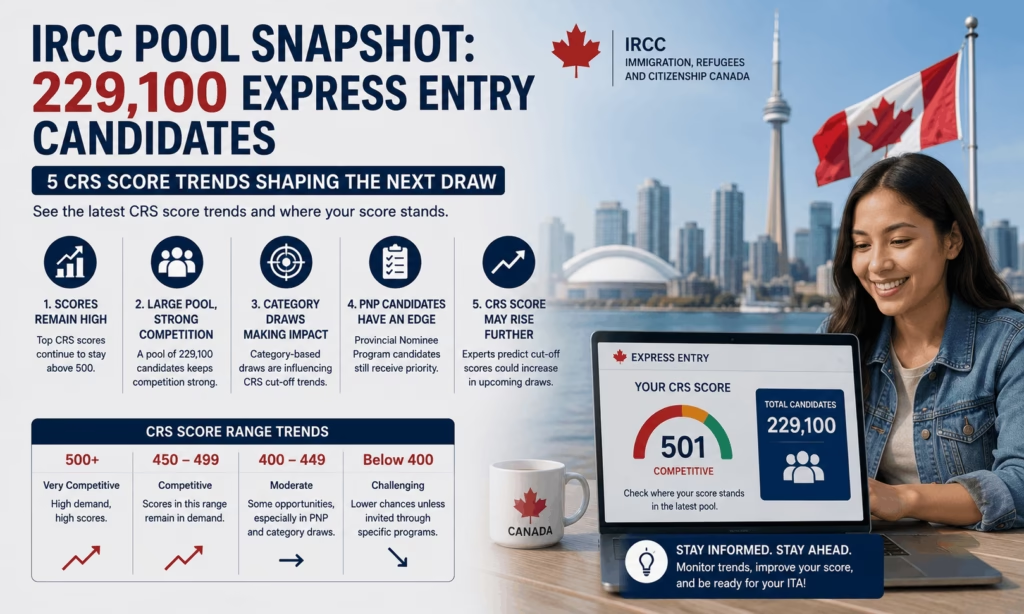
CRS Score Distribution 2026: Canada’s Express Entry pool sat at 229,100 candidates as of August 3, 2026, and buried inside that single number is a pattern that matters more than the headline count itself. Immigration, Refugees and Citizenship Canada released its newest CRS score distribution one day before the August 4 Provincial Nominee Program draw, and the breakdown shows the pool shrinking overall while the band that actually decides Canadian Experience Class invitations, scores between 501 and 600, kept growing. That single detail changes what candidates should expect from the next Express Entry draw far more than the total pool figure does. We’ll be updating this article monthly as IRCC releases new CRS score distribution data.
For anyone sitting in the Express Entry pool right now, this is the difference between hoping the cutoff drops and knowing why it probably will not. The 501 to 600 CRS score range added 1,572 candidates in the two weeks between July 19 and August 3, even as Canadian Experience Class draws pulled thousands of invitations directly from that same range. This article walks through what the newest CRS score distribution actually shows, the five trends hiding inside five months of IRCC snapshots, and what each score band should realistically expect from the next Express Entry draw.
What The Newest CRS Score Distribution Actually Shows
IRCC does not just publish a pool total. It breaks the Express Entry pool into CRS score bands, and that breakdown is where the real signal is. As of the August 3, 2026 snapshot, here is how candidates were distributed:
| CRS Score Range | Candidates (Aug 3, 2026) | Share of Pool |
|---|---|---|
| 601 and above | 500 | 0.2% |
| 501 to 600 | 19,705 | 8.6% |
| 451 to 500 | 73,099 | 31.9% |
| 401 to 450 | 60,905 | 26.6% |
| 351 to 400 | 50,107 | 21.9% |
| 301 to 350 | 17,101 | 7.5% |
| Below 300 | 7,683 | 3.4% |
Two bands alone, 401 to 450 and 451 to 500, hold more than 58 percent of every candidate currently in the pool. That concentration is the reason cutoffs in the 400s and low 500s move the way they do. There is a massive wall of candidates sitting just below the current Canadian Experience Class threshold, and every time a handful of them cross into the 500s, someone else from the 401 to 450 band moves up to take their place.
Trend 1: The Top Of The Pool Refills Faster Than Draws Can Empty It
This is the trend that explains almost everything else. Looking across five IRCC snapshots from late March through early August, the 501 to 600 CRS band grew from 11,648 candidates to 19,705, an increase of roughly 8,000 profiles in about four months. That happened while IRCC ran seven separate Canadian Experience Class draws in the same window, issuing more than 17,000 invitations that came directly out of that score range.
In plain terms, candidates are entering or climbing into the 500s faster than draws can remove them. Some are brand-new profiles from candidates with strong language scores and recent Canadian work experience. Others are existing candidates in the 451 to 500 range who retook IELTS or CELPIP, added another year of Canadian employment, or finished an educational credential assessment that boosted their score past 500. A smaller share are candidates who declined a previous invitation, or whose earlier invitation expired or application was refused, and who came back into the pool with a fresh profile.
The result is a top tier that behaves almost like a conveyor belt. Invitations go out, and the band fills right back up within days. That is a major reason the Canadian Experience Class cutoff has stayed locked between 514 and 518 since April 2026, regardless of whether a given draw issues 2,000 or 3,000 invitations.
2027 Social Security COLA Estimate Falls to 3.4%: How Much Could Your Check Increase?
Trend 2: The Middle Of The Pool Is Nearly Frozen
The 451 to 500 range is the largest single bracket in Express Entry, and it has barely moved all year. Across the same five-month stretch, this band stayed within a tight window of roughly 72,500 to 73,700 candidates. New candidates keep entering at this level almost exactly as fast as existing candidates leave it, whether by improving their score, receiving an invitation from a category-based draw, or letting their profile expire after twelve months.
That stability is not good news for candidates hoping the CEC cutoff eventually drops into their range. A band this large and this stable behaves like a reservoir. Every time a small opening appears near the top, it gets filled from below almost immediately, which keeps upward pressure on the cutoff rather than downward.
Trend 3: The Lower Bands Are Quietly Shrinking
While the 500-plus range has been climbing, the 401 to 450 band has been doing the opposite. It peaked near 66,500 candidates in late April and has fallen to roughly 60,900 by early August, a drop of nearly 4,000 profiles. The bands below 350 have thinned out as well, together losing more than 2,500 candidates over the same period.
Profile expirations explain part of this. Every Express Entry profile is only valid for twelve months, and candidates who never receive an invitation and never update their score simply age out of the pool. The rest of the decline comes from candidates actively improving their standing, whether through a new language test, additional work experience, or a provincial nomination, and moving up into a higher band rather than sitting still.
Trend 4: Provincial Draws Are Clearing The Top Of The Pool Almost Completely
The 601-plus CRS range, the smallest and most exclusive bracket in Express Entry, held just 500 candidates as of August 3, down slightly from 511 two weeks earlier. The August 4 Provincial Nominee Program draw issued 507 invitations at a cutoff of 768, which effectively cleared nearly the entire bracket in a single round. The same thing happened in the prior PNP draw in July, when the invitation count almost exactly matched the number of candidates sitting above 600.
This is a strong signal that IRCC is running these provincial rounds as near-total clearance events rather than partial draws. For candidates who already hold a provincial nomination, the message is straightforward: nominations worth 600 CRS points are close to a guaranteed invitation in the very next PNP round. For everyone else, the size of future PNP draws depends heavily on how many new nominations provinces feed into the system. Ontario reopened its Workforce Priority stream for expressions of interest in early August, and Alberta, British Columbia, and Manitoba have all continued issuing provincial nominations through the summer, which should keep this bracket moving.
EB-1 India Visa Bulletin Warning: Category Could Go Unavailable Within Weeks, State Department Says
Canada 50% Tariff 2026: Full List of Products That Could See Price Hikes
Trend 5: French Language And Category Draws Are Becoming The Real Alternate Route
For candidates sitting well below the Canadian Experience Class cutoff, category-based selection has quietly become the more realistic path to an invitation. The most recent French-language proficiency draw issued 5,000 invitations at a CRS cutoff of 391, the lowest French-language cutoff recorded so far this year. Across every French-language draw held in 2026, cutoffs have ranged between roughly 391 and 420, well below what a general or CEC round typically requires.
That gap matters enormously for the 50,000-plus candidates sitting in the 351 to 400 range and the roughly 61,000 in the 401 to 450 range. A French test result at NCLC 7 or higher, paired with an otherwise average profile, can realistically produce an invitation at a score more than 100 points below the current CEC threshold. IRCC has also opened public consultations on possible new Express Entry categories for 2027, with submissions accepted through early September, signalling that category-based selection is likely to expand rather than shrink in the coming year.
What This Means For The Next Express Entry Draw
Putting these five trends together, candidates should calibrate their expectations by score range rather than hoping for a single universal cutoff drop.
Candidates scoring 515 or higher are in reasonable position for the next Canadian Experience Class round and should focus on keeping their profile accurate, since even small delays in updating work experience or language results can cost an invitation.
Candidates in the 490 to 514 range sit closest to the action. Given how consistently the CEC cutoff has held between 514 and 518, a single language retest that adds even 15 to 20 points can be the difference between watching from the sidelines and receiving an invitation in the next round.
Candidates below 490 should treat a general cutoff drop as unlikely in the near term. The data across five snapshots simply does not support it. A provincial nomination, a French-language test, or eligibility under one of the active occupation-based categories remains the more dependable route for this group.
Key Dates And Numbers From The Latest Cycle
| Date | Detail |
|---|---|
| July 19, 2026 | Pool snapshot recorded 231,533 candidates |
| August 3, 2026 | Pool snapshot recorded 229,100 candidates |
| August 4, 2026 | PNP draw issues 507 invitations at CRS 768 |
| August 5, 2026 | CEC draw issues 3,000 invitations at CRS 516 |
| August 6, 2026 | French-language draw issues 5,000 invitations at CRS 391 |
| Year to date (2026) | More than 113,000 invitations issued across 45+ draws |
How To Check Your CRS Score And Apply
| Resource | Purpose | Official Link |
|---|---|---|
| Express Entry CRS criteria tool | Calculate your Comprehensive Ranking System score | canada.ca Express Entry CRS grid |
| Come to Canada tool | Check eligibility for Express Entry programs | canada.ca Come to Canada eligibility tool |
| Create or sign in to an Express Entry profile | Submit or manage your profile | canada.ca Express Entry submit profile |
| Rounds of invitations page | See every draw result, date, and cutoff | canada.ca Express Entry rounds of invitations |
| GCKey or Sign-In Partner | Secure login for your IRCC account | canada.ca GCKey sign-in |
| Educational credential assessment list | Find approved organizations for ECA | canada.ca designated ECA organizations |
| Provincial Nominee Program overview | Check nomination streams by province | canada.ca provincial nominees |
SNAP Enrollment Drop 2026: Why 5 Million People Lost Benefits?
FAQs About CRS Score Distribution 2026
What is a good CRS score for Express Entry right now?
A CRS score of 515 or higher currently gives a realistic chance in a Canadian Experience Class draw. A score above 390 can work in French-language draws, and a provincial nomination adds 600 points, which makes almost any base score competitive.
Why did the Express Entry pool shrink while the CRS distribution grew in the higher bands?
The overall pool fell because profile expirations and invitations removed more candidates from the lower and middle bands than new entrants replaced. At the same time, the 501 to 600 band grew because new high-scoring profiles and score improvements outpaced the invitations being issued from that range.
Will the CEC cutoff drop below 500 in 2026?
Current pool data does not support that. The 501 to 600 band has expanded steadily even through multiple CEC draws, which keeps the cutoff anchored in the mid 500s rather than falling.
How often does IRCC hold Express Entry draws?
IRCC has generally run draws in clusters roughly every two weeks throughout 2026, often combining a Provincial Nominee Program round, a Canadian Experience Class round, and a category-based round within the same week.
Does a provincial nomination guarantee an invitation?
A provincial nomination adds 600 CRS points, which places a candidate at or near the top of the pool. Recent PNP draws have issued invitation counts that closely match the number of candidates above 600, so a nomination comes very close to a guaranteed invitation in the following round.
What can I do if my CRS score is below 450?
Focus on the levers that move the score the most: retaking IELTS or CELPIP for higher language bands, gaining additional Canadian work experience, completing an educational credential assessment, applying to provincial nominee streams, or testing for French-language proficiency to qualify for category-based draws with lower cutoffs.
Conclusion
The headline pool number tells only part of the story. What actually predicts where the next Express Entry cutoff will land is how candidates are distributed across CRS score bands and how quickly each band refills after a draw. Right now, that data points to a top tier that keeps replenishing itself, a dense middle band that barely moves, and a growing gap between general draws and the more accessible French-language and category-based routes. Candidates who track their own score against these bands, rather than against the total pool size, will have a much clearer read on when their invitation is likely to arrive.
IRS Notice 2026-28: New Paid Family Leave Employer Credit Rules