New York Relief Programs 2026: New York homeowners in roughly a third of the state are still waiting on a STAR check that has already reached their neighbors two counties over, and that gap is not a mistake. The New York State Department of Taxation and Finance confirmed this month that phase two of the 2026 STAR benefit season, covering homeowners whose school tax bills come due in August and September, is now moving through the system, while phase one recipients in New York City, Buffalo, Rochester, and Syracuse received their money weeks ago. At the same time, the state has locked in a separate change that has not gotten nearly as much attention: starting with the tax year 2026 return that families file in early 2027, the Empire State Child Credit for children ages four through 16 rises again, from $330 to $500 per child, on top of the $1,000 per child under age four that already applies. We will be updating this article monthly as new STAR delivery waves and Empire State Child Credit filing guidance are confirmed.
Homeowners and parents are effectively tracking two different clocks right now, one tied to a rolling payment schedule and one tied to a future tax filing season. The STAR credit does not arrive on a single statewide date, it follows each school district’s own tax due date, so a homeowner in Nassau County and a homeowner in the city of Rochester are on completely different timelines even though both are collecting the same benefit. The Empire State Child Credit, on the other hand, is not a check the state mails out on its own, it only pays out when a family actually files a New York State income tax return and claims it on Form IT-213. Missing either window, a STAR registration deadline on one side or an April tax filing deadline on the other, means missing money that is otherwise sitting there for the taking. This guide focuses on what has changed in the last few weeks, exactly when payments land based on where you live, how much processing actually takes once you apply, and what step-by-step action gets your money moving if nothing has shown up yet.
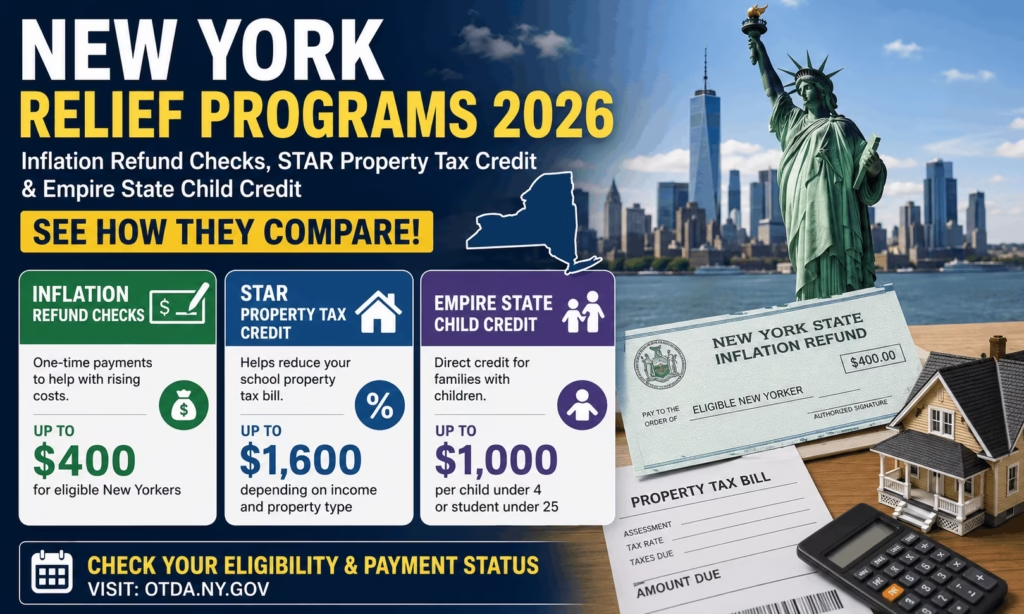
Quick Comparison: How the Three New York Relief Programs Differ
New York’s STAR credit, Empire State Child Credit, and 2025 inflation refund check are frequently lumped together because all three put cash back into resident households, but they run on separate legal authority, separate agencies, and separate timelines. The table below strips out the overlap so you are not reading the same eligibility rules three times.
| Program | Administered By | Action Needed | Current Status (August 2026) |
|---|---|---|---|
| STAR Credit | NYS Department of Taxation and Finance | One time registration through the Homeowner Benefit Portal, then automatic each year | Actively paying out, phase two underway |
| Empire State Child Credit | NYS Department of Taxation and Finance, with outreach support from OTDA | File Form IT-213 with your state income tax return every year | Tax year 2025 filing season closed April 15, tax year 2026 amount already confirmed higher |
| Inflation Refund Check | NYS Department of Taxation and Finance | None, payment was automatic based on 2023 tax return | Program concluded, only replacement and reissue requests remain active |
STAR Credit Payment Schedule: Where Your Check Stands Right Now
New York does not run STAR on a single mailing day. Instead, the Tax Department releases payments in waves tied to each municipality’s school tax due date, and homeowners in earlier-due districts are paid first. Governor Kathy Hochul’s office confirmed that the state began mailing this year’s STAR checks on June 16, 2026, targeting homeowners in New York City, Buffalo, Rochester, and Syracuse, where school taxes come due in late June and July. As of early August, the department confirmed that phase two, covering districts with August and September due dates, is actively being processed.
| STAR Phase | School Tax Due Date Window | Typical Mailing Window | Areas Affected |
|---|---|---|---|
| Phase One | Late June to July | Mid-June through July | New York City, Buffalo, Rochester, Syracuse |
| Phase Two | August to September | Late July through mid-September | Most upstate and suburban districts, including much of the Capital Region |
| Phase Three | October to January | September through December | Nassau County (first-half bills due October 1), other later-due districts |
| Long Island, Suffolk | January | Issued in December | Suffolk districts with January 10 first-half bills |
The overall 2026 STAR season runs from June through November statewide, though Long Island’s Suffolk County districts, which bill on a different cycle, typically see checks issued as late as December. If your school district has not yet reached its tax due date, your STAR payment has not been “missed,” it simply has not been scheduled yet. Once a payment is scheduled, most homeowners can expect delivery within five to ten business days, and direct deposit typically lands about two days faster than a mailed check.
2027 HSA Contribution Limits Announced: IRS Confirms $4,500 and $9,000 Caps
$450K Student Debt Relief: Here Are The Restrictions Behind The Sweet v. McMahon Settlement
Oregon Kicker Tax Credit 2026: How To Claim Your Share Of The $1.41 Billion Surplus
How Much the STAR Credit Is Worth in 2026
The dollar amount depends on whether you receive Basic or Enhanced STAR, which is determined by age and household income, not by where you live.
| STAR Tier | Who Qualifies | 2026 Income Limit | Typical 2026 Payment |
|---|---|---|---|
| Basic STAR | Any age, primary residence owner | Combined household income $500,000 or less | $350 to $600 |
| Enhanced STAR | Age 65 or older by end of the benefit year, primary residence owner | Combined household income $110,750 or less for 2026 | $700 to $1,500 |
The state has already locked in next year’s Enhanced STAR income threshold. For the 2027 benefit year, Enhanced STAR eligibility will require resident owner income of $113,550 or less, a modest increase that reflects the annual cost of living adjustment applied to the program. Homeowners nearing the current $110,750 cutoff who narrowly miss Enhanced STAR this year should recheck their eligibility once 2027 applications open, since the higher threshold may bring them in.
Your exact payment amount is not a flat statewide number, it is calculated using your school district’s tax rate and the STAR exemption base amount for your area, which is $30,000 for Basic STAR and $88,500 for Enhanced STAR for the 2026-2027 school year. Homeowners who want their specific district and municipality figure, rather than the statewide range, can look it up directly on the Tax Department’s STAR comparison tool.
How to Apply for the STAR Credit
Unlike the inflation refund check, STAR is not automatic the first time. You have to register once, and then the state carries your enrollment forward every year as long as you remain eligible.
- Confirm the property is your primary residence and that you are the owner of record.
- Go to the Homeowner Benefit Portal through your Individual Online Services account at tax.ny.gov.
- Register for the STAR credit, providing the names and Social Security numbers of all owners and their spouses.
- Choose direct deposit if you want faster payment, and enroll at least seven to fifteen business days before your school tax due date to guarantee that option this cycle.
- Watch for confirmation, and use the STAR Credit Delivery Schedule lookup tool to see your area’s projected payment window once registration is processed.
There is no annual deadline to register for the first time, you can sign up at any point during the year, but registering close to or after your district’s tax due date usually pushes your first payment to the following year’s cycle instead of the current one. Homeowners who switched homes, refinanced, or turned 65 since their last STAR update should also revisit their registration, since none of those changes update automatically.
Empire State Child Credit: What Changes for the 2026 Tax Year
Families claiming the credit on the return they just filed by April 15, 2026 for tax year 2025 received up to $1,000 per qualifying child under age four and up to $330 per child ages four through 16. That part is already settled and paid out. What is new, and not yet widely reported, is the amount locked in for the next filing cycle.
| Tax Year | Return Filed | Credit for Child Under Age 4 | Credit for Child Ages 4 to 16 |
|---|---|---|---|
| 2025 | 2026 | $1,000 | $330 |
| 2026 | 2027 | $1,000 | $500 |
| 2027 | 2028 | $1,000 | $500 |
The credit phases out gradually rather than cutting off at a hard line. For every $1,000 that your federal adjusted gross income exceeds your filing status threshold, the credit is reduced by $16.50 per qualifying child.
| Filing Status | Phase-Out Begins At |
|---|---|
| Married filing jointly | $110,000 |
| Single, head of household, or qualifying surviving spouse | $75,000 |
| Married filing separately | $55,000 |
A change that already took effect and is worth restating clearly: New York removed its old minimum income requirement, sometimes called the credit phase-in, that used to reduce how much the poorest families could claim. That barrier is gone, which means a household with no earned income at all can still receive the full per-child amount as a refund rather than a partial one.
California Climate Credit 2026: Payment Timing Just Changed, Here Is What to Expect on Your Bill
$1250 New Jersey Child Tax Credit: State Budget Delivers 25% Boost for Families With Young Children
H-1B Fraud Investigation Texas: Paxton Targets Nearly 30 Ghost Office Firms
How to Apply for the Empire State Child Credit
- File a full New York State income tax return, even if you have no income or owe no tax, since the credit is not issued outside of a filed return.
- Attach Form IT-213, Claim for Empire State Child Credit, to your state return.
- Provide a valid Social Security number or Individual Taxpayer Identification Number for yourself and for every child you are claiming.
- Confirm the child was under 17 as of December 31 of the tax year and lived with you as a full-year New York resident.
- File by April 15. If you need more time, submit Form IT-370 before that date to push your deadline to October 15.
Families earning under roughly $69,000, or under $39,000 without dependents, can get this filing done at no cost through free VITA and CASH program sites run in partnership with the Office of Temporary and Disability Assistance, rather than paying a preparer to claim a credit the state designed to be free to access.
Processing Time: What to Expect After You Apply
Processing time differs sharply depending on which of the three programs you are dealing with, and confusing one for another is the most common reason people think their payment is “late” when it is actually on schedule.
For STAR, once your school district’s tax roll is filed with the state, the law sets specific interest triggers rather than fixed delivery dates. If your district’s roll was filed by July 1, the state must issue your credit by July 31 or add interest automatically. If filed by September 1, the deadline shifts to September 30. If filed after September 1, the state has 30 days from the filing date. This only applies if you registered on or before July 1 of that year, so late registrants are not covered by the interest guarantee.
For the Empire State Child Credit, processing follows the same track as your overall state tax refund. Electronically filed returns with direct deposit typically process fastest, while paper returns or those flagged for identity verification take longer. You can track a specific refund using the state’s online refund status tool rather than guessing based on when you filed.
For the inflation refund check, the payout window itself has closed. The state’s large-scale mailing finished in November 2025, though small numbers of late payments continued into early 2026 as additional eligible taxpayers were identified. If you qualified based on your 2023 return and never received a check, the remaining process is a replacement request, not a new application.
Inflation Refund Check: Final Numbers and What To Do if Yours Never Arrived
The inflation refund program has fully wound down, but the exact income brackets are worth having in one place since several outlets have simplified them down to just two numbers.
| Filing Status | 2023 NY Adjusted Gross Income | Refund Amount |
|---|---|---|
| Single | $75,000 or less | $200 |
| Single | More than $75,000, up to $150,000 | $150 |
| Married filing jointly | $150,000 or less | $400 |
| Married filing jointly | More than $150,000, up to $300,000 | $300 |
| Married filing separately | $75,000 or less | $200 |
| Married filing separately | More than $75,000, up to $150,000 | $150 |
| Head of household | $75,000 or less | $200 |
| Head of household | More than $75,000, up to $150,000 | $150 |
Statewide, 8.21 million New Yorkers received a combined 2.035 billion dollars, with New York City households alone accounting for roughly 3.5 million of those checks and 828.8 million dollars in total value.
If your check never showed up, was destroyed, or was lost in the mail, the fix is a direct call, not a web form: contact the Personal Income Tax Information Center at 518-457-5181 with a copy of your 2023 return in hand. If the state already has your case on file, you should have received Forms DTF-32 and DTF-36 in the mail. Complete and return both by the response deadline printed on the forms to get a replacement issued. If you still physically have the check but never cashed it, cash it now rather than requesting a replacement, since a duplicate payment is not issued for an outstanding uncashed check.
How the Three Programs Can Stack for One Household
A New York family that owns a home, has two children under 16, and filed a 2023 state return could have legitimately touched all three programs, just never as a single combined deposit. The inflation refund, if they qualified, already arrived last fall. Their STAR credit is arriving now or will arrive later this year, timed to their specific school district. Their Empire State Child Credit showed up as part of their state refund after they filed by April 15, and it will show up again, at a higher amount for school-age children, when they file their 2026 return in the first months of 2027. None of the three programs affects eligibility for the others, and a delay in one, such as a STAR check held up by a late-filed school tax roll, has no bearing on whether the Empire State Child Credit portion of a refund processes on time.
Official New York Resources
| Resource | What It’s For | Official Link |
|---|---|---|
| Homeowner Benefit Portal | STAR registration, direct deposit enrollment, status checks | tax.ny.gov/star |
| STAR Credit Delivery Schedule | Look up your area’s projected STAR payment window | www8.tax.ny.gov/SCDS/scdsGateway |
| Property Tax Credit Lookup | Confirm whether your STAR credit has already been issued | tax.ny.gov/pit/property |
| STAR Comparison Tool | Find your exact district and municipality STAR amount | tax.ny.gov/pit/property/star/comparison |
| Empire State Child Credit Filing | Form IT-213 instructions and eligibility | tax.ny.gov/pit/credits/empire_state_child_credit.htm |
| NYS Income Tax Refund Status | Track your state refund, including the child credit portion | tax.ny.gov/pit/file/refund.htm |
| Inflation Refund Replacement Check | Request a reissue for a lost, stolen, or destroyed check | tax.ny.gov/pit/file/replacement-check.htm |
| Personal Income Tax Information Center | Phone support for refund and check issues | 518-457-5181 |
FAQs About New York STAR Credit and Empire State Child Credit 2026
When will my STAR check arrive if I live in a district with a September tax due date?
Your credit should arrive before your school tax due date, generally within the phase two window that runs from late July through mid-September, and the state must issue it by September 30 or add interest automatically if your district’s roll was filed by September 1.
Do I need to reapply for STAR every year?
No. You register once through the Homeowner Benefit Portal, and the state renews your STAR credit automatically each year as long as you still own and live in the property as your primary residence.
How much more will the Empire State Child Credit be worth next year?
For the tax year 2026 return filed in 2027, the credit for children ages four through 16 rises from $330 to $500 per child, while the credit for children under four stays at $1,000.
Can I still get an inflation refund check if I never received one?
Only if you were already eligible based on your 2023 tax return and the check was lost, stolen, or destroyed. There is no new application window for households that did not previously qualify.
What is the difference between the STAR credit and the STAR exemption?
The STAR credit is a check or direct deposit sent directly to you, while the STAR exemption is an older version of the benefit that reduces your school tax bill directly on the bill itself, generally only available to homeowners who enrolled before the credit version became standard.
Is there a minimum income needed to get the Empire State Child Credit?
No. New York eliminated its minimum income requirement, so families with no income or income under $4,000 can still receive the full credit amount as a refund by filing a return.
Does the STAR credit affect my Empire State Child Credit or other benefits?
No. STAR is tied to homeownership and is administered separately from the Empire State Child Credit, and neither program affects eligibility for Medicaid, SNAP, SSI, cash assistance, or housing assistance.
How long does it take to get my Empire State Child Credit after filing?
Processing follows the same timeline as your general state income tax refund, typically faster for electronically filed returns with direct deposit, and you can track the exact status using the state’s online refund tool.
Why did my STAR payment amount change from last year?
STAR credit amounts can rise by as much as 2 percent annually based on your school district’s tax rate and assessment changes, while STAR exemption savings are capped at the prior year’s amount and cannot increase the same way.
Conclusion
New York’s STAR credit is moving through its second payment phase this month, with homeowners in August and September due-date districts now seeing checks and direct deposits land, while Nassau and Suffolk County residents still have months to wait under the normal schedule. The Empire State Child Credit has already delivered its expanded 2025 tax year amounts to families who filed by April, and the state has now confirmed the next increase, pushing the school-age child amount from $330 to $500 starting with returns filed in 2027. The 2025 inflation refund check, by contrast, is a closed chapter, with the only remaining action available being a replacement request for checks that never arrived. Treating these as three separate systems, each with its own registration step, filing deadline, or reissue process, remains the only way to make sure a New York household collects everything it is actually owed. This article will be updated monthly as new STAR payment phases move forward and as the state releases further Empire State Child Credit filing guidance.
Empire State Child Credit 2026: $1,000 Per Child Under 4, Full Eligibility & Payment Guide