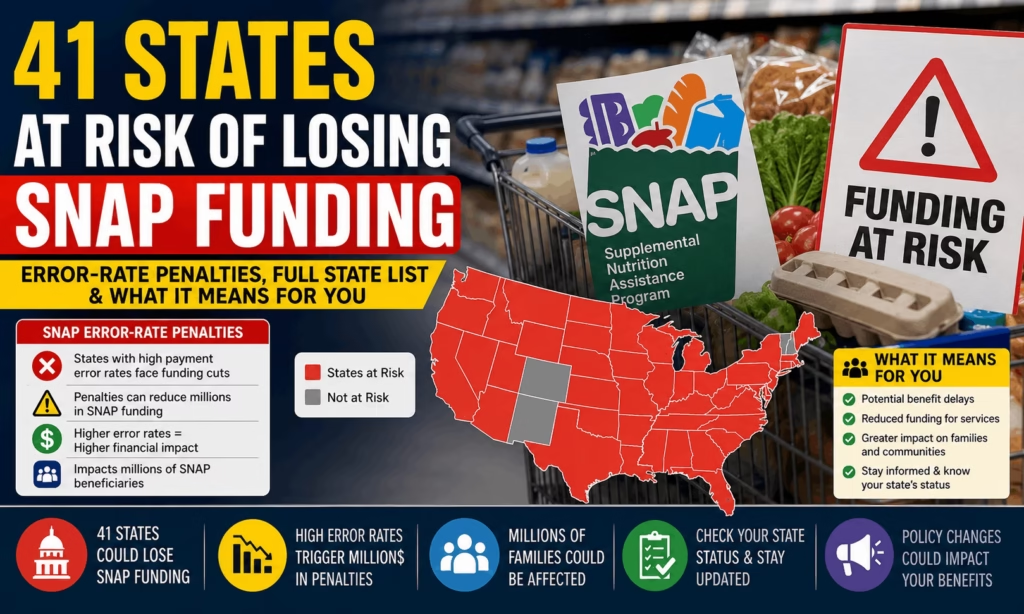
SNAP Funding Risk 2028: The SNAP funding risk facing states just became very real. On June 24, 2026, USDA released official fiscal year 2025 payment error rates, confirming that 41 states now face partial federal funding cuts for SNAP (Supplemental Nutrition Assistance Program) starting in fiscal year 2028, because their error rates exceed the 6% benchmark set under the One Big Beautiful Bill Act (OBBBA). Only nine states Idaho, Iowa, Kentucky, Nebraska, South Dakota, Utah, Vermont, Wisconsin, and Wyoming came in under 6% and will continue receiving fully federally funded SNAP benefits with no cost-sharing obligation. The national average error rate for FY2025 was 10.62%, only slightly improved from 10.9% in FY2024, meaning the vast majority of states remain far from the target. We’ll be updating this article monthly as USDA releases further guidance and as states respond to their Corrective Action Plan requirements.
This is not a cut to individual SNAP recipients’ monthly benefits it’s a cost-sharing requirement placed on state governments, who will need to cover between 5% and 15% of their SNAP benefit costs depending on how far above 6% their error rate falls, once cost-sharing begins in October 2027. Combined with a separate increase in states’ share of administrative costs, the total financial shift adds up to roughly $12.4 billion a year nationwide. This guide breaks down exactly what the error rate measures, which states are at the highest risk, the full penalty tier structure, and most importantly what this actually means (and doesn’t mean) for the roughly 40 million Americans who rely on SNAP.
What Is the SNAP Error-Rate Funding Risk?
The SNAP payment error rate, officially called the Payment Error Rate (PER), measures the percentage of SNAP benefit dollars issued incorrectly either as overpayments (a household received more than it was entitled to) or underpayments (a household received less). USDA’s Food and Nutrition Service (FNS) calculates this annually through a Quality Control (QC) review process that samples case files nationwide.
Importantly:
- A high error rate does not mean fraud. The PER captures administrative and reporting mistakes — such as income miscalculations, outdated household information, or documentation errors — not intentional misuse of benefits.
- Overpayments are far more common than underpayments in nearly every state.
- The 6% benchmark is the new compliance line established by OBBBA — states below it face no cost-sharing obligation; states at or above it move into a tiered penalty structure.
Why Are States at Risk of Losing Federal SNAP Funding?
Historically, SNAP benefits were 100% federally funded, with states only sharing in administrative costs. That changes under the One Big Beautiful Bill Act (OBBBA), signed into law in July 2025, which introduced a new cost-sharing requirement tied directly to each state’s payment accuracy:
- New federal funding rule: States with a PER at or above 6% must begin paying a percentage of their own SNAP benefit costs.
- Fiscal Year 2028 implementation: The requirement takes effect with FY2028 SNAP spending.
- October 2027 starting date: This is when the cost-sharing obligation actually begins, since FY2028 for federal budgeting starts October 1, 2027.
- Purpose: Congress designed the policy to push states toward greater payment accuracy and reduce the roughly $10.1 billion in nationwide improper payments recorded in FY2025.
- Which year’s data counts: States can choose to use either their FY2025 or FY2026 error rate to determine their FY2028 cost-sharing tier — giving states one more year to potentially improve their standing.
What Happens If a State Exceeds the 6% Error Rate?
States at or above 6% face several consequences, not just a straightforward invoice:
- Partial federal funding reduction — the state must now fund a percentage of its own SNAP benefit costs (previously fully federally funded).
- Corrective Action Plan (CAP) requirement — any state at or above 6% must file a formal plan with USDA explaining how it will address root causes of errors, generally due within 60 days of the official rate release.
- Increased compliance reviews — USDA will scrutinize higher-error states more closely going forward.
- Administrative reforms — states are incentivized to invest in staff training, verification technology, and process improvements to lower future error rates.
- Higher state budget burden — for large-caseload states like California, New York, Florida, and Texas, the dollar amounts involved are substantial regardless of their exact error-rate tier, simply due to program size.
SNAP Funding Penalty Timeline
| Milestone | Date |
|---|---|
| OBBBA signed into law | July 2025 |
| FY2025 error rates released (first year that counts) | June 24, 2026 |
| States may substitute FY2026 error rate instead | Data expected mid-2027 |
| Cost-sharing requirement begins | October 1, 2027 (start of FY2028) |
| “Alaska carveout” delay for highest-error states (FY2025 basis) | Exempt until FY2029 |
| “Alaska carveout” delay for highest-error states (FY2026 basis) | Exempt until FY2030 |
| Future annual reassessments | Ongoing, tied to each year’s PER |
State-by-State SNAP Funding Risk List
States Currently at Risk (41 States + D.C.)
Forty-one states, plus the District of Columbia, recorded FY2025 payment error rates at or above the 6% threshold, putting them on track for some level of cost-sharing obligation starting FY2028. Being “at risk” does not mean penalties are automatic and irreversible — states have the option to substitute a lower FY2026 error rate if they improve before the deadline, and all at-risk states must file Corrective Action Plans addressing the root causes of their errors.
States That Meet the 6% Benchmark (9 States)
Only nine states cleared the FY2025 accuracy target and will owe no cost-sharing contribution when the requirement begins:
| State | Notable Detail |
|---|---|
| South Dakota | Lowest error rate nationally, roughly 2.5% |
| Nebraska | Cleared the cutoff narrowly, at 5.9% |
| Idaho | Consistently one of the most accurate SNAP administrations |
| Iowa | Improved into compliance for FY2025 |
| Kentucky | Newly compliant for FY2025 |
| Utah | Below-benchmark accuracy maintained |
| Vermont | Below-benchmark accuracy maintained |
| Wisconsin | Below-benchmark accuracy maintained |
| Wyoming | Below-benchmark accuracy maintained |
Which States Face the Highest Financial Risk?
Financial exposure depends on two separate factors: a state’s error-rate tier (which sets the percentage it owes) and its total SNAP caseload size (which determines the dollar amount that percentage represents). Historically, the states with the highest payment error rates have included Alaska, the District of Columbia, Georgia, Florida, New Jersey, Massachusetts, Maryland, and New Mexico — several of which recorded error rates above 13%, and Alaska has recorded rates in the 20%+ range in recent years. Because of a provision known informally as the “Alaska carveout,” states with an error rate above 13.34% in FY2025 receive a two-year delay, becoming exempt from cost-sharing until FY2029 (or FY2030 if using an above-threshold FY2026 rate instead).
Separately, because the penalty is a percentage of total benefits issued, the largest-caseload states carry the largest absolute dollar exposure regardless of their specific tier. California alone is estimated to represent close to $1.9 billion of the total benefit base subject to cost-sharing calculations, with New York, Florida, Texas, Pennsylvania, and Massachusetts also representing especially large shares.
How Much Could States Pay?
The OBBBA cost-sharing structure uses three penalty tiers based on a state’s qualifying error rate:
| Error Rate Range | State Cost-Share Owed |
|---|---|
| Below 6% | 0% — no cost-sharing obligation |
| 6% to under 8% | 5% of SNAP benefit costs |
| 8% to under 10% | 10% of SNAP benefit costs |
| 10% and above | 15% of SNAP benefit costs |
| Above 13.34% (FY2025 or FY2026 basis) | Temporary exemption (“Alaska carveout”) until FY2029 or FY2030 |
Example: Nevada’s FY2025 error rate came in at 6.2% — just above the 6% line — meaning it falls into the 5% cost-share tier once the requirement begins. A state with a 9% error rate would owe 10%, while a state at 12% would owe the maximum 15%, unless it also qualifies for the high-error delay.
Will SNAP Benefits Be Reduced for Families?
This is the most important clarification for current recipients: the cost-sharing requirement does not directly cut individual SNAP benefits. The penalty applies to state governments, not to the benefit amount a household receives. Current SNAP recipients continue receiving their normal monthly benefit unless a separate, unrelated eligibility change affects their case.
That said, the policy carries indirect risk: because states must now find new funding to cover their share of benefit costs, the Congressional Budget Office estimates the resulting budget pressure could lead some states to tighten eligibility rules or reduce program scope, potentially affecting around 300,000 SNAP recipients and reducing child nutrition program subsidies for an estimated 96,000 children — not through a direct federal cut, but through state-level budget decisions made in response to the new cost burden.
Could States Change SNAP Rules to Avoid Penalties?
Yes — this is precisely what the Corrective Action Plan requirement is designed to encourage. States can work to lower their error rate through:
- Better income and eligibility verification at application and recertification
- Additional staff training on case processing and documentation
- Technology upgrades, including automated data matching
- More frequent eligibility reviews to catch outdated household information sooner
- Payment accuracy audits targeting the most common error sources
Why Do SNAP Payment Errors Happen?
Payment errors are overwhelmingly administrative rather than fraudulent, and commonly stem from:
- Income reporting changes that aren’t reflected quickly enough in a household’s case file
- Household composition changes — someone moving in or out, a change in dependents
- Documentation mistakes made during application processing
- Administrative processing delays, especially during periods of high caseload volume
- Eligibility calculation errors, including deduction miscalculations
Difference Between Payment Error and Fraud
| Payment Error | Fraud |
|---|---|
| Unintentional mistake in calculating benefits | Intentional misrepresentation to gain benefits |
| Can result from state administrative error OR unreported household changes | Involves deliberate deception by an applicant or recipient |
| Measured through USDA’s Quality Control review process | Investigated and prosecuted separately under program integrity rules |
| Includes both overpayments and underpayments | Almost always involves overpayment or misuse |
| Does not carry legal penalties for the recipient | Can result in disqualification, repayment, or criminal charges |
What Should SNAP Recipients Do?
To help reduce errors on their own case (and avoid overpayment repayment issues), recipients should:
- Report income changes promptly to their state SNAP agency
- Report address changes as soon as they occur
- Update household members whenever someone joins or leaves the household
- Submit required documents on time during reviews or verification requests
- Complete recertification by the deadline to avoid processing gaps or errors
How Can States Lower Their Error Rate?
Beyond the Corrective Action Plan basics, states pursuing lower error rates are increasingly investing in:
- AI-assisted fraud and error detection tools
- Improved cross-agency data matching (e.g., verifying income against wage databases)
- Faster case review turnaround to catch errors before they compound
- Digital documentation systems that reduce manual processing mistakes
- Additional staff training focused specifically on the most common error categories in that state
Could More States Avoid Penalties Before 2028?
Yes — this is one of the more important nuances of the policy. Since states may use either their FY2025 or FY2026 error rate to determine their FY2028 cost-share tier, a state that significantly improves its accuracy in FY2026 could still qualify for a lower tier (or even full exemption) even if its FY2025 rate was well above 6%. USDA’s annual measurement cycle means every state gets at least one more full year to improve before the October 2027 start date locks in.
Does This Affect Monthly SNAP Payments?
No — not directly, and not right now. Current SNAP payments to households remain unchanged by this policy. The cost-sharing requirement affects state funding obligations, not the benefit calculation formula used for individual households. Any future changes to actual benefit amounts would require separate state or federal policy action, distinct from the error-rate cost-sharing rule itself.
Official Resources
| Official USDA SNAP Program Page: | https://www.fns.usda.gov/snap |
| USDA SNAP State Error Rate Data & Quality Control Reports: | https://www.fns.usda.gov/snap/qc |
| State SNAP Agency Directory (to check your state’s specific status): | https://www.fns.usda.gov/snap/state-directory |
| Home Page | https://govtschemes.org/ |
FAQs
Is my state losing SNAP funding?
If your state’s FY2025 payment error rate was at or above 6%, it faces a cost-sharing obligation starting FY2028 — 41 states plus D.C. fall into this category. Only nine states (Idaho, Iowa, Kentucky, Nebraska, South Dakota, Utah, Vermont, Wisconsin, Wyoming) are fully exempt.
Which states are at risk?
Forty-one states and the District of Columbia currently exceed the 6% benchmark. States with the historically highest error rates include Alaska, Georgia, Florida, New Jersey, Massachusetts, Maryland, and New Mexico.
What is the SNAP payment error rate?
It’s the percentage of SNAP benefit dollars issued incorrectly — either overpaid or underpaid — as measured through USDA’s annual Quality Control review. It reflects administrative accuracy, not fraud.
Does this reduce my EBT benefits?
No. The cost-sharing requirement applies to state governments, not to individual benefit amounts. Current SNAP recipients continue receiving their normal monthly benefits.
Why is the 6% benchmark important?
It’s the compliance line set by the One Big Beautiful Bill Act. States below 6% owe nothing; states at or above 6% move into a tiered cost-sharing structure of 5%, 10%, or 15% of benefit costs.
Which states meet the SNAP accuracy target?
Idaho, Iowa, Kentucky, Nebraska, South Dakota, Utah, Vermont, Wisconsin, and Wyoming met the FY2025 target of under 6%.
When do penalties start?
The cost-sharing requirement takes effect October 1, 2027, at the start of fiscal year 2028.
Can states avoid penalties?
Yes. States can substitute a lower FY2026 error rate for their FY2025 rate, and all at-risk states are required to submit Corrective Action Plans aimed at reducing future errors.
How is the payment error rate calculated?
USDA’s Food and Nutrition Service samples SNAP case files annually through a Quality Control process, calculating the dollar-weighted percentage of benefits issued incorrectly (both over- and under-payments combined).
Does a payment error mean fraud?
No. Payment errors are typically administrative mistakes — outdated income information, documentation errors, or processing delays — not intentional fraud, which is investigated and handled separately.
People Also Ask
How many states are losing SNAP funding in 2028?
Forty-one states plus the District of Columbia face some level of cost-sharing obligation starting fiscal year 2028, based on FY2025 error rate data released in June 2026.
What states have the highest SNAP error rate?
Historically, Alaska, the District of Columbia, Georgia, Florida, New Jersey, Massachusetts, Maryland, and New Mexico have recorded some of the highest SNAP payment error rates nationally.
Will SNAP benefits be cut in 2028?
Not directly through this policy — individual benefit amounts are unaffected. However, budget pressure from the new state cost-sharing requirement could lead some states to make separate eligibility or program changes.
What is the SNAP cost-sharing requirement?
A provision of the One Big Beautiful Bill Act requiring states with a payment error rate at or above 6% to cover 5%, 10%, or 15% of their own SNAP benefit costs starting in fiscal year 2028, based on how far above the benchmark their error rate falls.