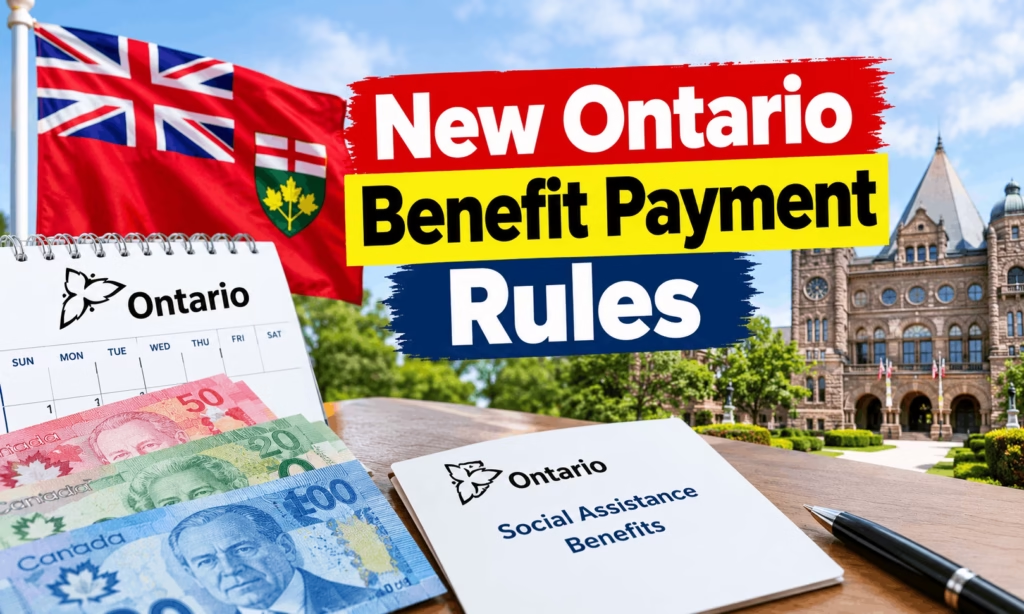
The New Ontario Benefit Payment Rules took effect immediately on August 13, 2026. People in Canada without legal authorization can no longer receive money through Ontario Works or the Ontario Disability Support Program. The amended regulations also close both programs to temporary residents, a group that includes study permit holders, work permit holders, visitors and tourists. Anyone applying must now show documents proving citizenship or immigration status. That is a sharp turn for two programs that together support several hundred thousand households, and it came within hours of being announced. If you are on Ontario Works, on ODSP, or planning to apply, the question is no longer only whether you are poor enough or disabled enough. It is also what your immigration status says on paper. We’ll be updating this article monthly.
Here is why it matters now, seven weeks later. Caseworkers, community legal clinics and newcomers are still sorting out what the change means in practice, especially for people on expiring permits or waiting on extension decisions. The rules follow a July tribunal decision that found the old wording did not clearly require legal status. This guide covers what changed, who is affected, what is still unclear, how to apply for social assistance in Ontario, how long decisions take, when payments arrive, and where the official links are. It also includes a simple calculator that shows the maximum monthly amounts for a single adult and flags whether a status is likely to qualify under the new wording.
What the Ontario Social Assistance Rule Change Actually Says?
The province amended regulations under both the Ontario Works Act, 1997 and the Ontario Disability Support Program Act, 1997. The minister responsible, Michael Parsa, announced the change on August 13 and said it would keep taxpayer dollars focused on people in financial hardship who are legally allowed to live in Canada. The change came by regulation, not by a new bill, which is why it could take effect the same day.
Coverage of the announcement describes the effect this way: people who are in Canada illegally and people authorized to stay only on a temporary basis are not eligible for social assistance. In practical terms, the new text names two broad groups who are shut out, and it asks applicants to prove where they stand.
| Group now excluded | Examples given in reporting |
|---|---|
| People in Canada without legal authorization | Someone whose permit or authorized stay ended and who has no maintained status or other lawful basis to remain |
| People authorized to remain only temporarily | Study permit holders, work permit holders, visitors and tourists |
Who Can Still Get Ontario Works and ODSP?
Reporting on the change says citizens and permanent residents remain eligible if they meet the usual financial and program tests. That is the clearest part of the picture. What the public materials I reviewed do not spell out is how the rules treat people in other categories, such as refugee claimants or protected persons. Do not assume either way. If that describes you, ask your caseworker in writing and consider calling a community legal clinic before you make any decisions.
The financial tests themselves did not change. Ontario Works still looks at income and assets, and ODSP still requires a substantial disability expected to last a year or more. The new piece is an added gate at the front door.
Social Security 2027 COLA Report That Could Change Everything
Why Ontario Moved: The Tribunal Ruling Behind the Change
The trigger was a decision by the province’s Social Benefits Tribunal that drew heavy media attention in July. The adjudicator concluded that the existing Ontario Works legislation did not explicitly require legal immigration status, so long as the applicant did not fall into a few specifically excluded categories. According to reporting, the man in the case arrived on a temporary work permit in 1997, stayed after it expired about four years later, worked for cash until 2023, and then entered the shelter system and applied for assistance.
Premier Doug Ford said publicly that his government would support people facing hard times but not those living in the country illegally, and promised to fix the wording. The regulation followed. Supporters see it as closing a loophole. Critics, including advocates who work with low-income newcomers, argue it will push vulnerable people further from support. Both views are part of the public debate, and this article does not take a side. It explains the rules and what they mean for real applications.
What the Old Rules Already Said About Status?
This was not a blank slate. The existing regulation on status in the country already excluded some people, including those with enforceable removal or deportation orders and visitors or tourists, with exceptions. What the tribunal case exposed was a gap for people who once had status, lost it, and were not clearly caught by those categories. The new regulation widens and clarifies the exclusions so that the gap no longer exists.
Ontario Works vs ODSP: Payment Amounts and How They Differ
The two programs are built for different situations, and the dollar amounts show it. Ontario Works is meant as temporary help while a person looks for work. ODSP is longer-term support for people with a disability.
| Feature | Ontario Works | ODSP |
|---|---|---|
| Purpose | Short-term aid and job-readiness support | Longer-term income support for people with a disability |
| Maximum for a single adult | $733 per month | $1,436 per month |
| Indexed to inflation | No, frozen since 2018 | Yes, annual adjustment |
| Latest change | None | 1.9% increase on July 1, 2026 |
| Employment earnings note | Caseworker supports job search | Up to $1,000 a month earned without affecting eligibility |
A single person on Ontario Works receives a maximum of $733 a month, a rate that has stayed frozen since 2018 while prices have risen roughly 23 percent. Advocates say that gap explains why housing is so hard to hold on the basic rate. ODSP, by contrast, has risen by close to 23 percent since September 2022 through indexation, and the 2026 provincial budget confirmed that indexing will continue. Amounts for couples and families are higher and depend on household makeup. I have not listed them because the sources I reviewed did not give current figures.
How Many People Depend on These Programs
For scale, the province’s caseload in the 2024 to 2025 fiscal year included about 282,000 Ontario Works cases and about 373,000 ODSP cases. Counting spouses and children, the number of individuals covered passed 970,000, according to reporting on the caseload data. The province has not published how many current recipients would lose eligibility under the new wording, so any figure you see claiming a specific number of people affected should be treated with caution.
The ODSP Pathway Just Got Narrower
Ontario Works is often the doorway into ODSP. A recipient with a qualifying disability can apply for ODSP while still getting Ontario Works, and the online system lets someone apply to both at once. The caseworker provides a Disability Determination Package, and a health professional completes the medical forms at no cost to the applicant. The Disability Adjudication Unit generally decides within about 90 business days of receiving a complete package, and Ontario Works payments keep going during the wait.
The change is that both doors now have the same status lock. A person without legal status, or with only temporary authorization, cannot enter through Ontario Works and move to ODSP later. Former ODSP recipients who return to assistance may still qualify for rapid reinstatement without a new medical package, but only if they meet the status requirement.
Study Permit and Work Permit Holders: What the New Ontario Benefit Payment Rules Mean
This is the group with the most questions. Analysts note the change matters especially for international students, because their ability to stay in Canada depends on temporary status. Under the amended regulation, study permit holders and work permit holders are named as ineligible. Many of them were unlikely to qualify before, since permits often come with proof-of-funds or employment conditions, but the wording now removes any doubt.
Maintained status is a gray area worth watching. It lets someone stay and, in many cases, keep working while immigration officials process an extension application. Reporting notes that maintained status is still temporary resident status, so it may fall inside the new exclusion. The government has not published detailed guidance I could find, so treat this as unresolved and get advice before relying on either reading.
For people on temporary permits, the practical message is to plan early. Permanent residents fall outside the exclusion. A person who is close to applying for permanent residence, through a provincial nominee stream or another route, should speak to a licensed immigration consultant or lawyer before their permit runs out.
If You Already Receive Ontario Works or ODSP
The announcement focused on eligibility and documents. It did not, in the material I reviewed, explain how the ministry will handle people already on the rolls whose status is temporary or expired. Do not assume nothing will happen, and do not assume the worst either. The sensible steps are these.
- Gather proof of your status now: passport, permit, permanent resident card, citizenship certificate or any IRCC letter.
- Ask your caseworker what documents they need and when.
- Keep copies of everything you hand in and note the date.
- If your status is temporary or in question, contact a community legal clinic or the Income Security Advocacy Centre before your next review.
- If you get a notice cutting off payments, you may have a right to appeal to the Social Benefits Tribunal, and deadlines are short, so act quickly.
How to Apply for Ontario Works and ODSP Under the New Rules
The application process itself is largely the same, with one new layer of paperwork.
- Confirm your basic eligibility. You generally need to live in Ontario, be in financial need, and, for ODSP, have a substantial disability expected to last at least a year.
- Collect status documents. Under the new rules, applicants must provide documentation of citizenship or immigration status. Also gather ID, proof of address, income and asset details, and banking information.
- Apply through the province. Start at the Ontario Works page on ontario.ca, which links to the online application. You can apply for both programs at the same time.
- Complete the caseworker steps. Expect an intake and a verification of your documents.
- For ODSP, complete the Disability Determination Package with your doctor or other approved health professional.
- Report changes. Tell your caseworker about new income, moves, household changes and any change in immigration status.
Processing Time for Ontario Works and ODSP Decisions
There is no single wait time for Ontario Works because it depends on how fast documents are verified. The added status check can slow files where paperwork is missing or a permit is close to expiring, so submit clean copies the first time.
For ODSP, the Disability Adjudication Unit generally issues its decision within about 90 business days of receiving a complete package. Incomplete medical forms are the most common reason for delay. If you are already on Ontario Works, those payments continue while the ODSP decision is pending, provided you still meet the status requirement.
Payment Schedule for Ontario Works and ODSP
Both programs pay monthly, and payments are generally issued ahead of the month they cover, usually near the end of the previous month. Your exact date depends on how you are paid. The most reliable place to check is your MyBenefits account, which you can reach from the Ontario Works page, or your caseworker. If a payment is late, contact the office before assuming a decision has been made on your file. Note that the ODSP increase of 1.9% took effect July 1, 2026, so payments issued for July onward reflect the higher single-adult maximum of $1,436.
Reporting Suspected Social Assistance Fraud
The government highlighted its fraud reporting channel alongside the announcement. The public can report suspected fraud through the province’s welfare fraud page or by calling 1-800-394-7867. Reports of fraud are separate from eligibility decisions. If you are worried a neighbour or coworker is breaking the rules, that hotline is the official route. Do not confront anyone directly, and do not accept offers from people who promise to “guarantee” approval for a fee.
New Ontario Benefit Payment Rules Key Dates and Numbers
| Item | Detail |
|---|---|
| Regulation change announced and in force | August 13, 2026 |
| Programs affected | Ontario Works and ODSP |
| Now excluded | People without legal authorization and people authorized to stay temporarily |
| Ontario Works single maximum | $733 per month, frozen since 2018 |
| ODSP single maximum | $1,436 per month |
| ODSP increase | 1.9% on July 1, 2026 |
| ODSP earnings allowance | Up to $1,000 per month without affecting eligibility |
| ODSP decision timeline | About 90 business days |
| Combined caseload, 2024 to 2025 | About 282,000 OW cases and 373,000 ODSP cases |
| Fraud hotline | 1-800-394-7867 |
Official Ontario and Canada Websites
| Purpose | Official link |
|---|---|
| Ontario Works program and application | https://www.ontario.ca/page/ontario-works |
| Ontario Disability Support Program | https://www.ontario.ca/page/ontario-disability-support-program |
| Government news release on the change | https://news.ontario.ca/en/release/1007869/ontario-ends-social-assistance-for-people-living-in-canada-illegally |
| Report welfare fraud | https://www.ontario.ca/page/report-welfare-fraud |
| Social Benefits Tribunal (appeals) | https://tribunalsontario.ca/sbt/ |
| Immigration status and permit checks | https://www.canada.ca/en/immigration-refugees-citizenship.html |
| Legal Aid Ontario | https://www.legalaid.on.ca |
| Income Security Advocacy Centre | https://incomesecurity.org |
| Fraud hotline | 1-800-394-7867 |
Ontario Social Assistance Eligibility and Payment Calculator
This tool is a quick screen, not a decision. It shows the maximum monthly and yearly amount for a single adult and gives a plain-language flag on whether the status you pick appears to fit the new wording. Only your caseworker can confirm eligibility.
Ontario Works and ODSP Quick Check
Single adult amounts only. Information tool, not legal or immigration advice. Confirm with your caseworker or a licensed professional.
Ontario Social Assistance and Immigration Status FAQs
Who is no longer eligible for Ontario Works and ODSP?
People in Canada without legal authorization and people authorized to remain only temporarily, including study permit holders, work permit holders, visitors and tourists, are excluded from both programs under the amended regulations.
When did the new rules start?
They took effect immediately on August 13, 2026, the same day they were announced.
Are permanent residents and citizens still eligible?
Yes, if they meet the usual financial and program requirements.
Why did Ontario change the rules?
The change followed a July tribunal decision that awarded Ontario Works to a man whose temporary work permit had expired decades earlier. The tribunal found the old wording did not clearly require legal status, and the government amended the regulations to remove that ambiguity.
Can an Ontario Works recipient still apply for ODSP?
Yes, if they meet the status requirement and have a qualifying disability. The medical package process is unchanged.
Where do I report suspected fraud?
Use the province’s welfare fraud page or call 1-800-394-7867.
Can temporary residents get Ontario Works?
No. Under the amended rules, people authorized to stay temporarily are not eligible for Ontario Works or ODSP.
Can international students get social assistance in Ontario?
Study permit holders are named as ineligible under the new regulation.
Can someone without status get ODSP?
No. People in Canada without legal authorization are excluded from both programs.
How much is Ontario Works per month in 2026?
A single adult receives a maximum of $733 a month, a rate frozen since 2018.
How much is ODSP per month in 2026?
A single adult can receive up to $1,436 a month after the 1.9% increase on July 1, 2026.
What proof of status do I need?
Applicants must provide documents showing citizenship or immigration status. A passport, permit, permanent resident card or citizenship certificate are the usual examples. Ask your caseworker which ones they will accept.
Is maintained status enough to qualify?
Unclear. Maintained status is still temporary resident status and may fall inside the exclusion, so confirm before relying on it.
What if my benefits are stopped?
You may be able to appeal to the Social Benefits Tribunal. Deadlines are short, so get advice quickly from a legal clinic.
Conclusion
The New Ontario Benefit Payment Rules turn immigration status into a front-line test for Ontario Works and ODSP. The government presents the change as a way to focus public money on people who are legally in Canada. Advocates worry about people who are already at risk of homelessness. What is settled is the text: people without legal authorization and people on temporary permits are excluded, citizens and permanent residents are not, and everyone must show documents. What is not settled, at least in public materials, is how the rules apply to current recipients, people on maintained status, and other categories such as refugee claimants.
If you are affected, gather your documents, ask your caseworker specific questions in writing, and get advice from a legal clinic or a licensed immigration professional before your permit changes. If you are not affected, the rule change is still a useful marker of how quickly provincial benefit policy can shift by regulation. We’ll be updating this article monthly as new guidance appears.
Social Security COLA 2027: How Much More Will You Get in January?
Social Security COLA CPI Report: What Sets Your Raise?
Social Security COLA Buying Power: Will the Raise Beat Inflation?