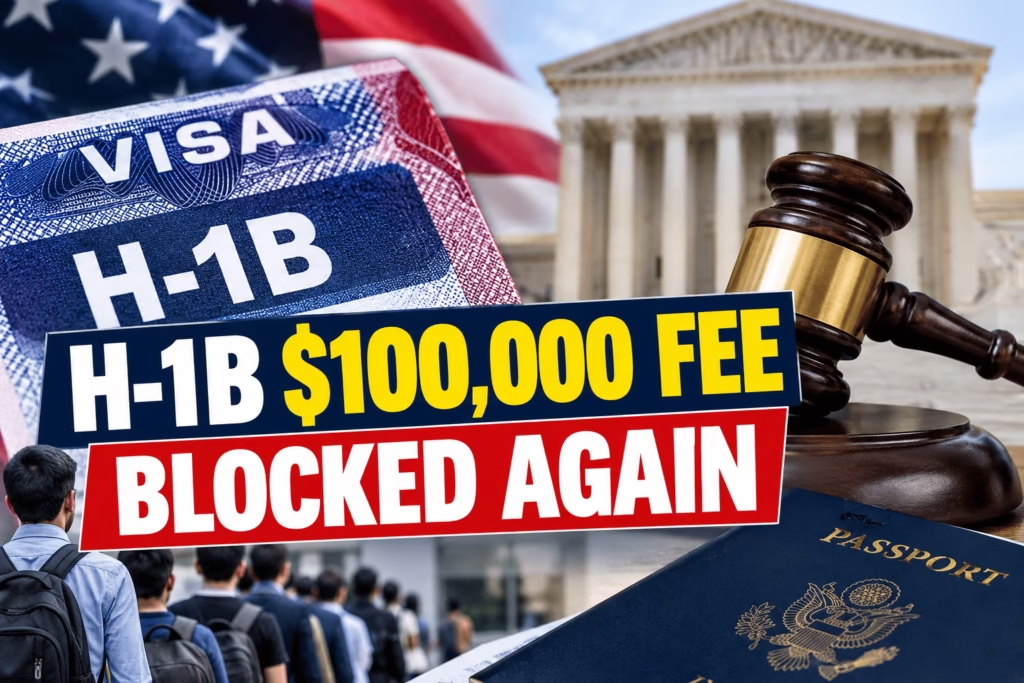
The H-1B $100,000 fee is blocked again. On Wednesday, September 30, 2026, U.S. District Judge Haywood Gilliam in Oakland, California, ruled that U.S. Citizenship and Immigration Services and the State Department cannot carry out President Donald Trump’s $100,000 payment on new H-1B petitions while a lawsuit moves forward. His reasoning was procedural. The agencies, he found, skipped the rule-making steps federal law requires before they put a charge like this into practice. It is the second federal court to stop the payment this year, following a Boston judge who struck it down in June in a case brought by 20 states. The timing makes the ruling more striking. Twelve days earlier, on September 18, the White House had extended the payment requirement through September 21, 2027. For employers holding back hiring plans, the practical message today is clear: the six-figure payment is not being collected, but the legal fight is far from finished. We’ll be updating this article monthly.
Behind the court order sits a larger story. Before the proclamation, H-1B filing costs typically ran about $2,000 to $5,000 per petition, according to Reuters. Trump’s September 2025 order pushed the price of certain new petitions past $100,000. September 2026 has now pulled the policy in three directions at once: a one-year extension from the White House, a second courtroom loss, and a Department of Homeland Security proposal, published August 25, to create a permanent fee of $103,265 on cap-subject petitions. Public comments on that proposal closed on September 24. Meanwhile the U.S. Chamber of Commerce is appealing in Washington. This report lays out the current status, a dated timeline, who was actually covered, how to file and pay today, and a calculator so you can test each scenario. We flag anything that is not yet confirmed.
H-1B $100,000 Fee Blocked Again Key Highlights
| Item | Latest detail |
|---|---|
| Newest ruling | September 30, 2026, Judge Haywood Gilliam, Oakland, California |
| Reason given | Agencies did not follow required rule-making procedures |
| What is blocked | USCIS and the State Department cannot implement the fee while the lawsuit continues |
| Earlier ruling | June 8, 2026, federal court in Boston, case by 20 states |
| Appeals court | First Circuit refused to pause the Boston ruling on July 24, 2026 |
| Extension | Proclamation signed September 18, 2026, runs through September 21, 2027 |
| Fee amount | $100,000 per covered new petition |
| Typical cost before 2025 | About $2,000 to $5,000 |
| Permanent proposal | $103,265 per cap-subject petition, proposed August 25, 2026 |
| Annual H-1B cap | 65,000 regular visas plus 20,000 for U.S. advanced degrees |
| Is it being collected? | No, per current court orders |
What Happened in Oakland on September 30
Judge Gilliam granted a request from a coalition of unions, employers and nonprofit groups who sued last October. Reports describe the order as a pause on implementation until the case is decided, which is a preliminary step rather than a final verdict. The plaintiffs argued that a charge of this size works like a tax and that federal agencies cannot create it without public notice and comment. Their lawyers at Democracy Forward welcomed the decision, saying it protects a system that had been thrown into chaos overnight.
One caution for readers. Published coverage does not spell out whether the Oakland order protects only the plaintiffs or every employer. That detail sits in the order itself, and the Supreme Court has recently narrowed how far a single district court can reach with injunctions. In practice, the earlier Boston ruling already vacated the payment policy, and the First Circuit has refused to pause it, so immigration lawyers say USCIS and the State Department cannot collect the money from anyone for now. Still, a company that is not a party to the Oakland case should ask its counsel before treating this order as its own shield.
Social Security 2027 COLA Report That Could Change Everything
Is the H-1B $100,000 Fee Still in Effect?
Short answer: the proclamation is still on the books, but the fee cannot currently be collected. The presidential extension runs to September 21, 2027, yet court orders stop USCIS and the State Department from enforcing the payment. Law firms that tracked the extension noted that it renews the old framework rather than creating a new one, so the existing block should keep applying. Employers can file under the standard fee schedule for now. If a higher court lifts the block, the payment could return quickly, and it would be due through the federal pay.gov system before filing.
H-1B $100,000 Fee Timeline: Important Dates
| Date | What happened |
|---|---|
| September 19, 2025 | Trump signs the proclamation creating the $100,000 payment |
| September 21, 2025 | Payment applies to covered petitions filed at or after 12:01 a.m. Eastern |
| October 20, 2025 | USCIS publishes guidance on who must pay and how |
| December 23, 2025 | A federal judge in Washington, D.C., upholds the fee under presidential immigration power |
| February 27, 2026 | Wage-weighted H-1B selection rule takes effect |
| June 8, 2026 | Boston federal court vacates the payment policy |
| July 24, 2026 | First Circuit denies the government’s request to pause that ruling |
| August 25, 2026 | DHS publishes the $103,265 proposed rule |
| September 18, 2026 | White House extends the proclamation to September 21, 2027 |
| September 24, 2026 | Comment period on the $103,265 proposal closes |
| September 30, 2026 | Judge Gilliam blocks the fee in Oakland |
| October 1, 2026 | Earliest start date for workers under approved FY 2027 cap petitions |
Who Had to Pay the $100,000 H-1B Fee?
The scope was narrower than the first headlines suggested. After a day of confusion in September 2025, the administration said the payment would apply going forward, and USCIS spelled out the details on October 20, 2025.
The payment applied to new petitions filed on or after September 21, 2025 when the worker was outside the United States without a valid H-1B visa, or when the petition asked for consular, port of entry or pre-flight notification. It did not apply to workers who already held valid H-1B visas. It also did not apply to approved extensions, amendments or changes of status for people inside the country. That last point mattered a great deal for international students, because a move from F-1 student status to H-1B inside the United States avoided the charge.
A few other rules shaped real cases:
- Payment had to be made through pay.gov before the petition was filed, and USCIS said it would refund the money if the petition was denied.
- The Secretary of Homeland Security could grant an exception only in what USCIS called extraordinarily rare circumstances tied to national interest.
- If a worker left the country while an in-country petition was pending, USCIS warned the case could be converted into one that needed the payment.
- The guidance made no distinction between lottery cases and petitions from universities and other cap-exempt employers.
Why Three Courts Are Pulling in Different Directions
The cases are not identical, and that is why the outcomes differ.
In Boston, the states argued that the proclamation amounted to a tax that the executive branch has no power to create. The court agreed and held the policy violated the Administrative Procedure Act. It briefly allowed collection while the government appealed, then the First Circuit declined to extend that pause on July 24.
In Washington, a different judge ruled in December 2025 that the fee fits within the president’s authority to restrict entry. The Chamber of Commerce is appealing that decision at the D.C. Circuit. Court reporting from September 28 says the Chamber told that court the new extension strengthens its case for relief.
In Oakland, Judge Gilliam focused on process rather than presidential power. A ruling about missing rule-making steps can be cured, at least in theory, by running the proper process, which is one reason DHS is now pursuing a fee through formal rule-making.
Because the courts have split, attorneys quoted by SHRM expect the dispute to reach the Supreme Court. We have not confirmed that any emergency application has been filed.
Trump Extends the H-1B Proclamation to September 2027
The White House extended the restriction on September 18, 2026, just before the original one-year term would have ended. According to the White House statement, registrations from the largest IT staffing and outsourcing companies have dropped by 92 percent since the payment and a new weighted selection system took effect, and more filings now involve advanced degrees and higher salaries. The proclamation also notes that more than 700 petitions have included the $100,000 payment. These are the administration’s own figures, and we have not been able to verify them independently.
The extension keeps limited exceptions for workers, companies or industries judged to be in the national interest. Practitioners read it as a signal that the administration intends to keep pressing its case in court, even though nobody is currently paying.
$103,265 H-1B Fee Proposal Explained
The second front is regulatory. On August 25, 2026, DHS published a notice of proposed rulemaking titled Fee for Certain H-1B Petitions, under regulatory file RIN 1615-AD20. It would add a $103,265 fee to every cap-subject H-1B petition, including those filed under the 20,000-visa advanced degree exemption.
How DHS reached the number matters. The department divided roughly $8.78 billion in annual costs by an estimated 85,000 cap-subject petitions. It says the money would cover the cost of administering lawful immigration across the Departments of Homeland Security, Justice, State and Labor, which is a sharp break from the usual practice of tying USCIS fees to the cost of processing the benefit.
Key points employers should know:
- It is a proposal, not a final rule, and no effective date exists yet.
- The fee would be paid when the petition is filed, on top of existing H-1B fees.
- Extensions, amendments, transfers and cap-exempt petitions would pay only standard fees.
- DHS says the rule rests on a separate legal authority. If a petitioner owed both the proclamation payment and this fee, the proposal says both would be due.
- The 30-day comment period ended on September 24. Critics noted the usual period is 60 days.
If the rule is finalized, expect fresh lawsuits. Those cases would ask different questions than the current ones, focusing on whether DHS can charge costs that go beyond the work of adjudicating H-1B cases.
H-1B Weighted Lottery 2026: How Selection Works Now
The fee fight overlaps with another major change. Under a final rule effective February 27, 2026, USCIS replaced the purely random lottery with a wage-weighted draw for fiscal year 2027, the first cycle run this way. A registration for a job paid at Level 4 of the Department of Labor wage scale gets four entries in the pool, Level 3 gets three, Level 2 gets two, and Level 1 gets one. Employers must report the occupation code, work location and wage level at registration, and the later petition has to match.
USCIS announced it had selected enough registrations to meet the FY 2027 cap, including the master’s exemption, and approved cap petitions can start employment no earlier than October 1, 2026. Entry-level candidates are not shut out, but their odds are lower than before.
H-1B Fee Calculator: Test Each Scenario
Use the calculator below to estimate the cost of a petition under four situations: today’s court-blocked status, a reinstated $100,000 payment, the proposed $103,265 rule, and both together. The default government fee amounts are editable estimates, so confirm them against the current USCIS fee schedule.
H-1B petition cost calculator
Compare what an employer pays today with what it could pay if the $100,000 payment is reinstated or the proposed $103,265 rule is finalized. Edit any fee to match the current USCIS schedule.
Edit fee amounts (USD)
Estimate for planning only. Default amounts are editable placeholders based on recent USCIS fee schedules and may be out of date. The $100,000 payment is currently blocked by court orders and the $103,265 fee is only a proposed rule. Confirm every figure with the USCIS fee calculator and an immigration attorney before filing.
How to Apply for an H-1B Visa Right Now
The basic path has not changed, though the cost picture is unsettled.
- A U.S. employer identifies the role and checks the Department of Labor prevailing wage level, since the wage level now affects lottery odds.
- The employer files a Labor Condition Application with the Department of Labor.
- For cap-subject jobs, the employer registers the worker in its USCIS online account during the March registration window and pays the registration fee.
- If selected, the employer files Form I-129 within the filing window shown in the selection notice.
- A worker abroad completes consular processing, including the DS-160 form and an interview at a U.S. embassy or consulate. A worker already in the United States, such as an F-1 student, can usually request a change of status.
- The employer pays the standard filing fees. If the $100,000 payment is ever reinstated and covers the case, that payment must be made first.
H-1B Processing Time
Processing times vary by service center and case type, so check the USCIS processing times page for current estimates. Cap petitions for the new fiscal year are generally filed beginning April 1, with a start date no earlier than October 1. Employers can add premium processing, which carries a separate fee and a 15 business day response target for the first action on the case. A consular interview is a separate step after approval and its wait depends on the post.
H-1B Fee Payment Schedule
| Payment | When it is due | Status today |
|---|---|---|
| Registration fee | At registration in March, cap cases only | Required |
| Form I-129 filing fee and related fees | At filing | Required |
| Premium processing fee | At filing, or when upgrading later | Optional |
| $100,000 proclamation payment | Before filing, through pay.gov, if the case is covered | Blocked by court orders |
| $103,265 proposed fee | At filing, cap-subject petitions only | Proposed, not in force |
Employers that already paid the $100,000 amount should keep proof of payment and speak with counsel about recovering it, since agency guidance on refunds has not been fully laid out.
H-1B $100,000 Fee Impact on Indian Professionals and Students
India accounted for about 71 percent of H-1B approvals in fiscal year 2024, which is why each twist in this case draws heavy attention in Indian news. The latest ruling is a relief, but it is not a guarantee. International students who plan to switch from F-1 status inside the United States were already outside the payment, though they may still face the proposed $103,265 fee if their petition is cap-subject and the rule is finalized. The weighted lottery is the more immediate hurdle for early-career applicants. Reuters has also reported that some large H-1B users, including Alphabet, have been expanding operations in India as visa rules tighten.
Why Hospitals, Schools and Public Employers Are Watching Closely
California Attorney General Rob Bonta, whose state led the multistate challenge, argued that schools, colleges and public hospitals cannot absorb an extra $100,000 for each hire. His office noted that roughly 11.4 million Californians live in areas with primary care shortages and that nearly 23,000 H-1B physicians have worked in underserved communities. Those figures come from the state’s own filings.
What Employers Should Do Now
Treat the ruling as breathing room, not a permanent answer. Companies can file under the standard fee schedule while the orders stand, but they should document each decision and ask immigration counsel whether the Oakland order covers them directly. Budget for FY 2028 using at least two scenarios, one with no extra fee and one with the $103,265 charge, and watch for the final rule. Track the First Circuit appeal, the D.C. Circuit case and any Supreme Court filing. Finally, review wage levels now, because they decide lottery odds regardless of how the fee fight ends.
Official H-1B Links: Login, Registration, Case Status and Rules
| Resource | Use it for | Link |
|---|---|---|
| USCIS H-1B Specialty Occupations | Official rules, eligibility and fee guidance | https://www.uscis.gov/working-in-the-united-states/h-1b-specialty-occupations |
| USCIS online account login and registration | Cap registration, filing and notices | https://myaccount.uscis.gov |
| USCIS case status | Track a receipt number | https://egov.uscis.gov/casestatus/landing.do |
| USCIS fee calculator | Check current filing fees | https://www.uscis.gov/feecalculator |
| Pay.gov | Government payment portal named in USCIS guidance | https://www.pay.gov |
| Federal Register | Read the proposed $103,265 rule | https://www.federalregister.gov |
| Regulations.gov | Docket USCIS-2026-0298-0001 | https://www.regulations.gov |
| Department of Labor FLAG system | Labor Condition Application filing | https://flag.dol.gov |
| U.S. State Department visas | Visa appointments and DS-160 | https://travel.state.gov |
| White House presidential actions | Text of proclamations | https://www.whitehouse.gov |
Social Security COLA 2027: How Much More Will You Get in January?
H-1B $100,000 Fee FAQs
Is the H-1B $100,000 fee blocked?
Yes. Courts in Boston and Oakland have each stopped the government from enforcing it, and it is not being collected at present.
Who blocked the H-1B $100,000 fee?
Judge Haywood Gilliam of Oakland issued the newest order on September 30, 2026. Before that, a Boston federal judge vacated the policy on June 8, 2026.
Why did the judge block the H-1B fee?
He found that USCIS and the State Department did not follow the rule-making process required before they put the fee into effect.
Does the $100,000 fee apply to current H-1B holders?
No. USCIS guidance excluded workers with valid H-1B visas and approved extensions, amendments and in-country changes of status.
Do F-1 students have to pay the $100,000 fee?
Not when they change status inside the United States, according to USCIS guidance. Students whose petitions request consular notification were in a different position.
What is the proposed $103,265 H-1B fee?
It is a DHS proposal that would charge every cap-subject H-1B petition a flat amount at filing. It is not final and has no effective date.
Can the fee come back?
Yes. A higher court could lift the blocks, the government could win its appeals, or the proposed rule could be finalized.
How long does the proclamation last?
The extension runs through September 21, 2027, unless it is renewed again or changed in court.
Can employers still sponsor H-1B workers?
Yes. The program continues, with 65,000 regular visas and 20,000 advanced degree visas each year, and filings follow the standard fee schedule for now.
What happens if I already paid the $100,000 fee?
Keep your payment proof and consult an immigration attorney. USCIS has not published full refund instructions after the court orders.
Will the Supreme Court decide the H-1B fee?
Lawyers expect the conflict between courts to reach it eventually, but no ruling from the justices has been reported.
How much did an H-1B petition cost before the new fee?
Typically about $2,000 to $5,000, depending on employer size and the type of filing.
Does the weighted lottery change my chances?
Yes. Higher wage levels receive more entries, so a Level 4 offer has far better odds than a Level 1 offer.
Where can I check my H-1B case status?
Use the USCIS case status page with your receipt number, or sign in to your USCIS online account.
Conclusion
The headline is simple: the H-1B $100,000 fee is blocked again, and employers can file under standard fees for the moment. The reality behind it is messier. The White House has extended the policy, DHS is trying to reach nearly the same number through a formal rule, and courts that disagree with one another are pushing the issue toward higher benches. Anyone planning an H-1B hire should prepare for both outcomes, keep careful records, and rely on official sources before acting. We’ll keep tracking the First Circuit appeal, the D.C. Circuit case and the final fate of the $103,265 proposal.
Sources and verification note: this report draws on Reuters, Bloomberg, SHRM, the California Attorney General, USCIS guidance as described by law firms, and DHS rule-making notices as summarized by immigration practitioners. Figures from the White House and the state of California are attributed to them and were not independently verified. This article is general information, not legal advice.
Social Security COLA Buying Power: Will the Raise Beat Inflation?
What Happens If Alberta Votes Yes? Inside Canada’s October 19 Independence Referendum