Employment Insurance (EI) 2026 Rule Changes: The Government of Canada has extended a major package of temporary Employment Insurance measures for the third time, pushing the deadline for expanded EI support from April 2026 all the way to October 10, 2026. The announcement, made on March 20, 2026, by Patty Hajdu, Minister of Jobs and Families, keeps three critical protections in place for workers affected by ongoing US tariffs: a waived one-week waiting period, suspended treatment of severance and separation pay, and up to 20 extra weeks of regular benefits for long-tenured employees, bringing their maximum entitlement to 65 weeks. Combined, these measures are expected to help more than 811,000 additional EI claims across sectors like steel, aluminum, automotive, and softwood lumber that continue to face trade-related disruption.
Alongside the tariff relief extension, several other Employment Insurance 2026 rule changes are already active or rolling out this year. The maximum insurable earnings ceiling rose to $68,900, pushing the maximum weekly EI benefit up to $729. A brand-new EI Board of Appeal launched on April 1, 2026, replacing the old Social Security Tribunal process for EI disputes. The Work-Sharing Program’s expanded flexibilities were extended to March 31, 2027, and a new Worker Retention Grant now lets employers top up wages for employees in training. With October 10 approaching fast and no confirmation yet on a fourth extension, this guide breaks down every confirmed 2026 EI rule change, what is temporary, what is permanent, and what workers should do before the current window closes. We’ll be updating this article monthly as Employment and Social Development Canada releases new guidance.
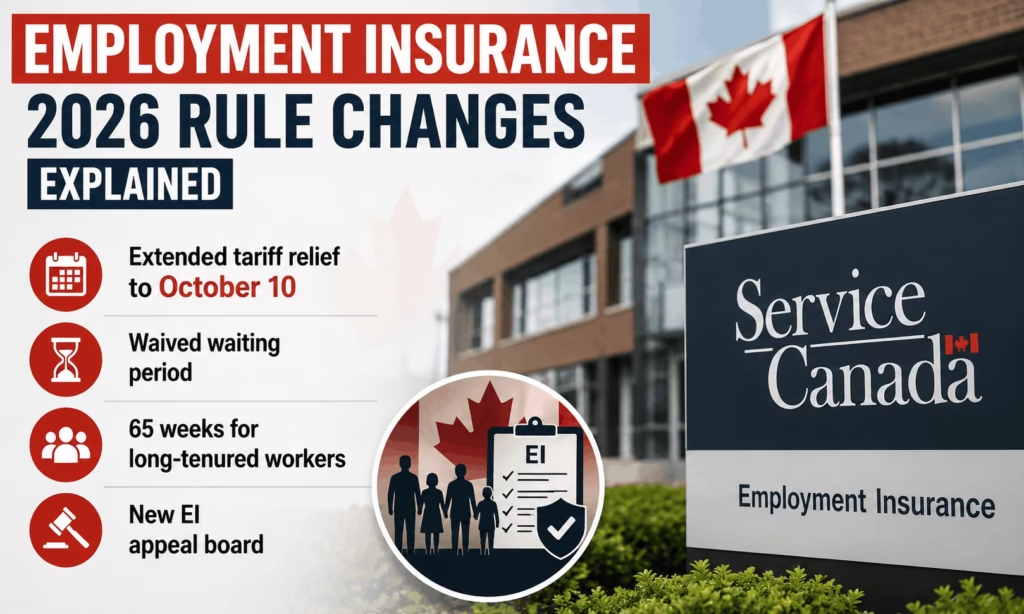
Employment Insurance (EI) 2026 Rule Changes Key Highlights
| Detail | 2026 Figure or Rule |
|---|---|
| EI premium rate (employee) | $1.63 per $100 of insurable earnings |
| EI premium rate (employer) | $2.28 per $100 of insurable earnings |
| Maximum insurable earnings (MIE) | $68,900 (up from $65,700 in 2025) |
| Maximum weekly EI benefit | $729 (up from $695 in 2025) |
| Maximum annual employee premium | $1,123.07 |
| Basic benefit rate | 55% of average insurable weekly earnings |
| Insurable hours needed to qualify | 420 to 700 hours, depending on region |
| Standard maximum benefit weeks | Up to 45 weeks |
| Long-tenured worker maximum (temporary) | Up to 65 weeks |
| Tariff relief measures deadline | October 10, 2026 |
| Work-Sharing flexibility deadline | March 31, 2027 |
| New EI Board of Appeal launch | April 1, 2026 |
What Is Employment Insurance and Why Are the Rules Changing in 2026?
Employment Insurance is Canada’s federal income-support program for workers who lose their job through no fault of their own, and it also funds special benefits for maternity, parental leave, sickness, caregiving, and compassionate care. The program is funded through payroll premiums paid by employees and employers, and both the premium rate and the maximum insurable earnings are recalculated every year based on actuarial forecasts.
What makes 2026 different is the scale of temporary intervention layered on top of the usual annual adjustments. Since March 2025, Ottawa has repeatedly extended a package of emergency EI measures designed to cushion the impact of foreign tariffs on Canadian manufacturing, steel, aluminum, automotive, and softwood lumber workers. What began as a short-term pilot has now been renewed three separate times, most recently pushing the expiry date to October 10, 2026, making this one of the most closely watched Employment Insurance stories of the year.
The Three Extended EI Tariff Relief Measures Explained
These are the temporary rule changes drawing the most attention right now, formally known as EI Pilot Project No. 24. All three were extended on March 20, 2026, and now apply through October 10, 2026, unless the government announces a further extension before that date.
Waived one-week waiting period. Normally, EI claimants must wait one full week before receiving their first payment. Under this measure, eligible claimants can receive benefits starting from the very first week of their claim. It applies to claims established between March 30, 2025, and October 10, 2026, and is expected to help roughly 632,000 additional claims.
Suspended treatment of separation earnings. Under standard rules, severance pay, vacation payouts, and pay in lieu of notice must typically be used up before EI benefits begin. This measure suspends that requirement, allowing eligible workers to receive EI benefits without first exhausting their severance. It applies to claims established, or allocations commencing, between March 30, 2025, and October 10, 2026, and is projected to benefit around 136,000 additional claims.
Extra 20 weeks for long-tenured workers. Long-tenured workers, generally those with a strong recent attachment to the workforce, can now receive up to 20 additional weeks of regular benefits, raising their maximum entitlement to 65 weeks instead of the usual 45. This applies to claims starting on or after June 15, 2025, through October 10, 2026, and is expected to help about 43,500 additional claims.
Empire State Child Credit 2026: $1,000 Per Child Under 4, Full Eligibility & Payment Guide
Oregon Kicker Tax Credit 2026: How To Claim Your Share Of The $1.41 Billion Surplus
California Climate Credit 2026: Payment Timing Just Changed, Here Is What to Expect on Your Bill
EI Temporary Measure
| Measure | Who It Helps | Eligible Claim Window | Estimated Claims Helped |
|---|---|---|---|
| Waived one-week waiting period | All eligible EI claimants | March 30, 2025 to October 10, 2026 | 632,000 |
| Suspended separation earnings treatment | Workers receiving severance or vacation payout | March 30, 2025 to October 10, 2026 | 136,000 |
| 20 extra weeks for long-tenured workers | Long-tenured workers needing more time to find work | June 15, 2025 to October 10, 2026 | 43,500 |
Why the Government Keeps Extending These EI Measures
The tariff relief package was first introduced in March 2025 as a short-term pilot, then extended in September 2025 to April 11, 2026, and now extended a third time to October 10, 2026. According to Employment and Social Development Canada, tariff-related job losses tracked between March and October 2025 suggested the EI program could see an increase of roughly 43,000 additional regular claims during the 2026-27 fiscal year alone. Minister Hajdu has stated that the extensions are meant to ensure “reliable and timely EI support” continues for workers in sectors and regions hit hardest by ongoing trade disruption, while officials continue monitoring whether the underlying tariff pressures ease.
Importantly, if a claim is established on or after October 11, 2026, standard EI rules apply again unless a fourth extension is announced beforehand. That means the normal one-week waiting period would return, severance would once again be deducted before benefits begin, and long-tenured workers would lose access to the extra 20 weeks. Workers anticipating a layoff should keep this date firmly in mind when timing their EI application.
Work-Sharing Program Extended to 2027
Separate from the three core tariff measures, the federal government also extended expanded flexibilities under the Work-Sharing Program, which allows employers facing a temporary slowdown to reduce staff hours instead of implementing layoffs, while EI tops up affected employees’ income for the lost hours. These flexibilities, first introduced in March 2025, have now been extended until March 31, 2027, giving employers a longer runway to keep workers on payroll during periods of reduced demand.
As of mid-March 2026, roughly 1,500 Work-Sharing applications had been approved for tariff-affected businesses, covering more than 54,000 workers, and the program is credited with helping prevent an estimated 20,000 layoffs.
New Worker Retention Grant for 2026
A newer addition to the EI support toolkit is the Worker Retention Grant, first announced by Prime Minister Mark Carney in November 2025. Employers who already have an active Work-Sharing agreement can apply for this grant to top up the income of participating employees, allowing them to maintain earnings closer to their normal wages while completing training during their non-work hours. The grant can bring an employee’s income up to approximately 70 percent of their reduced income during the Work-Sharing period, making it easier for businesses to retain skilled staff instead of laying them off during a temporary downturn.
New EI Board of Appeal Launched April 2026
One of the more structural Employment Insurance 2026 rule changes involves how disputes get resolved. Starting April 1, 2026, a new EI Board of Appeal took over responsibility for hearing first-level EI appeals, a role previously handled by the Social Security Tribunal, General Division. The EI Board of Appeal hears appeals related to EI regular benefits, sickness, maternity and parental benefits, caregiving benefits, fishing benefits, and benefits for self-employed workers.
Each hearing panel is regionally based and made up of three members: one presiding member appointed by the Governor in Council, one member representing employer interests, and one member representing worker interests. Any EI appeal received before March 31, 2026, continues to be handled by the Social Security Tribunal, while appeals filed on or after April 1, 2026, go through the new Board of Appeal process.
Standard EI Payroll Numbers for 2026
Beyond the temporary tariff measures, the routine annual EI adjustments are also in effect for 2026. The Canada Employment Insurance Commission set the 2026 premium rate at $1.63 per $100 of insurable earnings for employees, a one-cent decrease from 2025 and a three-cent decrease from 2024, keeping premiums well below the historic high of $1.88 recorded in 2016. Employers continue to pay 1.4 times the employee rate, or $2.28 per $100 of insurable earnings.
The maximum insurable earnings for 2026 rose to $68,900, up from $65,700 in 2025, which is why the maximum annual employee premium climbed to $1,123.07 and the maximum weekly EI benefit increased to $729. Quebec residents, who are covered separately under the Quebec Parental Insurance Plan, pay a lower EI rate of $1.30 per $100 of insurable earnings, with a maximum annual contribution of $895.70.
$450K Student Debt Relief: Here Are The Restrictions Behind The Sweet v. McMahon Settlement
Chapter 33 VA Benefits Housing Allowance: How Much Can You Get Per Month
Social Security Changes August 2026: SSA Announces Major Update for Retirees and Beneficiaries
EI Eligibility Requirements in 2026
To qualify for regular EI benefits, workers generally need to meet the following conditions.
- You lost your job through no fault of your own, such as a layoff or shortage of work
- You have accumulated the required number of insurable hours in your qualifying period, ranging from 420 to 700 hours depending on your region’s unemployment rate
- You are ready, willing, and capable of working each day
- You are actively looking for work and can provide proof of job search efforts if requested
- Your normal weekly earnings have decreased by more than 40 percent
Regions with higher unemployment rates require fewer insurable hours to qualify, while regions with lower unemployment require more hours, which is why two workers with the same work history can have different eligibility outcomes depending on where they live.
Seasonal Workers and the EI Modernization Outlook
Seasonal workers in 13 targeted EI economic regions continue to receive up to five additional weeks of benefits under a long-running pilot project designed to bridge the gap between when regular EI benefits end and seasonal work restarts. This support has been extended through October 2026.
Looking further ahead, Employment and Social Development Canada has confirmed that broader EI modernization remains under active discussion, with the current government’s 2025 platform committing to strengthen the EI safety net so it better reflects today’s labour market, including workers in seasonal industries, gig and digital-platform work, adoptive parents, and the self-employed. As of the most recent government briefing notes, no final modernization plan has been announced, meaning proposed changes to standardize eligibility hours or adjust benefit calculations across the country remain under consultation rather than confirmed policy for 2026.
How to Apply for EI Benefits in 2026
- Gather your Record of Employment (ROE). Most employers submit this electronically to Service Canada automatically after your last day of work.
- Apply as soon as possible after your job ends. Applying within four weeks of your last day of work protects your claim date, which matters given the October 10, 2026 deadline for temporary measures.
- Create or log into your My Service Canada Account (MSCA). This is where you submit your application, upload documents, and track your claim status.
- Complete your biweekly reports. Once approved, you must confirm your availability and job search efforts every two weeks to continue receiving payments.
- Watch for a decision letter. Service Canada will notify you of your benefit rate, weeks payable, and start date once your application is processed.
Official Employment Insurance Resources
| Resource | Purpose | Official Link |
|---|---|---|
| EI Overview | General program information and eligibility | canada.ca/en/services/benefits/ei.html |
| My Service Canada Account (MSCA) Login | Apply for EI and track your claim | canada.ca/en/employment-social-development/services/my-account.html |
| EI Regular Benefits Application | Start a new EI claim | canada.ca/en/services/benefits/ei/ei-regular-benefit.html |
| Record of Employment on the Web | Employer ROE submission portal | canada.ca/en/employment-social-development/services/employment-insurance/employers/roe-web.html |
| Work-Sharing Program | Apply for reduced-hours support | canada.ca/en/employment-social-development/services/work-sharing.html |
| EI Regional Unemployment Rates | Check hours required in your region | canada.ca/en/employment-social-development/programs/ei/ei-list/reports/rates.html |
Additional EI Benefit Types Still Available in 2026
While regular benefits get the most attention, several special EI benefits remain unchanged and fully active in 2026, and are worth knowing about even outside the current tariff relief news.
Sickness benefits provide up to 26 weeks of income support for workers unable to work due to illness, injury, or quarantine, a limit that has remained in place since it was expanded from 15 to 26 weeks in December 2022. Maternity benefits provide 15 weeks of support, while parental benefits offer either 40 weeks at the standard rate or up to 69 weeks at a reduced rate if shared between two parents. Caregiving and compassionate care benefits support workers who need to step away from their job to care for a critically ill or injured family member.
FAQs About Employment Insurance (EI) 2026 Rule Changes
What are the biggest EI rule changes for 2026?
The most significant changes are the extension of tariff-related temporary measures to October 10, 2026, the rise in maximum insurable earnings to $68,900, the increase in the maximum weekly benefit to $729, and the launch of a new EI Board of Appeal on April 1, 2026.
Will the EI waiting period waiver be extended again after October 2026?
The government has not confirmed a fourth extension as of this update. If no further extension is announced, claims established on or after October 11, 2026 will be subject to the standard one-week waiting period.
Who qualifies for the extra 20 weeks of EI benefits?
Long-tenured workers with claims starting between June 15, 2025 and October 10, 2026 can qualify for up to 20 additional weeks of regular benefits, bringing their total maximum to 65 weeks, subject to meeting standard EI eligibility requirements.
How many insurable hours do I need to qualify for EI in 2026?
You generally need between 420 and 700 insurable hours in your qualifying period, with the exact number depending on the unemployment rate in your EI economic region.
Is severance pay still deducted from EI benefits in 2026?
For claims established, or allocations commencing, between March 30, 2025 and October 10, 2026, separation earnings such as severance are not required to be exhausted before EI benefits begin. Outside that window, standard rules requiring severance to be used up first apply.
What is the maximum EI benefit amount for 2026?
The maximum weekly EI benefit for 2026 is $729, based on 55 percent of average insurable weekly earnings up to the maximum insurable earnings of $68,900.
People Also Ask
How much EI will I get in 2026? Most claimants receive 55 percent of their average insurable weekly earnings, up to the 2026 maximum of $729 per week, though your exact amount depends on your earnings history and region.
Can I still get EI if I have severance pay? Yes, for claims falling within the extended window through October 10, 2026, you can receive EI without first exhausting your severance pay, a temporary change from the usual rule.
What is the EI Board of Appeal? It is a new regionally based tribunal that began hearing first-level EI appeals on April 1, 2026, replacing the Social Security Tribunal, General Division for EI-related disputes.
How long can you collect EI in Canada in 2026? Standard EI regular benefits run up to 45 weeks, but long-tenured workers with claims in the eligible window can receive up to 65 weeks under the current temporary extension.
Is there a new EI reform coming after 2026? Broader EI modernization, including possible changes to eligibility hours and coverage for gig and seasonal workers, remains under government consultation, with no finalized plan confirmed as of the most recent briefing.
Conclusion
Employment Insurance in 2026 looks noticeably different from a standard year, largely because of the government’s repeated extensions of emergency tariff relief measures rather than a single sweeping reform. The waived waiting period, suspended severance treatment, and extra 20 weeks for long-tenured workers all remain active through October 10, 2026, alongside a higher maximum weekly benefit of $729, an expanded Work-Sharing Program running through March 2027, and a newly launched EI Board of Appeal handling disputes. Whether these tariff measures get extended a fourth time depends on how trade conditions evolve over the coming months, so workers who anticipate a layoff should apply as early as possible and keep the October deadline in mind. Because EI rules and deadlines can shift with each federal announcement, it is worth checking Canada.ca directly before making major decisions based on your claim timing. This article will continue to be updated as new EI announcements are made.
$450K Student Debt Relief: Here Are The Restrictions Behind The Sweet v. McMahon Settlement
Chapter 33 VA Benefits Housing Allowance: How Much Can You Get Per Month