$450K Student Debt Relief: Roughly 450,000 federal student loan borrowers are now eligible to have their debt wiped out under a court-enforced settlement that has quietly become one of the largest single student debt relief actions in years, but the eligibility rules behind it are far narrower than the headline number suggests. A federal appeals court ruling in late July 2026 cleared the way for the Department of Education to finish processing the Sweet v. McMahon settlement, a $23 billion class-action agreement covering borrowers who say they were defrauded by their colleges. This is not a new application window or a fresh forgiveness program open to any current borrower. It is the final phase of a legal case that has run since 2019, and the strict restrictions on who qualifies mean most federal student loan holders will not see a dime of this relief.
According to Eileen Connor, executive director of the Project on Predatory Student Lending, which brought the original lawsuit, eligibility for this student debt relief comes down to two specific factors: which school a borrower attended and when they submitted their Borrower Defense application. As Connor put it, this is not something a person can newly qualify for today, meaning anyone hoping to apply fresh and get included in this particular wave of relief is out of luck. We’ll be updating this article monthly as the Department of Education processes the remaining discharges under the court-ordered deadline.
Latest Update On The $450,000 Student Debt Relief Settlement
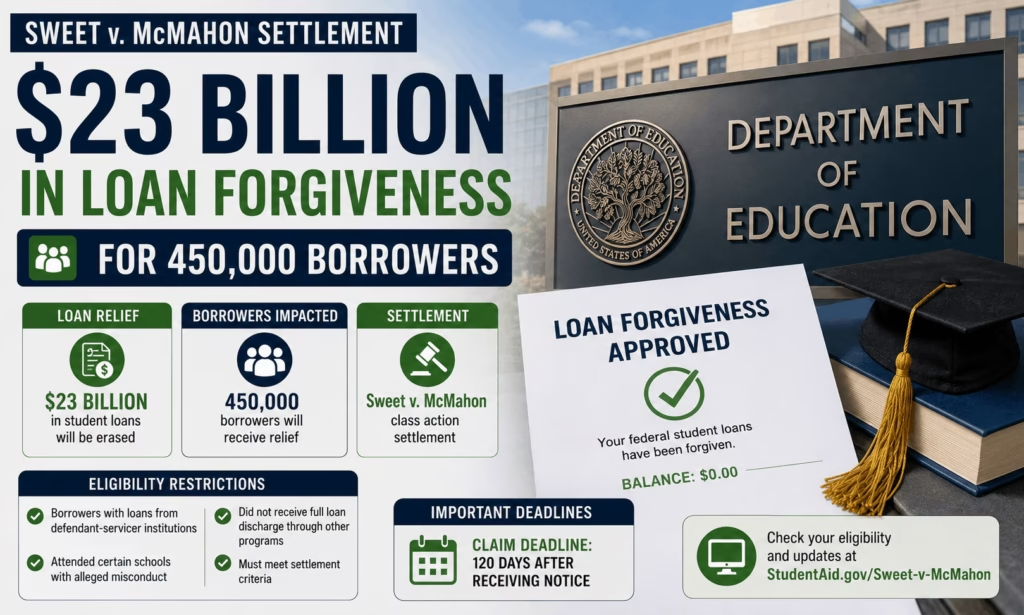
As of this month, the Department of Education has already discharged approximately $12 billion in loans and refunds for roughly 300,000 borrowers as of the most recent court filings from earlier this year. The July 17, 2026 ruling from the Ninth Circuit Court of Appeals rejected the Department’s latest attempt to delay processing a group of so-called post-class applicants, unlocking relief for nearly 200,000 additional borrowers and pushing the total number of people covered under the settlement to approximately 450,000, with total relief estimated at $23 billion.
The court has set a hard deadline for the remaining discharges. Under the settlement’s enforced timeline, the latest possible discharge date for any borrower still covered by the case is June 15, 2027, meaning the Department cannot indefinitely delay processing the remaining applications the way it has attempted to in prior court filings. This ruling marks what advocates describe as the effective end of the government’s ability to appeal or further stall the case, since the Ninth Circuit found no significant change in circumstances that would justify modifying the original settlement terms.
What Is The Sweet v. McMahon Settlement
The legal case behind this student debt relief has outlasted three presidential administrations and three different education secretaries, changing names along the way from Sweet v. DeVos in 2019, to Sweet v. Cardona under the Biden administration, and now Sweet v. McMahon under the current Trump administration’s Education Secretary Linda McMahon. The lawsuit was originally filed in 2019 on behalf of more than 750,000 borrowers who had submitted Borrower Defense to Repayment claims, a federal protection that allows defrauded student borrowers to have their loans discharged if their school engaged in misconduct.
Borrowers alleged the Department of Education had deliberately stopped processing their claims and, in some cases, wrongfully denied applications without properly reviewing their merits. A settlement was reached in 2022, finalized by the court that November, and it established strict rules for who would automatically qualify for relief and on what timeline, rules the Department has repeatedly tried to delay or narrow in the years since.
Direct Express Card Transition to Fifth Third Bank: What 3.6 Million Cardholders Need to Know
Federal Fuel Excise Tax Suspension: Ford Pushes Carney to Extend Relief Past Labour Day
USCIS Restored Power To Deny Without RFE: Here Is What Policy Alert PA-2026-05 Actually Changes
IEEPA Tariff Refund Process: How Businesses Are Claiming Their Share of $166 Billion
Key Highlights
| Detail | Information |
|---|---|
| Case name | Sweet v. McMahon, formerly Sweet v. DeVos and Sweet v. Cardona |
| Total borrowers covered | Approximately 450,000 |
| Total relief value | Approximately $23 billion |
| Already discharged as of earlier this year | Roughly $12 billion for about 300,000 borrowers |
| Most recent court ruling | Ninth Circuit Court of Appeals, July 17, 2026 |
| Newly unlocked borrowers from that ruling | Nearly 200,000 |
| Original lawsuit filed | 2019 |
| Settlement finalized | November 2022 |
| Final discharge deadline | June 15, 2027 |
| Governing protection | Borrower Defense to Repayment |
| New applications accepted under this settlement | No |
The Real Restrictions Behind The $450,000 Student Debt Relief
The single most important thing to understand about this student debt relief is that it is closed to new applicants. Eligibility depends entirely on two fixed factors that were locked in years ago: which school a borrower attended and when they filed their Borrower Defense application relative to the settlement’s key dates. Borrowers fall into a small number of defined groups rather than a single broad eligibility standard.
The first group covers original class members, meaning borrowers who had a pending Borrower Defense application as of June 22, 2022, and who attended one of more than 150 schools named on a specific settlement list known as Exhibit C. Borrowers who attended a school on that Exhibit C list were automatically eligible for full loan discharge and refunds without needing to prove anything further about their individual claim.
A second group covers borrowers who attended schools outside the Exhibit C list. These borrowers were instead assigned an individual deadline, based on when they applied for the settlement, by which the Department of Education was required to make a formal decision on their claim. If the Department missed that deadline, the borrower automatically qualified for full relief regardless of the underlying merits of their case, a provision that became central to the most recent court fight after the Department missed processing deadlines for more than 170,000 applicants and then asked the courts for an extension, which was denied.
A third, smaller restriction applies to what is actually forgiven. Relief under this settlement only covers loans tied to the specific school named in a borrower’s claim. A person who attended three different schools and was defrauded by only one of them still owes the loans connected to the other two institutions, since the discharge does not extend beyond the specific claim covered by the case.
Who Is Not Covered By This Settlement
Anyone hoping to newly apply for this specific pool of student debt relief will not be able to, since the settlement class was defined by the June 22, 2022 pending-application cutoff and the associated post-class filing window that ran through November 2022. Borrowers who believe they were defrauded by their school but never filed a Borrower Defense application, or who filed one after that window closed, are not covered by the Sweet v. McMahon settlement specifically. That said, the Borrower Defense to Repayment program itself remains open, and borrowers in that position can still submit a new claim through the standard process, it simply will not be decided under the accelerated timeline or automatic-relief provisions this settlement created.
Parent PLUS loan borrowers and loans not directly tied to a covered school are also excluded from the automatic relief structure, since the settlement’s discharge provisions are scoped specifically to the federal loans a borrower used to attend the institution named in their claim.
Why This Case Took So Long
The delay traces back to 2019, when the Department of Education under then-Secretary Betsy DeVos halted processing of Borrower Defense claims entirely, leaving more than 200,000 applications pending, some for nearly four years. Advocates sued, arguing the halt was deliberate and unlawful, and a settlement was eventually reached in 2022 requiring the Department to process claims on a strict schedule going forward. Even after that settlement, the current administration sought an 18-month extension in early 2026, which the district court denied, followed by an emergency stay request to the Ninth Circuit, which was also denied in March 2026 after the court found the Department unlikely to succeed on the merits of its appeal.
The Department’s stated reason for seeking delays centered on resource constraints and disagreement over whether post-class applicants who did not receive a timely decision should automatically qualify for full relief. The courts consistently rejected that argument, culminating in the July 2026 ruling that effectively closed off further appeals and set the final processing deadline for June 2027.
2027 Social Security COLA: 3.6% Estimate Beats Medicare Hike
2027 HSA Contribution Limits Announced: IRS Confirms $4,500 and $9,000 Caps
FTC Refund 2026: Millions of Americans May Be Owed Money and Most Don’t Know It
Tax Treatment Of This Student Debt Relief
Borrowers covered by this settlement should be aware of one important financial detail that separates this relief from other forms of student loan forgiveness making headlines in 2026. Discharges granted under Borrower Defense to Repayment, including everything processed through the Sweet v. McMahon settlement, remain federally tax-free, unlike income-driven repayment forgiveness, which lost its temporary tax exemption at the start of 2026 and can now generate a significant federal tax bill for borrowers whose remaining balance is canceled through those separate programs.
Official Sources
| Resource | Link |
|---|---|
| Federal Student Aid, Borrower Defense information | studentaid.gov/borrower-defense |
| Check your Borrower Defense application status | studentaid.gov, log into your account |
| Project on Predatory Student Lending, case tracker | ppsl.org/cases/sweet-v-mcmahon |
| U.S. Department of Education official announcements | ed.gov |
| Federal Student Aid scam warning resources | studentaid.gov/articles/avoid-student-loan-forgiveness-scams |
FAQs
Who qualifies for the $450,000 student debt relief settlement?
Borrowers who had a pending Borrower Defense application as of June 22, 2022 and attended one of more than 150 schools on the Exhibit C list, or who applied during the post-class window through November 2022 and did not receive a timely decision from the Department of Education.
Can I still apply for this specific student debt relief today?
No. This settlement’s eligibility was fixed by the June 22, 2022 cutoff and the associated post-class application window. You cannot newly qualify for this particular pool of relief, though the standard Borrower Defense program remains open for new claims.
How much debt is being erased under this settlement?
Approximately $23 billion total, covering roughly 450,000 borrowers, with about $12 billion already discharged for around 300,000 borrowers as of earlier this year.
Will this settlement cover all of my student loans?
Only if all of your loans are tied to the specific school named in your Borrower Defense claim. Loans connected to other schools you attended are not covered by this settlement.
Is this student debt relief taxable?
No. Discharges under Borrower Defense to Repayment, including this settlement, remain federally tax-free, unlike income-driven repayment forgiveness.
What is the deadline for the Department of Education to finish processing this relief?
The court has set June 15, 2027 as the latest possible discharge date for any borrower still covered under the Sweet v. McMahon settlement.
People Also Ask
What is Sweet v. McMahon? It is a class-action lawsuit, originally filed in 2019 as Sweet v. DeVos, on behalf of student loan borrowers who say they were defrauded by their colleges and sought Borrower Defense relief that the Department of Education delayed processing for years.
How do I check if I am covered by the Sweet v. McMahon settlement? Log into your account at studentaid.gov to check your Borrower Defense application status, or refer to the Project on Predatory Student Lending’s case tracker for the list of covered schools and settlement groups.
Do I need to pay anyone to get this student debt relief? No. Relief under this settlement is automatic for eligible borrowers and processed directly by the Department of Education at no cost. Anyone charging a fee to help you access this specific settlement is not legitimate.
Is Borrower Defense to Repayment still open for new claims? Yes. While the Sweet v. McMahon settlement itself is closed to new applicants, the underlying Borrower Defense to Repayment program remains open for borrowers who believe their school defrauded them.
Conclusion
The $450,000 student debt relief settlement represents one of the largest single debt cancellation actions of 2026, but it is far more restrictive than a general forgiveness program. Eligibility was locked in years ago based on which school a borrower attended and when they filed their claim, and the courts have now closed off the Department of Education’s ability to delay the remaining discharges further, with a final deadline of June 15, 2027. Borrowers who believe they may be covered should check their status directly through studentaid.gov rather than responding to unsolicited offers of help, since no legitimate part of this process requires a fee.
ICE Detained Military Families: AP Finds 50+ Spouses and Parents Held