SNAP State Cost-Share 2027: For the first time since the modern food stamp program began, states are about to become financially responsible for a share of the actual SNAP benefits paid to their own residents, and newly released federal error rate data shows most states are on track to owe money. The USDA’s Food and Nutrition Service confirmed that 10.62 percent of SNAP payments nationwide were made incorrectly in Fiscal Year 2025, a sharp jump from the pre-pandemic average of 6.6 percent between 2017 and 2019. Under the SNAP state cost-share 2027 requirement created by the One Big Beautiful Bill Act, or OBBBA, any state that fails to bring its payment error rate below 6 percent in either FY2025 or FY2026 will be required to fund a percentage of its own SNAP benefit costs starting in Fiscal Year 2028, which begins October 1, 2027. Only 9 states currently qualify for the zero percent tier, meaning 41 states plus the District of Columbia are facing a real financial bill unless they act fast. We’ll be updating this article monthly as more states release updated error rate data and finalize their FY2027 budgets.
This is a fundamental break from how SNAP has operated for decades. Historically, the federal government has covered 100 percent of SNAP benefit costs, while states and the federal government split administrative costs evenly. That changes on two fronts at once. Administrative cost sharing shifts from a 50-50 split to a 75-25 split in states’ favor of the federal government this October 2026, meaning states now cover 75 percent of administrative costs, and separately, the new benefit cost-share tiers tied to payment error rates begin in October 2027. Maryland alone has projected it could owe at least $240 million in FY2027 under the new formula, while national estimates suggest states collectively could be on the hook for up to $11 billion annually if error rates do not improve. This article breaks down exactly how the SNAP state cost-share 2027 formula works, which states are most exposed, and what happens next.
Key Highlights of the SNAP State Cost-Share 2027 Rule
| Detail | Information |
|---|---|
| Legal source | Section 10105, One Big Beautiful Bill Act (OBBBA) |
| Benefit cost-share start date | Fiscal Year 2028, beginning October 1, 2027 |
| Administrative cost-share change | Shifts from 50-50 to 75-25 (state-federal), effective October 2026 |
| National average error rate, FY2025 | 10.62 percent |
| Pre-pandemic average error rate (2017-2019) | 6.6 percent |
| States with error rate below 6 percent (zero cost-share) | Only 9 states |
| States facing potential cost-share exposure | 41 states plus Washington, D.C. |
| Error rate used for calculation | Lower of FY2025 or FY2026 rate (states can choose) |
| Maximum cost-share tier | 15 percent of benefit costs, for error rates 10 percent or higher |
| Estimated collective annual state exposure | Up to $11 billion |
| High-error state exemption cutoff | Error rate above 13.34 percent in FY2025 or FY2026 |
| Exemption expiration for high-error states | Fiscal Year 2029 or 2030, depending on which year triggered it |
How the SNAP Cost-Share Tiers Actually Work
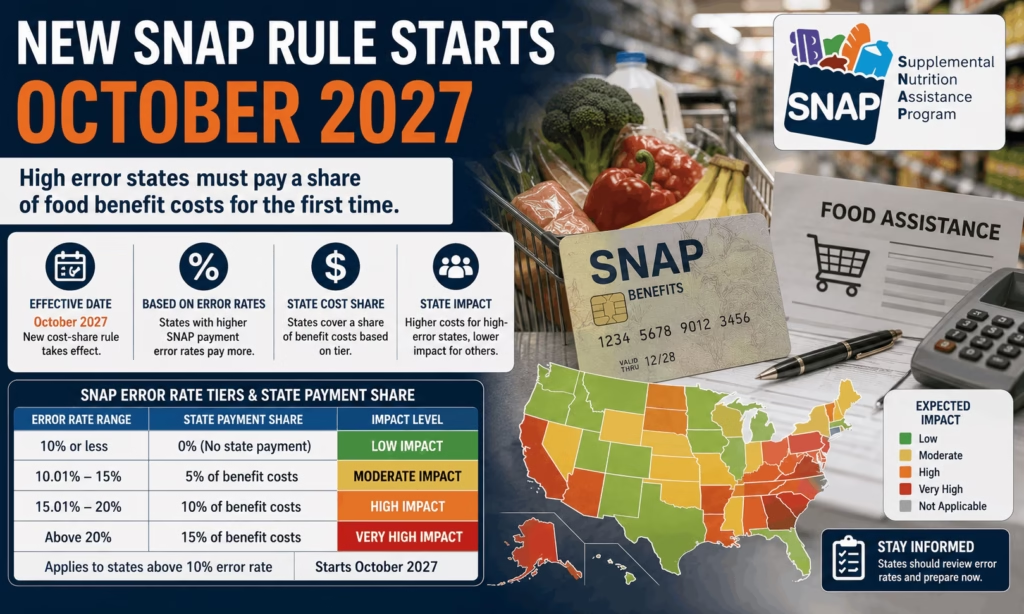
The OBBBA created a sliding scale that ties a state’s payment error rate directly to how much of its SNAP benefit costs it must cover starting in FY2028. States are grouped into four tiers based on their error rate performance.
| Payment error rate | State share of SNAP benefit costs |
|---|---|
| Below 6 percent | 0 percent |
| 6 percent to under 8 percent | 5 percent |
| 8 percent to under 10 percent | 10 percent |
| 10 percent or higher | 15 percent |
States get to choose whichever is lower between their FY2025 or FY2026 error rate when the initial cost-share obligation is calculated for FY2028. Starting in FY2029, though, USDA will simplify the process by automatically using the error rate from three fiscal years earlier, removing the option to pick the more favorable year going forward. This detail matters because it means FY2026 has effectively become a critical, one-time window for states to lower their error rates and lock in a lower long-term tier before the formula becomes fixed to a rolling three-year lookback.
The “Alaska Carveout”: A Temporary Exemption for the Worst-Performing States
A provision informally nicknamed the Alaska carveout gives the states with the highest error rates additional breathing room. Any state with an error rate above 13.34 percent in FY2025 gets its cost-share requirement delayed until FY2029, and any state that instead crosses that threshold in FY2026 gets a delay until FY2030. The delay can only be claimed once, based on either FY2025 or FY2026 data, not both years combined. Based on FY2024 data, ten jurisdictions would have qualified for this reprieve: Alaska, the District of Columbia, Florida, Georgia, Maryland, Massachusetts, New Jersey, New Mexico, New York, and Oregon. Alaska itself posted the nation’s highest error rate, above 23 percent, making it the clearest beneficiary of the delay.
Critics, including several state budget analysts, have pointed out that this creates a perverse incentive. Because the exemption rewards states with very high error rates by giving them extra years to prepare, while states that manage to lower their error rate just below the exemption threshold lose that protection and immediately face a cost-share bill, some states have reportedly slowed down error-rate improvement efforts to stay above the 13.34 percent cutoff a little longer. New Mexico’s Income Support Division director has publicly acknowledged managing this exact balancing act, since dropping the state’s error rate below 13.34 percent too early could trigger up to $153 million in new obligations sooner than necessary.
Real Numbers: What States Are Actually Projected to Owe
State-level fiscal analyses that have emerged since the FY2025 error rate release give a clearer sense of the real dollar exposure involved. Maryland’s current error rate of 13.08 percent places it in the maximum 15 percent cost-share tier, and state analysts project the commonwealth could owe at least $240 million in FY2027 alone, with additional exposure expected from other OBBBA provisions in later years. Massachusetts has projected its own exposure at $131.4 million annually at the current cost-share structure, with worst-case estimates reaching as high as $650 million annually if higher share percentages under alternate policy proposals had been adopted. New York previously estimated that a related administrative cost-sharing shift alone, separate from the benefit cost-share tiers, would add roughly $225 million in annual costs to the state budget.
| State | Reported error rate or tier | Estimated annual cost-share exposure |
|---|---|---|
| Maryland | 13.08 percent (15 percent tier) | At least $240 million |
| Massachusetts | High-error exemption eligible (FY2024 data) | $131.4 million to $650 million, depending on final structure |
| New York | Related to administrative cost-share shift | Approximately $225 million (administrative share alone) |
| Missouri | Error rate near or above 6 percent threshold | Approximately $150 million, based on 2024 benefit levels |
| Alaska | Over 23 percent (highest nationally) | Delayed to FY2029 under high-error exemption |
Why SNAP Payment Error Rates Jumped So Sharply
Understanding the cost-share fight requires understanding why error rates rose in the first place. SNAP operates as a federal-state partnership, with USDA’s Food and Nutrition Service setting program rules while state agencies handle eligibility determinations and benefit calculations. Advocacy groups such as the Food Research and Action Center argue that error rates reflect a complex administrative process carried out by eligibility workers under shifting rules, staffing constraints, and evolving verification requirements, not necessarily deliberate mismanagement. Pandemic-era staffing shortages, expanded caseloads, and repeated changes to program rules have all been cited as contributing factors behind the jump from the 6.6 percent pre-pandemic average to the 10.62 percent rate recorded in FY2025.
Agriculture Secretary Brooke Rollins has taken a different view, stating that the elevated error rates are proof that state accountability has been severely lacking in SNAP administration, a position that reflects the broader rationale Republicans in Congress used when designing the cost-share and increased work requirement provisions included in the OBBBA.
How States Can Prepare and Respond
- Confirm your state’s official FY2025 and FY2026 payment error rate directly through USDA’s Food and Nutrition Service quality control reports, since these figures determine your state’s cost-share tier.
- Identify whether your state qualifies for the high-error exemption, since states above the 13.34 percent threshold in either qualifying year receive a multi-year delay rather than immediate cost-share obligations.
- Review state budget projections now, since the FY2028 cost-share requirement, which begins October 1, 2027, requires lead time for legislative appropriations in most states.
- Track the separate administrative cost-share shift from 50-50 to 75-25, which takes effect in October 2026, a year before the benefit cost-share tiers begin, since it creates its own immediate budget pressure.
- Contact your state’s SNAP or human services agency directly for state-specific projections, since several states, including Maryland and Massachusetts, have already published their own fiscal impact estimates.
- Advocacy organizations and state legislators can track pending state-level legislation responding to the cost-share requirement, since some states are actively debating how to fund the new obligation or lobbying Congress for changes.
Processing Timeline: Key SNAP Cost-Share Dates to Know
| Date | What happens |
|---|---|
| July 2025 | OBBBA signed into law, creating the SNAP cost-share and work requirement provisions |
| FY2025 (October 2024-September 2025) | National error rate recorded at 10.62 percent |
| October 2026 | Administrative cost-share shifts from 50-50 to 75-25, state-federal split |
| FY2026 (October 2025-September 2026) | Second and final qualifying year states can use for their initial cost-share calculation |
| October 1, 2027 (start of FY2028) | Benefit cost-share tiers take effect for states above the 6 percent error rate threshold |
| FY2029 | Cost-share requirement begins for states that used the FY2025 high-error exemption |
| FY2029 onward | USDA switches to a fixed three-year lookback for calculating each state’s error rate tier |
| FY2030 | Cost-share requirement begins for states that used the FY2026 high-error exemption |
Who Is Affected by the New SNAP Rules
More than 41 million Americans rely on SNAP benefits nationwide, and while individual recipients are not directly billed under the cost-share rule, state budget pressure created by this requirement could influence future state-level SNAP policy, administrative funding, and program stability. State budget offices, human services agencies, and state legislators face the most direct and immediate impact, since they must plan for potentially hundreds of millions of dollars in new annual obligations depending on their state’s error rate. Grocery retailers and the broader food supply chain, which benefit from SNAP spending flowing through local economies, also have a financial stake in how states respond, since budget shortfalls could eventually translate into program cuts or eligibility changes at the state level if states struggle to cover their share.
Official SNAP and USDA Resources
| Resource | Link |
|---|---|
| USDA Food and Nutrition Service, SNAP program page | https://www.fns.usda.gov/snap/supplemental-nutrition-assistance-program |
| SNAP payment error rate reports | https://www.fns.usda.gov/snap/qc/error-rates |
| Find your state SNAP agency | https://www.fns.usda.gov/snap/state-directory |
| SNAP eligibility and application information | https://www.fns.usda.gov/snap/eligibility |
| USDA Food and Nutrition Service newsroom | https://www.fns.usda.gov/news |
| Text of the One Big Beautiful Bill Act (Congress.gov) | https://www.congress.gov |
Conclusion
The SNAP state cost-share 2027 requirement marks the most significant structural change to food assistance funding in the program’s history, ending an era where the federal government covered 100 percent of SNAP benefit costs regardless of state administrative performance. With only 9 states currently sitting below the 6 percent error rate threshold that avoids any cost-share obligation, most states have a narrow window through the end of FY2026 to improve their payment accuracy or begin planning for a bill that could reach into the hundreds of millions of dollars annually. States with the highest error rates get temporary relief through the so-called Alaska carveout, but that exemption expires by FY2029 or FY2030 at the latest, meaning the underlying financial reckoning is delayed, not avoided. For state budget officials, SNAP recipients, and anyone tracking how this policy reshapes food assistance funding nationwide, the next twelve months of error rate data will determine exactly how large each state’s bill becomes. This article will continue to be updated monthly as new state fiscal impact estimates and USDA error rate data are released.
FAQs About SNAP State Cost-Share 2027
What is the SNAP state cost-share requirement for 2027?
It is a new rule under the One Big Beautiful Bill Act requiring states with SNAP payment error rates above 6 percent to pay a percentage of their own SNAP benefit costs, starting in Fiscal Year 2028, which begins October 1, 2027.
How much will states have to pay under the new SNAP cost-share tiers?
States pay a sliding scale based on their error rate: 0 percent below 6 percent error, 5 percent for rates between 6 and 8 percent, 10 percent for rates between 8 and 10 percent, and 15 percent for rates of 10 percent or higher.
Which states currently qualify for zero cost-share under the SNAP rule?
Only 9 states had payment error rates below 6 percent in Fiscal Year 2025, allowing them to avoid the cost-share requirement entirely, based on the most recently released USDA data.
What is the Alaska carveout in the SNAP cost-share law?
It is a provision that delays the cost-share requirement until Fiscal Year 2029 or 2030 for states with error rates above 13.34 percent in FY2025 or FY2026, giving the highest-error states extra time before facing financial obligations.
Is the SNAP administrative cost-share also changing?
Yes, separately from the benefit cost-share tiers, the administrative cost split between states and the federal government shifts from 50-50 to 75-25 starting in October 2026, a year before the benefit cost-share rule begins.
How much could my state owe under the SNAP cost-share requirement?
It depends on your state’s error rate and total SNAP benefit spending. For example, Maryland has projected at least $240 million annually, while Massachusetts has projected a range between $131.4 million and $650 million depending on the final policy structure.
Can states still lower their error rate to avoid the cost-share requirement?
Yes, states can use whichever is lower between their FY2025 or FY2026 error rate for the initial FY2028 calculation, giving states through the end of FY2026 to improve payment accuracy before the tier is set.
Will SNAP benefits for individual recipients change because of the cost-share rule?
The rule directly affects state budgets rather than individual benefit amounts, though state budget pressure created by this requirement could influence future state-level program funding and policy decisions.
When does the SNAP state cost-share rule officially take effect?
The benefit cost-share tiers take effect at the start of Fiscal Year 2028, which begins October 1, 2027, for any state that has not brought its error rate below 6 percent by then.
Where can I check my state’s SNAP payment error rate?
USDA’s Food and Nutrition Service publishes payment error rate reports by state, linked in the official resources table above.