VA Benefits Lawyer: A wave of state crackdowns on so called claim sharks is reshaping how veterans think about paid help with their VA disability claims. California signed a law in February banning unaccredited companies from charging veterans for VA claims assistance, Texas secured a multimillion dollar settlement against a claims consulting firm accused of deceptive billing, and a federal judge in Louisiana struck down a state licensing scheme that let non-accredited consultants charge fees outside VA’s own rules. At the same time, the Department of Veterans Affairs has started publicly posting how much money it pays out directly to accredited attorneys and claims agents from veterans’ back pay awards, a transparency move meant to help veterans understand exactly where that money goes.
The result is a confusing landscape for any veteran wondering whether they actually need a VA benefits lawyer, and if they do, what a legitimate one is allowed to charge. The short answer is that federal law draws a hard line: no one, accredited or not, can charge you a fee to file your first VA disability claim. A VA benefits lawyer only enters the picture once VA has already issued a decision and you are appealing it, and even then, the fee is capped by regulation and tied strictly to the retroactive back pay you actually win. We’ll be updating this article monthly as new state laws, VA fee data, and payment rates come out.
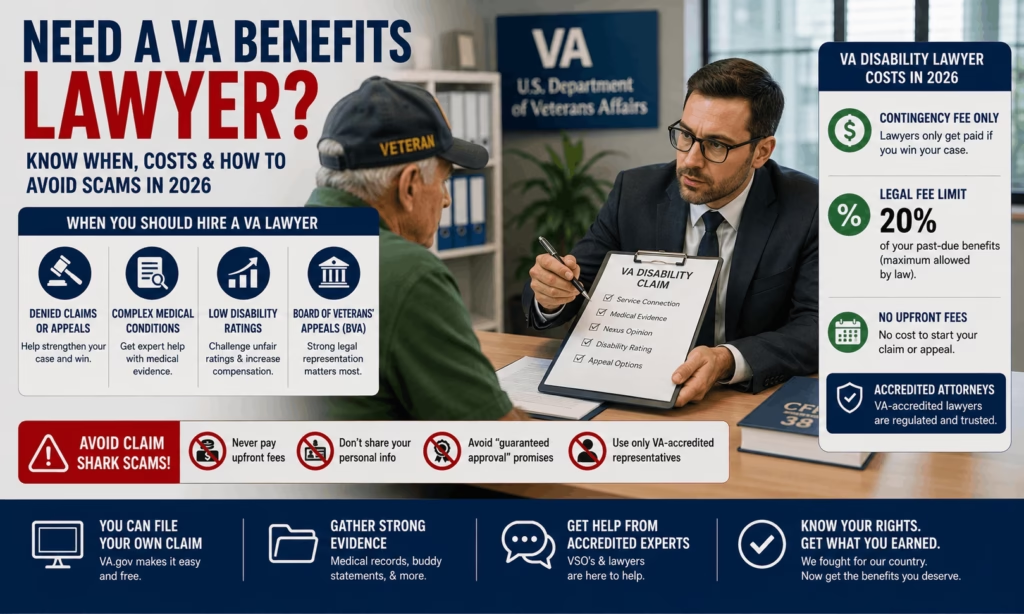
VA Benefits Lawyer Key Highlights
| Topic | Current Detail |
|---|---|
| Who can charge a fee | Only VA-accredited attorneys and claims agents, never Veterans Service Officers |
| When fees can start | Only after VA issues notice of an initial decision, never for a first time original claim |
| Presumed reasonable fee | 20 percent or less of past due benefits awarded |
| Presumed unreasonable fee | More than 33.33 percent of past due benefits awarded |
| Fee basis | Retroactive back pay only, never future monthly compensation |
| VA processing assessment | 5 percent of the attorney fee, capped at 100 dollars |
| 2026 VA backlog | About 100,000 claims pending over 125 days as of January 2026, down from 417,855 in January 2024 |
| Average claim decision time | 78.6 days as of May 2026, down from 141.5 days in January 2025 |
| States restricting claim sharks | California, Louisiana, Virginia, Mississippi, and others as of 2026 |
OAS Payment Increase September 2026: Confirmed Amounts, Payment Date, and the Annual GIS Reset !
Ohio SNAP Food Ban starts October 1, 2026: What’s Banned, Court Update & Rules
VSO, Claims Agent, or VA Benefits Lawyer: Who Actually Handles Your Claim
Every person who legally helps a veteran with a VA claim falls into one of three accredited categories, and understanding the difference matters more than most veterans realize before they sign anything.
Veterans Service Officers work for organizations like the American Legion, Disabled American Veterans, or a county veterans affairs office. They are accredited by VA, trained specifically on the claims process, and by law they can never charge a fee for their help, whether that is an original claim, a supplemental claim, or a Board appeal. For a large share of veterans filing a first time claim, a VSO is the right and only necessary point of contact.
Claims agents are non-attorneys who pass a VA administered exam and background check. They can charge fees under the same rules that apply to attorneys, but only for work performed after VA has issued an initial decision.
A VA benefits lawyer is a licensed attorney who has also completed VA accreditation. Attorneys operate under the identical fee structure as claims agents, but they are typically the better choice once a case moves toward the Board of Veterans Appeals or the United States Court of Appeals for Veterans Claims, where legal argument and case law carry more weight.
All three types must be individually accredited by the VA Office of General Counsel, and veterans can verify anyone’s accreditation status directly through VA’s own online representative database before signing a power of attorney or fee agreement.
Which VA Claims Actually Need a Lawyer
Hiring a VA disability lawyer is not the right move for every claim, and federal law does not even allow it for some. Here is where an accredited attorney genuinely tends to change the outcome.
Denied initial claims heading into appeal. Once VA denies a claim or grants a lower rating than expected, a veteran can choose one of three appeal lanes under the modernized review system, and this is the earliest point an attorney can legally get involved for a fee.
Total Disability based on Individual Unemployability, known as TDIU, where a veteran argues their service-connected conditions prevent substantially gainful employment. These claims often hinge on vocational evidence and medical opinion linkage that benefits from legal strategy.
Board of Veterans Appeals hearings, especially cases involving multiple denied conditions, conflicting medical evidence, or effective date disputes where thousands of dollars in retroactive pay are on the line.
Appeals to the United States Court of Appeals for Veterans Claims, or CAVC. This is a federal court, and representation here almost always requires an attorney because the proceedings involve formal legal briefing.
Complex secondary condition claims, where a veteran is trying to connect a new diagnosis, such as sleep apnea or a mental health condition, to an already service-connected disability through medical nexus evidence that VA has previously rejected.
Toxic exposure claims tied to the PACT Act that were initially denied, particularly where presumptive condition lists and exposure location evidence intersect in ways a VSO may not be equipped to litigate.
Effective date disputes, where a veteran believes VA assigned the wrong start date for benefits, potentially costing years of retroactive compensation.
Claims a veteran has already lost more than once, since a pattern of denial often signals the case needs a different kind of evidence development or legal argument than a first attempt provided.
| Claim Type | Lawyer Typically Needed | Free VSO Usually Sufficient |
|---|---|---|
| First time original disability claim | No, illegal to charge a fee | Yes |
| Claim denied, first appeal | Often helpful, optional | Sometimes |
| TDIU claim | Frequently recommended | Case dependent |
| Board of Veterans Appeals hearing | Frequently recommended | Case dependent |
| CAVC federal court appeal | Yes, near mandatory | No |
| Effective date dispute with large back pay | Often recommended | Case dependent |
| Routine rating increase request | No | Yes |
| Repeated denials on same condition | Often recommended | Case dependent |
$400 Inflation Refund Checks 2026: New York’s Real Program, Fact-Checked
Stimulus Check 2026: Fact-Checking Every Viral Payment Claim (Tracker)
Social Security SSI Payment Date September 2026 Confirmed by SSA- Check Full Schedule here!
How Much Does a VA Benefits Lawyer Cost
This is where federal regulation, specifically 38 CFR 14.636, does most of the work for veterans. The rule sets up two thresholds rather than one fixed number.
A contingency fee of 20 percent or less of the past due benefits VA awards is presumed reasonable, and this is also the only fee level that qualifies for VA’s direct pay arrangement, meaning VA sends the attorney their cut straight out of the back pay lump sum and the veteran never has to write a check.
A fee above 33.33 percent of past due benefits is presumed unreasonable, though that presumption can technically be challenged case by case based on complexity and time invested. In practice, most reputable VA benefits lawyer firms charge somewhere between 20 and 33.33 percent, with 20 percent and 30 percent being the two most common figures veterans encounter.
Three details matter more than the percentage itself. First, the fee only applies to retroactive back pay, the lump sum covering the period between your original claim’s effective date and the date VA finally approved it. Second, an attorney can never take a cut of your future monthly disability payments going forward, a claimant who tries to charge based on a rating increase for years into the future is violating VA rules outright. Third, if VA pays the attorney directly out of the award, VA also collects a processing assessment equal to 5 percent of that fee, capped at 100 dollars, which comes out of the attorney’s cut rather than the veteran’s pocket.
A 2025 rule change also restructured how VA handles disputes when more than one representative worked a single case over time. VA now issues what is called a Fee Allocation Notice with a default split between prior and current representatives instead of automatically reviewing every multi-attorney case, which has sped up how quickly veterans actually receive their portion of a delayed award.
To put the dollar amounts in perspective, here is what 2026 monthly compensation looks like at several rating levels for a veteran with no dependents, since past due benefits are essentially this monthly figure multiplied by the number of months a claim was wrongly delayed or underrated.
| 2026 Disability Rating | Monthly Payment, No Dependents |
|---|---|
| 10 percent | 180.42 dollars |
| 30 percent | 552.47 dollars |
| 50 percent | 1,132.90 dollars |
| 70 percent | 1,808.45 dollars |
| 90 percent | 2,362.30 dollars |
| 100 percent | 3,938.58 dollars |
These 2026 rates reflect a 2.8 percent cost of living adjustment effective December 1, 2025. A veteran who wins a Board appeal raising a rating from 50 percent to 100 percent with a two year retroactive effective date could be looking at a back pay award well into six figures depending on dependents, which explains why a properly capped contingency fee still leaves the overwhelming majority of the award, generally between 66.66 and 80 percent, in the veteran’s hands.
The Claim Shark Problem Every Veteran Should Know About
The single most important legal line in this entire topic is one veterans routinely encounter online: it is illegal for anyone, accredited or not, to charge a fee for helping file an original VA disability claim. Federal law removed the criminal penalty for violating this rule back in 2006, which is part of why a growing industry of unaccredited claims consultants has been able to operate for years, sometimes charging veterans 5,000 dollars or more for services a VSO provides free of charge.
That gap is now closing state by state. California’s SB 694, signed by Governor Gavin Newsom in February 2026, bans unaccredited private companies from billing veterans for VA claims help entirely and specifically targets companies that access a veteran’s VA.gov login without authorization. Texas secured more than 6.8 million dollars in debt relief for disabled veterans in a settlement with a claims consulting company accused of deceptive advertising and fee practices. Louisiana tried a different approach, licensing paid consultants under a state framework called the PLUS Act, but a federal court struck that law down in February 2026, ruling it was preempted by the existing federal scheme governing VA representation. Virginia and Mississippi have since passed their own versions of state oversight, and the rules can differ sharply depending on where a veteran lives.
At the federal level, two competing bills remain stalled in committee as of mid-2026. The GUARD VA Benefits Act and the SAFEGUARD Veterans Act would restore criminal penalties for unaccredited fee charging, while the CHOICE for Veterans Act would instead create a new legal paid pathway outside traditional accreditation. Neither has reached a floor vote.
Until federal law settles this question, the safest move for any veteran is to verify a representative’s accreditation status directly with VA before signing anything, and to walk away from any company charging a fee for an original claim regardless of how the service is marketed.
How to Apply for Representation
Hiring an accredited attorney or claims agent follows a specific process, and skipping steps can delay a claim.
Verify accreditation first. Search VA’s Office of General Counsel accredited representative database using the person or firm’s name before any conversation about fees.
Sign a power of attorney, VA Form 21-22a for an individual attorney or claims agent, which authorizes that person to act on your behalf and receive your claim file information.
Review the written fee agreement carefully. Federal law requires this agreement to be in writing, signed by both parties, and filed with VA. It must state clearly whether VA will pay the attorney directly out of past due benefits, and any agreement that fails to specify direct pay or that lists a fee above 20 percent is automatically treated as a private pay arrangement instead.
Confirm the fee is contingent, not hourly or a flat rate, unless the scope of work is narrow and clearly defined in writing. Contingency means the veteran pays nothing if the case is lost.
Ask specifically when the attorney’s involvement begins relative to your claim status, since fees are only permitted for work performed after VA has already issued notice of an initial decision, not before.
Processing Time for VA Appeals With Representation
Once a veteran chooses to appeal a decision, they select one of three lanes under VA’s modernized Appeals Modernization Act system, and processing time varies significantly by lane.
A Supplemental Claim allows a veteran to submit new and relevant evidence for VA to review, typically the fastest option when strong new medical evidence exists.
A Higher-Level Review sends the case to a more senior VA reviewer who looks only at the evidence already in the file, with no new evidence submitted, making it the quickest lane when a veteran believes VA simply made a factual or legal error the first time.
A Board Appeal sends the case to a Veterans Law Judge at the Board of Veterans Appeals, either with a hearing or without one, and this is the lane where an attorney’s involvement tends to matter most given the formal nature of the proceeding.
VA’s overall claims processing has accelerated sharply in 2026. The average time to complete a decision fell to 78.6 days by the end of May 2026, compared to 141.5 days in January 2025, even as VA processed a higher claims volume than the prior year and pushed accuracy above 94 percent. The national backlog, defined as any claim pending more than 125 days, dropped to about 100,000 claims by early 2026, down from a decade high of 417,855 in January 2024. Board appeals still generally take longer than original claims given hearing scheduling and case complexity, so veterans working with an attorney on a Board case should expect a longer timeline than a straightforward Supplemental Claim.
Canada 50% Tariff 2026: 700 US Goods Hit With Tariffs Up to 50% From September 8
Social Security Changes September 2026: SSA Announces Major Update for Retirees and Beneficiaries
Minimum Wage Increase in 5 Canadian Provinces: What Changes October 1, 2026
Payment Schedule: How and When the Attorney Actually Gets Paid
Veterans frequently misunderstand the mechanics of how a contingency fee moves once a case is won, so it helps to walk through the sequence.
VA issues its decision granting the claim or appeal, along with the retroactive effective date that determines the back pay period.
VA calculates the total past due benefits owed, essentially the monthly compensation rate multiplied by the number of months between the effective date and the date the award began.
If the fee agreement is a qualifying direct pay arrangement, meaning 20 percent or less and properly filed, VA withholds the attorney’s percentage from that lump sum and pays the attorney directly, then deposits the remaining balance to the veteran, generally between 66.66 and 80 percent of the total.
VA separately deducts its own processing assessment, 5 percent of the attorney’s fee up to a 100 dollar maximum, which comes out of the attorney’s payment rather than adding any cost to the veteran.
If the fee agreement exceeds 20 percent, VA does not handle payment directly, and the veteran is responsible for paying the attorney out of their own award once VA deposits the full retroactive amount.
Ongoing monthly disability compensation going forward is never touched by an attorney fee under any circumstance, since fees can only attach to the one time retroactive lump sum.
Official VA Resources
| Resource | Purpose | Link |
|---|---|---|
| VA Accredited Representative Search | Verify an attorney, claims agent, or VSO’s accreditation | va.gov/ogc/apps/accreditation |
| VA.gov Login and Claim Status | Check the status of a pending disability claim | va.gov/claim-or-appeal-status |
| VA Disability Compensation Rates | Official current monthly payment tables | va.gov/disability/compensation-rates |
| File a Disability Claim | Start or continue an original claim application | va.gov/disability/file-disability-claims-form-21-526ez |
| Appeal a VA Decision | Choose a Supplemental Claim, Higher-Level Review, or Board Appeal | va.gov/decision-reviews |
| Power of Attorney Form 21-22a | Appoint an individual accredited representative | va.gov/find-forms/about-form-21-22a |
FAQs About VA Benefits Lawyer 2026
Can a VA benefits lawyer help with my very first disability claim?
No. Federal law prohibits any representative, accredited or not, from charging a fee for an original claim before VA has issued its first decision. A free VSO is the appropriate choice at this stage.
How much does a VA disability lawyer cost on average?
Most accredited attorneys charge between 20 and 33.33 percent of the past due benefits awarded, with 20 percent being the most common rate since it qualifies for VA’s direct pay system.
Do I have to pay a VA benefits lawyer if I lose my appeal?
No. Nearly all VA disability attorneys work strictly on contingency, meaning payment only occurs if the veteran wins retroactive benefits.
Is it legal for a company to charge me for help filling out my initial VA claim forms?
No. This is one of the most common scams veterans encounter, and several states including California have passed laws in 2026 specifically banning this practice for unaccredited companies.
What is the difference between a claims agent and a VA benefits lawyer?
Both are individually accredited by VA and follow identical fee rules. A claims agent is a non-attorney who passed VA’s exam, while an attorney is a licensed lawyer with VA accreditation, generally preferred for Board or federal court level appeals.
Can a VA attorney take a percentage of my future monthly disability payments?
No. Fees can only be based on retroactive past due benefits already awarded, never on ongoing future compensation.
How do I check if a VA benefits lawyer is actually accredited?
Search the person or firm’s name directly in VA’s Office of General Counsel accredited representative database before signing any agreement.
People Also Ask
What percentage do VA disability lawyers take?
Typically between 20 and 33.33 percent of past due benefits, with anything above that threshold presumed unreasonable under 38 CFR 14.636.
Is it worth hiring a lawyer for VA disability?
For denied claims, TDIU cases, Board appeals, and CAVC appeals, an attorney often improves outcomes enough to justify the contingency fee, though straightforward first time claims rarely need one.
Can I switch VA disability lawyers in the middle of a case?
Yes, though a discharged attorney is only entitled to a fee reflecting their actual contribution to the case, not the full agreed percentage.
How long does a VA disability appeal take with a lawyer?
Timelines vary by appeal lane, but VA’s overall average decision time was 78.6 days as of May 2026, while Board appeals involving hearings typically take longer.
What happens if a VA claims agent is not accredited?
Charging a fee without accreditation violates federal law, and several states now impose their own additional penalties or outright bans on unaccredited paid claims assistance.
Conclusion
The rules governing a VA benefits lawyer are more protective of veterans than most people realize once they are laid out clearly. No one can legally charge for a first time claim, fees only apply to retroactive back pay, and federal regulation caps what is presumed reasonable at 20 percent while flagging anything above 33.33 percent as suspect. The bigger risk in 2026 is not accredited attorneys, who operate under strict VA oversight, but unaccredited claim sharks charging thousands of dollars for services a free VSO already provides, a problem state legislatures from California to Virginia are now actively working to shut down. Veterans considering an appeal, a TDIU claim, or a Board hearing should verify accreditation first, read the fee agreement carefully, and remember that a legitimate representative never gets paid unless the veteran wins.
Trump Accounts Dell $250 Grant: Did Deposits Actually Start Monday? Here’s Who’s Actually Been Paid
2027 Social Security COLA Forecast: Latest 3.6% Estimate and How Much Retirees Could Get
$2000 Stimulus Payment September 2026 Fact-Check: Is It Really Coming?