UK Free Bus Pass Rules 2026: Millions of people approaching retirement in England are facing a longer wait for free travel, after the Department for Transport confirmed the qualifying age for the free bus pass is rising from 66 to 67. The UK free bus pass rules 2026 change began phasing in from April 2026 and ties eligibility directly to the State Pension age, which is itself climbing under the Pensions Act 2014. Roughly 700,000 older adults are expected to be affected, though because the increase rolls out gradually by month of birth rather than overnight, most people will only wait a few extra months rather than a full year.
The government has been clear about one thing: this is not the scheme being scrapped. Free off-peak bus travel remains available under the English National Concessionary Travel Scheme, and anyone who already holds a valid pass keeps it until it expires. What has changed is the entry point, and it now depends heavily on your exact date of birth rather than a fixed birthday. This guide walks through the new phased timetable, how the rules differ across Scotland, Wales, and Northern Ireland, what happens to disabled person’s passes, and how to check your own eligibility date. We’ll be updating this article monthly as further transport announcements are confirmed.
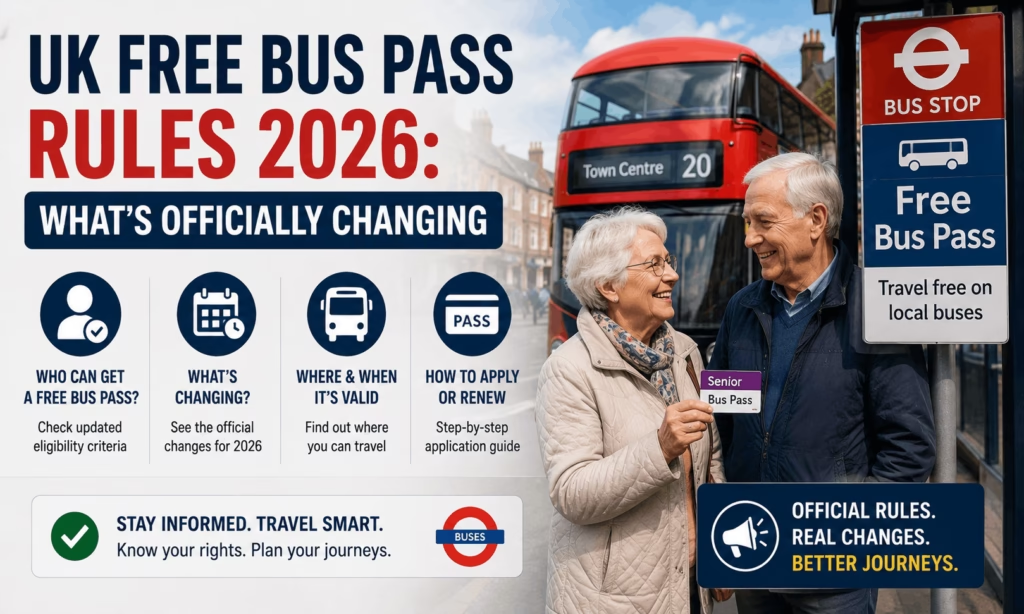
What Exactly Is Changing Under the New UK Free Bus Pass Rules
Free bus travel for older people in England is provided through the English National Concessionary Travel Scheme, commonly known as the ENCTS. Historically, the qualifying age for this scheme was fixed at the State Pension age, which stood at 66 for several years. Under reforms tracing back to the Pensions Act 2014, the State Pension age is now rising to 67, with the increase being phased in between 2026 and 2028, and a further rise to 68 planned for the period between 2044 and 2046.
Because bus pass eligibility has always been linked to State Pension age rather than a standalone number, the concessionary travel threshold automatically moves alongside it. The Department for Transport has confirmed this is a direct knock-on effect of the pension reform rather than a separate cut to transport spending, though critics argue the practical result is the same for anyone who now has to wait longer.
The Phased Timetable: When You Actually Qualify
This is the detail that trips up most people searching for an answer, since the change does not happen on a single fixed date. Instead, it phases in month by month according to date of birth.
| Date of Birth | New Qualifying Position |
|---|---|
| Before 6 April 1960 | Already qualified under the previous age-66 threshold |
| 6 April 1960 to 5 March 1961 | Qualifies on a phased date part-way between 66 and 67, based on exact birth month |
| On or after 6 March 1961 | Qualifies at age 67 under the fully phased-in rule |
The safest way to find an exact personal date is to use the official State Pension age checker on GOV.UK, since in England that result now doubles as the free bus pass eligibility date. Anyone who already holds a valid pass does not need to do anything, as existing passes remain valid right through to their printed expiry date regardless of the age change.
How the Rules Differ Across the UK
This is where a lot of confusion comes from, because the age rise only applies in England. The devolved nations continue to run considerably more generous schemes of their own, and none of them have announced a matching increase.
| Nation | Free Bus Travel From | Scheme Name |
|---|---|---|
| England | State Pension age, rising to 67 | English National Concessionary Travel Scheme (ENCTS) |
| Scotland | Age 60 | Scotland’s National Entitlement Card |
| Wales | Age 60 | Welsh Concessionary Travel Scheme |
| Northern Ireland | Age 60 | SmartPass |
| London (within England) | Age 60 | 60+ London Oyster photocard |
That gap between England’s rising threshold and the age-60 schemes elsewhere has drawn sustained criticism from campaigners, who argue England should align with the rest of the UK rather than the other way around. A public petition on the issue gathered more than 100,000 signatures, clearing the threshold required to trigger a formal debate in Parliament, and that debate has since taken place, though no commitment to lower the English age has followed.
Notably, London retains its own separate 60+ Oyster photocard scheme even though it sits within England, which means a Londoner and someone living just outside the capital can face genuinely different qualifying ages despite both living in England.
USCIS Restored Power To Deny Without RFE: Here Is What Policy Alert PA-2026-05 Actually Changes
IEEPA Tariff Refund Process: How Businesses Are Claiming Their Share of $166 Billion
50% US Tariffs on Canadian Goods: Full List and What Changes
Disabled Person’s Bus Passes Are Not Affected
One point the Department for Transport has repeatedly stressed is that this change applies only to the older person’s pass. A Disabled Person’s Bus Pass remains available at any age to anyone who meets the qualifying disability criteria, which typically covers mobility impairments, serious sight or hearing loss, certain learning disabilities, and a range of long-term health conditions assessed individually by local councils. The age rise has no bearing whatsoever on this route into the scheme, and existing disabled person’s passes are entirely unaffected.
Local councils remain responsible for assessing individual disability applications, and criteria can vary slightly depending on the local transport authority, so anyone applying on disability grounds should check their specific council’s requirements rather than assuming a single national standard applies everywhere.
What Stays the Same Under the 2026 Rules
Away from the headline age change, most of the scheme continues exactly as before. Standard off-peak travel hours remain 9:30am to 11pm on weekdays, with free travel all day on weekends and bank holidays. The government has repeatedly stated the benefit itself is not being withdrawn, only the entry age is shifting in line with pension reform. Local transport authorities also retain the ability to offer more generous local terms funded from their own budgets, and several are already doing so.
Greater Manchester’s Bee Network is a notable example, scrapping the 9:30am off-peak restriction entirely from March 2026, meaning concessionary pass holders there can travel free at any time of day rather than only outside the morning rush. Other city regions are reportedly watching how that change plays out and may follow with similar local enhancements, though there is no national requirement forcing them to do so.
Key UK Free Bus Pass Updates at a Glance
| Update | Detail | Effective Date |
|---|---|---|
| Age rise begins | ENCTS qualifying age starts moving from 66 toward 67 | April 2026 |
| Phased increase continues | Age rises month by month according to date of birth | 2026 to 2028 |
| Fully phased in | Everyone born on or after 6 March 1961 qualifies at 67 | By 2028 |
| Bee Network change | Greater Manchester removes the 9:30am off-peak restriction | March 2026 |
| Next pension age rise | State Pension age set to rise from 67 to 68 | Between 2044 and 2046 |
How to Check Your Eligibility and Apply
- Use the official State Pension age checker on GOV.UK to find your exact personal qualifying date, since this now determines your bus pass eligibility date in England.
- If you already hold a valid pass, take no action. It remains valid until its printed expiry date regardless of the new age rule.
- If you are approaching your new qualifying date, watch for a renewal or first-time application notice from your local council, since councils administer passes locally even though the scheme is nationally funded.
- Apply through your local council’s website once you reach your confirmed qualifying date, providing proof of age and address as required.
- If you believe you qualify on disability grounds regardless of age, apply directly to your local council for a Disabled Person’s Bus Pass, using their specific assessment process.
- If facing a longer wait under the new rules, ask your local council whether any local concessions, discounted fares, or community transport options are available in the meantime.
Official Bus Pass Resources
| Resource | What It’s For | Official Link |
|---|---|---|
| Apply for an Older Person’s Bus Pass | Official GOV.UK application guidance | gov.uk/apply-for-elderly-person-bus-pass |
| Check Your State Pension Age | Confirms your exact bus pass qualifying date | gov.uk/state-pension-age |
| Disabled Person’s Bus Pass | Apply for a pass regardless of age | gov.uk/apply-for-disabled-bus-pass |
| Scotland’s National Entitlement Card | Free travel from age 60 in Scotland | mygov.scot/free-bus-travel-older-people |
| Welsh Concessionary Travel Scheme | Free travel from age 60 in Wales | gov.wales/concessionary-travel |
| Northern Ireland SmartPass | Free travel from age 60 in Northern Ireland | nidirect.gov.uk/articles/smartpass |
Borrower Defense Student Loans: How to Apply for a Full Discharge?
IRS Business Tax Account New Features Give Small Businesses More Ways to Skip the Phone Line
SSA Payroll Information Exchange and New SSI Improvement Office: What the Report Actually Changes
FAQs
What is the new age for a free bus pass in England?
The qualifying age is rising from 66 to 67, phased in gradually by date of birth between April 2026 and 2028, in line with the increase in the State Pension age.
Will I lose my bus pass if I already have one?
No. Any pass already issued remains valid until its printed expiry date. The age change only affects people who have not yet reached their qualifying date.
Does the age rise apply to Scotland, Wales, or Northern Ireland?
No. This change is specific to England’s National Concessionary Travel Scheme. Scotland, Wales, and Northern Ireland continue to offer free bus travel from age 60 under their own separate schemes.
Does the change affect disabled person’s bus passes?
No. A Disabled Person’s Bus Pass remains available at any age to anyone who meets the qualifying disability criteria, and this route is completely unaffected by the older person’s age rise.
How do I find out my exact qualifying date?
The most reliable way is to use the official State Pension age checker on GOV.UK. Because English bus pass eligibility is tied to State Pension age, that result tells you your qualifying date for both.
Are the free travel hours changing too?
For most of England, no. Standard off-peak hours remain 9:30am to 11pm on weekdays with free travel all day on weekends and bank holidays, though some local authorities, such as Greater Manchester, are removing these restrictions locally.
Will the qualifying age keep rising after 2028?
The State Pension age is scheduled to rise again from 67 to 68 between 2044 and 2046, and since bus pass eligibility tracks pension age, the qualifying age is expected to rise again at that point too.
Conclusion
The UK free bus pass rules 2026 update is best understood as a knock-on effect of pension reform rather than a standalone cut to transport support. The scheme itself is not disappearing, existing passes remain valid, and disabled person’s passes are entirely untouched, but anyone in England approaching their mid-sixties now needs to check their specific date of birth against the phased timetable rather than assuming a fixed birthday applies. With Scotland, Wales, and Northern Ireland holding firm on their age-60 schemes, and some English city regions like Greater Manchester adding their own local improvements, where someone lives now plays a bigger role than ever in when they can start travelling for free. Anyone unsure of their position should check the official GOV.UK State Pension age tool first, since that single result answers the bus pass question for most people in England.
Direct Express Card Transition to Fifth Third Bank: What 3.6 Million Cardholders Need to Know
Federal Fuel Excise Tax Suspension: Ford Pushes Carney to Extend Relief Past Labour Day
FTC Refund 2026: Millions of Americans May Be Owed Money and Most Don’t Know It