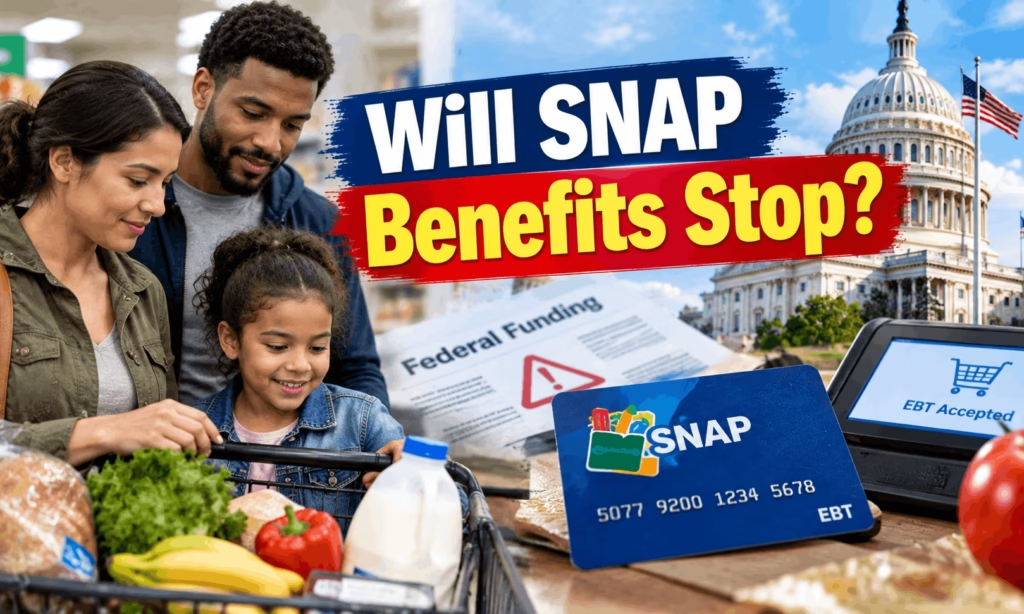
SNAP Benefits: The October 1 funding cliff came and went without a shutdown this year, but that hasn’t erased the anxiety millions of SNAP households felt just eleven months ago, when food assistance for 42 million Americans was suspended for the first time in 60 years during the 2025 shutdown. With government funding now set to expire again on December 11, 2026, and twelve full-year spending bills still unresolved, the question on many families’ minds is straightforward: will SNAP benefits stop if the government shuts down once more?
The honest answer, based on what just happened less than a year ago, is that it depends entirely on how long a shutdown lasts and how the U.S. Department of Agriculture chooses to interpret its own contingency funding rules a legal gray area that ended up in federal court last time. During the 43-day shutdown that ran from October 1 to November 12, 2025, the USDA initially announced it would suspend all November SNAP payments, triggering lawsuits from Democratic attorneys general, emergency court orders, and weeks of confusion for states trying to figure out whether they could issue full benefits, partial benefits, or none at all. With another funding deadline now on the calendar, understanding exactly how that standoff played out is the clearest guide to what SNAP recipients could face if December 11 arrives without a deal. We’ll be updating this article monthly as the funding deadline approaches and if new USDA guidance is issued.
SNAP Benefits and Government Shutdown Risk
As of this writing, the federal government is fully funded through December 11, 2026, under a continuing resolution President Trump signed into law on September 2. That means SNAP benefits are currently being issued on their normal schedule, and no suspension is in effect. However, the same underlying dynamic that caused the November 2025 disruption a mismatch between mandatory program obligations and annual appropriations hasn’t gone away. SNAP is a mandatory spending program, meaning Congress is legally obligated to fund it, but the actual money still flows through annual appropriations bills that must be renewed or extended, which is exactly the mechanism that broke down last time.
SNAP Benefits Government Shutdown Key Highlights
| Detail | Information |
|---|---|
| Current government funding status | Funded through December 11, 2026 |
| Americans who rely on SNAP | Approximately 42 million |
| Monthly cost to fully fund SNAP | Roughly $8–9 billion |
| USDA SNAP contingency fund (2025) | Approximately $5–6 billion |
| Last time SNAP benefits were suspended | November 1, 2025, during the 43-day shutdown |
| How the 2025 suspension ended | Federal judges in Rhode Island and Massachusetts ordered USDA to release contingency funds |
| Groups most affected by SNAP disruptions | 16 million children, 8 million seniors, 4 million people with disabilities, 1.2 million veterans |
| Next possible shutdown risk date | December 11, 2026 |
What Happened to SNAP During the 2025 Government Shutdown
To understand what could happen to SNAP benefits if the December 11 deadline is missed, it’s worth walking through exactly what unfolded during the last shutdown, since it remains the clearest real-world precedent. Early in the shutdown, USDA’s own published contingency plan stated plainly that the agency believed it had congressional authority to keep SNAP running using multi-year contingency funds, even during a lapse in annual appropriations. That plan explicitly said those contingency dollars could be used to fund participant benefits, not just state administrative costs, if a funding lapse occurred mid-year.
That position changed abruptly in late October. On October 24, 2025, the USDA reversed course, telling state agencies in a memo that contingency funds could only be used to supplement regular benefits when funds had already been appropriated but were insufficient not to replace an appropriation that no longer existed at all. Around the same time, the agency’s original 55-page shutdown contingency plan disappeared from its website entirely. The USDA formally announced that all November SNAP payments would be suspended starting November 1, 2025, warning that the program’s contingency well had “run dry.”
US Diesel Prices $6 a Gallon: Iran War Squeezes Fuel Supply to a Record High
25th Anniversary of 9/11 Attacks: How America Is Marking ‘Moments That Divide Time’
Timeline: The 2025 SNAP Shutdown Crisis
| Date | Development |
|---|---|
| October 1, 2025 | Government shutdown begins after Congress fails to pass appropriations |
| October 10, 2025 | States warned SNAP funding could run out by month’s end |
| October 24, 2025 | USDA reverses its own shutdown plan, says contingency funds cannot cover November benefits |
| October 24–31, 2025 | USDA’s original contingency plan document removed from its website |
| November 1, 2025 | SNAP benefits officially suspended for the first time in roughly 60 years |
| Early November 2025 | Democratic attorneys general and governors sue USDA over the suspension |
| November 2025 | Federal judges in Rhode Island and Massachusetts order USDA to use contingency funds to pay benefits |
| November 12, 2025 | Government shutdown ends after 43 days; full funding restored |
| November 13, 2025 | USDA instructs states to issue full SNAP benefits following the shutdown’s resolution |
The Legal Fight Over SNAP’s Contingency Funds
At the center of the 2025 dispute was a genuine legal disagreement over how SNAP’s contingency reserve estimated at somewhere between $5 billion and $6 billion could legally be used. Democratic state officials argued in lawsuits that the USDA had funds available sufficient to cover all, or at least a substantial portion, of November benefits, pointing to the agency’s own prior shutdown plan, which stated clearly that Congress intended for the reserve to support participant benefits during a mid-year funding lapse.
The USDA countered that the contingency fund was designed specifically for sudden, unforeseen emergencies like natural disasters such as the disaster-specific SNAP program used after hurricanes or floods and argued that a government shutdown caused by a congressional impasse didn’t qualify as that kind of contingency. The agency also noted that even the full contingency reserve wouldn’t come close to covering a full month of national SNAP benefits, since it costs roughly $8 to $9 billion per month to fund the program nationwide, meaning contingency funds alone could only ever cover a fraction of what recipients normally receive.
Federal judges ultimately sided against the USDA’s narrower interpretation, ordering the agency to tap its contingency funds to pay benefits during the shutdown. Even so, the legal back-and-forth, combined with appeals and shifting USDA guidance, left many states distributing partial benefits or facing delays even after the court orders were issued a reminder that a court ruling doesn’t guarantee an immediate, smooth resumption of payments.
Could the Same Thing Happen at the December 11 Deadline?
Nothing about the underlying legal ambiguity that caused the 2025 crisis has been permanently resolved, which is why the question of what happens to SNAP at the next funding deadline remains genuinely uncertain. If Congress fails to pass full-year appropriations or another continuing resolution before December 11, the same basic dynamic could repeat: SNAP would continue to be legally classified as mandatory spending, but the actual appropriated funds needed to issue monthly benefits would still lapse alongside other discretionary government functions, forcing USDA to decide once again whether and how to use its contingency reserve.
There are a few meaningful differences worth noting heading into this next deadline. USDA’s shutdown contingency plan for the current fiscal year, and the exact size of its current contingency reserve, may differ from what was available in October 2025, and it remains unclear whether the agency would take the same legal position it took last year or adopt a different approach after facing multiple adverse court rulings. Additionally, unlike the run-up to the October 2025 shutdown, this year’s political dynamics are shaped heavily by the fact that a December 11 shutdown would land squarely in a post-election lame-duck session, which could change the incentives for both parties to reach a deal quickly rather than risk a repeat standoff.
How SNAP Recipients Can Prepare?
While there’s no way to predict with certainty whether the December 11 deadline will produce another shutdown, SNAP recipients can take a few practical steps to reduce the impact if a disruption does occur, based on lessons learned from the 2025 experience. Households should make sure their contact information and EBT card details are current with their state SNAP office, since state agencies are typically the first to communicate any changes to benefit timing. Building even a small buffer of shelf-stable food, when financially possible, can help offset a short delay in benefit issuance. Recipients should also watch for official communication directly from their state SNAP agency rather than relying solely on national headlines, since the exact timing and amount of any partial benefits during a funding lapse can vary significantly by state, as it did in November 2025.
Food banks and local charitable organizations also play a critical role during SNAP disruptions. During the 2025 shutdown, many food banks nationwide reported sharp increases in demand as SNAP households sought alternative food assistance while payments were delayed, underscoring the broader ripple effect a SNAP suspension has on emergency food systems even beyond the households directly affected.
Steps SNAP Households Can Take Now
- Confirm your mailing address and contact information are current with your state SNAP office
- Sign up for email or text alerts from your state agency if available
- Locate a nearby food bank or pantry in advance, in case of a delay
- Check your state’s SNAP website directly rather than relying only on national news for benefit timing updates
- Review your EBT balance regularly so you know exactly what’s available if new deposits are delayed
Gas Tax Holiday 2026: Which States Are Giving Drivers Relief Right Now
Government Shutdown October 2026 Averted — Funding Runs to Dec 11
SNAP Shutdown Gap Calculator
Use this calculator to estimate how much of a shortfall your household could face if SNAP benefits are delayed during a future funding lapse, based on your normal monthly benefit amount. This tool is for planning purposes only and does not affect your actual EBT balance or benefit issuance.
What About Other Federal Nutrition Programs?
SNAP isn't the only nutrition assistance program affected by shutdown risk, though it tends to draw the most attention given its size. The Special Supplemental Nutrition Program for Women, Infants, and Children, known as WIC, has historically had somewhat more flexibility during funding lapses, since states can carry over a percentage of the previous year's WIC funding and the program has its own contingency mechanisms. During the 2025 shutdown, the USDA used Section 32 funds to temporarily support WIC even as SNAP benefits were suspended, though WIC funding is also finite and can face its own risk of disruption during a prolonged lapse.
School meal programs, by contrast, are generally considered more insulated from short-term shutdowns because school districts typically have funding commitments and reimbursement structures that operate somewhat independently of the federal government's day-to-day appropriations status, though a sufficiently long shutdown could eventually affect reimbursement timing there as well.
Official Resources to Track SNAP and Shutdown Updates
| Resource | Purpose | Link |
|---|---|---|
| USDA Food and Nutrition Service | Official SNAP program updates and shutdown guidance | https://www.fns.usda.gov/snap |
| Your state's SNAP office | State-specific benefit status, EBT balance, and login/registration | https://www.fns.usda.gov/snap/state-directory |
| Congress.gov | Track appropriations bills tied to the December 11 deadline | https://www.congress.gov |
| USDA WIC Program | WIC benefit status and eligibility during funding lapses | https://www.fns.usda.gov/wic |
| Feeding America | Locate a food bank near you | https://www.feedingamerica.org |
FAQs About SNAP Benefits Shutdown News
Will SNAP benefits stop if the government shuts down in December 2026?
It's possible, based on what happened during the 2025 shutdown, when SNAP benefits were suspended for the first time in roughly 60 years. Whether it happens again depends on how long any future shutdown lasts and how USDA chooses to interpret its contingency funding authority.
Did SNAP benefits actually stop during the last government shutdown?
Yes. The USDA suspended all November 2025 SNAP payments starting November 1, before federal judges ordered the agency to use contingency funds to pay benefits, resulting in a mix of full, partial, and delayed payments across different states.
How much money is in SNAP's contingency fund?
Estimates place the SNAP contingency reserve at roughly $5 to $6 billion, though the exact figure fluctuates and would only cover a fraction of the roughly $8 to $9 billion needed to fund a full month of national SNAP benefits.
Is the government currently shut down?
No. Congress passed a continuing resolution that President Trump signed into law on September 2, 2026, funding the government through December 11, 2026.
What should I do if my SNAP benefits are delayed during a shutdown?
Contact your state SNAP office directly for the most accurate, up-to-date information, and consider reaching out to a local food bank for temporary assistance while payments are resolved.
Does a government shutdown affect WIC benefits too?
It can, though WIC has historically had somewhat more funding flexibility than SNAP during short-term shutdowns, thanks to carryover funds and its own contingency mechanisms.
How long did SNAP benefits remain suspended in 2025?
SNAP benefits were suspended starting November 1, 2025, with court-ordered partial and full payments following over the subsequent weeks until the shutdown ended on November 12 and full funding was restored.
Conclusion
SNAP benefits are not currently affected by any government shutdown, since Congress and President Trump reached a funding agreement through December 11, 2026. But the legal ambiguity that caused a first-of-its-kind SNAP suspension during the 2025 shutdown hasn't disappeared, and if lawmakers fail to reach a new agreement by the December deadline, roughly 42 million Americans who rely on food assistance could once again face uncertainty over whether, and when, their benefits will arrive. The clearest lesson from last year's crisis is that court intervention, not a swift administrative decision, ultimately restored SNAP payments a process that took weeks and left many households in temporary limbo even after judges ruled in their favor. Staying informed through official state and federal channels, rather than relying on shifting headlines, remains the most reliable way for SNAP households to navigate any future disruption.
How The 2026 Midterms Could Affect Your SNAP, Medicaid & Social Security Benefits
H-1B Families Leaving US Homes and Cars Behind to Return to India? See Viral Post