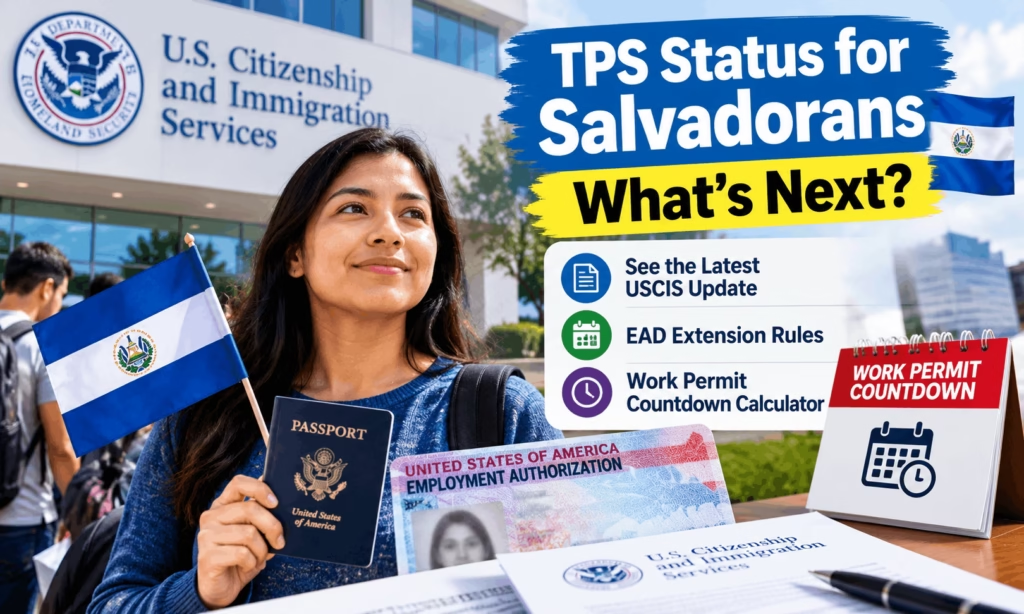
TPS Status for Salvadorans: Temporary Protected Status for roughly 200,000 Salvadorans passed its scheduled September 9, 2026 expiration date without a termination notice from the Department of Homeland Security, leaving hundreds of thousands of long-term residents in a holding pattern rather than facing an immediate loss of status. USCIS confirmed on its designated country page that “an announcement on El Salvador’s TPS will be made at the appropriate time” and that until that announcement is issued, Salvadoran individuals in the United States under TPS retain their protection, including work authorization. The statement replaced earlier guidance that had described the designation as “set to terminate,” a shift that immigration attorneys and advocacy groups are calling significant given the surrounding legal landscape. We’ll be updating this article monthly as DHS moves toward a final decision and as new court rulings affect Salvadoran TPS holders directly.
The uncertainty traces back to a federal law that most TPS holders have never had to think about until now. Under the statute governing Temporary Protected Status, the Homeland Security Secretary is required to review country conditions and publish a decision at least 60 days before a designation expires. If no determination is published on time, the designation is supposed to extend automatically for six months, or longer at the secretary’s discretion. DHS Secretary Markwayne Mullin missed that statutory deadline for El Salvador, and as of this update, the government has not filed a Federal Register notice terminating or extending the designation. That gap, combined with the Supreme Court’s June ruling narrowing judicial review of TPS decisions in unrelated cases, has created the most consequential open question in immigration policy for Salvadoran families this fall, and it directly affects whether hundreds of thousands of work permits remain valid past September.
TPS Status for Salvadorans Key Highlights
| Detail | Information |
|---|---|
| Approximate number of Salvadoran TPS holders | About 200,000 people |
| TPS designation in place since | 2001, following two major earthquakes |
| Scheduled expiration date | September 9, 2026 |
| Statutory deadline for a DHS decision | 60 days before expiration (July 11, 2026); missed |
| Current USCIS guidance | Protections and work authorization continue pending formal announcement |
| Automatic EAD extension for A-12/C-19 categories | Extended through September 9, 2026 |
| Legal precedent narrowing court review | Mullin v. Doe, Supreme Court, June 25, 2026 |
| Notice period required before termination takes effect | 60 days after a Federal Register termination notice |
| Annual remittances sent to El Salvador | Approximately $9.9 billion, about 24% of El Salvador’s GDP |
Latest Update: Why TPS Status for Salvadorans Is Still Active
USCIS’s own guidance changed at the last possible moment. As recently as early September, the agency’s alert page for El Salvador described the designation as “set to terminate on Sept. 9, 2026” and instructed employers on how to update Form I-9 records accordingly. Then, on the day the designation was scheduled to lapse, the page was updated again, this time stating that a final decision had not been made and that protections, including employment authorization, would continue until DHS formally announces otherwise.
The Department of Homeland Security has offered a similar explanation directly to reporters, telling news outlets that an announcement “will be made at the appropriate time.” Because the statute governing TPS does not specify an exact hour or day by which the government must act once the review period has passed, immigration attorneys say Salvadoran TPS holders are currently protected by the combination of missed statutory deadlines and the absence of any published termination decision. Attorneys have also emphasized that even if DHS eventually announces a termination, the law requires a 60-day notice period before work authorization and protection from removal actually end, meaning the situation would not translate into an overnight loss of status.
Medicare Open Enrollment 2026-27 Dates and the New Rule Changes Behind Them
Trump Accounts Dell $250 Grant: Did Deposits Actually Start Monday? Here’s Who’s Actually Been Paid
Social Security Max Contribution 2026: How to Get $3,000/Month?
Background: What Temporary Protected Status Actually Provides
Temporary Protected Status is a form of humanitarian relief that Congress created in 1990 for people already present in the United States whose home countries are experiencing armed conflict, environmental disaster, or other extraordinary conditions that make safe return impossible. TPS does not grant a green card or a path to permanent residency on its own, but it does protect designated individuals from deportation and allows them to apply for a renewable Employment Authorization Document while the designation remains active.
El Salvador first received a TPS designation in 2001 after a pair of devastating earthquakes destroyed housing and infrastructure across the country. The designation has been extended repeatedly since then under both Democratic and Republican administrations, meaning most Salvadoran TPS holders have lived, worked, and raised families in the United States for roughly a quarter century. According to figures cited by members of Congress, Salvadoran TPS holders contribute more than five billion dollars to the U.S. economy each year, and close to 90 percent participate in the labor force, figures that lawmakers on both sides of the aisle have cited while pressing DHS for clarity.
Economic and Community Impact of Salvadoran TPS Holders
Salvadoran TPS holders are concentrated in a handful of metropolitan areas, including the Washington, D.C. region, Los Angeles, Houston, and parts of Long Island, where they have built businesses, bought homes, and raised children who are U.S. citizens by birth. Community organizations estimate that the vast majority of Salvadoran TPS households include at least one American-born child, a detail lawmakers have repeatedly raised in letters to DHS as they argue that termination would separate families rather than simply end a temporary program. The remittances Salvadoran workers send home are also a significant piece of El Salvador’s own economy, with roughly $9.9 billion sent back last year alone, equal to close to a quarter of the country’s gross domestic product, meaning any disruption to the Salvadoran TPS population carries consequences on both sides of the border.
Local employers in industries such as construction, hospitality, food service, and home health care have also flagged workforce concerns tied to the uncertainty. Employers who rely on Salvadoran TPS workers have been advised to keep detailed I-9 and E-Verify records tied to each automatic extension notice, since a gap in documentation could create compliance problems even for employees whose underlying status remains valid.
The Legal Fight Behind the Delay
El Salvador’s TPS designation has largely avoided the direct termination attempts that have hit other countries during this administration, but the surrounding legal environment still shapes what happens next. In 2018, TPS terminations for El Salvador, Haiti, Nicaragua, and Sudan were blocked by a preliminary injunction in Ramos v. Nielsen. That case worked through the courts for years, was reversed and then reheard en banc, and ultimately led the Biden administration to rescind the termination and extend El Salvador’s designation through the current September 2026 date.
The more recent turning point is Mullin v. Doe, a case that reached the Supreme Court over TPS terminations for Haiti and Syria rather than El Salvador specifically. In a 6-3 ruling issued June 25, 2026, the Court held that federal law largely prevents judges from second-guessing a Homeland Security Secretary’s TPS termination decisions. The case took the name Mullin after Markwayne Mullin replaced Kristi Noem as Homeland Security Secretary partway through the litigation, following Noem’s departure from the post and Mullin’s Senate confirmation by a 54-45 vote in March 2026. While the ruling does not decide El Salvador’s fate directly, it substantially narrows what any future Salvadoran TPS lawsuit could accomplish if DHS does eventually move to terminate the designation.
A separate but related legal fight has also affected Salvadoran TPS holders this year. A federal court in Boston temporarily blocked a USCIS policy that would have shortened automatic employment authorization extensions before they could take effect. That ruling did not extend El Salvador’s designation itself, but it restored longer automatic EAD extension periods for TPS holders who qualify, which matters directly to Salvadorans whose work permits were set to expire before September 9.
What’s Next: The Possible Outcomes for Salvadoran TPS Holders
Immigration attorneys following the case point to three realistic paths forward. First, DHS could publish a formal termination notice in the Federal Register, which would trigger the mandatory 60-day notice period before protections actually end, giving Salvadoran TPS holders a defined window to pursue alternative immigration options or prepare for the designation’s end. Second, DHS could formally extend the designation, whether for the automatic six-month period required when no timely decision is made or for a longer 12 to 18 month period at the secretary’s discretion, which has been the outcome in most prior review cycles. Third, DHS could continue operating without a published decision for an extended period, effectively leaving Salvadoran TPS holders in the same protected but uncertain status they are in right now, an outcome attorneys describe as unusual but not unprecedented given how the review process has unfolded for El Salvador so far.
Members of Congress have also floated policy alternatives outside the standard TPS process. Representative Tom Suozzi of New York proposed a parole in place policy paired with an extended two-year transition period specifically for Salvadoran TPS holders, arguing that most beneficiaries have no other realistic path to legal status if the designation ends. DHS responded by pointing to existing alternative pathways, though Suozzi and other lawmakers have argued those pathways are not viable options for the vast majority of the Salvadoran TPS population.
How to Apply or Re-Register for TPS El Salvador?
Salvadoran nationals who are not yet enrolled, or whose status lapsed and who need to re-register, generally follow this process once a new registration period is announced.
- Confirm the current registration period and filing instructions on the USCIS El Salvador TPS designated country page, since instructions can change between registration cycles.
- File Form I-821, Application for Temporary Protected Status, either online or by mail depending on the filing instructions in effect at the time.
- File Form I-765, Application for Employment Authorization, at the same time if you want a work permit, even if you plan to apply later, since filing together can speed up when the EAD is issued.
- Pay the applicable filing fees for both forms, or submit Form I-912, Request for Fee Waiver, for the portions of the fee that remain eligible for a waiver.
- Attend a biometrics appointment at your local Application Support Center if one is required for your case.
- Keep copies of your receipt notice, biometrics notice, and any USCIS correspondence, since these documents can serve as interim proof of your pending status.
Applicants should gather identity and nationality documents before starting the process, since incomplete filings are one of the most common reasons for delay. Acceptable evidence typically includes a valid Salvadoran passport, a birth certificate paired with a government-issued photo ID, or a national identity card, along with proof of continuous residence in the United States since the relevant date tied to the current designation. Family members must each file their own Form I-821 and, if seeking work authorization, their own Form I-765, even when applying at the same time as a spouse or parent, since TPS is granted on an individual basis rather than to a household as a unit.
Processing Time for TPS and Work Permit Applications
USCIS processing for Form I-821 generally takes around six months, though case-specific factors, biometrics scheduling, and the volume of applications during an active registration period can extend that timeline considerably. Form I-765 applications filed alongside a TPS registration typically follow a similar timeline, though EAD-specific delays have varied significantly in 2026 given the litigation affecting automatic extension policies. Applicants who already hold a qualifying EAD under category A-12 or C-19 that falls within an announced automatic extension period do not need to wait for a new card to keep working, since the USCIS notice itself, alongside the expired card, serves as proof of continued work authorization through the extension date.
Trump’s $5000 Dividend: Is It a Bribe If Americans Never Get Paid?
Is Trump Bribing Voters? $500 Obamacare Rebate After $5000 Dividend
EITC Income Limits 2026: New Thresholds and Max Credit Amounts
Payment Schedule: TPS and Work Permit Filing Fees
Filing fees for TPS-related forms have changed multiple times over the past two years due to a new fee structure created under the 2025 reconciliation law, commonly referred to as the One Big Beautiful Bill Act, along with annual inflation adjustments that took effect January 1, 2026. Applicants should always confirm the exact current fee on the official USCIS fee schedule before filing, since even a small discrepancy can result in a rejected application.
| Form | Purpose | Approximate 2026 Fee |
|---|---|---|
| Form I-821 | Initial TPS registration | $510 |
| Form I-821 | Re-registration | Typically no separate fee |
| Form I-765 | Initial TPS-based work permit (category A-12/C-19) | Approximately $550 under the current fee structure |
| Form I-765 | TPS-based renewal or extension | Approximately $280 |
| Biometrics services fee | Required for most applicants over age 13 | $30 to $85 depending on category |
| Form I-912 | Fee waiver request | No fee to file |
Every member of a household applying for TPS must file a separate Form I-821 and pay any applicable fee individually. The portion of the fee created under the new reconciliation law generally cannot be waived, even for applicants who qualify for a fee waiver on the older base fee, so households should budget accordingly before submitting an application.
TPS Work Permit Status and Countdown Calculator
TPS El Salvador Work Permit Status Checker
Enter the expiration date printed on your EAD card and its category code to check whether it falls under the current automatic extension. If DHS later publishes a termination notice, use the second tool to calculate your actual last day of work authorization.
Tool 1: EAD Auto-Extension Checker
Tool 2: 60-Day Termination Notice Countdown
If DHS publishes a Federal Register notice terminating the designation, federal law requires a 60-day notice period before work authorization actually ends. Enter the notice date to calculate the real last day of status.
This tool provides general information only and is not legal advice. Confirm your specific situation with an accredited immigration attorney or the official USCIS TPS El Salvador page before making decisions about work, travel, or legal status.
Official TPS El Salvador Resources
| Resource | Purpose | Official Link |
|---|---|---|
| USCIS TPS El Salvador page | Current status, alerts, and filing instructions | https://www.uscis.gov/humanitarian/temporary-protected-status/temporary-protected-status-designated-country-el-salvador |
| myUSCIS account login | Track applications and receive electronic notices | https://myaccount.uscis.gov/ |
| Case status check | Check the status of a pending I-821 or I-765 | https://egov.uscis.gov/casestatus/landing.do |
| Form I-821 | TPS application and instructions | https://www.uscis.gov/i-821 |
| Form I-765 | Employment authorization application | https://www.uscis.gov/i-765 |
| Form I-912 | Fee waiver request | https://www.uscis.gov/i-912 |
| USCIS fee schedule | Confirm current filing fees | https://www.uscis.gov/forms/filing-fees |
25th Anniversary of 9/11 Attacks: How America Is Marking ‘Moments That Divide Time’
US Diesel Prices $6 a Gallon: Iran War Squeezes Fuel Supply to a Record High
FAQs About TPS Status for Salvadorans
Is TPS for El Salvador still active right now?
Yes. As of this update, USCIS has confirmed that Salvadoran TPS holders retain their protection and work authorization pending a formal decision from DHS, since no termination notice has been published.
What happens if DHS terminates TPS for El Salvador?
Federal law requires a 60-day notice period after a termination decision is published in the Federal Register before protections and work authorization actually end, so termination would not take effect immediately.
Do I need a new EAD card right now if mine expired before September 9?
If your EAD carries category code A-12 or C-19 and falls within the announced extension window, the USCIS notice and your expired card together serve as proof of continued work authorization through September 9, 2026.
Can Salvadoran TPS holders apply for a green card?
TPS does not directly lead to permanent residency, but some TPS holders may qualify for a green card through a separate process, such as marriage to a U.S. citizen or an existing family petition, depending on their individual immigration history.
Why hasn’t DHS made a decision on El Salvador yet?
DHS missed the statutory 60-day deadline to publish a decision before the September 9 expiration date, and as of this update, the agency has not issued a Federal Register notice either extending or terminating the designation.
Will the Supreme Court ruling in Mullin v. Doe affect El Salvador’s TPS?
The ruling addressed TPS terminations for Haiti and Syria specifically, but it narrows the ability of federal courts to block a future termination decision for any country, including El Salvador, if DHS eventually moves to end the designation.
How long does TPS processing normally take?
Form I-821 applications generally take around six months to process, though timelines vary based on application volume, biometrics scheduling, and whether the case is filed during an active registration period.+
What is the difference between TPS and asylum?
TPS is a temporary, country-based protection tied to conditions in a person’s home country, while asylum is an individual protection based on a specific fear of persecution and can lead to a green card, which TPS does not.
How many people are affected by the TPS status for Salvadorans?
Approximately 200,000 Salvadoran nationals currently hold TPS, a population that has lived in the United States since the designation began in 2001.
Can TPS holders travel outside the United States?
TPS holders generally need to apply for advance parole using Form I-131 before leaving the country, since departing without authorization can prevent reentry even with valid TPS.
What should Salvadoran TPS holders do while waiting for a decision?
Immigration attorneys recommend keeping all EAD cards, USCIS notices, and receipt documents on file, confirming any pending Form I-765 renewal status, and checking the official USCIS TPS page regularly rather than relying on secondhand information.
Has TPS for El Salvador ever been terminated before?
DHS attempted to terminate TPS for El Salvador during the first Trump administration, but the termination was blocked by litigation and ultimately rescinded, with the designation extended through the current September 2026 date instead.
Conclusion
TPS status for Salvadorans remains legally active despite the passage of its scheduled September 9, 2026 expiration date, a result of DHS missing its statutory deadline to publish a decision and the absence of any termination notice in the Federal Register. The situation leaves roughly 200,000 people in a protected but unresolved position, with outcomes ranging from a formal extension to an eventual termination that would still carry a mandatory 60-day notice period before taking effect. Salvadoran TPS holders and their employers should treat the current USCIS guidance as accurate for now, use the tools above to track their own EAD status, and check the official USCIS TPS El Salvador page directly before making decisions about work, travel, or legal filings.
3 Benefits at Risk This Fall: Shutdown, ACA Subsidies & SNAP — And What to Do Now
EITC Income Limits 2026: New Thresholds and Max Credit Amounts
GOP Convention Fact-Check: What Independent Reviewers Found True, False, or Missing Context