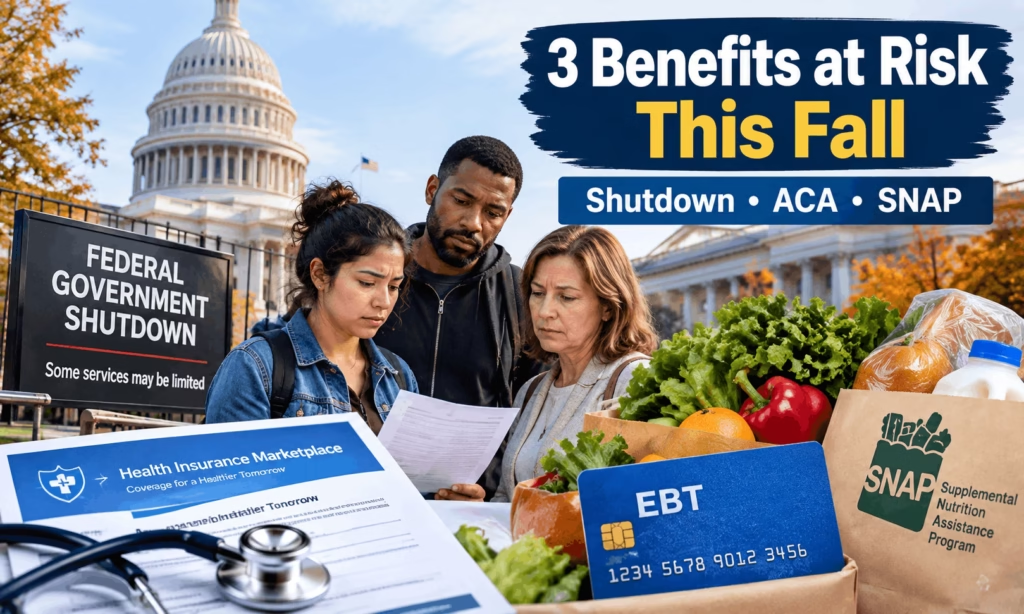
3 Benefits at Risk – Shutdown, ACA Subsidies & SNAP: Three separate federal deadlines are converging on American households at the same time this fall, and together they touch nearly every corner of the safety net. Government funding runs out again on December 11, 2026. ACA open enrollment opens November 1 with the 400% income subsidy cliff still fully in effect for a second straight year. And SNAP, which was suspended for the first time in roughly 60 years during last November’s 43-day shutdown, faces the same underlying funding risk if Congress can’t reach a deal before the new deadline. None of these three are guaranteed disasters but all three carry real, dated risk, and each one requires a different kind of preparation.
What makes this fall different from a typical benefits news cycle is the overlap. A missed December 11 funding deadline wouldn’t just risk a repeat of last year’s SNAP suspension — it would land squarely in the middle of ACA open enrollment, a period when Marketplace shoppers are already absorbing a second consecutive year of the restored subsidy cliff and steep premium increases. Millions of households could realistically be navigating all three risks simultaneously over the next 90 days. This article breaks down exactly where each of these three stands right now, what the realistic worst case looks like based on what actually happened last year, and the specific steps to take before any of these deadlines arrive. We’ll be updating this article monthly as the shutdown deadline, ACA enrollment period, and SNAP funding status develop.
Benefits at Risk This Fall: Where Things Stand Right Now
Before diving into each program individually, it helps to see the three timelines side by side, since the overlap between them is exactly what makes this fall unusually consequential for benefit-dependent households.
3 Benefits at Risk This Fall — Key Highlights
| Program | Key Date | What’s at Stake |
|---|---|---|
| Government funding | December 11, 2026 | Risk of another shutdown affecting SNAP, federal pay, and agency services |
| ACA open enrollment | November 1, 2026 – January 15, 2027 (most states) | Subsidy cliff at 400% FPL remains in effect; premiums up sharply for a second year |
| SNAP benefits | Ongoing, tied to shutdown risk | 42 million recipients could face delays again if funding lapses past December 11 |
| Deadline for January 1, 2027 ACA coverage | December 15, 2026 | Missing this date pushes coverage start to February 1, 2027 |
| Last SNAP suspension | November 1–12, 2025 | First suspension of SNAP benefits in roughly 60 years |
Medicare Open Enrollment 2026-27 Dates and the New Rule Changes Behind Them
Trump Accounts Dell $250 Grant: Did Deposits Actually Start Monday? Here’s Who’s Actually Been Paid
Social Security Max Contribution 2026: How to Get $3,000/Month?
Risk #1: Another Government Shutdown by December 11
Congress avoided a shutdown at the original October 1 deadline this year, passing a continuing resolution that funds the government only through December 11, 2026. That reprieve was deliberately timed to keep a funding fight away from the November midterm elections, pushing the harder negotiations — covering 12 still-unresolved full-year appropriations bills — into a post-election lame-duck session instead. Whether that session produces a deal, another short-term patch, or a repeat standoff remains genuinely uncertain as of this writing.
The stakes of missing that date aren’t hypothetical. The government shut down for a record 43 days from October 1 to November 12, 2025, furloughing hundreds of thousands of federal employees and, for the first time in roughly six decades, disrupting SNAP payments nationwide. With the same underlying disagreements over spending levels still unresolved heading into December, a second shutdown this fiscal year isn’t off the table, even though most in Washington are eager to avoid a repeat so close to the holidays.
Trump’s $5000 Dividend: Is It a Bribe If Americans Never Get Paid?
Is Trump Bribing Voters? $500 Obamacare Rebate After $5000 Dividend
EITC Income Limits 2026: New Thresholds and Max Credit Amounts
Risk #2: The ACA Subsidy Cliff Enters Its Second Year
Open enrollment for 2027 ACA coverage begins November 1, 2026, and runs through January 15, 2027 in most states, with the deadline to lock in January 1 coverage falling on December 15. This will be the second full enrollment season since the enhanced premium tax credits — first introduced in 2021 and extended through 2025 — expired at the end of last year, meaning the hard 400% federal poverty level income cutoff remains fully in force with no extension passed by Congress.
The financial impact from the first year of this reverted structure was significant. KFF’s analysis found that Marketplace enrollment fell by roughly 21.5%, from about 22.3 million people in 2025 to an estimated 17.5 million in 2026, as premiums rose sharply and hundreds of thousands of households above the 400% threshold lost eligibility for any assistance at all. Average deductibles across ACA plans climbed 37% to $3,786 in 2026, according to the same analysis, as more shoppers shifted toward lower-premium, higher-deductible plans to offset the loss of subsidy support. With no new legislation restoring the enhanced credits ahead of this year’s enrollment window, that same dynamic is expected to repeat for 2027 coverage.
ACA Subsidy Status: What Changed and What Hasn’t
| Detail | 2021–2025 (Enhanced Subsidies) | 2026–2027 (Reverted Rules) |
|---|---|---|
| Income cap for subsidy eligibility | None — gradual phase-out above 400% FPL | Hard cutoff at 400% FPL |
| Marketplace enrollment | 22.3 million (2025) | Estimated 17.5 million (2026) |
| Average deductible | Lower, more stable | $3,786 (up 37% in 2026) |
| Legislative status for 2027 | N/A | No extension passed as of this writing |
Risk #3: SNAP’s Contingency Funding Gap
SNAP benefits are not currently disrupted, and roughly 42 million Americans continue receiving their normal monthly allotment. But the same structural vulnerability exposed during last year’s shutdown hasn’t been resolved. SNAP is classified as mandatory spending, meaning Congress is obligated to fund it, but the actual dollars still flow through annual appropriations — the same mechanism that lapses during a shutdown. During the 2025 shutdown, USDA reversed its own published contingency plan midway through the crisis, telling states it would not use contingency funds to cover November benefits, before federal judges in Rhode Island and Massachusetts ordered the agency to release those funds anyway.
That legal fight was never definitively resolved on the merits — it ended because the shutdown itself ended on November 12. If the December 11, 2026 deadline is missed, nothing currently on the books guarantees USDA would handle a repeat lapse any differently, particularly since the agency’s contingency reserve, estimated at $5 to $6 billion, only covers a fraction of the roughly $8 to $9 billion needed to fund a full month of national SNAP benefits.
How These Three Risks Overlap This Fall
The reason this fall deserves closer attention than a typical benefits news cycle is timing, not any single program in isolation. If Congress fails to reach a funding deal by December 11, the resulting shutdown would land in the middle of ACA open enrollment — a period when Marketplace shoppers are already weighing higher premiums under the restored subsidy cliff — while simultaneously threatening the same SNAP payment disruption that hit 42 million households last November. A household that relies on SNAP, shops for ACA coverage, and has a family member employed by the federal government could realistically be affected by all three risks within the same 30-day window.
Fall Benefits Risk Checklist
Because each of these three risks affects different households differently, use this checklist to identify which specific actions apply to your situation before the December 11 deadline and the ACA enrollment window close.
What to Do Now: Action Steps for Each Program
For SNAP recipients: Confirm your contact information and EBT card details are current with your state SNAP office, keep track of your remaining balance, and identify a nearby food bank now rather than waiting for a possible December disruption. If a lapse does occur, court intervention — not immediate agency action — restored payments last time, so expect any repeat disruption to take time to resolve even after a shutdown ends.
For ACA Marketplace shoppers: Enroll or renew before December 15 to secure January 1 coverage, and actively review your plan rather than accepting auto-renewal, since subsidy amounts and available plans can shift year to year. If your income is near the 400% FPL threshold, estimate carefully — the excess subsidy repayment cap has been eliminated, meaning underestimating your income and later earning more than expected could result in a larger repayment at tax time than in past years.
For federal employees, VA beneficiaries, and Social Security recipients: Core benefit payments — Social Security, VA disability compensation, pensions, and GI Bill benefits — are structurally protected from a shutdown through mandatory spending and advance appropriations. Federal employee pay, however, can be temporarily delayed even though back pay is legally guaranteed under the Government Employee Fair Treatment Act, so building a short-term financial buffer is a reasonable precaution for federal workers specifically.
Official Resources for All Three Programs
| Resource | Purpose | Link |
|---|---|---|
| USDA Food and Nutrition Service | SNAP program updates and state office directory | https://www.fns.usda.gov/snap |
| HealthCare.gov | ACA enrollment, plan comparison, and login | https://www.healthcare.gov |
| Congress.gov | Track appropriations bills tied to the December 11 deadline | https://www.congress.gov |
| Feeding America | Locate a food bank near you | https://www.feedingamerica.org |
| VA.gov | VA benefit status and shutdown guidance | https://www.va.gov |
| Social Security Administration | Benefit status and my Social Security account | https://www.ssa.gov |
25th Anniversary of 9/11 Attacks: How America Is Marking ‘Moments That Divide Time’
US Diesel Prices $6 a Gallon: Iran War Squeezes Fuel Supply to a Record High
FAQs About 3 Benefits at Risk – Shutdown, ACA Subsidies & SNAP
Will there be another government shutdown in December 2026?
It’s uncertain. Government funding is set to expire December 11, 2026, and whether Congress reaches a deal before then depends on unresolved negotiations over 12 full-year appropriations bills.
Are ACA subsidies being restored for 2027?
As of this writing, no legislation has passed to restore the enhanced premium tax credits, meaning the 400% FPL subsidy cliff remains in effect for the 2027 plan year.
Will SNAP benefits be suspended again if there’s another shutdown?
It’s possible. The same funding structure that caused the November 2025 SNAP suspension remains unchanged, and USDA’s contingency reserve would likely again fall short of covering a full month of national benefits.
When is the deadline to enroll in ACA coverage for January 1, 2027?
December 15, 2026 in most states. Enrolling after that date, but before the window closes January 15, 2027, pushes your coverage start to February 1, 2027 instead.
Are Social Security and VA benefits at risk during a government shutdown?
No. Both are funded through mechanisms — mandatory spending and advance appropriations — that are structurally protected from a shutdown, though related administrative services can still be disrupted.
What happened the last time SNAP benefits were suspended?
SNAP payments were suspended starting November 1, 2025, during the 43-day shutdown, before federal judges ordered USDA to use contingency funds to resume payments, a process that took weeks even after the court rulings.
How much did ACA premiums increase after the subsidy cliff returned?
KFF found average deductibles rose 37% to $3,786 in 2026, and Marketplace enrollment fell by roughly 21.5% as many households lost eligibility for financial assistance entirely.
Conclusion
The overlap between the December 11 funding deadline, the ACA open enrollment window, and SNAP’s unresolved funding vulnerability makes this fall a genuinely higher-stakes period for benefit-dependent households than a typical year. None of the three outcomes are certain — Congress could reach a funding deal well before December 11, and ACA enrollment could proceed without incident — but the realistic worst case for each program is no longer hypothetical, since all three played out in some form just months ago. Taking the specific steps outlined for each program now, rather than waiting to see how the deadlines resolve, is the most reliable way to avoid being caught unprepared if any of these risks materializes simultaneously. We’ll be updating this article monthly as the shutdown deadline, ACA enrollment period, and SNAP funding status develop.