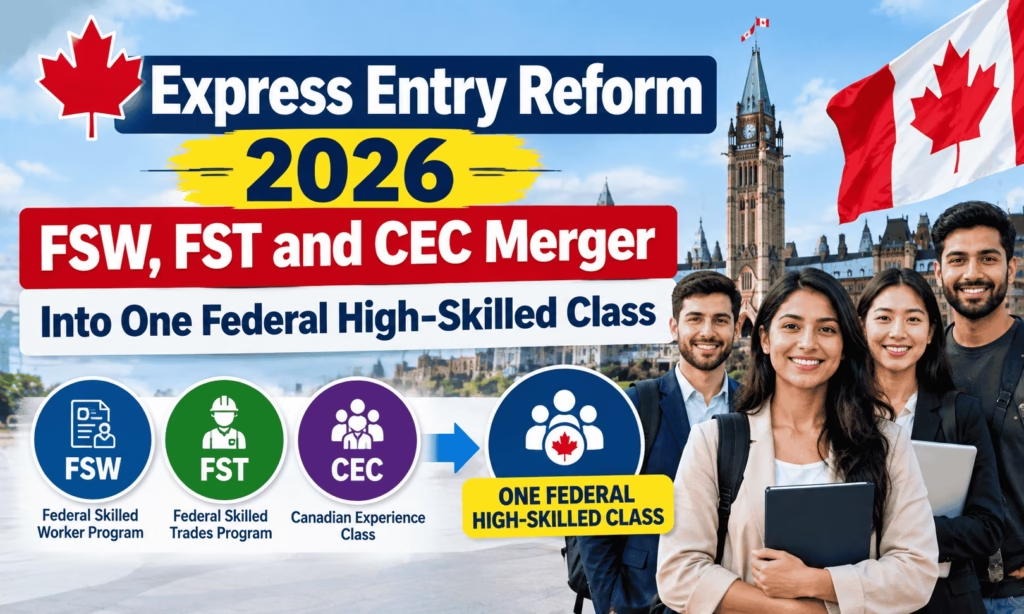
Express Entry Reform 2026: Canada’s Express Entry reform proposal would merge the Federal Skilled Worker Program, the Federal Skilled Trades Program and the Canadian Experience Class into a single Federal High-Skilled Class, the biggest structural change to the system since it launched in 2015. Immigration, Refugees and Citizenship Canada opened public consultations on the plan from April 23 to May 24, 2026, and confirmed the direction through its Forward Regulatory Plan, which sets out amendments to the Immigration and Refugee Protection Regulations that would formally repeal the three existing programs. As of late September 2026, this remains a proposal under review, not law: all three current programs are still active, and IRCC held a Canadian Experience Class draw as recently as September 1, 2026, inviting 2,000 candidates at a CRS cutoff of 521. We’ll be updating this article monthly.
What makes this reform significant is not just the merger itself but what comes with it: a single CLB 6 language threshold across every occupation, the elimination of the decades-old 67-point FSW grid, and a reweighted Comprehensive Ranking System that would reward high-wage job offers and strong pre-landing earnings over factors like French bonus points and sibling-in-Canada points. IRCC’s own reasoning is that some current scoring factors are weak predictors of long-term economic success while other, currently unmeasured factors are strongly predictive, and the agency wants the pool to reflect that data. Below is exactly what would change, the proposed timeline, how your eligibility might shift, and the official IRCC resources to track this reform as it develops.
What Is the Federal High-Skilled Class? Express Entry Merger Explained
The Federal High-Skilled Class is IRCC’s proposed name for the single program that would replace FSW, FST and CEC. Instead of checking eligibility against three separate rule sets, every candidate would be assessed against one common standard before entering the Express Entry pool.
| Requirement | Current system | Proposed single class |
|---|---|---|
| Work experience | FSW: 1 year foreign, skilled work. CEC: 1 year Canadian work. FST: 2 years in a skilled trade | 1 year cumulative TEER 0-3 experience (Canadian or foreign) in the last 3 years |
| Language | FSW: CLB 7. CEC: CLB 5-7 depending on TEER. FST: CLB 5 speaking/listening, CLB 4 reading/writing | CLB 6 across all four skills, for every occupation level |
| Education | FSW requires a post-secondary credential with ECA; CEC has no minimum; FST requires trade certification | Canadian high school credential or equivalent, verified by ECA |
| Selection method | FSW uses a separate 67-point eligibility grid before CRS ranking | 67-point grid eliminated; CRS ranking applies directly |
IRCC’s stated rationale is straightforward: candidates already frequently qualify for more than one of the three current programs, so maintaining separate eligibility rules mostly adds confusion and duplication rather than meaningfully different standards. A software developer with three years of experience abroad currently applies under FSW; the same developer after a year of Canadian work applies under CEC; a certified welder can only use FST. Under the merged class, all three would be assessed the same way.
Express Entry Reform Key Dates
| Date | Milestone |
|---|---|
| April 8, 2026 | IRCC publishes its Forward Regulatory Plan confirming intent to repeal FSW, CEC and FST and create a single class |
| April 17, 2026 | IRCC formally announces the proposed Federal High-Skilled Class and outlines public consultation plans |
| April 23 to May 24, 2026 | Public consultation period on eligibility, CRS predictor groupings and the high-wage occupation factor |
| April 30, 2026 | Separately, PR application fees rise: principal applicant fee increases from $950 to $990 |
| September 1, 2026 | Most recent CEC draw under the current system invites 2,000 candidates at a CRS cutoff of 521 |
| Late 2026 to early 2027 (expected) | Proposed regulatory text published in the Canada Gazette, Part I, opening a further comment period |
| Early 2027 (expected) | IRCC reviews public comments and finalizes regulatory text |
| Late 2027 or later (expected) | Earliest possible implementation of the Federal High-Skilled Class |
Amendments to the Immigration and Refugee Protection Regulations require Canada Gazette publication and a mandatory public comment period before taking effect, which is why immigration lawyers consistently describe late 2027 as the earliest realistic start date, not 2026.
Why Some SSI Recipients Get Two Payments in October 2026?
$2400 Social Security Increase: What the Proposed $200 Monthly Boost Really Means
Social Security Payment Dates October 2026: Full Schedule By Birthday, SSI Quirk and COLA Update
Express Entry Reform Checker: How Might the Merger Affect You?
Express Entry Reform Checker: How Might the Merger Affect You?
Use this tool to see how your own profile compares under the current three-program system versus the proposed Federal High-Skilled Class rules. This reflects publicly available consultation proposals, not final regulations, and outcomes could change before anything takes effect.
This checker is based on publicly described consultation proposals. Nothing here reflects final law, and IRCC has not published binding regulatory text. Confirm current eligibility through the official IRCC website before making any decisions.
How the CRS Scoring System Would Change
Alongside the program merger, IRCC has floated a reweighted Comprehensive Ranking System that shifts points toward factors the data shows are stronger predictors of long-term settlement success. Reporting on the leaked scoring redesign describes a new high-wage occupation factor, tiered by how far a job’s typical earnings exceed the national median.
| CRS factor | Proposed change |
|---|---|
| High-wage job offer or Canadian work | New tiered bonus: highest tier for occupations paying 2x the national median wage (e.g. physicians, university professors), a second tier for 1.5x median (e.g. engineers, teachers) |
| Job-offer points | Removed in March 2025; proposed to return, but only for high-wage occupations |
| Pre-landing temporary resident earnings | Proposed as a new predictor; candidates earning $100,000 or more as temporary residents reportedly saw 162% higher post-landing earnings than those with no job offer |
| French-language bonus | Marked as a weaker predictor in IRCC’s own data; proposed for reduction or removal |
| Sibling-in-Canada points | Marked as a weaker predictor; proposed for reduction or removal |
| Education-in-Canada points | Also flagged as a weaker predictor and under review |
| Provincial Nominee Program bonus (600 points) | Under separate review, not confirmed for removal |
None of these CRS changes are finalized. IRCC has described them as directions under consideration based on internal data analysis, and the agency has said it wants to reward candidates whose profiles are most strongly linked to successful long-term economic integration, rather than factors that made sense administratively but do not predict outcomes well.
Is CEC Being Removed? What Happens to Current Applicants
Not yet, and not without further regulatory steps. The Canadian Experience Class continues to operate under existing rules today, and IRCC has kept running regular CEC draws throughout 2026, including the September 1 draw that invited 2,000 candidates. The 2026-2028 Immigration Levels Plan allocates more than 109,000 spots for Federal High-Skilled applicants, a category that includes CEC, FSW and, to a smaller extent, FST, which is one reason immigration analysts expect CEC draws to continue through the rest of 2026 regardless of the reform’s progress.
Candidates currently in the Express Entry pool, or planning to enter soon, are not required to wait for the new class. Existing profiles remain valid, and IRCC has indicated that transition rules, if the reform proceeds, would likely allow current applicants to be assessed under whichever system is in effect at the time of their invitation, though final transition details have not been published.
$100000 Social Security Benefits Per Year: How Married Couples Actually Reach It in 2026
Medicare Part D Premium 2027 New Rates Announced, How Much Will You Pay?
2027 Social Security COLA Forecast: Latest 3.6% Estimate and How Much Retirees Could Get
Who Benefits and Who Might Be Disadvantaged Under the Merger
Lowering the language threshold to CLB 6 for every occupation, down from CLB 7 for FSW, would open the pool to some applicants previously excluded entirely, particularly from countries where CLB 7 has been a persistent barrier. Eliminating the FSW 67-point grid removes a separate hurdle that has tripped up otherwise strong candidates on rigid category counts. Candidates with strong Canadian work experience or a high-wage job offer would likely see a scoring advantage under the proposed high-wage occupation factor.
Candidates who currently rely heavily on French-language bonus points, sibling-in-Canada points or education-in-Canada points could see their competitive position weaken if those factors are reduced as proposed. Skilled tradespeople, who currently qualify through a comparatively accessible FST pathway, would need to meet the same one-year TEER 0-3 and CLB 6 standard as everyone else, which for some trades represents a language requirement increase.
Why IRCC Is Proposing This Reform Now
IRCC’s own explanation centers on outdated design. The three current programs predate Express Entry itself; FSW, CEC and FST were originally built as standalone immigration categories operating on a first-come, first-served basis, long before the ranked pool system launched in 2015. Retrofitting three separately designed programs into one ranking system has left overlapping, sometimes contradictory eligibility rules that no longer reflect how the pool actually functions in practice.
The agency has also pointed to the rise of category-based draws, introduced in 2023, which already let IRCC invite candidates based on specific attributes such as French proficiency, healthcare occupations or STEM backgrounds, cutting across the old program boundaries. With category-based draws already treating the pool as one unified group in practice, maintaining three separate legal eligibility gates ahead of that stage has become, in IRCC’s framing, an administrative relic rather than a meaningful distinction. Internal data analysis reportedly found that several existing CRS factors, including some of the bonus point categories, correlate weakly with long-term outcomes such as employment rate and income growth after landing, while other unmeasured factors, like pre-landing Canadian earnings, correlate strongly. That mismatch between what the system currently rewards and what actually predicts success is the central data-driven argument behind the proposed overhaul.
How to Apply for Express Entry Under the Current System
- Confirm which of the three current programs you qualify for: FSW, CEC or FST, since eligibility rules still differ today.
- Complete a Language proficiency test (IELTS, CELPIP or TEF) and, if your credentials are foreign, an Educational Credential Assessment.
- Create an Express Entry profile through your IRCC secure account, entering your work history, language scores and education details to receive a CRS score.
- Enter the pool and wait for an Invitation to Apply, either through general draws or category-based draws targeting specific occupations or attributes.
- Once invited, submit your complete permanent residence application within the deadline, along with the current $990 principal applicant fee.
Express Entry Processing Time and Fees in 2026
| Item | 2026 figure |
|---|---|
| Standard processing time, most complete applications | Around 6 months from submission |
| Principal applicant PR application fee | $990 (up from $950 as of April 30, 2026) |
| Accompanying spouse or partner fee | $990 |
| Dependent child fee | Set separately; check current IRCC fee schedule |
| Recent CEC draw CRS cutoff (September 1, 2026) | 521, for 2,000 invitations |
Processing time and fees apply under the current system regardless of the proposed reform, since none of the merger changes are in effect yet. Candidates should not delay a strong application while waiting for the Federal High-Skilled Class, given the multi-year timeline still ahead.
Social Security COLA 2027 by State: These 10 States Could See the Biggest Dollar Increase
What This Means for Provincial Nominee Program Candidates
The reform proposal does not directly restructure the Provincial Nominee Program, which operates through separate agreements between IRCC and individual provinces, but PNP candidates who also hold an Express Entry profile would still be affected indirectly. Most provincial nominations currently carry a 600-point CRS bonus, which is described as under separate review rather than confirmed for removal or reduction. If IRCC does adjust the PNP bonus alongside the broader CRS reweighting, provincially nominated candidates could see a smaller relative advantage over other pool members than they do today, even though their nomination itself would remain valid under provincial rules.
Provinces have historically used their nomination programs to fill gaps the federal system does not fully address, including regional labour shortages and occupations outside the federal high-wage focus. Immigration analysts expect provinces to continue operating largely independently of the federal merger, meaning candidates without a high-wage job offer or strong federal CRS score may find a PNP stream remains their most realistic path even after the Federal High-Skilled Class takes effect.
Official Express Entry and IRCC Resources
| Resource | Use it for | Link |
|---|---|---|
| IRCC secure account | Login, registration, Express Entry profile and application status | canada.ca IRCC account |
| Express Entry overview | Current program eligibility and how the pool works | canada.ca Express Entry |
| Check your CRS score | Official Comprehensive Ranking System criteria tool | canada.ca CRS criteria |
| Forward Regulatory Plan | Reading the official reform proposal and regulatory status | canada.ca Forward Regulatory Plan |
| Express Entry rounds of invitations | Latest draw results and CRS cutoffs | canada.ca Express Entry rounds |
| Check application status | Tracking a submitted PR application | canada.ca check status |
| Fee list | Current PR and processing fees | canada.ca fees |
| Canada Gazette | Reading final regulatory text once published | gazette.gc.ca |
FAQs About the Express Entry Reform
What is the Express Entry FSW, FST and CEC merger?
It is IRCC’s proposal to replace the Federal Skilled Worker Program, Federal Skilled Trades Program and Canadian Experience Class with a single Federal High-Skilled Class, using one unified set of eligibility rules instead of three separate program requirements.
Is the Express Entry merger already in effect?
No. As of September 2026, this is a consultation-stage proposal. IRCC held public consultations from April 23 to May 24, 2026, and expects to publish draft regulatory text in the Canada Gazette in late 2026 or early 2027, with implementation not expected before late 2027.
Is CEC being removed from Express Entry?
Yes, under the proposal, but not yet in law. The Canadian Experience Class continues to operate under current rules, with a draw as recently as September 1, 2026. It would only be formally repealed once final regulations take effect.
What are the proposed eligibility requirements for the new Express Entry class?
The proposal describes one cumulative year of TEER 0-3 work experience in the last three years (Canadian or foreign), CLB 6 across all four language skills, and a Canadian high school credential or equivalent verified by an Educational Credential Assessment.
Will the CRS scoring system change with the Express Entry reform?
IRCC has floated reweighting the Comprehensive Ranking System to reward high-wage job offers, strong pre-landing earnings in Canada, and other factors linked to long-term economic success, while reducing points tied to French-language bonuses, sibling-in-Canada points and education-in-Canada points. None of these changes are finalized.
Should I apply to Express Entry now or wait for the new class?
Immigration consultants generally recommend applying under the current system if your profile is competitive now, since the earliest realistic implementation of the new class is late 2027, and current profiles and draws remain fully valid in the meantime.
What is the Federal High-Skilled Class in Canada?
It is the proposed name for a single Express Entry program that would replace the Federal Skilled Worker Program, Canadian Experience Class and Federal Skilled Trades Program, using one unified eligibility standard for all high-skilled candidates.
What is the current CRS cutoff for Express Entry draws?
Cutoffs vary by draw type and change frequently. The most recent Canadian Experience Class draw, on September 1, 2026, invited 2,000 candidates at a CRS cutoff of 521.
How much does it cost to apply for Express Entry in 2026?
As of April 30, 2026, the principal applicant fee for Express Entry and other Federal High-Skilled programs is $990, with the same $990 fee applying to an accompanying spouse or partner.
What is the difference between FSW, CEC and FST?
FSW is for candidates with foreign skilled work experience and requires a 67-point eligibility grid; CEC is for candidates with at least one year of Canadian work experience; FST is for certified skilled tradespeople with at least two years of trade experience.
How long does Express Entry processing take in 2026?
Standard processing for a complete Express Entry application is generally around six months from submission, though individual cases can vary based on completeness and background checks.
Conclusion: Plan for Today’s Rules, Watch the Reform Closely
The Express Entry reform merging FSW, FST and CEC into a Federal High-Skilled Class is the most significant proposed change to Canada’s flagship immigration system since 2015, but it remains a consultation-stage proposal without published regulatory text. CEC draws continued as recently as September 1, 2026, and the earliest realistic implementation date sits in late 2027 or beyond. Candidates with a competitive profile today should apply under the current system rather than waiting, while using the checker above to understand how their eligibility might shift once, and if, the new class takes effect. We will refresh this guide’s dates, figures and proposed rules every month as the Canada Gazette process moves forward.
2027 COLA: How Much Will Your Social Security Check Increase?
Social Security October 2026 Payments: Why SSI Gets Two Checks?
$255 Social Security Death Benefit: Who Actually Qualifies and How to Apply?