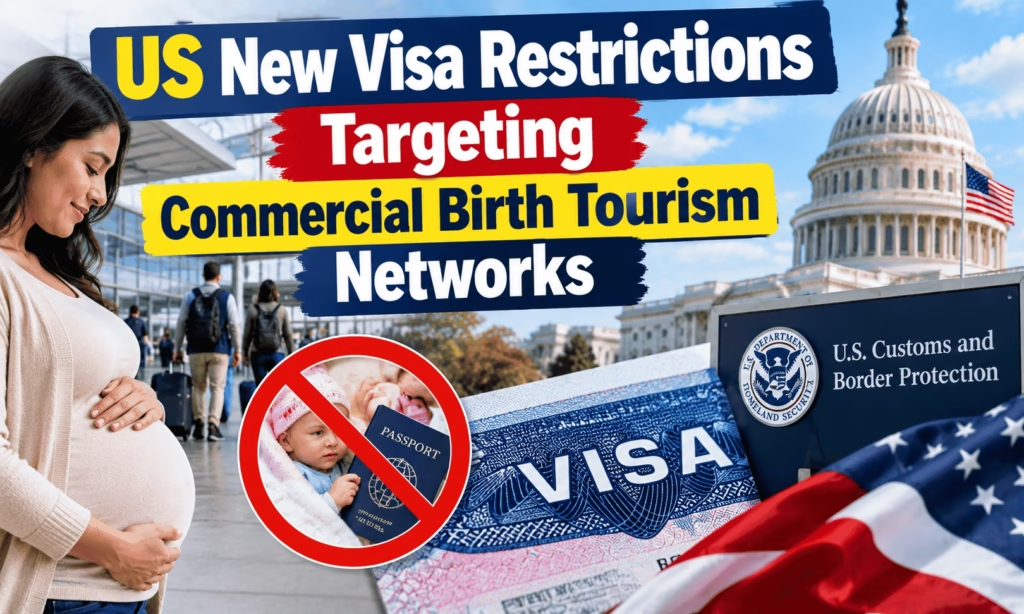
US New Visa Restrictions Targeting Commercial Birth Tourism Networks: The United States has announced new visa restrictions targeting commercial birth tourism networks, giving federal officials a direct tool to bar visas for the businesses, brokers and medical facilitators who run organized schemes charging pregnant travelers tens of thousands of dollars to give birth on US soil. Secretary of State Marco Rubio unveiled the policy on September 23, 2026, invoking Section 212(a)(3)(C) of the Immigration and Nationality Act to restrict visas for network owners, operators and managers, visa “fixers” who coach clients to misrepresent their travel purpose, and foreign medical providers who knowingly arrange the trips. The Department says certain family members connected to these networks could also face restrictions. We’ll be updating this article monthly.
This is not the government’s first attempt to shut these operations down. A decade ago, federal agents raided so-called “maternity hotels” across Southern California, unsealing indictments against 19 people linked to three networks that had charged clients between $10,000 and $80,000 each and served hundreds of customers before being dismantled. Those cases relied on criminal prosecution for visa fraud and money laundering, a slow, resource-intensive process. The new 2026 policy instead uses visa ineligibility as a faster administrative tool, letting the State Department restrict a network operator’s own ability to travel or do business in the US without waiting for a criminal conviction. Below is how these commercial networks actually operate, what past prosecutions revealed, what the new restrictions cover, and a checklist to help identify a network showing red flags.
What Are Commercial Birth Tourism Networks?
A commercial birth tourism network is a business, or a loose group of connected businesses, that packages travel, housing, medical coordination and sometimes visa application coaching specifically for pregnant clients who want to give birth in the US so their child receives automatic citizenship. These operations are distinct from an individual traveler who happens to be pregnant during a trip; they are organized, for-profit enterprises built around the citizenship outcome itself.
| Service | What it involved |
|---|---|
| Package pricing | Clients paid a bundled fee, historically $10,000 to $80,000 per stay, covering housing, meals and coordination |
| “Maternity houses” | Ordinary homes illegally converted into multi-bedroom facilities to house several pregnant clients at once, sometimes subdividing a 7-bedroom house into 17 bedrooms |
| Visa coaching | Clients coached to misstate their length of stay and true purpose to US consular officers and border officers |
| Concealment tactics | Clients instructed to wear loose clothing to conceal pregnancy when passing through Customs and Border Protection |
| Medical coordination | Referrals to local hospitals, sometimes without disclosing that bills would go unpaid and be sent to collections |
| Marketing | Advertised benefits of US citizenship for the child, including free public education and future immigration sponsorship |
A History of US Birth Tourism Network Enforcement
The September 2026 visa restrictions build on a decade of on-and-off federal enforcement against these networks, most of it concentrated in Southern California, where the practice became heavily associated with clients from China.
| Date | Action |
|---|---|
| 2014 | Irvine Police Department receives an anonymous tip about a maternity house at a luxury property called The Carlyle, later referred to Homeland Security Investigations |
| March 2015 | Federal agents execute 35 search warrants, dismantling three networks operating in Irvine, Rancho Cucamonga and elsewhere in Southern California; a Chino Hills mansion illegally subdivided from 7 to 17 bedrooms is among the properties |
| January 2019 | Federal grand jury unseals indictments against 19 people linked to the three networks, the first-ever federal criminal charges against birth tourism business operators and customers |
| September 2019 | Operator Dongyuan Li pleads guilty to conspiracy to commit immigration fraud and visa fraud after running a network that served more than 500 clients and collected millions of dollars |
| 2019 to 2020 | Rancho Cucamonga operators Michael Wei Yueh Liu and Jing Dong found guilty at trial of conspiracy and 10 counts of international money laundering |
| January 2020 | State Department’s B-visa pregnancy screening rule takes effect, letting officers deny visas to individual applicants suspected of birth tourism intent |
| June 2026 | State Department revokes more than 100 visas tied to an alleged birth tourism network |
| September 23, 2026 | Rubio announces new visa restrictions under INA 212(a)(3)(C) targeting network operators, fixers and complicit medical providers directly |
The gap between the 2015 raids and the 2019 indictments illustrates why criminal prosecution alone struggled to keep pace with these businesses: building a money laundering and visa fraud case took years, during which networks could continue operating or new ones could open elsewhere. The 2026 policy’s administrative approach, restricting visas directly rather than waiting for a criminal case to conclude, is designed to close that gap.
Why Some SSI Recipients Get Two Payments in October 2026?
$2400 Social Security Increase: What the Proposed $200 Monthly Boost Really Means
Social Security Payment Dates October 2026: Full Schedule By Birthday, SSI Quirk and COLA Update
How the New 2026 Visa Restrictions Target Networks Specifically
Unlike the 2020 rule, which screens individual pregnant travelers at their own visa interview, the September 2026 policy is built entirely around the people who run and profit from the business side of birth tourism.
| Role | How it maps to real network operations |
|---|---|
| Network owners, operators and managers | The equivalent of the maternity house operators charged in the 2015-2019 California cases |
| Visa “fixers” and intermediaries | Those who coach clients on what to tell consular officers, mirroring tactics described in past indictments |
| Foreign medical providers | Doctors or clinics abroad that knowingly refer patients specifically for citizenship-focused US births |
| Others who “support or enable” | A broad category that could include property owners, drivers or staff knowingly involved in network operations |
| Certain family members | Relatives of targeted individuals, with the exact scope not yet defined by the Department |
Rubio’s announcement framed the goal directly: restricting visa issuance for those who “both engage in and profit from this fraud,” language that echoes the profit-driven, organized nature of the businesses uncovered in the earlier California prosecutions, rather than targeting individual travelers.
Birth Tourism Network Red Flag Checker
Birth Tourism Network Red Flag Checker
Check any of the following that apply. This tool compares your answers against factors publicly cited by the State Department, ICE, and past prosecutions as indicators reviewed during birth tourism enforcement — it does not predict a visa or immigration outcome.
Is It Illegal to Travel to the US While Pregnant?
No. As officials have repeatedly confirmed, including during the 2015 raids, it is not illegal for a pregnant woman to travel to or enter the United States. What becomes illegal is misrepresenting the purpose of travel to obtain a visa or entry, a pattern federal agents documented extensively in past network cases, from coached consulate interviews to concealment tactics at the border. The new 2026 policy does not change this basic distinction; it adds a visa consequence specifically for the people who organize and profit from that misrepresentation on a commercial scale.
$100000 Social Security Benefits Per Year: How Married Couples Actually Reach It in 2026
Medicare Part D Premium 2027 New Rates Announced, How Much Will You Pay?
2027 Social Security COLA Forecast: Latest 3.6% Estimate and How Much Retirees Could Get
What Made Past Prosecutions Difficult
The Southern California cases took roughly four years from the 2015 raids to the first guilty plea in 2019, illustrating how resource-intensive criminal prosecution of these networks has been. Cases required proving conspiracy, immigration fraud and, in several instances, international money laundering across jurisdictions spanning the US and China. Some defendants remained fugitives even after indictments were unsealed, and local zoning enforcement, such as Los Angeles County’s crackdown on unlicensed “maternity hotels” that received a surge of 60 complaints in a single month, operated on an entirely separate, slower track from federal immigration enforcement.
The new visa-restriction approach sidesteps some of these difficulties. Because Section 212(a)(3)(C) is a foreign-policy inadmissibility tool applied at the Secretary of State’s discretion, it does not require the multi-year evidentiary process a criminal conviction demands, though it also offers less due process and is subject to far more limited judicial review than a criminal case.
How Birth Tourism Compares Internationally
The United States is not the only country to have grappled with commercial birth tourism, though its combination of unconditional birthright citizenship and no exit requirement for pregnant travelers has made it a particularly attractive destination for organized networks. Canada shares a similar birthright citizenship framework and has seen its own birth tourism debate, prompting periodic government reviews of hospital data on non-resident births, though it has not pursued the kind of criminal prosecutions seen in the US. Most European countries and Australia require at least one parent to be a citizen or permanent resident for a child to acquire citizenship by birth, which structurally limits the commercial incentive that drives US-style birth tourism networks.
This difference in law is part of why enforcement efforts in the US have focused on the visa and immigration fraud angle, misrepresenting travel purpose, rather than on birthright citizenship itself, which remains constitutionally protected following the Supreme Court’s June 30, 2026 ruling. Countries with conditional citizenship laws generally address the same underlying concern through eligibility requirements rather than after-the-fact enforcement against travel facilitators.
How to Apply for a Visa if You Have No Connection to Birth Tourism
- Apply through the standard nonimmigrant visa process; complete the DS-160 accurately, describing your actual travel purpose.
- If pregnant, be prepared to answer honestly if a consular officer asks about your travel plans; the 2020 screening rule, not this new policy, governs that interview.
- Avoid any service or agency that asks you to misstate your length of stay, conceal a pregnancy, or that markets citizenship as the primary benefit of a US trip.
- Keep documentation of your genuine purpose, such as a return ticket, employer letter, or medical referral unrelated to birth tourism.
- Track your visa application status through the official CEAC portal rather than relying on a third-party agency’s promises.
Reporting a Suspected Birth Tourism Network
The State Department’s new visa fraud tip portal, launched the same week as the birth tourism policy, gives the public a direct channel to report suspected commercial birth tourism operations, alongside existing channels used in past investigations such as local police tips and Homeland Security Investigations referrals.
| Channel | Best for |
|---|---|
| State Department Visa Fraud Tip Portal | Suspected visa fraud, sham operations and birth tourism facilitation |
| ICE Homeland Security Investigations tip line | Organized criminal schemes involving money laundering or fraud |
| Local police or code enforcement | Illegally converted residential properties operating as unlicensed maternity houses |
| USCIS fraud reporting | Immigration benefit fraud connected to citizenship claims |
Social Security COLA 2027 by State: These 10 States Could See the Biggest Dollar Increase
Processing and Response Time for Network-Related Visa Cases
The State Department has not published a fixed processing timeline for visa restrictions applied under Section 212(a)(3)(C), since each case depends on individualized evidence gathered by consular and Diplomatic Security officers. Past criminal cases against network operators took years to reach indictment and trial, but the new administrative visa restriction is designed to move faster, since it does not require proof beyond a reasonable doubt or a full criminal trial process, only the Secretary of State’s reasonable grounds determination.
The Business Model Behind Birth Tourism Networks
Court records from the Southern California prosecutions reveal how profitable these operations became before enforcement caught up. Operator Dongyuan Li’s network alone advertised serving more than 500 clients and collected millions of dollars over roughly two years, according to her federal indictment. The business model relied on high per-client margins, since housing costs for a shared, illegally subdivided property were far lower than the $40,000 to $80,000 typically charged per client, and on referral networks reaching back into China that could reliably supply new customers.
Medical costs were often a separate revenue leak for hospitals rather than the networks themselves. Investigators found that clients frequently skipped payments on hospital bills, which were then referred to collections, meaning local healthcare providers absorbed costs the networks had not built into their own pricing. This pattern, packaging a client experience while externalizing real costs onto property owners, landlords and hospitals, appears repeatedly across the cases prosecutors brought, and it is part of why the 2026 policy explicitly includes “others who support or enable” the schemes, not just the headline operators.
Official Resources on Birth Tourism Network Enforcement
| Resource | Use it for | Link |
|---|---|---|
| Visa Fraud Tip Portal | Reporting suspected birth tourism networks or facilitators | travel.state.gov/reportvisafraud |
| US Visas news | Official State Department visa policy announcements | travel.state.gov visas news |
| ICE Homeland Security Investigations tips | Reporting organized immigration fraud schemes | ice.gov HSI tip form |
| B-1/B-2 visitor visa information | Standard visa rules for legitimate travel | travel.state.gov visitor visa |
| DS-160 application (CEAC) | Login, registration and completing a visa application | ceac.state.gov/genniv |
| Visa application status | Checking your own visa case status | ceac.state.gov/CEAC |
| US Attorney’s Office press releases | Reading records of past birth tourism prosecutions | justice.gov/usao-cdca |
Be cautious of any unofficial agency claiming to guarantee a birth tourism package or expedited visa; these promises mirror the tactics documented in past federal prosecutions.
FAQs About Birth Tourism Network Restrictions
What are commercial birth tourism networks?
They are organized, for-profit businesses that package travel, housing and medical coordination specifically for pregnant clients seeking to give birth in the US so their child gains automatic citizenship, distinct from an individual traveler who happens to be pregnant.
What new visa restrictions target birth tourism networks?
On September 23, 2026, Secretary of State Marco Rubio announced visa restrictions under INA Section 212(a)(3)(C) for network owners, operators and managers, visa fixers who coach clients to misrepresent applications, complicit foreign medical providers, and potentially certain family members connected to these networks.
Were birth tourism networks prosecuted before this new policy?
Yes. Federal agents raided Southern California maternity houses in March 2015, and a federal grand jury unsealed indictments against 19 people in January 2019, the first criminal charges ever brought against birth tourism business operators, in cases that took years to reach guilty pleas and trial verdicts.
How did past birth tourism networks operate?
Documented cases show networks charging clients $10,000 to $80,000 for bundled travel and housing packages, using illegally converted residential properties as makeshift maternity houses, coaching clients to misstate their travel purpose, and instructing clients to conceal pregnancies from border officers.
Is it illegal to be pregnant and travel to the US?
No. Officials have consistently confirmed that traveling to the US while pregnant is not illegal. What can constitute fraud is misrepresenting the purpose of travel to obtain a visa or entry, which is what both the 2020 individual screening rule and the 2026 network restrictions target.
How can I report a suspected birth tourism network?
Use the State Department’s Visa Fraud Tip Portal at travel.state.gov/reportvisafraud, or report organized schemes to ICE Homeland Security Investigations through its tip form.
How much did birth tourism operators charge clients in past cases?
Federal cases documented pricing between $10,000 and $80,000 per client, depending on the network and level of service, covering housing, coordination and sometimes medical referrals.
What happened to the maternity houses raided in California?
Federal agents executed 35 search warrants in March 2015 dismantling three networks in Irvine, Rancho Cucamonga and nearby areas. Indictments against 19 people followed in January 2019, with guilty pleas and trial convictions in 2019 and 2020.
What is the legal basis for the new birth tourism visa restrictions?
The September 2026 policy relies on Section 212(a)(3)(C) of the Immigration and Nationality Act, which lets the Secretary of State restrict visas for people whose activities could have serious adverse foreign policy consequences.
Does the new policy affect individual pregnant travelers?
Not directly. The September 2026 policy targets network operators, fixers and complicit medical providers. Individual pregnant travelers remain subject only to the existing 2020 screening rule, which applies at their own visa interview.
What is a maternity hotel or birthing house?
It is a term used for residential properties, sometimes illegally converted with far more bedrooms than permitted, used to house multiple pregnant clients of a commercial birth tourism network at once.
Conclusion: A Faster Tool Against an Old Problem
The new US visa restrictions targeting commercial birth tourism networks respond to a problem federal agents have documented since at least 2015, when raids on Southern California maternity houses first exposed organized, multi-million-dollar operations built around citizenship-for-profit schemes. Where past enforcement relied on years-long criminal prosecutions, the September 2026 policy gives the State Department a faster administrative tool: visa ineligibility for the operators, fixers and complicit medical providers who run these businesses. Use the red-flag checklist above if you are evaluating a service that shows these warning signs, and report suspected networks through the official channels listed here. We will refresh this guide’s details every month as enforcement actions develop.
2027 COLA: How Much Will Your Social Security Check Increase?
Social Security October 2026 Payments: Why SSI Gets Two Checks?
$255 Social Security Death Benefit: Who Actually Qualifies and How to Apply?