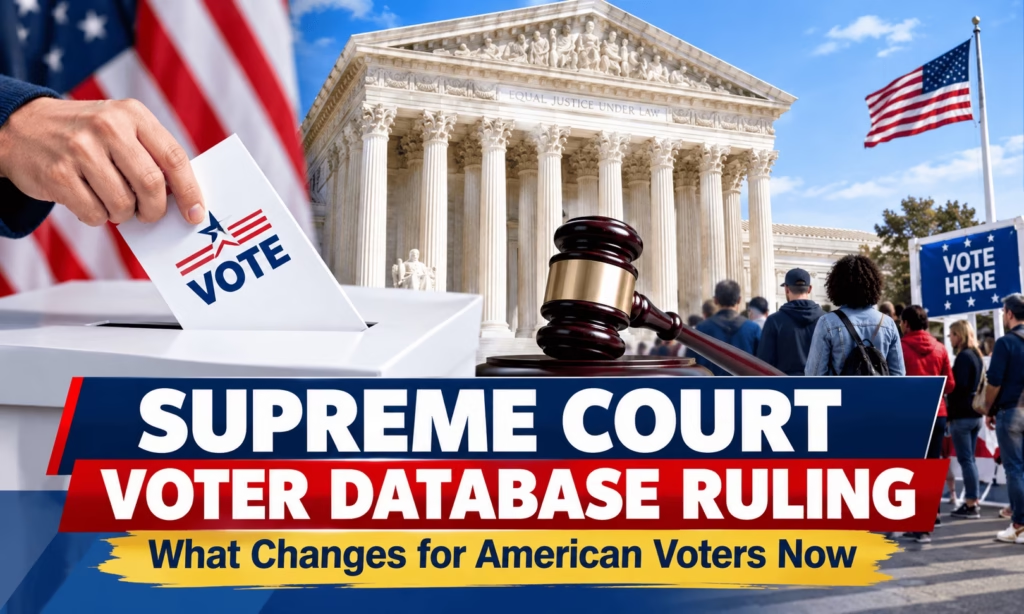
Supreme Court Voter Database Ruling: The Supreme Court has cleared the way for the Trump administration to use a dramatically expanded federal database to check the citizenship status of registered voters nationwide, a decision that lands just weeks before early voting begins in several states for the 2026 midterms. The Supreme Court voter database ruling, issued Friday, September 25, 2026, lifts a lower court block on the retooled Systematic Alien Verification for Entitlements program, known as SAVE, and hands the administration a win in its push to root out noncitizen voting, even though independent research has repeatedly found that practice to be exceedingly rare.
The 6-3 decision, split along ideological lines, pauses a federal judge’s June ruling that had found the revamped SAVE program likely violated federal privacy law and the Social Security Act. The order lets the Trump administration move forward with its expansion of the federal voter-verification database ahead of the midterms, even as a lower court had found the government was misusing Social Security information and violating privacy rights. We’ll be updating this article monthly as new developments, state-level actions, and court filings emerge in this fast-moving case. Voting rights groups warn the ruling puts millions of naturalized citizens at risk of being wrongly flagged, while the administration and Republican-led states call it a straightforward tool for keeping voter rolls accurate. Below is a complete breakdown of what actually changed, what stays the same for most voters in 2026, and how to check your own registration status through official channels.
Supreme Court Voter Database Ruling Key Highlights
| Detail | Information |
|---|---|
| Ruling date | Friday, September 25, 2026 |
| Court vote | 6-3, along ideological lines |
| Program affected | SAVE (Systematic Alien Verification for Entitlements) |
| Agency running SAVE | U.S. Citizenship and Immigration Services (USCIS), under DHS |
| Dissenting justices | Ketanji Brown Jackson, Sonia Sotomayor, Elena Kagan |
| Underlying executive order | Signed by President Trump, March 2025 |
| Lower court judge who blocked the program | U.S. District Judge Sparkle L. Sooknanan |
| Immediate effect on 2026 midterms | Limited, due to the 90-day pre-election blackout rule |
| Legal status of the case | Not final; litigation continues in the D.C. district court |
| Plaintiffs challenging the program | League of Women Voters, Electronic Privacy Information Center, and allied groups |
What the Supreme Court Actually Decided?
It’s worth being precise about what this ruling does and does not do, because a lot of confusion has followed the announcement. The Supreme Court voter database ruling is an emergency order, not a final decision on the merits of the underlying lawsuit. The order allows states to use the Department of Homeland Security’s revamped SAVE program, and its immediate impact on the midterms is likely limited because existing law blocks most states from systematically purging voters from their rolls within 90 days of an election.
The justices split 6-3 along ideological lines, with the conservative majority granting an emergency request the government filed after lower courts found the administration’s changes to the database were likely unlawful. That distinction matters. The Court did not rule that the SAVE expansion is legal in every respect; it ruled that the government can keep using the tool while the broader legal fight over its legality continues in lower courts.
The unsigned opinion noted that the National Voter Registration Act bars broad purging of voter rolls in the weeks before an election, which limits how much the ruling can affect this year’s contests, and states can still make individualized queries about specific voters. In plain terms, the Court is saying that even with the database unlocked, states cannot use it to run mass purges right before Election Day. They can still look up individual voters one at a time.
The three liberal-leaning justices publicly dissented, and states’ use of the SAVE program remains voluntary, which limits how much the decision will reshape the midterm elections; David Becker, an election law expert who leads the Center for Election Innovation and Research, pointed out that DHS itself has admitted the underlying data is not perfect.
Why Some SSI Recipients Get Two Payments in October 2026?
$2400 Social Security Increase: What the Proposed $200 Monthly Boost Really Means
Social Security Payment Dates October 2026: Full Schedule By Birthday, SSI Quirk and COLA Update
Express Entry Reform 2026: FSW, FST and CEC Merger Into One Federal High-Skilled Class
How We Got Here: A Timeline of the SAVE Database Expansion
To understand why this fight reached the Supreme Court’s emergency docket, it helps to see how quickly the underlying program changed over the past eighteen months.
| Date | What Happened |
|---|---|
| 1986 | Congress creates SAVE under the Immigration Reform and Control Act, originally to verify immigration status for public benefits, not voting |
| March 2025 | President Trump signs an executive order directing DHS, the Social Security Administration, and other agencies to pool records to help confirm only U.S. citizens are voting |
| April 22, 2025 | DHS announces a “comprehensive optimization” of SAVE, eliminating per-query fees for non-federal agencies and enabling bulk searches instead of one-at-a-time lookups |
| May 22, 2025 | USCIS deploys the updated SAVE system, letting states search using Social Security numbers through a new partnership with the SSA |
| October 31, 2025 | SAVE is linked to the State Department’s passport database and state driver’s license records, expanding what identifying information can trigger a match |
| June 2026 | A federal district court blocks the expanded SAVE program, ruling it likely violates privacy and benefits-data laws |
| September 25, 2026 | The Supreme Court stays the lower court’s block, allowing the expanded program to operate while the case continues |
Before the overhaul, non-federal agencies paid $1.50 per query to use SAVE, but the 2025 optimization eliminated that fee, allowed bulk searches instead of individual ones, and integrated criminal records, immigration timelines, and addresses into the system. That single change, from a paid, one-by-one lookup tool to a free, bulk-search system, is what turned SAVE from a narrow benefits-verification tool into something states could run their entire voter file through in a single afternoon.
What Is the SAVE Program, and Who Actually Runs It?
SAVE stands for Systematic Alien Verification for Entitlements. It was originally set up by Congress in 1986 so government agencies could quickly determine someone’s immigration status when they applied for benefits like Social Security. It is managed by U.S. Citizenship and Immigration Services, a division of the Department of Homeland Security.
The government expanded the database by adding information from the Social Security Administration, which enabled searches using Social Security numbers and allowed officials to run bulk searches. In practical terms, a state election office can now feed its entire voter registration file into SAVE and get back a list of anyone the system flags as a potential noncitizen, rather than looking up voters individually.
That scale is exactly what alarms critics. The system now combines citizenship information, Social Security numbers, and other sensitive data about millions of Americans, and a coalition including the League of Women Voters and the Electronic Privacy Information Center called the decision profoundly disappointing, warning it puts millions of Americans at risk of being unlawfully targeted by what they describe as an unreliable voter purge database.
The Real-World Accuracy Problem
The strongest argument voting rights advocates have raised is not about the government’s authority to check citizenship, but about how reliable the results are once you run 18 million names through a bulk system. Texas admitted that its mass checks yield some inaccurate information, citing 2,724 people flagged as potential noncitizens among its 18 million registered voters, and noted that a person’s status does not automatically update in the system if they later naturalize.
That last point is the crux of the legal fight. A naturalized citizen who registered to vote using older immigration records could show up in a bulk search as a “potential noncitizen” simply because the underlying federal database hasn’t caught up with their citizenship status. Judge Sooknanan’s original order had blocked use of the data specifically on the grounds it was error-prone, particularly for naturalized citizens, and Justices Ketanji Brown Jackson, Sonia Sotomayor, and Elena Kagan dissented from the decision overturning that block.
On the other side, states running the program describe it as a major efficiency win. Texas said the new database allowed it to more efficiently, promptly, and economically ensure the accuracy of its voter rolls, running its entire list of 18 million voters through the expanded system in bulk and for no cost.
How to Check Your Voter Registration Status?
If you’re worried about whether this ruling affects your own registration, the process to check your status hasn’t changed. Here’s what to do.
- Go to a trusted official source. The federal government’s official voter portal, vote.gov, lets you check your registration status, confirm your polling place, and see your state’s specific rules.
- Contact your state or county election office directly. Every state maintains its own voter file separate from SAVE, and only your local election official can confirm whether your registration is active.
- Watch for official mail, not unsolicited calls or texts. If a state does flag your record through SAVE, federal law generally requires individualized notice and a chance to respond before any registration is removed. States cannot conduct blanket removals inside the 90-day pre-election window.
- Keep your documentation current. If you naturalized after registering to vote, updating your driver’s license or passport records with your new citizenship status can reduce the odds of an inaccurate match in cross-referenced systems like SAVE.
$100000 Social Security Benefits Per Year: How Married Couples Actually Reach It in 2026
Medicare Part D Premium 2027 New Rates Announced, How Much Will You Pay?
2027 Social Security COLA Forecast: Latest 3.6% Estimate and How Much Retirees Could Get
US New Visa Restrictions Targeting Commercial Birth Tourism Networks
Processing Time and Costs
There is no fee for voters in this process. The elimination of the old $1.50-per-query charge in 2025 applied to the government agencies using SAVE, not to individual voters, and there has never been a cost to voters for checking or maintaining their own registration. Processing time for an individualized SAVE query by a state agency is typically described by USCIS as near-instant to a few business days, though contested or flagged cases can take considerably longer while additional verification steps play out. There is no “payment schedule” involved for voters at any stage of this process; SAVE is strictly a government-to-government data tool, not a public-facing payment or benefits system.
Who Supports and Who Opposes the Ruling?
Supporting the ruling:
Several Republican-led states, including Texas and Florida, supported the administration’s appeal to the Supreme Court. Jason Snead, executive director of a group backing the administration’s voting law efforts, said the ruling simply makes it easier for states to get federal citizenship data to help clean up voter rolls. DHS General Counsel James Percival wrote publicly that the department had to file an emergency petition just to use government data to help states stop noncitizens from illegally voting. aol
Opposing the ruling:
The League of Women Voters called the decision profoundly disappointing, saying it puts millions of Americans at risk of being unlawfully targeted by the administration’s unreliable voter purge database weeks before the midterm elections, and stressed the case is not over since the D.C. district court had ruled the expanded SAVE program violated multiple laws. Voting rights lawyers argue the program was never explicitly authorized by Congress for election purposes and note that the groups challenging the plan, led by the League of Women Voters, argued it violates several laws, including the Social Security Act and the Privacy Act.
What This Means for the 2026 Midterms?
For most voters, the practical effect this election cycle will be small. Existing law blocks most states from systematically purging voters from their rolls within 90 days of an election, so the timing of this ruling, so close to the midterms, means large-scale bulk purges tied directly to this decision are unlikely before November. What can happen immediately is that states begin running individualized checks on specific voters flagged through other means, and they can start preparing bulk queries to run once the 90-day blackout window has passed after this election cycle.
The decision means the administration can deploy the system in the run-up to the November midterm elections as Republicans defend their narrow congressional majority, even though studies have repeatedly found that noncitizen voting is a rare occurrence. The longer-term significance of the ruling is less about November 2026 and more about setting a precedent: it confirms, at least for now, that the federal government can build and share this kind of cross-agency verification tool with states, and that question will likely keep working its way through the courts well beyond this election.
It’s also worth noting this isn’t the administration’s only recent brush with the Court over election policy. The decision came after the justices had dealt the administration a setback earlier this month by blocking a separate plan to require the Postal Service to screen mail-in ballots, a loss that led Trump to criticize the Court on social media. Reading these two rulings together shows a Court willing to intervene on both sides of the administration’s election-integrity agenda, depending on the specific legal question involved.
Official Resources and Where to Get Verified Information
Because this topic attracts a lot of misinformation, always confirm your registration status and any notices through official government sources rather than third-party sites or unsolicited messages.
| Resource | Purpose | Official Link |
|---|---|---|
| Vote.gov | Check registration status, register to vote, find your polling place | https://vote.gov |
| U.S. Election Assistance Commission | Federal election administration guidance and state contacts | https://www.eac.gov |
| USCIS, SAVE Program | Official information on the SAVE program (government agency use only, not a public voter portal) | https://save.uscis.gov |
| Supreme Court of the United States | Read the full opinion and case docket | https://www.supremecourt.gov |
| Department of Justice, Civil Rights Division | Information on the National Voter Registration Act and voter list maintenance rules | https://www.justice.gov/crt |
| Your state’s Secretary of State or election office | State-specific deadlines, voter roll maintenance rules, and appeals process | Search “[your state] Secretary of State elections” |
Social Security COLA 2027 by State: These 10 States Could See the Biggest Dollar Increase
US New Visa Restrictions Targeting Commercial Birth Tourism Networks
Voter Roll Blackout Window Checker
Because the 90-day pre-election blackout period under the National Voter Registration Act is the single most important protection limiting this ruling’s near-term impact, we built a simple calculator below so you can check whether a given date falls inside that protected window ahead of any federal election. Enter an election date and it will tell you when the blackout period begins and whether today’s date falls inside it.
Voter Roll Blackout Window Calculator
FAQs About Supreme Court Voter Database Ruling
What is the Supreme Court voter database ruling about?
It's a September 25, 2026 emergency order allowing the Trump administration to keep using an expanded version of the SAVE database, which combines citizenship, Social Security, passport, and driver's license records, to help states check voter rolls for noncitizens while a lawsuit over the program continues.
Does this ruling mean my voter registration could be canceled right now?
For most voters, no. The National Voter Registration Act still bars states from conducting broad, systematic purges within 90 days of a federal election, so mass removals tied directly to this ruling are unlikely before the 2026 midterms. States can still check individual voters one at a time.
What is the SAVE program?
SAVE, or Systematic Alien Verification for Entitlements, is a database run by USCIS that was originally created in 1986 to verify immigration status for public benefits eligibility. It was expanded in 2025 to include Social Security, passport, and driver's license data and to allow free, bulk searches by state agencies.
Why did the Supreme Court get involved?
A federal judge blocked the expanded SAVE program in June 2026, ruling it likely violated privacy and Social Security data laws. An appeals court left that block in place, so the administration asked the Supreme Court for emergency relief, which it granted on September 25, 2026.
Is the case over now?
No. The Supreme Court's order only pauses the lower court's injunction while the underlying lawsuit continues. The district court's finding that the program likely violates multiple federal laws still stands as the case proceeds.
How can naturalized citizens protect themselves from being wrongly flagged?
Keep identification documents, such as driver's licenses and passports, updated to reflect current citizenship status, and respond promptly to any official notice from a state election office. Federal law generally requires individualized notice before a registration can be removed.
Where can I check if I'm still registered to vote?
Use the federal government's official portal at vote.gov or contact your state or county election office directly. Avoid unofficial third-party sites for anything involving your personal voter data.
Who dissented from the ruling, and why does it matter?
Justices Ketanji Brown Jackson, Sonia Sotomayor, and Elena Kagan dissented, arguing the harm of wrongly disenfranchising even a small number of lawful voters outweighs any burden on the government from waiting for the case to be fully resolved.
Conclusion
The Supreme Court voter database ruling is a significant, but not final, win for the Trump administration's effort to expand citizenship checks on voter rolls nationwide. For now, the practical effect on the 2026 midterms is limited by the same federal law that has protected voters from last-minute mass purges for decades. The bigger story is the precedent this sets for how much data the federal government can pool and share with states going forward, a legal question that is far from settled and will keep unfolding in the courts long after this November. Voters concerned about their own status have one reliable path forward: check directly with official state and federal election resources, not secondhand reports. We'll continue updating this article monthly as the underlying lawsuit progresses and as states begin using the expanded SAVE system in practice.
2027 COLA: How Much Will Your Social Security Check Increase?
Social Security October 2026 Payments: Why SSI Gets Two Checks?
$255 Social Security Death Benefit: Who Actually Qualifies and How to Apply?
Social Security Cuts by State 2032: Which States Face the Biggest Economic Impact
States That Tax Social Security Benefits in 2026: Full List, Income Limits and Free Calculator