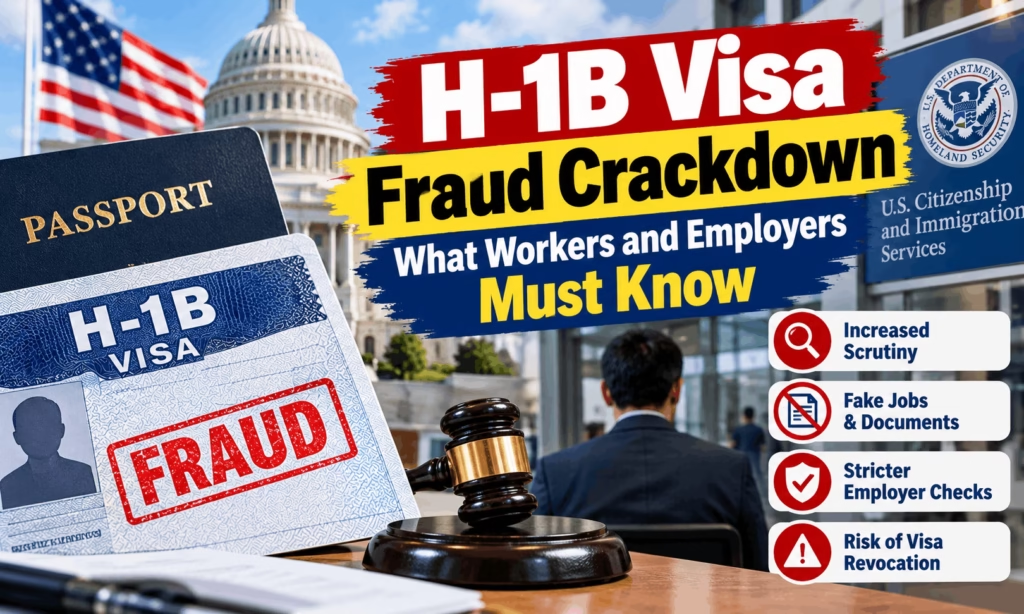
H-1B Visa Fraud Crackdown: The federal government has sharply escalated its H-1B visa fraud crackdown, and the ripple effects are now landing on real companies, real petitions, and real paychecks. The Department of Labor’s Office of Inspector General has issued dozens of subpoenas since July 2026, investigators have walked into office buildings tied to hundreds of approved H-1B filings and found locked doors and empty desks, and the White House has signed a new executive order pulling the Department of Homeland Security, the State Department, and the Department of Labor into a single, coordinated enforcement push. For an H-1B worker wondering whether their job is safe, or an employer wondering whether their last labor condition application will survive a second look, this is no longer a background policy story it is an active, fast-moving compliance risk. We’ll be updating this article monthly as new enforcement actions, court rulings, and agency guidance are released.
What makes the current moment different from earlier rounds of H-1B scrutiny is the sheer coordination behind it. Rather than one agency quietly reviewing paperwork, this is a multi-agency H-1B fraud investigation that ties together Labor Department audits, Homeland Security site visits, State Department consular screening, and Justice Department prosecutions all under a single anti-fraud mandate that officials have described as the most aggressive of its kind. Inspector General Anthony D’Esposito has directly linked parts of the probe to labor trafficking and organized exploitation of foreign workers, not just paperwork violations, which raises the legal stakes considerably for any employer caught in the crossfire. Meanwhile, a separate and still-unresolved court fight over the administration’s $100,000 H-1B fee continues to create day-to-day uncertainty for anyone filing a new petition this fall.
H-1B Visa Fraud Crackdown Key Highlights
| Date | Development |
|---|---|
| Sept 19, 2025 | Presidential Proclamation 10973 imposes a $100,000 supplemental fee on new H-1B petitions for beneficiaries outside the U.S. |
| Nov 2025 | DOL’s Project Firewall initiative launches, opening 175+ H-1B abuse investigations |
| April 2026 | Two individuals in California plead guilty to conspiracy after filing H-1B petitions for jobs that did not exist |
| June 7, 2026 | Reports surface of roughly 100,000 suspect or fake degrees used to support past H-1B petitions |
| June 8, 2026 | U.S. District Court (Massachusetts) vacates the $100,000 fee, calling it an unlawful tax |
| June 30, 2026 | FY2027 H-1B cap registration window closes; USCIS confirms the cap was reached with no second lottery |
| July 8, 2026 | DOL announces its first major multi-agency H-1B/PERM fraud probe, issuing dozens of subpoenas |
| July 24, 2026 | First Circuit Court of Appeals denies a stay, keeping the $100,000 fee vacated |
| Aug 2026 | Field investigators visit a Dallas office building tied to 500+ approved H-1B visas, reporting signs of inactivity |
| Sept 18, 2026 | White House signs an executive order directing DHS, DOL, and State to coordinate H-1B enforcement, with a 30-day LCA review deadline |
| Sept 20, 2026 | The original $100,000 fee proclamation is set to expire unless renewed or extended |
Why the Crackdown Is Widening Now?
The current enforcement wave did not start with the September executive order it started building nearly a year earlier under Project Firewall, a Department of Labor initiative launched in late 2025 that has since grown into more than 175 open investigations into H-1B and PERM program abuse. What changed over the summer of 2026 is scale and coordination. In July, DOL Inspector General Anthony D’Esposito confirmed on national television that his office had opened its first major multi-agency H-1B and PERM visa fraud probe, describing it as targeting not just paperwork fraud but labor trafficking and the alleged displacement of qualified American workers by “people who are gaming the system.” Investigators have already issued dozens of subpoenas to employers and staffing intermediaries as part of that inquiry.
Field work has followed the subpoenas. In August 2026, investigators visited an office building in Dallas linked to more than 500 approved H-1B visas and reported locked doors, dark offices, and little sign of active business the kind of “shell office” pattern regulators say is common among fraud-linked H-1B sponsors, particularly IT staffing and consulting intermediaries. Officials have pointed to similar patterns nationally: in Minnesota, authorities reportedly found that roughly half of reviewed immigration-related cases, including H-1B filings, showed signs of fraud. In California, two men pleaded guilty in April 2026 to conspiracy to commit visa fraud after investigators found that the job positions listed on their H-1B petitions did not actually exist. Separately, reporting in June 2026 raised concerns about as many as 100,000 potentially fake or misrepresented academic degrees used to support past H-1B petitions, an issue that has drawn particular attention from USCIS adjudicators reviewing specialty-occupation qualifications.
Why Some SSI Recipients Get Two Payments in October 2026?
$2400 Social Security Increase: What the Proposed $200 Monthly Boost Really Means
Social Security Payment Dates October 2026: Full Schedule By Birthday, SSI Quirk and COLA Update
Express Entry Reform 2026: FSW, FST and CEC Merger Into One Federal High-Skilled Class
The September 18 Executive Order: What It Actually Does
On September 18, 2026, President Trump signed an executive order directing federal agencies to sharply increase oversight of the H-1B program. It’s important to be precise about what the order does and does not do: it does not immediately rewrite H-1B eligibility rules or change who qualifies for the visa. What it does is direct the Departments of Homeland Security, Labor, and State to coordinate enforcement, with support from Commerce, Education, and the Small Business Administration in evaluating wage, labor-market, and education data tied to H-1B compliance.
Two provisions matter most for employers right now:
- Layoff scrutiny. The order directs agencies to weigh an employer’s recent layoff history when reviewing new H-1B filings a company that recently cut U.S. staff can expect heightened scrutiny and more Requests for Evidence (RFEs) on subsequent H-1B petitions.
- LCA lookback. Within 30 days of the order, the Department of Labor must begin reviewing previously filed Labor Condition Applications (LCAs) — the wage attestations employers file before an H-1B petition — to determine whether enforcement action against sponsoring employers is warranted.
Immigration attorneys have described the order as a “whole of government” signal rather than a single new rule, meaning employers should expect the practical effects to show up gradually, through more RFEs, more site visits, and more audits, rather than through an overnight change in the law.
The $100,000 Fee: A Fast-Moving Legal Fight
No part of the current H-1B story has moved faster — or more confusingly — than the fight over the $100,000 H-1B fee. Here is the plain-language version of where things stand:
- On September 19, 2025, a presidential proclamation imposed a $100,000 payment requirement on new H-1B petitions filed for beneficiaries located outside the United States (i.e., those who would need consular processing rather than a simple change of status).
- Multiple lawsuits followed. A Washington, D.C. court initially upheld the fee in December 2025.
- A Massachusetts federal court reached the opposite conclusion on June 8, 2026, ruling the fee was functionally an unlawful tax that the executive branch had no authority to impose without clear congressional approval, and vacating the policy nationwide.
- The administration appealed, and on July 24, 2026, the First Circuit Court of Appeals denied the government’s request to reinstate the fee while the appeal continues.
- As of late September 2026, the $100,000 fee is not being enforced, but the underlying proclamation was scheduled to expire on September 20, 2026 unless renewed and the administration has signaled it intends to keep pursuing the fee through further appeals, so the situation remains unsettled.
Employers who already paid the fee before it was vacated should keep complete payment records, since refund guidance may follow depending on how the appeal is resolved. Because rulings have gone in different directions in different courts, anyone filing a new H-1B petition this fall should check the live fee schedule on USCIS.gov immediately before submission rather than relying on a headline from a few weeks ago.
Fewer Applications, Tighter Scrutiny: What the Numbers Show
The chilling effect of this environment is visible in the raw registration numbers. For fiscal year 2026, USCIS received 358,737 total H-1B registrations, down roughly 25% from 479,953 the year before, and ultimately selected 120,141 registrations — an 11% drop from FY2025. The FY2027 cap registration window closed on June 30, 2026, with USCIS confirming the cap was met without a second selection round, suggesting continued but softer demand. Officials have pointed to the drop as evidence that the anti-fraud push is working; immigration attorneys have countered that broader anti-immigration rhetoric, fee uncertainty, and recession fears are likely also driving the decline. Either way, the effect on employers is the same: a smaller, more heavily scrutinized applicant pool, and a labor certification and compliance process that now carries real legal exposure if it isn’t handled carefully.
Who Is Affected: H-1B Workers
If you currently hold H-1B status, the crackdown mostly changes your risk exposure, not your day-to-day legal status — but a few things are worth watching closely:
- If your employer is under investigation (subpoenaed, audited, or flagged for an inactive worksite), your own status can become entangled even if you personally did nothing wrong, particularly if your employer is found to have filed a fraudulent LCA or misrepresented your job duties.
- Degree and credential verification is under closer review, so workers whose petitions relied on foreign academic credentials should be prepared for additional Requests for Evidence.
- Workers placed at third-party client sites through staffing or consulting intermediaries are in the highest-scrutiny category right now, since “shell office” and end-client placement patterns are a central focus of the DOL’s Project Firewall investigations.
- If you’re contacted directly by DOL, DHS, or USCIS investigators, you have the right to consult an immigration attorney before answering questions, and doing so is strongly advisable if your employer is already under scrutiny.
Who Is Affected: Employers
For sponsoring employers, the current environment demands a genuinely proactive compliance posture, not just a reactive one:
- Public Access Files (the documentation package every H-1B sponsor must maintain) need to be complete, accurate, and instantly retrievable — DOL audits increasingly start here.
- Prevailing wage compliance is being checked against actual pay records, not just the wage listed on the LCA.
- The actual job duties performed must match what was described in the LCA and I-129 petition a mismatch is one of the most common fraud findings in current cases.
- Employers with recent layoffs should expect additional scrutiny on any new or pending H-1B filings under the September executive order.
- Employers using third-party placement models (staffing firms placing H-1B workers at client sites) face the highest current enforcement focus and should review end-client contracts and worksite documentation now, rather than waiting for an audit letter.
$100000 Social Security Benefits Per Year: How Married Couples Actually Reach It in 2026
Medicare Part D Premium 2027 New Rates Announced, How Much Will You Pay?
2027 Social Security COLA Forecast: Latest 3.6% Estimate and How Much Retirees Could Get
US New Visa Restrictions Targeting Commercial Birth Tourism Networks
Supreme Court Voter Database Ruling: What Changes for American Voters Now
How to Apply for an H-1B Visa (Current Process)
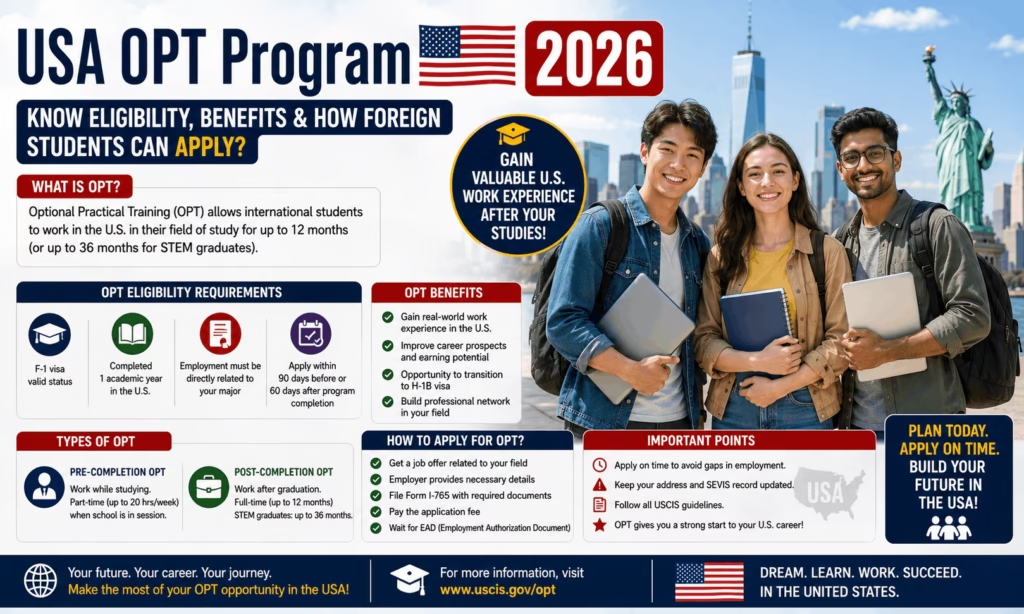
- Employer registration (March window): The sponsoring employer electronically registers each candidate through a USCIS online account during the annual registration period, paying the $215 registration fee per beneficiary.
- Lottery selection: USCIS runs a random (wage-weighted) selection process if registrations exceed the annual cap.
- Labor Condition Application (LCA): Selected employers file Form ETA-9035 through the Department of Labor’s FLAG system, attesting to wage and working-condition requirements.
- Form I-129 petition: The employer files Form I-129 with USCIS, including the approved LCA, job description, and supporting evidence of the position and the worker’s qualifications.
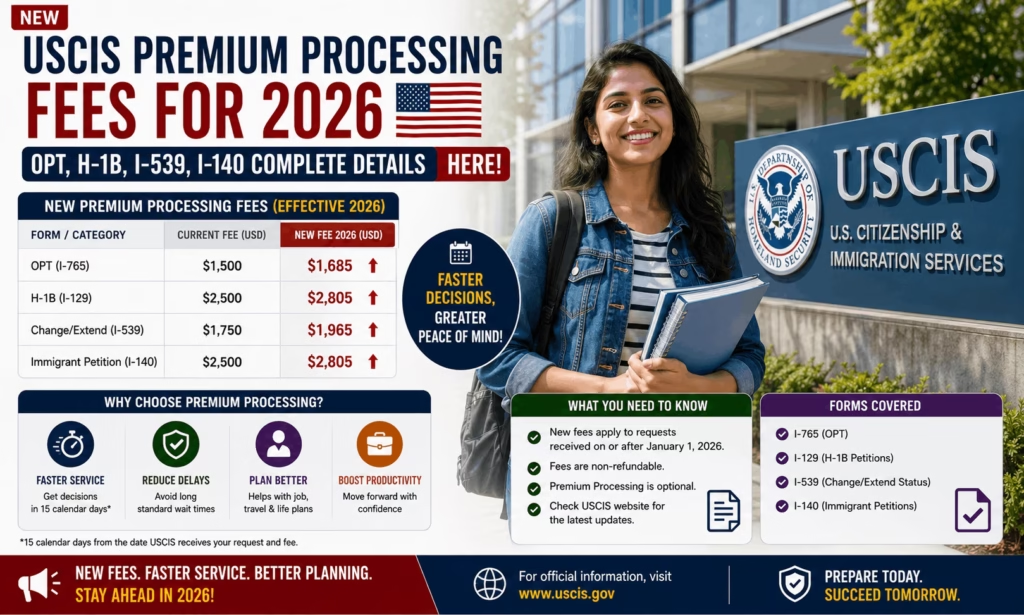
- Adjudication or premium processing: USCIS reviews the petition under standard timelines, or the employer can pay for premium processing for a 15-business-day decision.
- Visa stamping / change of status: If the worker is abroad, they attend a consular interview to obtain the H-1B visa stamp; if already in the U.S. in another status, they may instead request a change of status.
Processing Time: What to Expect Right Now
Regular H-1B petition processing at USCIS service centers is currently running at roughly two to six months, depending on the service center and time of year, though the ongoing LCA review mandated by the September executive order may add delays for petitions flagged for closer inspection. Premium processing guarantees a decision (approval, denial, or a Request for Evidence) within 15 business days of filing, for an additional fee. Petitions connected to an employer under active DOL or DHS investigation, or filed for a company with a recent history of layoffs, should expect longer timelines and a higher chance of an RFE under the current enforcement climate.
Payment Schedule: Current H-1B Fees (2026)
| Fee | Standard Employer | Small Employer / Nonprofit (≤25 FTE) |
|---|---|---|
| H-1B registration fee | $215 | $215 |
| Form I-129 base filing fee | $780 | $460 |
| ACWIA training fee | $1,500 | $750 |
| Fraud Prevention & Detection fee | $500 | $500 |
| Asylum Program fee | $600 | $300 |
| Public Law 114-113 fee (H-1B-dependent employers, 50+ staff) | $4,000 | Not applicable |
| Premium Processing (optional, Form I-907) | $2,965 | $2,965 |
| $100,000 proclamation fee (consular cases) | Not currently enforceable — vacated by court order, appeal pending | Not applicable |
Most of these fees are legally required to be paid by the employer, not the worker only premium processing may, in limited circumstances, be paid by the employee if it primarily benefits them. Given how often the $100,000 fee’s status has changed in 2026, employers should verify the live fee schedule on Pay.gov and USCIS.gov immediately before submitting any new petition.
Official Government Resources
| Resource | Link |
|---|---|
| USCIS H-1B Program Overview | https://www.uscis.gov/working-in-the-united-states/h-1b-specialty-occupations |
| USCIS Case Status Online (check a pending petition) | https://egov.uscis.gov/casestatus/landing.do |
| myUSCIS Account (registration & filing) | https://my.uscis.gov |
| USCIS Fee Schedule (Form G-1055) | https://www.uscis.gov/g-1055 |
| DOL Labor Condition Application (FLAG System) | https://flag.dol.gov |
| DOL Office of Inspector General | https://www.oig.dol.gov |
| DOL Office of Foreign Labor Certification | https://flag.dol.gov/programs/oflc |
| U.S. Department of State Visa Status Check | https://ceac.state.gov/CEACStatTracker/Status.aspx |
Social Security COLA 2027 by State: These 10 States Could See the Biggest Dollar Increase
US New Visa Restrictions Targeting Commercial Birth Tourism Networks
Full Social Security at 60: Who Qualifies Under the New Blue Collar Bill
FAQs About H-1B Visa Fraud Crackdown
Is the H-1B $100,000 fee still active right now?
No. A federal court vacated the fee in June 2026, and an appeals court declined to reinstate it as of July 2026. It is not currently being collected, but the case is still on appeal, so the situation could change.
What is Project Firewall?
Project Firewall is the Department of Labor’s ongoing initiative, launched in late 2025, to investigate suspected fraud and abuse in the H-1B and PERM programs; it has since expanded into the broader 2026 multi-agency fraud probe.
Can my H-1B be revoked if my employer is under investigation?
Not automatically, but if investigators find your specific petition involved fraud, a nonexistent position, or a misrepresented job description, your status can be directly affected. Speaking with an immigration attorney early is strongly recommended.
How long does H-1B processing take in 2026?
Standard processing is currently running about two to six months; premium processing guarantees a decision within 15 business days for an additional fee.
Who pays H-1B visa fees, the employer or the employee?
By law, the employer must pay the registration fee, base filing fee, ACWIA fee, fraud prevention fee, and Asylum Program fee. Only the optional premium processing fee may sometimes be paid by the employee.
What triggers an H-1B fraud investigation?
Common red flags include vacant or inactive worksites, job duties that don’t match the LCA, wages below the prevailing wage, heavy reliance on third-party client placements, and recent employer layoffs paired with new H-1B filings.
Did H-1B applications drop because of the crackdown?
Registrations for FY2026 fell about 25% year over year, and selected registrations fell about 11%. Officials attribute part of the drop to the anti-fraud push; attorneys also point to fee uncertainty and broader immigration policy as contributing factors.
Where can I check my H-1B case status?
Use the USCIS Case Status Online tool with your receipt number, or check your myUSCIS account directly.
Conclusion
The H-1B visa fraud crackdown of 2026 is not a single policy — it’s a fast-moving combination of a multi-agency investigation, a new executive order, an unresolved court battle over a six-figure fee, and a visibly shrinking applicant pool. For workers, the practical advice is to know your employer’s compliance standing and understand your rights if investigators come calling. For employers, the message from every agency involved is the same: Public Access Files, prevailing wage compliance, and accurate job descriptions are no longer optional paperwork — they are frontline legal protection. Because court rulings and agency guidance are changing month to month, treat any specific number or fee status in this article as a snapshot of late September 2026, and verify current details directly with USCIS, the Department of Labor, or a qualified immigration attorney before making filing decisions.
2027 COLA: How Much Will Your Social Security Check Increase?
Social Security October 2026 Payments: Why SSI Gets Two Checks?
$255 Social Security Death Benefit: Who Actually Qualifies and How to Apply?
Social Security Cuts by State 2032: Which States Face the Biggest Economic Impact
States That Tax Social Security Benefits in 2026: Full List, Income Limits and Free Calculator