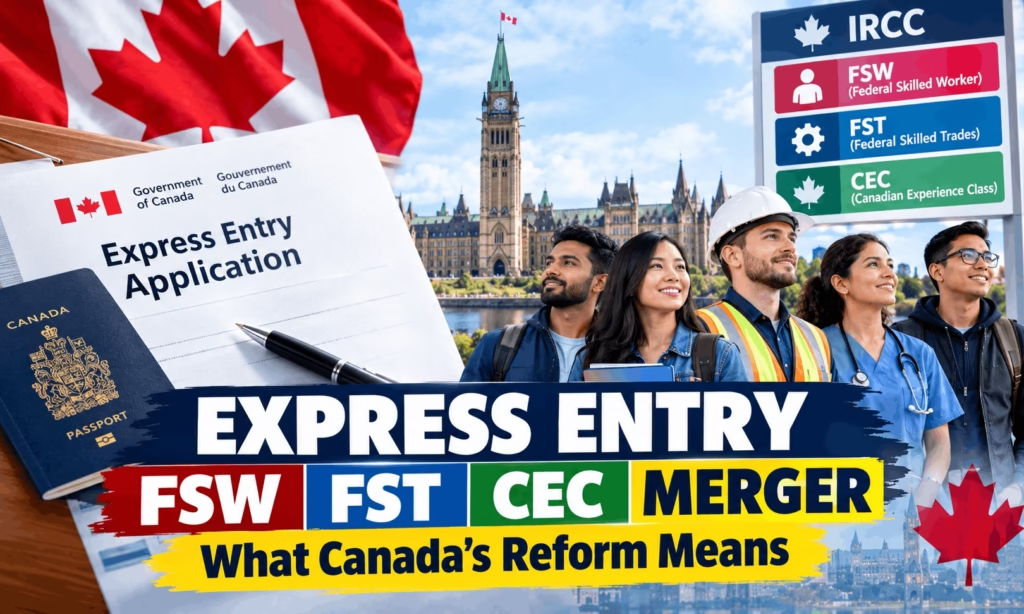
Express Entry FSW FST CEC Merger: Canada is preparing for the most significant restructuring of its federal economic immigration system since Express Entry launched in 2015, and the centerpiece of that overhaul is the proposed Express Entry FSW FST CEC merger, a plan that would fold the Federal Skilled Worker Program, the Federal Skilled Trades Program, and the Canadian Experience Class into one single, unified immigration category. Immigration, Refugees and Citizenship Canada closed its public consultation on this reform on May 24, 2026, and as of late September 2026, the department is still reviewing feedback before drafting formal regulatory amendments, meaning no final rules have taken effect yet for anyone currently in the Express Entry pool.
The proposal goes far beyond a simple name change. It would eliminate the separate minimum eligibility grids that have defined FSW, FST, and CEC for a decade, replace them with one common set of requirements, and simultaneously recalibrate the Comprehensive Ranking System that decides who receives an invitation to apply for permanent residence. We’ll be updating this article monthly as IRCC releases new details, publishes draft regulations in the Canada Gazette, or announces an implementation date. For the hundreds of thousands of candidates currently sitting in the Express Entry pool, or planning to enter it in the coming year, this is not a distant policy footnote. It touches the exact criteria that decide whether you qualify at all, and how many points your profile earns once you’re in.
Express Entry FSW FST CEC Merger Key Highlights
| Detail | Information |
|---|---|
| Reform name | Merger of FSW, FST, and CEC into one Federal High Skilled program |
| Announcing body | Immigration, Refugees and Citizenship Canada (IRCC) |
| Consultation period | April 23, 2026 to May 24, 2026 |
| Current status (as of late September 2026) | Feedback under review; no final regulations published yet |
| Programs affected | Federal Skilled Worker (FSW), Federal Skilled Trades (FST), Canadian Experience Class (CEC) |
| Also under review | Comprehensive Ranking System (CRS) scoring factors |
| Legal mechanism | Amendments to the Immigration and Refugee Protection Regulations, plus new Ministerial Instructions |
| Where changes will be published | Canada Gazette |
| 2026 permanent resident admissions target | 380,000 (also planned for 2027 and 2028) |
| Implementation timeline | Not yet announced; regulatory changes typically take several months to over a year after consultation |
What Is Actually Being Proposed?
Express Entry itself is not going away. It remains Canada’s online application management system for economic immigration, and it will keep managing intake for federal programs plus a portion of the Provincial Nominee Program. What’s changing is the structure underneath it. Right now, a candidate must qualify for one of three separate programs before they can even enter the pool: the Federal Skilled Worker Program for people with foreign work experience, the Canadian Experience Class for people with Canadian work experience, and the Federal Skilled Trades Program for tradespeople with a job offer or trade certification.
IRCC’s own reasoning, laid out in its 2026 discussion paper, is that these three programs were designed years before Express Entry existed and were originally meant to process applications on a first-come, first-served basis. In today’s system, actual selection is driven almost entirely by CRS scores and category-based draws, so the old program-specific eligibility grids increasingly function as confusing gatekeeping hurdles rather than meaningful selection tools. The department’s stated goals for the reform are to focus on the strongest predictors of long-term economic success, cut down on overlap between programs, reduce overall complexity, and protect the integrity and fairness of the system.
Why Some SSI Recipients Get Two Payments in October 2026?
$2400 Social Security Increase: What the Proposed $200 Monthly Boost Really Means
Social Security Payment Dates October 2026: Full Schedule By Birthday, SSI Quirk and COLA Update
Express Entry Reform 2026: FSW, FST and CEC Merger Into One Federal High-Skilled Class
Proposed Eligibility Requirements Under the Merged Program
| Requirement | Current Rules (Vary by Program) | Proposed Under the Merger |
|---|---|---|
| Education | FSW requires Canadian high school or equivalent; CEC and FST have no formal minimum | Canadian high school diploma or equivalent, verified through an Educational Credential Assessment |
| Language ability | CLB/NCLC 7 for FSW; CLB/NCLC 5 to 7 for CEC depending on job type; CLB/NCLC 4 to 5 for FST | CLB/NCLC 6 across all four language abilities, for all occupation types |
| Work experience | 1 year continuous for FSW; 1 year Canadian experience for CEC; 2 years in a skilled trade for FST | 1 year of cumulative experience in one or more TEER 0 to 3 occupations, in Canada or abroad, within the last 3 years |
| Job offer | Required for FST unless a trade certificate is held; optional bonus factor for FSW; not applicable for CEC | No longer proposed as a minimum eligibility requirement on its own |
| Minimum points grid | 67-point pass mark under FSW only | Proposed to be eliminated entirely |
If finalized as proposed, this would mean a meaningfully lower and more uniform entry bar for many candidates, particularly those who previously fell short of the FSW’s stricter language and education thresholds but had solid, recent work experience in a skilled occupation.
Why the Comprehensive Ranking System Is Also Being Rebuilt?
The second, and arguably more consequential, part of this reform is a recalibration of the CRS itself, the points system that determines who actually gets an invitation to apply once inside the pool. IRCC says internal research has identified which existing scoring factors are strong predictors of a newcomer’s long-term economic success in Canada, and which ones are weak.
According to the department’s own findings, the strongest predictors include prior temporary resident earnings in Canada, official language proficiency, Canadian work experience, a job offer in a high-wage occupation, education level, and age. On the other end of the scale, IRCC has flagged several bonus factors as weak predictors of economic outcomes, including spousal attributes, additional points for French language ability, points for studying in Canada, and bonus points for having a sibling already living in the country.
Proposed Changes to CRS Scoring Factors
| CRS Factor | Current Structure | Proposed Direction |
|---|---|---|
| Age, Education, First and Second Official Language | Existing point ranges under core human capital factors | No change proposed |
| Canadian Work Experience | Up to 80 points for 5+ years | Restructured under a new “Labour Market Integration” factor combining experience with high-wage occupation status or a job offer |
| Job Offer Points | Removed in March 2025 | Proposed to be reintroduced, but only for job offers in occupations paying above the national median wage |
| High-Wage Occupation Bonus | Does not currently exist | New tiered factor proposed, potentially rewarding wages at 1.3x, 1.5x, or 2x the national median |
| Provincial Nomination | 600 points | Proposed for removal or modification |
| French-Language Bonus Points | 25 to 50 bonus points | Proposed for removal, with French-speaking candidates instead prioritized through category-based draws |
| Studies in Canada | 15 to 30 points | Proposed for removal or modification |
| Sibling in Canada | 15 bonus points | Proposed for removal or modification |
| Spousal Factors | Up to 40 points | Proposed for removal or modification |
| Skills Transferability, Trade Certification | Existing structure | Enhanced recognition proposed for Red Seal Certificate of Qualification holders |
IRCC has explained that the logic behind the new high-wage occupation factor is that occupational earnings, not just job titles, are a better signal of who will thrive economically in Canada, and that limiting job-offer points to higher-paid roles also reduces fraud risk since those positions are easier to verify.
How to Apply Right Now, and What Happens During the Transition
Because none of these changes are final, current Express Entry applicants and prospective candidates should continue operating under today’s rules. Here is the practical process as it stands.
- Confirm you meet one of the three current programs. You still need to qualify under FSW, FST, or CEC as they exist today; the merged program does not yet exist in law.
- Create an Express Entry profile through your secure account. This requires a GCKey or Sign-In Partner login through the official IRCC portal.
- Complete language testing and, if required, an Educational Credential Assessment. These results feed directly into your CRS score under the current system.
- Wait for an Invitation to Apply. If your CRS score meets or exceeds the cutoff in a draw, you receive an invitation and generally have 60 days to submit a complete application.
- Monitor IRCC’s official channels for regulatory updates. Any finalized change to eligibility will be published in the Canada Gazette before it takes legal effect.
Processing Time and Costs
Processing times for Express Entry applications currently average around six months for a complete application once submitted, according to IRCC’s published service standards, though this can vary based on application volume and completeness. There is no separate fee tied to the proposed merger itself. Standard Express Entry government processing fees currently apply per program (permanent residence application fees, the right of permanent residence fee, and biometrics fees), and these are expected to remain in place regardless of which program category an applicant ultimately falls under once the merger takes effect. There is no announced new “payment schedule” specific to this reform, since it changes eligibility criteria and scoring, not government fee structures.
$100000 Social Security Benefits Per Year: How Married Couples Actually Reach It in 2026
Medicare Part D Premium 2027 New Rates Announced, How Much Will You Pay?
2027 Social Security COLA Forecast: Latest 3.6% Estimate and How Much Retirees Could Get
US New Visa Restrictions Targeting Commercial Birth Tourism Networks
Supreme Court Voter Database Ruling: What Changes for American Voters Now
Timeline: How This Reform Has Progressed
| Date | Development |
|---|---|
| 2015 | Express Entry launches, managing intake for FSW, FST, and CEC |
| March 2025 | Job offer points temporarily removed from the CRS |
| Early 2026 | IRCC’s Forward Regulatory Plan 2026-2028 signals intent to merge the three federal programs |
| April 2026 | IRCC publishes a discussion paper outlining proposed eligibility and CRS changes |
| April 23, 2026 | Public and stakeholder consultation officially opens |
| May 24, 2026 | Consultation period closes |
| June 2026 | Federal, provincial, and territorial immigration ministers meet to discuss economic immigration priorities |
| Late September 2026 | Feedback still under departmental review; no finalized regulations or implementation date announced |
Analysts tracking the file note that any regulatory change of this scale typically takes several months to more than a year to move from a closed consultation to a published rule in the Canada Gazette, which means candidates should not expect an abrupt overnight switch to the new system.
Who Benefits and Who Should Be Cautious
Candidates likely to benefit from a merged, streamlined program include those with recent, cumulative TEER 0 to 3 work experience who previously struggled to meet FSW’s stricter one-year continuous experience rule, and tradespeople who may find it easier to qualify without a mandatory job offer requirement. Candidates with strong official language scores and post-secondary education in high-wage fields also stand to gain from the proposed high-wage occupation bonus.
Candidates who should watch developments closely include those currently relying heavily on spousal points, sibling bonus points, French-language bonus points, or study-in-Canada points, all of which are proposed for removal or reduction. Someone who previously qualified for CEC with a CLB 5 score should also note that the proposed uniform CLB/NCLC 6 threshold across all TEER levels could raise the bar for certain occupation categories, even as it lowers the bar for others.
IRCC has stressed that category-based selection rounds, which target specific in-demand occupations, French-speaking candidates outside Quebec, and other labour market priorities, will continue to operate alongside the redesigned core system.
Official Resources and Where to Apply or Check Status
Always verify Express Entry rules, your profile status, and any regulatory updates directly through official Government of Canada channels rather than third-party consultants claiming special access.
Proposed Merged Program Eligibility Estimator
Because the exact eligibility thresholds proposed for the merged program are already public through IRCC’s discussion paper, we built a simple tool below so candidates can check how their profile would likely stack up against the proposed rules, separate from today’s actual FSW, FST, and CEC requirements. This is an estimate based on published proposals only, not a confirmed government calculator.
Express Entry Merged Program Eligibility Estimator
Your Profile
Social Security COLA 2027 by State: These 10 States Could See the Biggest Dollar Increase
US New Visa Restrictions Targeting Commercial Birth Tourism Networks
Full Social Security at 60: Who Qualifies Under the New Blue Collar Bill
FAQs
What is the Express Entry FSW FST CEC merger?
It’s a proposed reform by Immigration, Refugees and Citizenship Canada that would eliminate the Federal Skilled Worker, Federal Skilled Trades, and Canadian Experience Class as separate programs and replace them with one unified federal economic immigration category with a single set of eligibility rules.
Has the Express Entry merger already happened?
No. As of late September 2026, this remains a proposal. IRCC closed public consultation on May 24, 2026, and is still reviewing feedback. Any final change must be published in the Canada Gazette before it becomes law.
Will my current Express Entry profile be affected right now?
Not immediately. Candidates currently in the pool continue to be assessed under the existing FSW, FST, and CEC rules and the current CRS structure until any new regulation formally takes effect.
Why is Canada merging these three immigration programs?
IRCC says the three programs were designed before Express Entry existed and now function mainly as outdated eligibility gatekeepers, since actual candidate selection already depends on CRS scores and category-based draws rather than which specific program a person qualifies under.
Will spousal and sibling points be removed from the CRS?
IRCC has proposed removing or modifying points for spousal factors, sibling relationships in Canada, French-language bonus points, and study-in-Canada points, based on research suggesting these are weaker predictors of long-term economic success than factors like language ability and work experience.
What is the proposed language requirement under the new merged program?
The proposal sets a uniform requirement of CLB or NCLC 6 across all four language abilities, replacing the current range that varies from CLB 4 to CLB 7 depending on the program and occupation type.
When will the new Express Entry rules take effect?
No implementation date has been announced. Regulatory changes of this scale typically take several months to more than a year to finalize after a consultation period closes, so candidates should continue following official IRCC updates rather than assuming an immediate rollout.
Where can I check the official status of these proposed changes?
The Government of Canada’s official consultation page and IRCC’s newsroom are the most reliable sources, and this article will be updated monthly as new developments are confirmed.
Conclusion
The proposed Express Entry FSW FST CEC merger represents the most substantial rethink of Canada’s economic immigration selection process since 2015, touching everything from basic eligibility thresholds to how points are awarded for work experience, language ability, and family ties. While the direction of travel is clear from IRCC’s discussion paper and consultation record, nothing is finalized yet, and candidates currently in or entering the Express Entry pool should keep meeting today’s actual FSW, FST, or CEC requirements rather than planning around rules that haven’t been legally adopted. The safest approach is to track official Government of Canada sources directly and treat third-party summaries, including this one, as a guide rather than a substitute for confirmed regulatory text. We’ll continue updating this article monthly as IRCC moves from consultation to formal rulemaking.
2027 COLA: How Much Will Your Social Security Check Increase?
Social Security October 2026 Payments: Why SSI Gets Two Checks?
$255 Social Security Death Benefit: Who Actually Qualifies and How to Apply?
Social Security Cuts by State 2032: Which States Face the Biggest Economic Impact
States That Tax Social Security Benefits in 2026: Full List, Income Limits and Free Calculator