How Is the COLA Calculated: The Social Security Administration averages a price index called the CPI-W for July, August and September, then compares that average with the same three months a year earlier. July came in at 327.104 and August at 328.481. September, due October 14, decides the rest. If it lands between 329.047 and 329.999, the COLA rounds to 3.5 percent. A lower reading pulls the result to 3.4 percent or less, and a higher one pushes it to 3.6 percent or more. That is how the COLA is calculated each year, and this year the margin is thin: a tenth of a percentage point is worth about $2 a month on a $2,000 benefit. The official figure is expected on October 14, 2026. We will be updating this article monthly.
The formula has barely changed in decades, but the debate around it has. A bill called the Social Security 2100 Act, reintroduced this year, would bring in a different inflation measure built for older Americans, though reports describe very limited support for it in Congress. In the sources we reviewed, nothing has been enacted that alters the method for 2027. Last year the same formula produced 2.8 percent, from a third quarter average of 317.265 against 308.729 a year earlier. This guide walks through the calculation step by step, shows the 2026 example with the real index values, lays out which September number leads to which result, explains why Social Security uses the CPI-W, and covers what lawmakers are weighing. It also covers dates, payments, how to avoid fake COLA messages and what to do if you are about to apply. Every figure comes from a published source, and estimates are labeled as estimates.
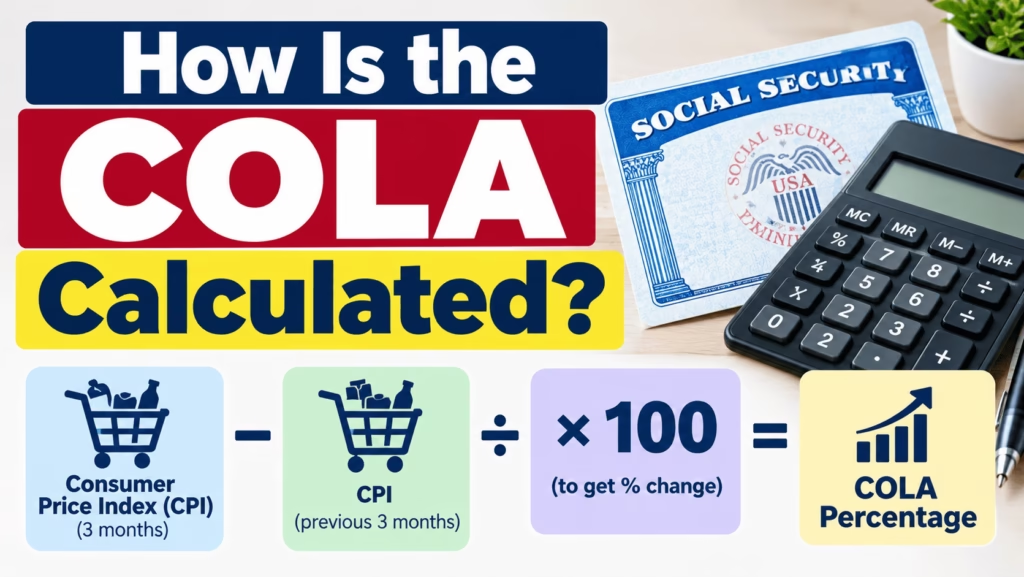
How Is the COLA Calculated Each Year?
The Social Security Act sets the method, and the Bureau of Labor Statistics supplies the data. Here is the sequence the Social Security Administration follows every fall.
- The Bureau of Labor Statistics publishes the Consumer Price Index for Urban Wage Earners and Clerical Workers, known as the CPI-W, every month.
- The agency averages the index for July, August and September. That is the third quarter average, kept to three decimal places.
- It compares that average with the third quarter average from the last year a COLA took effect, which is normally the year before.
- The percentage change is rounded to the nearest tenth of a percent. That rounded figure is the COLA.
- The increase applies to benefits for December, which are paid in January. SSI payments rise in January as well.
- A COLA cannot be negative. If prices fall or the rounded change is zero, benefits stay the same.
Only the third quarter counts directly. Prices in January or May do not enter the formula, though they shape where the third quarter ends up. That is why the monthly CPI report in October is so closely watched.
2026 COLA Example: The Real Numbers Behind 2.8 Percent
The most recent determination shows the method clearly. The agency’s published figures are below.
| Month | 2024 CPI-W | 2025 CPI-W |
|---|---|---|
| July | 308.501 | 316.349 |
| August | 308.640 | 317.306 |
| September | 309.046 | 318.139 |
| Third quarter average | 308.729 | 317.265 |
The calculation is 317.265 minus 308.729, divided by 308.729, which equals 2.765 percent. Rounded to the nearest tenth, that is 2.8 percent, the COLA that took effect for December 2025 benefits and showed up in checks in January 2026. The agency also raised the SSI federal payment levels by 2.8 percent.
SNAP Work Requirements: Who Is Affected, Ages 18 to 64, Exemptions and Calculator
2027 COLA Calculation
For 2027, the benchmark is the 317.265 average from last year’s third quarter. Two of the three months that count are already published.
| Month | 2025 CPI-W | 2026 CPI-W | Change from a year earlier |
|---|---|---|---|
| July | 316.349 | 327.104 | 3.40% |
| August | 317.306 | 328.481 | 3.52% |
| September | 318.139 | Due October 14 | Not yet known |
The path through 2026 has been bumpy. The index was 317.942 in January, climbed steadily to a peak of 328.829 in May, then slipped to 327.075 in June, a drop of about half a percent. July was nearly flat at 327.104, and August rose to 328.481. That dip in June is one reason forecasters trimmed their estimates over the summer.
| 2026 month | CPI-W index |
|---|---|
| January | 317.942 |
| February | 319.422 |
| March | 323.500 |
| April | 326.541 |
| May | 328.829 |
| June | 327.075 |
| July | 327.104 |
| August | 328.481 |
What September CPI-W Number Is Needed for Each 2027 COLA?
Because July and August are fixed, we can work backward. The table below shows the September index that would produce each COLA, based on our own arithmetic from the published figures. The ranges run from the lower number up to just under the higher one, since the result is rounded to the nearest tenth.
| 2027 COLA | September 2026 CPI-W needed | Change from August | Change from September 2025 |
|---|---|---|---|
| 3.3% | 327.143 to 328.094 | Down 0.41% to down 0.12% | 2.83% to 3.13% |
| 3.4% | 328.095 to 329.046 | Down 0.12% to up 0.17% | 3.13% to 3.43% |
| 3.5% | 329.047 to 329.998 | Up 0.17% to up 0.46% | 3.43% to 3.73% |
| 3.6% | 329.999 to 330.950 | Up 0.46% to up 0.75% | 3.73% to 4.03% |
| 3.7% | 330.951 to 331.901 | Up 0.75% to up 1.04% | 4.03% to 4.33% |
A few scenarios make it concrete. If September is flat compared with August, the third quarter average works out to 328.022 and the COLA is 3.4 percent. A 0.2 percent rise gives 3.5 percent. A 0.5 percent rise gives 3.6 percent, and a 0.8 percent rise gives 3.7 percent. A 0.2 percent decline would produce 3.3 percent.
Compare that with the forecasts. The Senior Citizens League estimates 3.5 percent and AARP estimates 3.6 percent. Our arithmetic suggests those forecasts assume September rises roughly 0.2 to 0.5 percent from August. That is plausible given the recent trend, but it is not guaranteed, and a flat month would drop the result to 3.4 percent.
COLA Formula Calculator
COLA Formula Calculator
Calculate the Cost-of-Living Adjustment and your new benefit amount.
Formula: COLA % = ((Current Q3 CPI-W − Prior Q3 CPI-W) ÷ Prior Q3 CPI-W) × 100. New Benefit = Current Benefit × (1 + COLA ÷ 100). Results are estimates; the official COLA is announced by the relevant authority (e.g., SSA).
Why Social Security Uses the CPI-W Instead of Other Inflation Measures
Congress enacted cost-of-living adjustments in 1973, and the CPI-W was the only official consumer price index the government produced at the time, according to the Bipartisan Policy Center. The Social Security Administration notes that automatic annual adjustments began in 1975. The Bureau of Labor Statistics did not start publishing the broader CPI-U until 1978, and the law was never rewritten to switch.
The CPI-W tracks spending by urban wage earners and clerical workers, roughly 30 percent of the population, while the CPI-U covers more than 90 percent. The two move closely together, so there has been little push to change that choice. The debate is really about two other measures.
| Index | Who or what it covers | Effect on COLAs, per SSA actuaries as summarized by BPC |
|---|---|---|
| CPI-W | Urban wage earners and clerical workers, about 30% of population | Current method |
| CPI-U | Over 90% of the population | Tracks CPI-W closely |
| Chained CPI | Accounts for shoppers switching between products | About 0.3 point lower per year on average |
| CPI-E | Research index for Americans 62 and older, with more weight on medical care and housing | About 0.2 point higher per year on average |
Supporters of the CPI-E argue that older Americans spend more of their budget on health care and housing, so a general index understates their costs. Critics counter that the CPI-E is a research series rather than the official measure, and that switching to it would worsen the program's finances.
Breaking: Official 2027 COLA Time, What to Expect and Medicare Open Enrollment Checklist
Medicare Open Enrollment Changes, Who Must Switch and How to Compare Plans
COLA History: Every Adjustment Since 2012
The table lists the percentage applied in each year that benefits were paid, using the Social Security Administration's series.
| Benefit year | COLA |
|---|---|
| 2012 | 3.6% |
| 2013 | 1.7% |
| 2014 | 1.5% |
| 2015 | 1.7% |
| 2016 | 0.0% |
| 2017 | 0.3% |
| 2018 | 2.0% |
| 2019 | 2.8% |
| 2020 | 1.6% |
| 2021 | 1.3% |
| 2022 | 5.9% |
| 2023 | 8.7% |
| 2024 | 3.2% |
| 2025 | 2.5% |
| 2026 | 2.8% |
The agency lists these by the December in which each increase took effect, so its own table shows each figure one year earlier. Averaged over the fifteen adjustments, the COLA is about 2.6 percent, and over the last ten it is about 3.1 percent, pulled up by the post pandemic inflation of 2022 and 2023. A 3.5 percent result for 2027 would be the biggest since 2023.
What Is Being Considered for the 2027 Adjustment?
The short answer is that the 2027 COLA will be set by the existing formula. Several ideas are circulating in Congress and among advocates, but the sources we reviewed show none that has become law.
The Social Security 2100 Act and the CPI-E
The most prominent proposal is the Social Security 2100 Act, reintroduced in 2026 and first introduced in 2017. The Senior Citizens League describes it as switching the COLA to the CPI-E. A Newsweek report from August 3 describes a narrower version: keep the CPI-W, add the CPI-E, and use whichever produces the larger increase for the COLAs from 2027 through 2036, then revert to the current method. The two descriptions differ, so readers should check the bill text on congress.gov.
The effect would be modest in any one year. Newsweek reports that the CPI-E has historically run about 0.2 percentage points faster than the CPI-W, which on a $1,500 benefit is roughly $3 a month in the first year, and about 2 percent more over ten years as the gains compound. The Senior Citizens League says the bill also includes a 2 percent across the board benefit increase, a higher minimum benefit and payroll tax changes. Both sources say passage is unlikely, and the league cites a GovTrack estimate of a 0 percent chance.
Chained CPI and the Cost Question
The opposite idea is the chained CPI, which the Bipartisan Policy Center's 2016 retirement commission recommended. SSA actuaries estimate that it would trim COLAs by about 0.3 percentage points a year and cut the program's long term shortfall by 14 percent. By the same estimates, moving to the CPI-E would increase the shortfall by 11 percent. Those numbers explain why changes to the formula are hard politically: one raises benefits and costs more, and the other saves money and lowers checks.
Emergency Relief Proposals
The Senior Citizens League also points to a separate bill, the Social Security Emergency Inflation Relief Act, which would add $200 a month for six months. We found no sign it is moving, and it would not alter the COLA calculation.
The Trust Fund Backdrop
All of this plays out against the program's finances. The 2026 Trustees Report, as summarized by the Congressional Research Service, projects that the retirement trust fund is depleted in the fourth quarter of 2032 and the combined retirement and disability funds in the third quarter of 2034. After that, incoming taxes would cover about 83 percent of scheduled benefits, falling to 65 percent by 2100. That pressure is why a formula change that costs money is a hard sell, and why one that saves money is politically risky.
Social Security Payments October 14: Who gets checks as 2027 COLA forecast hits 3.6%?
VA Education Benefits 2027 COLA: How Much Are Payments Increasing Under the Latest Projection?
What the 2027 COLA Means in Dollars
A COLA of 3.5 percent adds about $35 to each $1,000 of monthly benefit. Using the average retired worker benefit of $2,087.52 reported by Kiplinger as of August, the scenarios look like this.
| Monthly benefit | At 3.4% | At 3.5% | At 3.6% |
|---|---|---|---|
| $1,000 | +$34.00 | +$35.00 | +$36.00 |
| $2,087.52 (average retired worker) | +$70.98 | +$73.06 | +$75.15 |
| $3,000 | +$102.00 | +$105.00 | +$108.00 |
Medicare takes a share. The standard Part B premium is $202.90 in 2026, and the 2026 Trustees Report estimate for 2027 is $209.50, an increase of $6.60. The official figure has not been announced. For someone whose Part B premium comes out of their check, the net gain is the COLA minus that change.
2027 COLA Announcement Date and Payment Schedule
The Bureau of Labor Statistics releases the September index on October 14, 2026, and the Social Security Administration is expected to announce the COLA that day. Last year a government shutdown pushed the report and the announcement to October 24. A Motley Fool piece syndicated on Nasdaq says Senate leaders have agreed to funding that runs past the midterm elections, so a repeat looks unlikely, though not impossible.
| Date | What happens |
|---|---|
| October 14, 2026 | September CPI-W released, official 2027 COLA expected |
| Mid November 2026 | CMS expected to announce the official 2027 Part B premium |
| December 2026 | Notices of new benefit amounts typically posted in my Social Security |
| December 31, 2026 | SSI payment for January 2027, the first with the increase |
| January 13, 20 and 27, 2027 | Social Security Wednesday payments by birth date, with the increase |
How to Get the COLA: Do You Need to Apply?
No. The increase is applied automatically to anyone already receiving Social Security or SSI. What you can do is make sure nothing gets in the way.
- Create or sign in to a my Social Security account to see your benefit amount and notices.
- Check that your mailing address and bank details are current.
- If you are not yet receiving benefits, apply through ssa.gov or by calling 1-800-772-1213. Your first benefit amount will already include any increases since you became eligible.
- Keep the December notice, because it shows your new gross benefit and your new Medicare premium deduction.
Processing Time: When the New Amount Shows Up
Nothing needs to be processed on your end. The agency applies the percentage to your record. SSI recipients see the increase first, in the payment scheduled for December 31, 2026. Other beneficiaries see it in January 2027, on their usual payment day. If your amount looks wrong, compare your old benefit with the new notice and the final COLA percentage, then call 1-800-772-1213 or visit a local office.
Scam Warning: Fake COLA Messages
Announcements of benefit increases bring scam calls and texts. The agency does not charge a fee for the COLA and does not require you to apply. Anyone asking for a gift card, a payment or your account login to release a raise is not from Social Security. Sign in to your account directly instead of using links in messages, and report suspicious contact to the agency's Office of the Inspector General.
Official Resources for the Social Security COLA
| Resource | What it is for | Link |
|---|---|---|
| Social Security COLA page | Official COLA announcements and fact sheets | https://www.ssa.gov/cola/ |
| COLA determination page | Formula and the latest calculation | https://www.ssa.gov/oact/cola/latestCOLA.html |
| COLA history | Percentages by year | https://www.ssa.gov/oact/cola/colaseries.html |
| Average CPI-W by quarter | Quarterly averages used in the formula | https://www.ssa.gov/oact/STATS/avgcpi.html |
| Monthly CPI-W values | Index levels by month | https://www.ssa.gov/oact/STATS/cpiw.html |
| Bureau of Labor Statistics CPI | The monthly inflation reports | https://www.bls.gov/cpi/ |
| my Social Security login and registration | Benefit amounts, notices and payment dates | https://www.ssa.gov/myaccount/ |
| Retirement benefits | Apply for or learn about retirement benefits | https://www.ssa.gov/benefits/retirement/ |
| Trustees Reports | Trust fund projections | https://www.ssa.gov/oact/TR/ |
| Congressional Research Service on COLAs | Formula explainer | https://www.congress.gov/crs_external_products/IF/HTML/IF12675.html |
| Medicare | Part B premiums and coverage | https://www.medicare.gov |
| Phone | General help and payment questions | 1-800-772-1213 |
FAQs About How the COLA Is Calculated
How is the COLA calculated each year?
The Social Security Administration averages the CPI-W for July, August and September and compares it with the same quarter in the last year a COLA took effect. The percentage change, rounded to the nearest tenth, is the COLA.
Which inflation index does Social Security use?
The CPI-W, the index for urban wage earners and clerical workers.
When is the 2027 COLA announced?
The announcement is expected on October 14, 2026, when the September CPI report is released.
What September CPI-W number gives a 3.5 percent COLA?
By our arithmetic from the published July and August figures, a September index from 329.047 up to just under 329.999.
Can the COLA be negative?
No. If prices fall, benefits stay the same.
Do I have to apply for the COLA?
No. It is applied automatically to Social Security and SSI payments.
Will Congress change the formula for 2027?
Nothing enacted so far changes it. The Social Security 2100 Act would add the CPI-E, but reports describe its chances as slim.
Does the COLA raise my Medicare premium?
Not directly. The Part B premium is set separately, and the projected 2027 figure is $209.50, up from $202.90.
What is the COLA formula?
Third quarter average CPI-W this year, minus the third quarter average from the base year, divided by the base year average, rounded to the nearest tenth of a percent.
What is the 2027 COLA estimate?
Forecasts are 3.5 percent from the Senior Citizens League and 3.6 percent from AARP, ahead of the official figure.
Why does Social Security use the third quarter?
The statute sets July through September as the measuring period, which is why the announcement comes in October and applies to December benefits.
What is the difference between CPI-W and CPI-E?
The CPI-W tracks wage earners and clerical workers, and the CPI-E is a research index for people 62 and older with more weight on medical care and housing.
Is the COLA the same for everyone?
The percentage is the same. The dollar amount depends on your benefit.
When will I see my new benefit amount?
SSI recipients should see it in the payment on December 31, 2026, and others in January 2027.
Conclusion
How is the COLA calculated? Strip away the headlines and it is a simple calculation with a clear deadline. Two of three months are in, the base is fixed at 317.265, and September decides whether the 2027 increase is 3.4, 3.5 or 3.6 percent. Forecasters expect the middle of that range, which would be the largest increase since 2023.
For readers, the useful steps are short: watch the October 14 release, check your new amount in my Social Security in December, and ignore anyone who says you must apply or pay to get a raise. On the policy side, the CPI-E and chained CPI debates are real but unlikely to change the 2027 number. We will be tracking the official announcement, the Part B premium and any movement on the Social Security 2100 Act, and we will update this guide as each arrives.