SNAP Work Requirements: Millions of food assistance households entered the new federal fiscal year on October 1, 2026 with one rule firmly in place. Adults up to age 64 who can work and have no young children at home must show 80 hours a month of work, volunteering or approved training, or their benefits stop after three months. The SNAP work requirements, rewritten by the One Big Beautiful Bill Act signed on July 4, 2025, now reach adults between 55 and 64 who were once exempt, plus parents whose youngest child is 14 or older. Veterans, people experiencing homelessness and former foster youth also lost their automatic protection. Nationally, enrolment has slid from about 42 million people to roughly 36 million, according to NPR reporting relayed by WHYY’s Billy Penn on October 6, 2026. This guide explains who is affected, who is exempt and what to do next. We’ll be updating this article monthly.
The timing matters because several changes landed together this month. USDA’s fiscal year 2027 cost-of-living adjustment took effect on October 1, 2026, lifting the maximum monthly benefit for a family of four in the 48 states and Washington, D.C. from $994 to $1,023. States also became responsible for 75 percent of SNAP administrative costs, up from 50 percent, which is why caseworkers are under pressure to document every work-rule decision. One university explainer says a new three-year clock for the time limit begins on October 1, 2026, but that detail comes from a single source and states count months differently, so confirm your own start date with your local office.
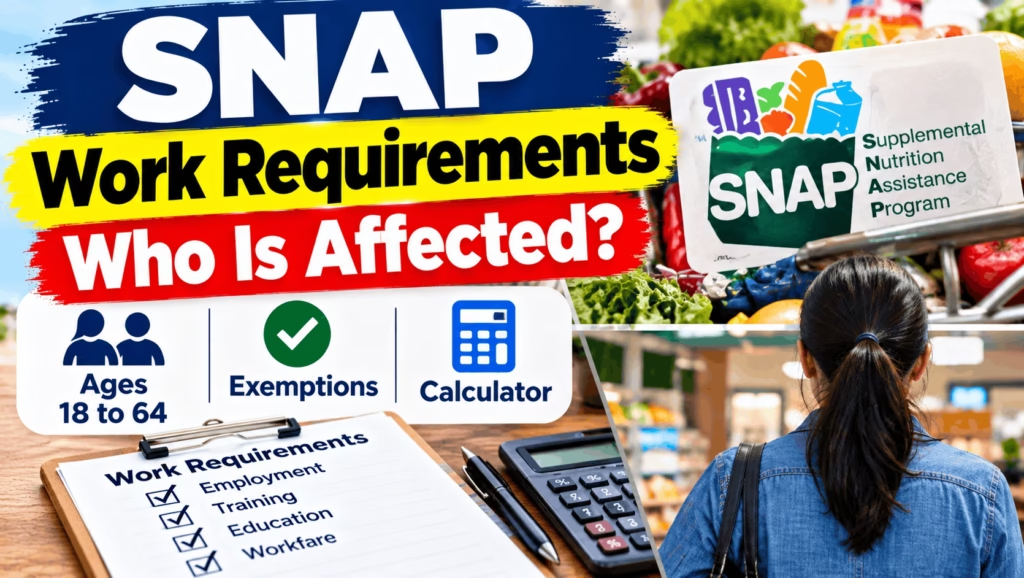
SNAP Work Requirements Key Dates and Highlights
| Item | Latest verified detail |
|---|---|
| Law that changed the rules | One Big Beautiful Bill Act (Public Law 119-21), signed July 4, 2025 |
| Time limit age range | Adults 18 through 64 (previously 18 through 54) |
| Monthly requirement | 80 hours of work, volunteering, job training or a combination |
| Time limit | 3 months of benefits in any 36-month period if the rule is not met |
| Parent exemption | Only when a child under 14 is in the household (previously under 18) |
| Lost automatic exemptions | Veterans, people experiencing homelessness, former foster youth aged 24 and under |
| New exemption | Members of federally recognized tribes, Urban Indians and California Indians |
| Typical state start | November 1, 2025 for many states, with some delayed into early 2026 |
| New Year benefit amounts | Effective October 1, 2026 through September 30, 2027 |
| State cost shift | 75 percent of administrative costs from fiscal year 2027; benefit cost share tied to error rates from October 1, 2027 |
Who Must Meet SNAP Work Requirements in 2026?
The group most people mean when they search for SNAP work requirements is called able-bodied adults without dependents, or ABAWDs. You fall into this group when you are between 18 and 64, you are physically and mentally able to work, you do not live with a child under 14 in your SNAP household, and no other exemption applies. If all of that is true, federal law limits you to three months of benefits in a 36-month period unless you meet the 80-hour rule.
Age is where most confusion starts, so here is the distinction that official USDA guidance draws. The time limit reaches age 64. The general work requirements, which cover registering for work, accepting a suitable job offer and taking part in employment and training when assigned, still stop at age 59. USDA’s implementation memo states plainly that people aged 60 or older remain exempt from the general rules. In practice, a 62-year-old with no disability and no child at home is not pushed into mandatory job search, yet that person can still lose benefits after three months without 80 hours of qualifying activity.
The three groups the new law pulled in
First, adults aged 55 through 64 are now subject to the time limit. One estimate attributed to the Center on Budget and Policy Priorities puts this group at more than a million people, though we could not confirm that figure on an official USDA page, so treat it as an outside estimate. Second, parents and caregivers whose youngest child is 14 to 17 are no longer shielded. Third, veterans, people experiencing homelessness and young adults who aged out of foster care can no longer rely on a blanket exemption and must qualify another way.
Who Is Exempt From SNAP Work Requirements?
Exemptions are where a lot of benefits are saved, so it pays to learn them. The table below summarizes the groups that are generally not subject to the ABAWD time limit. Rules are applied by your state agency, and documentation is usually required.
| Situation | Exempt from the time limit? | What agencies often ask for |
|---|---|---|
| Under 18 or 65 and older | Yes | Date of birth |
| Physically or mentally unable to work | Yes | Doctor’s note or proof of disability benefits |
| Living with a child under 14 in the SNAP household | Yes | Household composition and child’s age |
| Pregnant | Yes | Statement or medical verification |
| Member of a federally recognized tribe, Urban Indian or California Indian | Yes (new) | Tribal enrolment or eligibility documents |
| Working at least 80 hours a month | Meets the rule | Pay stubs, schedules, employer letter |
| Enrolled at least half time in school or training | Yes, in most cases | Enrolment verification |
| In a substance use treatment program | Yes | Provider letter |
| Receiving or applying for unemployment benefits | Yes, in most states | Benefit notice |
| Veteran | No longer automatic | Must meet another exemption |
| Experiencing homelessness | No longer automatic | Must meet another exemption |
| Aged out of foster care at 24 or younger | No longer automatic | Must meet another exemption |
SNAP Work Requirements Calculator: Check Your Status in Two Minutes
The tool below estimates whether you are likely subject to the three-month time limit and how many hours you need each month. It runs entirely in your browser and does not store or send anything. It is an educational estimate. Only your state SNAP agency can make an official determination, and some states apply stricter or more generous documentation standards.
SNAP Work Requirements Calculator
Estimate whether the three-month time limit may apply to you. Nothing is stored or sent.
Educational estimate only, based on federal rules as of October 2026. Veterans, people experiencing homelessness and former foster youth are no longer exempt automatically, so tick another exemption if one applies. Your state SNAP agency makes the official decision and may apply different documentation or earnings tests.
What Counts Toward the 80 Hours a Month
The 80-hour figure works out to about 20 hours a week. Hours do not have to come from a single job, and they can be mixed across categories. Paid employment counts, including self-employment. Volunteering counts when it is verifiable through the organization. Participation in SNAP Employment and Training, sometimes shortened to SNAP E&T, counts, as do certain Workforce Innovation and Opportunity Act programs and approved job search or training combined with work.
Some states also let you meet the rule by earnings instead of hours. Maryland’s human services department, for example, says you can fulfill the requirement by earning at least $217.50 each week, and notes that someone paid the state minimum wage would reach that in about 14.5 hours. Because that figure is state-specific and may reflect a different test from the standard 80-hour rule, ask your caseworker which measure your state uses before you rely on it.
SNAP Work Requirements Before and After the 2025 Law
| Rule | Before the law | Now |
|---|---|---|
| Time limit age range | 18 to 54 | 18 to 64 |
| Child exemption | Child under 18 in household | Child under 14 in household |
| Veterans | Exempt | Not automatically exempt |
| Homeless individuals | Exempt | Not automatically exempt |
| Former foster youth up to 24 | Exempt | Not automatically exempt |
| Tribal members | No special exemption | New exemption |
| Area waivers | Allowed for weak labor markets using several tests | Mainly areas with unemployment over 10 percent; special 150 percent test for Alaska and Hawaii |
USDA’s implementation memo says it will not approve waivers outside the narrower statutory criteria, and it encouraged states to end existing waivers rather than renew them. For Alaska and Hawaii, the law lets USDA consider areas where unemployment runs 150 percent above the national rate, along with a good-faith exemption for states that show they are working to comply.
How States Rolled Out the Changes
Federal law set the framework, but states decided when and how to start enforcing it. Maryland reports that its rules took effect on November 1, 2025, with new applicants covered right away and existing households covered at their next recertification. Oregon began reviewing people in six counties on October 1, 2025 and moved statewide in January 2026. Newsweek reported that Alaska, Colorado, Georgia, Hawaii, Nebraska, South Carolina, Texas and West Virginia were among the states that began enforcing the expanded rules in late 2025.
Other states got extra time. Court action led several states, including New York, to keep waivers in place until the end of February 2026, and New York’s full phase-in began on March 1, 2026. In early March, Newsweek reported that Nevada and 15 other states were told an exemption would stay in place for the time being because of litigation. Nevada had already issued about $7.3 million in payments to more than 25,000 people who lost eligibility on March 1. Because court rulings and state notices can shift quickly, always check your state’s current notice rather than relying on a national summary.
Who Is Losing Benefits: The Latest Numbers
Early data shows the combined effect of the law’s changes. Nationally, SNAP participation has dropped from about 42 million to about 36 million people, per NPR reporting cited by WHYY’s Billy Penn in its October 6, 2026 explainer. In Pennsylvania, about 234,000 of roughly 2 million recipients, or about 12 percent, have lost benefits since the federal changes were signed, according to figures that outlet attributes to The Philadelphia Inquirer. New York’s governor’s office has estimated that 300,000 households will lose some or all of their SNAP benefits, with an average loss of $220 a month, according to Adelphi University’s summary.
SNAP Benefit Amounts From October 1, 2026
Work rules decide whether you can receive benefits. The table below shows how much a household can receive at most under the fiscal year 2027 adjustment in the 48 contiguous states and Washington, D.C., valid through September 30, 2027. Your actual amount depends on net income and deductions.
| Household size | Maximum monthly benefit |
|---|---|
| 1 person | $306 |
| 2 people | $562 |
| 3 people | $808 |
| 4 people | $1,023 |
| 5 people | $1,217 |
| 6 people | $1,463 |
| 7 people | $1,616 |
| 8 people | $1,841 |
Other updated figures include a maximum excess shelter deduction of $769 for the 48 states and D.C., a homeless shelter deduction of $205.66 and a minimum benefit of $25 for small households. Hawaii is the exception this year: the maximum for a family of four there falls to $1,655 from $1,689, while Guam’s is $1,507.
Social Security COLA Increase 2027: How Much Your Check Could Rise and the Catch for Retirees
Is Your 2027 COLA Eaten by Medicare Premiums? What You Really Keep After Part B
How to Apply for SNAP Under the New Work Rules
SNAP is run by each state, so there is no single federal login. The steps are similar everywhere.
- Find your state agency. Use the USDA state directory or your state’s benefits portal listed in the resource table below.
- Gather documents. Typical items are photo ID, proof of address, proof of income, rent and utility bills, and anything supporting an exemption such as a doctor’s letter or school enrolment record.
- Submit an application. Most states accept online, mail, fax and in-person applications. The filing date can affect when benefits start, so submit a basic application early and add details later if needed.
- Complete the interview. A caseworker will usually call or meet you. This is where work status is screened, so be ready to explain your hours or your exemption.
- Report your work activity. If you are an ABAWD, ask how your state wants hours reported, and whether you can submit logs online or by mail.
- Keep your account active. Create an online account if your state offers one so you can check case status, upload documents and read notices.
Processing Time: How Long Does It Take?
Under standard federal rules, states have 30 days from the application date to decide. Households with very low income and resources, or those with urgent housing costs that exceed available cash, may qualify for expedited service and should receive benefits within seven calendar days.
Payment Schedule: When Do SNAP Benefits Arrive?
Benefits are loaded onto an Electronic Benefit Transfer, or EBT, card. States spread deposits across the month rather than paying everyone on one day, and the date usually depends on your case number, the last digits of your Social Security number or your birth date. Because schedules differ by state, check your state portal or the notice you received. New applicants typically receive a first payment after approval, and the amount may be prorated from the filing date. Under the fiscal year 2027 adjustment, the new maximum amounts apply from October 1, 2026, so you may notice a small change in your next deposit if you receive the maximum for your household size.
What Happens If You Lose SNAP Because of the Time Limit?
After three countable months without meeting the rule, benefits end. You are not barred forever. You can regain eligibility by meeting the 80-hour requirement for 30 consecutive days, which may restore up to three more months within the window. You can also qualify again if you become exempt, for example through a new medical determination, pregnancy or a change in household that adds a child under 14.
Official SNAP Resources and Application Links
| Resource | Purpose | Link |
|---|---|---|
| USDA Food and Nutrition Service: SNAP work requirements policy | Federal policy library and memos | https://www.fns.usda.gov/snap/work-requirements/policies |
| USDA ABAWD exceptions memo | Official list of exceptions changed by the 2025 law | https://www.fns.usda.gov/snap/obbb-abawd-exemptions-implementation |
| USDA ABAWD waivers memo | Waiver criteria and Alaska and Hawaii rules | https://www.fns.usda.gov/snap/obbb-abawd-waivers-implementation |
| USDA One Big Beautiful Bill Act page | Overview of SNAP changes | https://www.fna.usda.gov/obbb |
| USDA ABAWD waiver history | Waiver status by state | https://www.fns.usda.gov/snap/abawd/waivers |
| USDA SNAP state directory | Find your state agency | https://www.fns.usda.gov/snap/state-directory |
| ACCESS NY | New York application and case status | https://access.ny.gov |
| COMPASS | Pennsylvania application and renewals | https://www.compass.state.pa.us |
| BenefitsCal | California application and status check | https://benefitscal.com |
| Your Texas Benefits | Texas login and case tracking | https://www.yourtexasbenefits.com |
| ACCESS Florida | Florida application and status | https://www.myflfamilies.com/access |
| Illinois ABE | Illinois application and benefits | https://abe.illinois.gov |
USDA’s nutrition agency pages now appear under both fns.usda.gov and fna.usda.gov, reflecting a name change, so if one address redirects, that is expected. State portal addresses can change, so if a link fails, search your state’s name with the words SNAP and .gov and use the official result.
2027 COLA: How Much Will Your Social Security Check Increase?
2027 COLA Estimate: Latest Increase Estimate, Payment Dates, and Calculator
FAQs About SNAP Work Requirements
What are the SNAP work requirements in 2026?
Able-bodied adults aged 18 to 64 without a child under 14 at home must work, volunteer or train for 80 hours a month. If they do not, they can receive SNAP for only three months in any 36-month period.
What is the age limit for SNAP work requirements?
The ABAWD time limit now applies through age 64. The broader general work requirements still end at 59, and people 60 or older remain exempt from those.
Who is exempt from SNAP work requirements?
Common exemptions include being under 18 or 65 and older, being unable to work because of a physical or mental condition, being pregnant, living with a child under 14, being in a treatment program, being a half-time student, receiving unemployment benefits and, newly, being a member of a federally recognized tribe, an Urban Indian or a California Indian.
Are veterans still exempt from SNAP work requirements?
Not automatically. The 2025 law removed the blanket exemption for veterans, so a veteran must qualify under another category such as disability.
Can I volunteer instead of working?
Yes. Verified volunteering counts toward the 80 hours, alone or combined with paid work and training.
How do I prove I am meeting the work rule?
Pay stubs, an employer letter, signed volunteer logs and training attendance records are the usual proof. Ask your agency how and when to submit them.
How long does SNAP approval take?
States have up to 30 days to process a standard application and about seven days for expedited cases that qualify.
What happens after three months?
If you have not met the rule or qualified for an exemption, your benefits stop at the end of the third countable month, but you can restore eligibility by meeting the requirement later.
Do SNAP work requirements apply to seniors?
Only partly. People 65 and older are exempt. Adults aged 55 to 64 are now covered by the time limit unless they qualify for another exemption.
Do I have to work 20 hours a week for SNAP?
If you are an ABAWD and not exempt, you need about 80 hours a month, which averages roughly 20 hours a week.
Can I get SNAP if I am unemployed?
Yes, but the time limit applies if you are an ABAWD without an exemption. Receiving or applying for unemployment benefits is an exemption in most states, and SNAP Employment and Training can help you log countable hours.
Do SNAP work requirements apply to parents?
They now apply to parents of children aged 14 and over if no other exemption fits. Parents living with a child under 14 are exempt.
Is there a SNAP work requirement waiver in my area?
Waivers are now mainly limited to areas with unemployment above 10 percent, with a special test for Alaska and Hawaii. Check your state agency for the latest list.
Where can I check my SNAP application status?
Use your state’s benefits portal, such as ACCESS NY, COMPASS in Pennsylvania or BenefitsCal in California, or call the number on your notice.
When do SNAP benefits increase in 2026?
The fiscal year 2027 cost-of-living adjustment took effect on October 1, 2026, and applies through September 30, 2027.
Conclusion
The SNAP work requirements are now broader and less forgiving than they were a year ago. The core test is simple: if you are between 18 and 64, can work and have no child under 14 at home, expect to document 80 hours a month or qualify for an exemption. What is not simple is the patchwork of state start dates, court-driven delays and documentation habits that decide who keeps benefits in practice.
Three actions help most. Read your notice carefully, because it states which rules apply to you. Gather proof of work, volunteering or exemption before your interview or recertification, not after. And contact your state agency or a local legal aid office early if a deadline is near. Use the calculator above as a starting point, then confirm with your caseworker, since only your state can make an official ruling.
Social Security COLA 2027 by State: These 10 States Could See the Biggest Dollar Increase
Social Security COLA 2027 Projection: How Much Benefits Rise?