
Will My 3.6% COLA Push My Benefits Into Taxable Territory: The 2027 raise is the biggest in four years. The income thresholds that decide whether your benefits get taxed haven’t moved since 1993. Here’s how those two facts collide, with a calculator for your own numbers. If you saw “3.6%” in the headlines on October 14 and felt a small lift, that’s fair. It’s the largest cost-of-living adjustment in four years, and it follows a 2.8% raise this year. The Social Security Administration says benefits for about 76 million people go up with the January 2027 payments, and the average retired worker’s check moves from $2,095 a month to $2,170.
Then comes the second thought, the one a lot of retirees have every fall. Is this raise going to cost me something in taxes? It might. Here’s the odd part of the system. The raise is tied to inflation, but the income thresholds that decide whether your benefits are taxable are not. They’re $25,000 and $34,000 for single filers, and $32,000 and $44,000 for married couples filing jointly. Congress set them in the 1980s and 1990s and never indexed them. So every COLA nudges a few more households toward the line, and some right over it.
The good news is that one year’s raise does less damage than most people expect. Below, we’ll walk through how the math works, run a handful of real examples, and give you a calculator so you can try your own figures. Everything labeled 2027 comes from SSA or IRS material, and where a number is still a projection, we say so.

What the 2027 COLA actually gives you
The 3.6% comes from the Consumer Price Index for Urban Wage Earners and Clerical Workers, usually shortened to CPI-W. SSA compares the third quarter of this year with the third quarter of last year. The agency announced the result on October 14, the same morning the Bureau of Labor Statistics released September inflation data, and it applies to benefits for January 2027. Supplemental Security Income recipients see their increase start on December 31, 2026.
SSA’s fact sheet puts the averages like this:
| Type of beneficiary | Before COLA | After 3.6% |
|---|---|---|
| All retired workers | $2,095 | $2,170 |
| Aged couple, both receiving benefits | $3,238 | $3,355 |
| Aged widow or widower, alone | $1,936 | $2,005 |
| All disabled workers | $1,642 | $1,701 |
Estimated average monthly benefits payable in January 2027. Source: SSA 2027 COLA fact sheet. Your own raise is simply 3.6% of whatever you receive now. The maximum benefit for someone retiring at full retirement age rises to $4,188 a month from $4,152. SSA says you can see your new amount in your my Social Security account starting in late November, and if you sign up for digital notices by November 18 you’ll get it up to three weeks ahead of the mailed letter.
One more thing if you’re still working. The earnings limit for people under full retirement age goes up to $25,560 in 2027, and to $67,920 in the year you reach full retirement age. Wages feed into the tax calculation below, so they matter twice.
How Social Security actually gets taxed
Most of the confusion comes from the phrase “taxable Social Security.” It doesn’t mean the government taxes your entire benefit, or even most of it. It means that up to 50 or 85 percent of your benefit can be added to your other income on your tax return, and that total is then taxed at your ordinary rates.
The share that gets added depends on something called provisional income, which the IRS also calls combined income. The recipe is your adjusted gross income, not counting Social Security, plus any tax-exempt interest, plus half of your Social Security benefits.
| Provisional income | Single, head of household | Married filing jointly | Share of benefits that can be taxable |
|---|---|---|---|
| Lowest tier | Up to $25,000 | Up to $32,000 | None |
| Middle tier | $25,001 to $34,000 | $32,001 to $44,000 | Up to 50% |
| Top tier | Over $34,000 | Over $44,000 | Up to 85% |
From IRS Publication 915. The dollar amounts are fixed in law and aren’t adjusted for inflation. A few things trip people up here. First, “up to 85%” is a cap on how much of your benefit gets counted as income. It is not a tax rate. Nobody hands 85 percent of their check to the IRS. Second, tax-exempt interest counts. Municipal bond interest is free of federal income tax on its own, but it still goes into provisional income, so it can push you over a line even though you never pay tax on it directly.
Third, use the right number from your SSA-1099. Box 5 shows your net benefits for the year. That figure is before Medicare premiums come out of your check, so don’t subtract Part B yourself. If you’re married filing separately and lived with your spouse at any point during the year, the base amount drops to zero, and up to 85% of your benefits can be taxable almost immediately. The calculator below doesn’t cover that situation.
Why Federal Retirees Got 2.6% Instead of 3.6%
No SSI Payment November 2026? Here’s Why and When You Get Paid
Why a COLA nudges you, and by how much
Here’s the part that takes some of the sting out. Since provisional income counts only half your benefits, a COLA moves it by half as much as you’d guess. Say you collect $24,000 a year. A 3.6% raise adds $864. Half of that, $432, lands in provisional income. A handy rule of thumb is that the COLA raises your provisional income by about 1.8% of your annual benefit. For a $30,000 benefit, that’s $540. For $40,000, it’s $720. Then the tier you’re in decides how much of that becomes taxable. In the middle tier, half of the added provisional income is taxed, so roughly $216 of that $864 raise is added to your taxable income. In the top tier, it’s 85 percent, or about $367. At a 12% marginal rate, that works out to something like $26 or $44 of extra federal tax for the year. Out of $864.
The COLA rarely creates a tax problem on its own. It edges you closer to one your other income is already building. So the real question isn’t whether the raise is a tax disaster. It isn’t. The question is whether you’re close enough to a line that an extra $432 tips you over, and what life looks like once you’re in the next tier. That’s where the friction lives. While you’re climbing through the middle tier, each extra dollar of other income, from an IRA withdrawal, interest, or a part-time paycheck, adds about $1.50 to your taxable income, because half a dollar of benefits gets pulled in with it. In the top tier it’s about $1.85. Tax pros call this the tax torpedo.
The COLA doesn’t set off the torpedo. Your other income does. And that income probably isn’t standing still either, since required minimum distributions, dividends and interest tend to creep up on their own. The raise is usually one of several things moving your provisional income in the same direction.
Run your own numbers
This calculator uses the method in IRS Publication 915 to compare your taxable benefits this year with next year, after the 3.6% raise. The starting figures are an example, so replace them with yours. Everything runs in your browser, and nothing is sent anywhere.
Taxable benefits, before and after the 2027 COLA
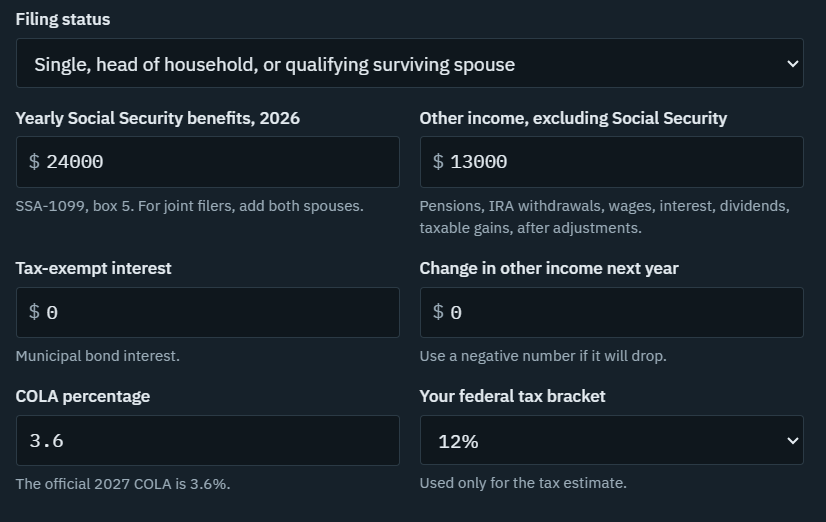
The raise moves you from below the first line into the 50% tier. About $216 more of your benefits become taxable.
Headroom: your 2027 provisional income of $25,432 is $432 over the $25,000 line and $8,568 under the $34,000 line.
| 2026 | 2027 | Change | |
|---|---|---|---|
| Social Security benefits | $24,000 | $24,864 | +$864 |
| Other income plus tax-exempt interest | $13,000 | $13,000 | $0 |
| Provisional income | $25,000 | $25,432 | +$432 |
| Taxable benefits | $0 | $216 | +$216 |
| Share of benefits taxable | 0.0% | 0.9% | +0.9 pts |
| Added federal tax, estimated | +$26 |
Estimates for planning only. The added-tax line multiplies the extra taxable benefits by the bracket you chose. It ignores deductions, credits and state tax. Look at the headroom line under the result. If it shows you’re within a couple of thousand dollars of a threshold, that’s the zone where planning pays off. If you’re far from either line, you can mostly relax.
Four households, four outcomes
Numbers on a page make this easier to see. These four examples use the same method as the calculator and assume other income stays flat.
| Household | Provisional income, 2026 | Provisional income, 2027 | Taxable benefits, 2026 | Taxable benefits, 2027 |
|---|---|---|---|---|
| Single, $24,000 benefits, $12,000 other income | $24,000 | $24,432 | $0 | $0 |
| Single, $24,000 benefits, $13,000 other income | $25,000 | $25,432 | $0 | $216 |
| Married, $38,000 benefits, $20,000 other income | $39,000 | $39,684 | $3,500 | $3,842 |
| Single, $30,000 benefits, $30,000 other income | $45,000 | $45,540 | $13,850 | $14,309 |
The first household stays safely below the first line, with about $568 to spare. The second is the one that worries people. They sit exactly at $25,000 this year, so none of their benefits are taxable, and the raise carries them just over. The result is $216 of taxable benefits, which at a 12% bracket is about $26 in tax. Not nothing, but not a crisis.
The married couple was already in the middle tier. Their taxable benefits grow by $342, because they’re still climbing through that tier and the COLA adds half its value to provisional income. The last household is in the top tier, where the raise adds about $459 to taxable income.
There’s also a ceiling. Once 85% of your benefit is already taxable, a bigger raise just raises the ceiling by 85% of the raise. Someone with $40,000 in benefits and $80,000 of other income is already there, and the COLA adds about $1,224 more to their taxable income, which is 85% of the $1,440 raise.
Taxable isn’t the same as taxed
Here’s a point that gets lost. Having a portion of your benefits counted as taxable doesn’t mean you owe tax. It means that amount goes into your income, where it meets your deductions. For 2026, the standard deduction is $16,100 for single filers and $32,200 for joint filers. If you’re 65 or older, you add $2,050 as a single filer, or $1,650 per spouse if you’re married. On top of that, the 2025 tax law created a new deduction of $6,000 per person age 65 or older, available for tax years 2025 through 2028. You can take it whether you itemize or not.
It starts shrinking once modified adjusted gross income passes $75,000 for single filers or $150,000 for joint filers, and it phases out at 6 cents on the dollar, reaching zero at $175,000 and $250,000. Married couples have to file jointly to claim it, and everyone claiming it needs a Social Security number on the return. Take a single 67-year-old with $24,000 in benefits and $14,000 of IRA withdrawals. Provisional income is $26,000, so $500 of benefits become taxable. Their adjusted gross income is $14,500. Their deductions total $24,150, made up of $16,100, $2,050 and $6,000, so their taxable income is zero and they owe no federal income tax. After the COLA, the taxable portion of benefits grows to $716 and the answer is the same.
One detail matters here. The $6,000 senior deduction lowers your taxable income, but it comes after adjusted gross income, so it doesn’t reduce provisional income. It can shrink or erase the tax on your taxable benefits. It doesn’t change how much of your benefits are taxable. You may have heard that the 2025 law “ended taxes on Social Security.” It didn’t. A lot of experts said an SSA email describing the law that way was misleading. The law added a deduction that helps many seniors, and the Committee for a Responsible Federal Budget estimates it cuts taxation of benefits by roughly $30 billion a year. Benefits are still taxable above the thresholds.
The IRS hasn’t yet published its official 2027 inflation adjustments, and it usually does so in late October or early November. Wolters Kluwer and Bloomberg Tax both project a 2027 standard deduction of $16,600 for single filers and $33,200 for joint filers. Treat those as estimates until the IRS confirms them. The provisional income thresholds won’t change either way.
Medicare and ACA Open Enrollment 2027 Dates: Full Calendar, Deadlines and What’s Changing
Average Social Security Check in January 2027: $2,170 (Retired Worker)
$200 Extra Social Security Payment: When Is It Being Approved, and Who Can Get It?
Don’t forget the Medicare premium
Most of us who are on Medicare Part B have the premium taken straight out of our Social Security check, and that eats into the raise. The standard premium in 2026 is $202.90 a month. The 2026 Medicare Trustees Report, released in June, projects $209.50 for 2027, with the official number due from CMS in November. If that holds, the premium rises $6.60 and trims the average $75 raise to about $68.
Most people whose premium is deducted from their benefit are covered by a hold-harmless rule, which keeps a premium increase from shrinking their check below what they got the year before. People who are new to Medicare or Social Security, or who pay the premium directly, don’t get that protection.
There’s a tax link too. Higher earners pay an income-related surcharge called IRMAA, and it’s based on income from two years earlier. Taxable Social Security is part of that income. A jump in your taxable benefits in 2027 wouldn’t affect your Medicare premium until 2029. Open enrollment runs from October 15 to December 7, so this is the season to compare plans anyway.
Diffrent Rule for diffrent States
Federal tax is only one layer. Eight states still tax Social Security benefits to some degree in 2026: Colorado, Connecticut, Minnesota, Montana, New Mexico, Rhode Island, Utah and Vermont. West Virginia finished phasing out its tax this year and came off the list. Even in those eight, most offer exemptions or credits tied to age and income, so many lower-income retirees owe nothing. The rules differ a lot from state to state, so check with your state’s revenue department or a local tax preparer.
Moves that can help
You can’t change the thresholds, but you have some say over what goes into provisional income. Start by knowing your cushion. Run the calculator and read the headroom line. If you’re thousands of dollars from the next line, don’t spend energy on it. If you’re within a few hundred, it’s worth planning.
Then look at where your other income comes from. Qualified withdrawals from a Roth IRA or Roth 401(k) don’t count toward provisional income, while traditional IRA withdrawals and required distributions do. A Roth conversion can make sense in a low-income year, but the converted amount counts as income in the year you do it, so a large conversion can spike provisional income for that year. Timing matters.
If you’re 70½ or older and give to charity, a qualified charitable distribution sends money from your IRA directly to the charity. It counts toward your required distribution and stays out of adjusted gross income, so it doesn’t raise provisional income.
Check your withholding as well. You can ask SSA to withhold federal tax from your benefits by filing Form W-4V, at 7, 10, 12 or 22 percent, or you can make quarterly estimated payments. The tax from a COLA is small, but if your taxable benefits grow and nothing is being withheld, you could land on an unexpected balance in April 2028.
Finally, wait for the official numbers before you lock anything in. The IRS will publish its 2027 inflation adjustments soon, and CMS will confirm the Part B premium in November. And if your situation is complicated, with a mix of pensions, investments, an IRA and a working spouse, an hour with a tax professional is cheap compared to a mistake.
For most retirees, the 3.6% raise doesn’t change the tax picture much. If you’re well under the first line, you stay there. If you’re well into the top tier, you’ll pay tax on a share of the raise, and at a typical bracket that’s tens of dollars, not hundreds. The people who feel it most are the ones within about 1.8% of their yearly benefit of a threshold, like the second household above.
The bigger story is the one the COLA can’t fix. Those $25,000 and $34,000 lines were set when a gallon of gas cost about a dollar, and every year more retirees drift over them without getting richer. If you’re close, use the calculator, look at your other income, and see a tax professional before the year ends.
A note on scope. This article is general information, not tax or legal advice, and we aren’t your tax advisor. Figures labeled projected are estimates from the 2026 Medicare Trustees Report and from tax publishers, and they may change when the IRS and CMS release official 2027 numbers. Your own situation may differ.