Social Security Spousal Benefits in 2026: A viral claim about “$3,000 Social Security Spousal Benefits” has been circulating online, and it’s important to be clear from the start: there is no fixed, universal $3,000 spousal payment program. What’s real is the actual Social Security spousal benefits 2026 rule — a spouse can receive up to 50% of the higher-earning partner’s Primary Insurance Amount (PIA), the benefit they’d get at their own full retirement age. So if a husband’s full retirement benefit is $3,000 a month, his wife could qualify for up to $1,500 not $3,000 and only if she waits until her own full retirement age to claim.
Beyond spousal benefits, survivor benefits work differently and are often confused with them: a surviving spouse can receive between 71.5% and 100% of a deceased spouse’s benefit depending on age at claiming this is not tied to any “nominee” designation, as some sources incorrectly suggest, but is determined automatically by your marriage record on file with the Social Security Administration. This guide brings together the complete, accurate picture spousal benefit percentages by claiming age, eligibility rules for current and divorced spouses, how survivor benefits actually work, and a full fact-check of the viral $3,000 claim. We’ll be updating this article monthly as SSA rules and COLA adjustments change.
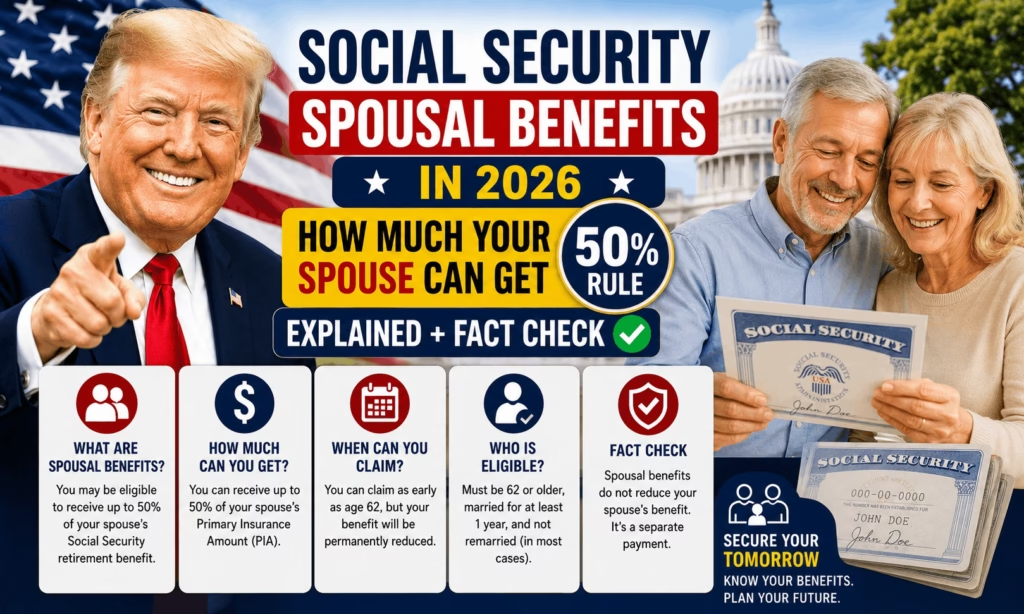
Social Security Spousal Benefits 2026 Key Highlights
| Detail | Information |
|---|---|
| Maximum Spousal Benefit | 50% of higher earner’s Primary Insurance Amount (PIA) |
| Minimum Claiming Age | 62 (or any age if caring for a qualifying child) |
| Reduced Benefit at Age 62 | ~32.5% of PIA |
| Full Benefit Age | Full Retirement Age (66–67, depending on birth year) |
| Benefit After Full Retirement Age | No increase beyond 50% — delaying past FRA does not help spousal benefits |
| Divorced Spouse Eligibility | Marriage lasted 10+ years, currently unmarried |
| Survivor Benefit Range | 71.5%–100% of deceased spouse’s benefit, based on claiming age |
| Survivor Minimum Age | 60 (50 if disabled; any age if caring for child under 16/disabled) |
| 2026 COLA Increase | 2.8%, applied automatically to all benefit types |
| Application Required | Yes — spousal and survivor benefits do not start automatically |
| Official Calculator | ssa.gov/oact/quickcalc/spouse.html |
| SSA Helpline | 1-800-772-1213 |
Fact Check: Is There Really a “$3,000 Social Security Spousal Benefit”?
No — this viral claim is misleading. Social Security spousal benefits are not distributed as a fixed or special one-time payment of $3,000. The amount a spouse receives depends entirely on the higher earner’s Primary Insurance Amount and the age at which the spouse claims. Under official SSA rules, a spouse can receive up to 50% of the primary earner’s full retirement benefit if claimed at full retirement age so if the primary beneficiary receives $3,000 per month, the spouse typically qualifies for a maximum of around $1,500, not $3,000.
There are rare cases where combined household Social Security income could exceed $3,000 when both spouses receive their own retirement benefits but this should not be confused with a separate “$3,000 spousal benefit” program, because no such program exists. No official SSA announcement has confirmed any universal $3,000 spousal benefit for 2026. Always verify payment-related claims directly through ssa.gov rather than relying on social media posts.
What Are Social Security Spousal Benefits?
Spousal benefits give married (or previously married) spouses additional monthly income based on the higher-earning spouse’s work record — regardless of whether the lower-earning spouse worked enough to qualify for their own benefit. In simple terms: a spouse can receive up to 50% of the other spouse’s Primary Insurance Amount, typically calculated at full retirement age (66–67, depending on birth year).
Who Is Eligible for Spousal Benefits?
- Age requirement: At least 62 years old, or any age if caring for a qualifying child under 16 or a child receiving disability benefits.
- The higher-earning spouse must have already filed for their own retirement benefits — spousal benefits cannot begin until the primary earner has claimed.
- Divorced spouses may also qualify if the marriage lasted at least 10 years and the applicant is currently unmarried — importantly, this does not reduce the ex-spouse’s own benefit in any way.
- Certain spouses caring for a child under 16, or a child receiving disability payments, are exempt from the age-62 minimum.
How Much Can a Spouse Actually Receive? (By Claiming Age)
Using an example where the higher-earning spouse’s full retirement benefit is $3,000/month:
| Claiming Age | Spousal Benefit Percentage | Monthly Amount |
|---|---|---|
| 62 | 32.5% of PIA | $975 |
| Full Retirement Age (66–67) | 50% of PIA | $1,500 |
| 70 | 50% of PIA (no increase) | $1,500 |
Key takeaway: Unlike a worker’s own retirement benefit, which grows with delayed retirement credits up to age 70, spousal benefits max out at full retirement age and do not increase further — waiting past FRA provides no additional spousal benefit.
How SSA Determines Your Final Payment
The Social Security Administration automatically pays whichever amount is higher — your own retirement benefit or your spousal benefit — never both separately. For example:
- If your own retirement benefit is $1,200/month and your spousal benefit would be $1,500/month, SSA pays you $1,500 total (your $1,200 plus a $300 spousal top-up).
- If your own retirement benefit is $1,600/month and your spousal benefit would only be $1,500/month, SSA pays you your own $1,600 — spousal benefits never reduce what you’d otherwise receive.
Spousal benefits are never subtracted from the primary earner’s own payment, and the primary earner cannot block or restrict a spouse’s access to them — but the spouse must still file a separate application with the SSA to receive them; they never start automatically.
Survivor Benefits: How They Actually Work (Corrected)
Survivor benefits are frequently confused with spousal benefits, but they apply after a spouse’s death and follow different percentages entirely — they are not based on any “nominee” designation you fill out in advance, as is sometimes incorrectly suggested. Instead, eligibility and payment amounts are determined automatically by your legal marriage record on file with the SSA at the time of your spouse’s death.
| Survivor Situation | Percentage of Deceased Spouse’s Benefit |
|---|---|
| Claimed at age 60 (earliest possible) | 71.5% |
| Claimed between 60 and survivor Full Retirement Age | 71.5%–99% (rises gradually) |
| Claimed at survivor Full Retirement Age or later | 100% |
| Disabled, claiming between age 50–59 | 71.5% |
| Caring for deceased’s child under 16 or disabled | 75%, regardless of your own age |
- Minimum age to claim: 60 (or 50 if disabled), with no age minimum at all if caring for the deceased’s child under 16 or disabled.
- Divorced spouses can also qualify for survivor benefits if the marriage lasted 10+ years, even without being married at the time of death.
- A one-time $255 lump-sum death payment is also available to an eligible surviving spouse — contact the SSA promptly after a spouse’s death to claim it.
- If you’re currently receiving your own retirement benefit when your spouse dies, and their benefit would be higher, you’ll generally switch automatically to the higher survivor amount once you notify SSA.
Spousal Benefits vs. Survivor Benefits: Quick Comparison
| Spousal Benefits | Survivor Benefits | |
|---|---|---|
| Applies when | Both spouses are alive | After a spouse’s death |
| Maximum percentage | 50% of PIA | 100% of PIA |
| Earliest claiming age | 62 | 60 (50 if disabled) |
| Grows past Full Retirement Age? | No | No (caps at 100% at survivor FRA) |
| Divorced spouse eligible? | Yes (10+ year marriage) | Yes (10+ year marriage) |
How to Apply for Spousal or Survivor Benefits
- Confirm the primary earner has filed for their own retirement benefit (required for spousal benefits; not required for survivor benefits).
- Gather required documents — marriage certificate, Social Security numbers for both spouses, and (for survivor benefits) a death certificate.
- File a separate application with the SSA — online at ssa.gov, by phone at 1-800-772-1213, or in person at a local SSA office. Survivor benefit claims currently require a phone appointment; no fully online process is available for survivor claims.
- Confirm which benefit is higher — SSA will automatically calculate and pay the larger of your own benefit or the spousal/survivor benefit.
- Consult a financial advisor if you’re unsure about optimal claiming age, since claiming early permanently reduces your monthly amount for life.
Official Resources
| Official SSA Spousal Benefits Calculator: | ssa.gov/oact/quickcalc/spouse.html |
| SSA Official Website: | ssa.gov |
| My Social Security Account (Login/Registration): | ssa.gov/myaccount |
| SSA Helpline: | 1-800-772-1213 |
FAQs
Is there really a $3,000 Social Security Spousal Benefit in 2026?
No. This is a misleading viral claim. Spousal benefits max out at 50% of the higher earner’s benefit — so a $3,000 primary benefit produces a maximum $1,500 spousal benefit, not $3,000.
How much can a spouse actually receive?
Up to 50% of the higher-earning spouse’s Primary Insurance Amount, if claimed at full retirement age. Claiming at 62 reduces this to about 32.5%.
Does claiming spousal benefits reduce my spouse’s own payment?
No. Spousal benefits are paid separately by the SSA and never reduce the primary earner’s own monthly benefit.
Can divorced spouses claim spousal or survivor benefits?
Yes, if the marriage lasted at least 10 years and the applicant is currently unmarried. This has no effect on the ex-spouse’s own benefit.
Can I receive both my own retirement benefit and a spousal benefit?
No, not as separate payments. SSA pays whichever amount is higher — your own benefit, or your own benefit plus a spousal top-up if the spousal amount is greater.