VA Disability Pay Rise 2027: If you collect VA disability compensation, you probably spent part of last Wednesday morning refreshing a news page. The Social Security Administration put out the 2027 cost-of-living adjustment on October 14, and the number came in at 3.6 percent. That’s the biggest bump in four years, and it’s the number that, by law and by long habit, drives the raise in VA disability checks too.
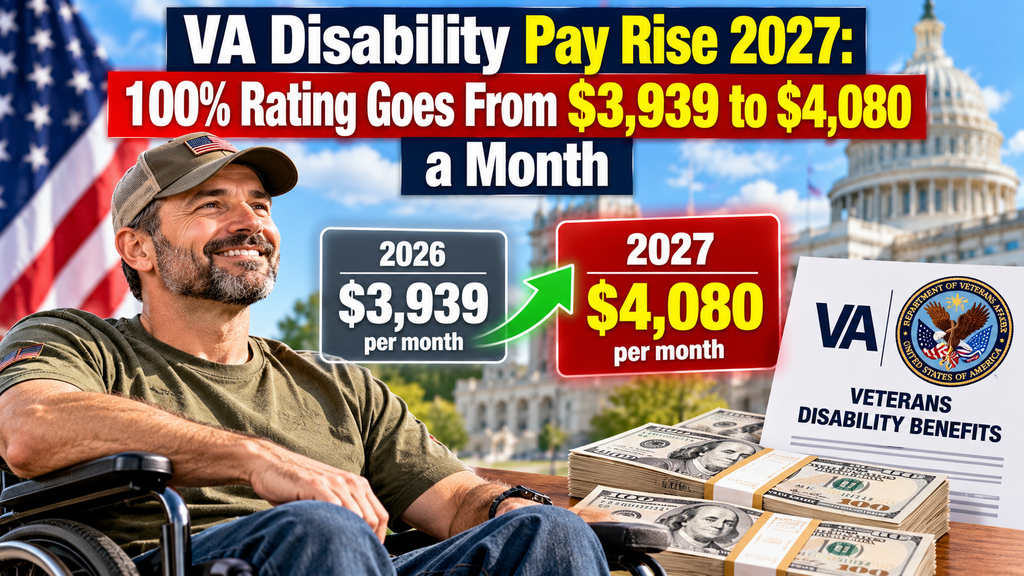
For a veteran rated 100 percent with no dependents, the math works out to a jump from $3,938.58 a month to roughly $4,080. That’s about $142 more every month, or around $1,700 more over a full year, and every dollar of it is tax-free.
There’s a catch, though, and it’s one a lot of headlines gloss over. The Social Security percentage is official. The VA dollar amounts are not, at least not yet. Congress still has to pass its annual VA cost-of-living bill, the president has to sign it, and then VA has to publish the new tables. Here’s where everything stands as of October 20, 2026, what it likely means for your check, and what you can do while you wait.
The 3.6 Percent Number Is Official
Let’s start with what’s settled. On October 14, SSA announced that benefits for roughly 76 million Americans will rise 3.6 percent for 2027. The agency says nearly 72 million Social Security beneficiaries will see the higher amount starting in January 2027, and about 7.3 million people on Supplemental Security Income (SSI) will get their bigger payments starting December 31, 2026. On average, retired workers will see about $75 more per month.
SSA’s formula isn’t mysterious. The Social Security Act ties the COLA to the Consumer Price Index for Urban Wage Earners and Clerical Workers, known as CPI-W, which the Bureau of Labor Statistics publishes. SSA takes the average CPI-W for July, August and September, compares it with the same three months from the year before, and the percentage difference becomes next year’s raise. This year the third-quarter average landed at about 328.7, against about 317.3 a year ago. That’s a hair over 3.6 percent, hence the final figure.
For context, the 2026 COLA was 2.8 percent. A 3.6 percent adjustment is the largest since the 8.7 percent raise that took effect for 2023, and it comfortably beats the roughly 2.6 percent average over the past two decades. Analysts had been guessing somewhere between 3.5 and 3.6 percent heading into the announcement, so nobody was shocked, but a lot of people were relieved. Prices for groceries, utilities and health care have eaten into budgets, and a number below 3 percent would’ve stung.
Why a Social Security Number Changes a VA Check
This is the part that confuses people, so it’s worth slowing down. VA disability compensation isn’t paid out of Social Security. It’s a completely separate benefit, run by the Department of Veterans Affairs, funded through the federal budget, and paid to veterans with service-connected injuries or illnesses.
The link between the two is a piece of legislation Congress passes almost every year, the Veterans’ Compensation Cost-of-Living Adjustment Act. The bill tells VA to raise compensation rates, additional amounts for dependents, the clothing allowance for certain disabled veterans, and Dependency and Indemnity Compensation (DIC) for survivors by the same percentage Social Security recipients get. Congress has been doing this every year since the 1970s, and the bill is usually uncontroversial. It tends to pass with bipartisan support, often by unanimous consent in the Senate.
That history is why you’ll see confident statements like “VA disability is going up 3.6 percent.” It almost certainly is. But technically, until the law is signed, it’s a very safe expectation rather than a done deal.
Medicare Part D Premium 2027 New Rates Announced, How Much Will You Pay?
$2000 Tariff Dividend Update: Is It Still Coming? Full Fact-Check for September 2026
Costco Dot Cakes: Where to Find the New Mini Six-Pack and How Much It Costs?
Where the 2027 VA COLA Bill Stands Right Now
The 2027 version is called the Veterans’ Compensation Cost-of-Living Adjustment Act of 2026. Two versions are moving, one in each chamber. In the Senate, it’s S. 4487, introduced on May 11, 2026, with Senator Jerry Moran of Kansas as the sponsor and a long list of bipartisan cosponsors. Per Congress.gov, its latest action is that it was referred to the Senate Veterans’ Affairs Committee.
In the House, it’s H.R. 8552, introduced April 28, 2026, by Representative Morgan Luttrell of Texas with Representative Morgan McGarvey of Kentucky as an original cosponsor. On June 30, a House Veterans’ Affairs subcommittee forwarded it to the full committee by voice vote.
Neither bill has passed either chamber as of this writing. The text of both is simple. It tells VA to raise the rates effective December 1, 2026, by the same percentage as the Social Security COLA that takes effect on that date, and it requires VA to publish the new amounts in the Federal Register.
Should you worry? Not much. Last year’s version, the Veterans’ Compensation Cost-of-Living Adjustment Act of 2025, was folded into S. 2392 and became Public Law 119-42, signed on November 25, 2025. That kept the December 1 effective date intact, and veterans never missed a beat. The pattern in recent years has been late fall passage, and nothing about this year looks unusually shaky. Still, “probably” isn’t the same as “law,” and if you’re budgeting tightly, it’s smart to plan around the 2026 amount until VA confirms otherwise.
What 3.6 Percent Looks Like at Every Rating
VA hasn’t released its official 2027 tables, so the numbers below are estimates. They take the official 2026 rates and multiply by 1.036. When VA publishes its own tables, individual amounts may be off by a few cents, and a couple of the dependent-related rates could differ by a dollar or two because of how VA rounds.
Here’s what a veteran with no dependents can expect, rated 10 through 100 percent:
| Rating | 2026 monthly | Estimated 2027 monthly | Estimated increase |
|---|---|---|---|
| 10% | $180.42 | $186.92 | +$6.50 |
| 20% | $356.66 | $369.50 | +$12.84 |
| 30% | $552.47 | $572.36 | +$19.89 |
| 40% | $795.84 | $824.49 | +$28.65 |
| 50% | $1,132.90 | $1,173.68 | +$40.78 |
| 60% | $1,435.02 | $1,486.68 | +$51.66 |
| 70% | $1,808.45 | $1,873.55 | +$65.10 |
| 80% | $2,102.15 | $2,177.83 | +$75.68 |
| 90% | $2,362.30 | $2,447.34 | +$85.04 |
| 100% | $3,938.58 | $4,080.37 | +$141.79 |
Notice that gap between 90 and 100 percent. Under the 2026 rates, the jump from a 90 percent rating to a 100 percent rating is more than $1,576 a month. In 2027 that gap should widen to about $1,633. It’s the steepest step on the whole VA pay scale, which is why so many veterans fight to get over that final line.
The 100 Percent Picture, With Dependents
Veterans rated 30 percent or higher get additional money for a spouse, children and dependent parents. If you’re at 10 or 20 percent, you get the same flat rate no matter who’s in your household. Here’s how the 100 percent rate shakes out for some common situations, using the 2026 official figures and a 3.6 percent bump:
- Veteran alone: $3,938.58 now, about $4,080 next year
- Veteran with a spouse: $4,158.17 now, about $4,308 next year
- Veteran with one child, no spouse: $4,085.43 now, about $4,233 next year
- Veteran with a spouse and one child: $4,318.99 now, about $4,474 next year
A veteran with a spouse and one child, for instance, would see an increase of roughly $155 a month, which adds up to more than $1,865 across a year. Families with extra children, a spouse who qualifies for Aid and Attendance, or dependent parents will see the same 3.6 percent applied to those add-on amounts too.
Who Else Gets the Raise?
Plenty of people beyond the classic “100 percent, single, no kids” veteran.
Veterans paid at the 100 percent rate through TDIU. If you’re rated lower than 100 percent but VA pays you at the total rate because you can’t hold down substantial work due to service-connected conditions, your check gets the same percentage increase as a schedular 100 percent rating.
Special Monthly Compensation (SMC) recipients. Every SMC level goes up by the same COLA percentage. Those payments are much higher than standard compensation, so the dollar jump is bigger.
Survivors receiving DIC. The basic monthly DIC rate for a surviving spouse was $1,699.36 in 2026. If the bill passes as written, it rises 3.6 percent, which would put it around $1,760.
In total, more than 6 million veterans currently receive VA disability compensation, according to Newsweek’s reporting on the 2027 adjustment, so this isn’t a small-bore change. It touches a huge slice of the veteran community and a lot of surviving families.
When Will the Higher Payment Actually Show Up?
If the bill passes in time and keeps its December 1, 2026 effective date, the new rate technically applies to December. But VA pays compensation in arrears, meaning the money for a month arrives at the start of the following month. December’s payment would normally land on January 1, 2027.
January 1 is New Year’s Day, a federal holiday. Under federal law, when the first of the month falls on a holiday, VA pays on the last business day before it. That points to Thursday, December 31, 2026 as the date of your first payment at the new rate, assuming Congress and the president act before then.
One consequence that trips people up every time this happens: you won’t get a separate VA deposit in January 2027. Your December 31 payment covers December, and the next one is the regular deposit on February 1. If you budget by calendar month, that can feel like a missing check. It isn’t. It just shifted a day earlier than usual. If your bills are due early in January, plan around it. If the bill is signed after December 1, expect the timing of your first raised payment to depend on when VA updates its systems. Don’t count on a precise deposit date until the law is signed and VA posts its tables.
Powerball Winning Numbers: Jackpot Hits $635 Million
Why Federal Retirees Got 2.6% Instead of 3.6%
No SSI Payment November 2026? Here’s Why and When You Get Paid
Do You Need to Do Anything?
No. VA applies the cost-of-living increase automatically to everyone receiving compensation. You don’t file a claim, fill out a form or call a number. Nothing about your disability rating changes either. A COLA raises the dollar amount paid at each rating, but it doesn’t alter your percentage, your diagnostic codes or your combined rating.
That said, there are a few things worth doing now, while the news is fresh.
Check your dependents. The extra money at 30 percent and above depends on VA having correct information about your spouse, children and parents. If you’ve married, divorced, had a child, or a child has turned 18 and isn’t in school, update your record. VA Form 21-686c is the usual route, and you can submit it online at VA.gov. Underreporting costs you money, and failing to report a removed dependent can lead to an overpayment VA will want back.
Watch where you get your information. When COLA season arrives, scammers go to work. VA won’t call to charge you a fee to “unlock” your raise, and no legitimate VA representative will ask for your bank login to apply a COLA. If something seems off, hang up and call VA directly, or contact an accredited Veterans Service Organization.
Think about whether your rating is right. A COLA is a nice bump, but it applies to whatever rating you already hold. If your conditions have gotten worse, or you’ve developed secondary conditions tied to something already service-connected, you may be entitled to a higher rating, and that move would matter far more than 3.6 percent. A county or state Veterans Service Officer, an accredited VSO such as the American Legion, VFW or DAV, or an accredited attorney can walk you through it at no cost or a regulated cost.
Is 3.6 Percent Enough?
Honest answer: it depends on where you live and how you spend.
On paper, a 3.6 percent raise outruns the inflation rate that’s been built into SSA’s formula, so it should maintain purchasing power for a typical household. But the CPI-W measures an average basket of goods for hourly workers and clerical employees. It doesn’t perfectly match what a disabled veteran spends on prescriptions, home modifications, specialized transportation, or caregiving. A veteran who pays a lot for medical needs outside the VA system may feel that costs have risen faster than 3.6 percent.
There’s also the fact that many veterans get Social Security, too, and for those people the picture is more complicated. Social Security recipients on Medicare will see their Part B premium announced later this fall, and that premium typically gets deducted from Social Security checks, which can swallow part of the COLA. VA compensation, by contrast, isn’t reduced by Medicare premiums, because they’re separate programs. The Medicare 2027 premium details are due at Medicare.gov, and SSA says enrollees will see their premium in their my Social Security message center in late November.
Still, as raises go, this one’s meaningful. The jump from 2.8 percent last year to 3.6 percent this year, applied to a 100 percent rating, is the difference between adding about $107 a month (what the 2026 increase delivered) and adding about $142.
Don’t Forget the Tax-Free Part
One feature of VA disability compensation that doesn’t get enough attention in these discussions: it’s exempt from federal income tax. It also generally isn’t counted as taxable income by states. A 100 percent veteran collecting $4,080 a month is getting about $48,964 a year, and that’s the full amount, not a before-tax figure. For comparison, someone earning a salary would need to make considerably more to take home the same amount after federal and state taxes and payroll withholding.
What to Watch Over the Next Few Weeks
If you want to follow this closely, here’s the timeline worth tracking.
Congress. Keep an eye on S. 4487 and H.R. 8552 on Congress.gov. Movement could come in the form of a committee markup, a floor vote, or the language being attached to another bill, as happened with last year’s version. The House and Senate calendars in November and December are the likeliest windows.
The president’s signature. Last year’s signing happened on November 25. If you see a signing announcement, that’s when the 3.6 percent becomes law.
VA’s updated rate tables. After enactment, VA posts new tables on VA.gov’s compensation rates page. Last year VA updated its page within about a week of the signing. Once those tables appear, they replace every estimate you’ve read, including the ones in this article.
The Bottom Line
Here’s what we know for sure and what we’re still waiting on. What’s confirmed: Social Security’s 2027 cost-of-living adjustment is 3.6 percent, announced October 14, 2026. The VA bills now before Congress would apply that same percentage to disability compensation, DIC and related benefits, effective December 1, 2026.
What’s not confirmed yet: whether those bills pass and when, and what VA’s exact published dollar figures will be. Based on the official 2026 table, a veteran rated 100 percent with no dependents should see the monthly rate rise from $3,938.58 to somewhere around $4,080, give or take pennies. If it follows past patterns, the first payment at that new rate would hit accounts on December 31, 2026.
For now, there’s nothing you need to file. Keep your dependent information current, be skeptical of anyone offering to help you “claim” a COLA, and plan on the 2026 amount until VA posts the official numbers. If everything holds to the usual script, the extra money is on its way, and it should arrive right at the end of the year. This article is for general information and isn’t legal or financial advice. For questions about your own claim or payment, contact VA directly or an accredited Veterans Service Organization.