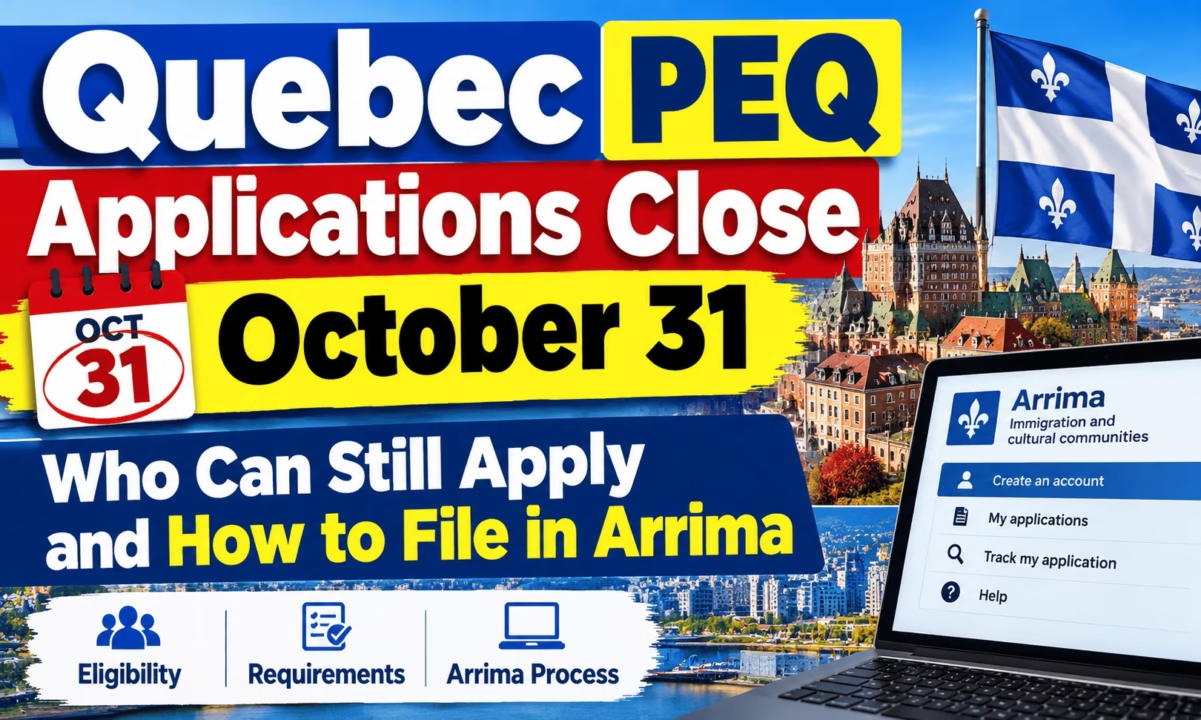
The Quebec PEQ deadline arrives this Saturday. Quebec will stop receiving applications under the Quebec Experience Program (Programme de l’expérience québécoise, PEQ) at 11:59 p.m. Montreal time on October 31, 2026, ending the first intake that opened on July 2. Both streams, Quebec Graduates and Temporary Foreign Workers, close together. There is no cap, no waiting list and no invitation to wait for. Eligible candidates simply need a complete file, the June 2026 forms and a paid fee in Arrima before the clock runs out. Quebec has not announced an extension, and a new government sworn in on October 21 has promised deeper immigration cuts, so waiting for a second chance is a risky plan. Anyone who met the program’s conditions on November 19, 2025, lives in Quebec and can prove the required French level should treat the next three days as the real deadline. We’ll be updating this article monthly as Quebec confirms new intake periods, processing data and policy changes.
The pressure is already visible in the numbers. Quebec received 12,364 PEQ applications in July and August alone, more than the 8,000 to 12,000 the government had projected for the whole four-month window, according to figures released through an access to information request and reported in mid-October. Quebec Graduates made up about 64 percent of those files. Meanwhile, Premier Paul St-Pierre Plamondon’s Parti Québécois government wants to reduce permanent admissions to 35,000 a year, down from roughly 45,000, and the immigration ministry was renamed on October 22. None of that changes the rules for the current window, but it explains why lawyers, universities and employers are urging eligible people to file now. This guide covers who can still apply, French levels, fees, the Arrima steps, realistic processing time, official links and what is known about life after October 31.
Quebec PEQ Deadline Key Highlights
The table below pulls the essentials into one place. Every figure comes from Quebec government notices or from reporting that cites them, and the fee amounts are in Canadian dollars.
| Detail | Information |
|---|---|
| Intake window | July 2, 2026 (8:30 a.m. Montreal time) to October 31, 2026 (11:59 p.m. Montreal time) |
| Streams open | Quebec Graduates and Temporary Foreign Workers |
| Application cap | None. Every complete, eligible application is processed |
| Eligibility snapshot date | November 19, 2025 |
| Where to apply | Arrima online portal only |
| Forms | June 2026 versions. Older forms are not accepted |
| Fees | $940 principal applicant, $201 spouse or partner, $201 per dependent child |
| French level | Graduates: oral 7 and written 5. Workers: oral 7. Accompanying partner: oral 4 |
| Processing promise | The old six-month service standard was not renewed |
| Program end date | July 2, 2028 |
| Step after selection | Certificat de sélection du Québec (CSQ), then a federal application to IRCC |
Quebec PEQ Deadline Dates
| Date | What happened |
|---|---|
| November 19, 2025 | Quebec abolished the PEQ. This date became the eligibility snapshot |
| May 5, 2026 | Premier Christine Fréchette announced a two-year revival |
| June 10, 2026 | Immigration Minister François Bonnardel released the details |
| June 17, 2026 | Regulation and ministerial order published in the Gazette officielle du Québec, new forms posted |
| July 2, 2026 | Arrima began receiving applications at 8:30 a.m. Montreal time |
| Mid-October 2026 | Data showed 12,364 applications filed in July and August |
| October 21 to 22, 2026 | New Parti Québécois government sworn in and ministry renamed |
| October 31, 2026 | First intake closes at 11:59 p.m. Montreal time |
| November 2026 | Quebec to adjust PSTQ invitation levels based on PEQ volume |
| July 2, 2028 | PEQ expires under the current regulation |
PEQ Applications 2026: How Many Have Been Filed So Far
The most useful number for anyone still deciding is 12,364. That is how many applications Quebec received across July and August 2026, according to a document the ministry released on October 9 in response to an access request. July alone brought in 10,487 applications, while August added 1,877, which shows how heavily the first weeks were front-loaded. Quebec Graduates filed 6,861 applications in July and 1,077 in August, roughly 64 percent of the total, and Temporary Foreign Workers made up the rest.
Those totals matter for three reasons. First, they already exceed the 8,000 to 12,000 range ministers floated when the program was announced, which hints at how long the backlog will take to clear. Second, Quebec has said it intends to issue a similar number of selection certificates through the PEQ and the Skilled Worker Selection Program (PSTQ) between now and the end of its 2026 to 2029 planning period, so heavy PEQ volume can squeeze future PSTQ invitations. Third, the PSTQ had 12,152 applications by the end of August, so both pathways are carrying large queues at once.
For context, Quebec selected 5,915 people through the PEQ in 2022, 9,313 in 2023 and 20,201 in 2024, according to figures cited in the National Assembly. The 2026 intake is therefore not a small niche program. It is one of the largest permanent selection channels Quebec runs.
TPS Lebanon Automatic Extension: Work Permits Valid Through November 27, What Happens Next
New Quebec Government and the PEQ: What Changes After October 31
The political backdrop shifted sharply this month. Premier Paul St-Pierre Plamondon’s Parti Québécois government took office on October 21, and Catherine Gentilcore became immigration minister and deputy premier. On October 22 the ministry dropped “Francisation” from its name and is now the Ministère de l’Immigration et de l’Intégration. Quebec says French-language services continue inside the department.
The party campaigned on cutting permanent immigration from about 45,000 to 35,000 admissions a year, a reduction of roughly 22 percent. It has also proposed halving the temporary resident population over a four-year mandate, to a range of 250,000 to 300,000 people, and pausing the selection of new economic immigrants from outside Quebec while giving priority to people already living in the province. None of these proposals has been formally implemented, and Quebec has not announced any change to the October 31 deadline.
Two readings are possible. Candidates already in Quebec, speaking French and working or studying locally, may be the group the new government wants to prioritize. Or a lower admissions ceiling could mean fewer certificates overall and longer waits. Nobody can say yet which view will prevail. The practical takeaway is simple: a filed application is protected by the rules that applied on the day it was filed, while a missed deadline offers no protection at all.
Who Can Still Apply for the PEQ Before the Deadline?
This intake is not open to every temporary resident in Quebec. Applicants must declare that they already met the program’s reception criteria on November 19, 2025, and then satisfy the full selection conditions when they submit. A person who completed a diploma or reached two years of work experience after that date cannot use the current window.
Quebec Graduates stream
Under the official notice, Graduates must have earned, in Quebec and on or before November 19, 2025, one of the following: a bachelor’s degree, a master’s degree, a doctorate, a technical college diploma (DEC), or a vocational diploma (DEP) of at least 1,800 hours, alone or followed by an attestation of vocational specialization.
Quebec confirmed that graduates must be staying in Quebec when they apply and throughout processing, although they are not required to work. They must keep a valid immigration status and renew it if it expires. The ministry also removed the requirement, added during the suspension period, that the diploma come from a program taught in French or that the applicant have three years of full-time French study. All eligible diplomas now count regardless of the language of instruction. The French proficiency requirement itself remains, as explained below.
Temporary Foreign Workers stream
Workers must have at least two years of Quebec work experience in a TEER 0, 1, 2 or 3 occupation under the National Occupational Classification, measured at November 19, 2025. Experience in TEER 4 or 5 jobs does not count for the PEQ, although those workers may look at the PSTQ’s intermediate and manual skills or regulated professions streams.
A worker must be employed full time in an eligible job when applying and keep that job during processing. Quebec added a flexibility for people who already had the experience on the snapshot date but had to leave the country when their permit expired. They can apply if they are back in Quebec with a valid work permit, hold an eligible full-time job at filing, and meet the other conditions.
PEQ French Language Requirements 2026
French remains the most common reason strong files get stuck. Quebec measures proficiency on its own scale of levels, not on the Canadian Language Benchmarks.
| Applicant | French level required |
|---|---|
| Quebec Graduates, principal applicant | Oral level 7 and written level 5 |
| Temporary Foreign Workers, principal applicant | Oral level 7 |
| Accompanying spouse or partner | Oral level 4 |
Quebec says candidates must be able to demonstrate these levels, including in an interview if the ministry asks for one. Accepted evidence typically includes a recognized French test result or qualifying French-language schooling, so applicants relying on an old score should check validity dates now. Booking a French test this late is not realistic for this intake. If your proof is not already in hand, speak to a regulated immigration professional about what other documents might apply.
Canada Language Test Checks 2026: What IRCC’s 23 June Update Means for Applicants
How to Apply for the PEQ in Arrima, Step by Step
All PEQ applications go through Arrima, Quebec’s online platform. Paper applications have not been accepted since January 2021. The sequence below follows the official application page and the June 17 notice.
- Confirm you met the reception criteria on November 19, 2025, for either the Graduates or the Workers stream.
- Download the June 2026 forms from Quebec.ca. Older versions will make the application inadmissible.
- Complete, date and sign every form and declaration.
- Gather identity and civil status documents, proof of the diploma or work experience, proof of French, and proof of your current immigration status.
- Create an Arrima account, or sign in if you already have one.
- Enter your information, upload the documents and add your spouse or children if they are included.
- Pay the fees online by credit card.
- Submit and wait for the confirmation notice. Quebec sends an email and posts a message in the Arrima message center once your application is received.
Save a screenshot and the confirmation as soon as you submit. Because the portal closes at 11:59 p.m. Montreal time, applicants in other time zones should convert the cutoff to their own clock. For anyone in India, that falls at 9:29 a.m. on Sunday, November 1, 2026, but filing a day early is wiser than testing a traffic spike.
PEQ Processing Time After You Apply
Quebec used to promise decisions within six months. For this reopening, it has said that receiving a large volume of applications over four months could produce longer delays than usual, and the six-month commitment in the earlier customer service declaration will not be renewed. Processing of PEQ and PSTQ files runs in parallel, and neither program gets an accelerated lane.
Some online guides still repeat the old six-month figure. Treat those numbers as historical. Immigration commentators expect many decisions to land in 2027, and the ministry said it has been analyzing admissibility since the window opened, not only after October 31. A complete file with clear documents is the best way to avoid requests for more information, which are the most common source of delay.
After the CSQ arrives, the federal step begins. IRCC reviews medical, security and criminal admissibility, and that stage has its own timeline and fees. Budget for a full process of well over a year from filing to permanent residence rather than the shorter figures sometimes quoted in marketing copy.
PEQ Fees and Payment Schedule
Quebec charges fees when you file, not after a decision. The amounts below are in effect since January 1, 2026 and may be updated without notice, so confirm them on Quebec.ca before paying.
| Applicant | Fee (CAD) |
|---|---|
| Principal applicant | $940 |
| Spouse or common-law partner | $201 |
| Each dependent child | $201 |
A family of four, meaning two adults and two children, would pay $940 plus $201 for each of the other three people, a total of $1,543. Payment is made online by credit card inside Arrima when you submit the application, and Quebec does not refund these fees if the application is refused or rejected. Anyone adding a family member later must update the household count in Arrima and pay for each person added.
The payment schedule has two stages. The first is the Quebec fee above, due at submission. The second is the set of federal fees due to IRCC once you hold a CSQ and apply for permanent residence. Those amounts change periodically, so check the IRCC fee page rather than relying on a blog table, including this one.
If you file under both the PEQ and the PSTQ, you pay the review fee for each application and Quebec will not refund either one.
PEQ vs PSTQ: Which Quebec Pathway Fits You
The PEQ is Quebec’s direct, no-invitation route for people with a local diploma or two years of local skilled work. The PSTQ, the Skilled Worker Selection Program, works differently. Candidates submit an expression of interest in Arrima and wait for an invitation, with selection based on factors such as education, experience, French and regional labour needs.
Quebec confirmed that you may apply to the PEQ even if you have a PSTQ invitation or a pending PSTQ application. The two programs process in parallel, and you cannot expect faster handling in either one. You are also responsible for judging which pathway suits your profile.
A rough guide to choosing:
- If you meet the November 19, 2025 criteria and have your French proof ready, the PEQ is the more predictable option because it needs no invitation.
- If your Quebec work is in a TEER 4 or 5 job, the PEQ will not count it, and the PSTQ is likely the better fit.
- If you graduated or hit the two-year mark after November 19, 2025, you cannot use this window and should monitor the PSTQ and any future PEQ intake.
Why the PEQ Closed and Why It Reopened?
The PEQ was one of Quebec’s most used immigration programs until the province paused graduate intake in late 2024, suspended the worker stream in mid-2025, and abolished the program on November 19, 2025 in favour of the PSTQ. Thousands of students and workers who had planned around the PEQ were left uncertain.
Public pressure built during the Coalition Avenir Québec leadership race in spring 2026. Christine Fréchette won the leadership, promised to revive the program, and became premier. Her government announced the two-year reopening in May and published the details in June, limiting the first intake to people who had already been eligible when the program closed. Advocates criticized the narrow scope, while the government said the PSTQ would remain the long-term pathway. The October election then replaced the government that designed the reopening, which is why this deadline carries more weight than a normal intake cutoff.
What Happens After the PEQ Deadline?
Three things are known. The PEQ remains in the regulation until July 2, 2028. Quebec has said it will receive applications in separate periods and will review the volume it gets by October 31 before setting later intakes. And starting in November, it will adjust the number of PSTQ invitations in line with PEQ volume.
Two things are not known. Quebec has not published eligibility criteria or dates for any future PEQ window, and the new government has not said whether it will keep, narrow or cancel them. Candidates who qualify only after November 19, 2025 should therefore plan around the PSTQ while watching official announcements. If you are eligible today, a late submission has no fallback.
PEQ Eligibility and Fee Calculator
Use the free calculator below to check whether you meet the intake criteria, see which gaps remain, calculate your family’s Quebec fees and count down the hours to the deadline. It is a planning aid built on the published rules, not legal advice, and it cannot replace the official forms or an assessment from a regulated professional.
PEQ Eligibility, Fee and Deadline Calculator
Based on the published October 31, 2026 intake rules. For planning only.
1. Eligibility check
2. Fee calculator (CAD)
Fees used: $940 for the principal applicant and $201 for each spouse, partner or dependent child. Quebec may change fees without notice, and fees are not refunded. This tool does not replace the official forms, Quebec.ca or advice from a regulated immigration professional. Federal IRCC fees are separate and are not included.
Official PEQ Links: Login, Registration, Application and Status Check
Use only government addresses when entering personal data. Quebec does not charge for information, and unofficial sites that ask for payment to “reserve” a PEQ place should be avoided.
The Arrima steps for registration are straightforward: choose the online services option, create an account with your personal details exactly as they appear on your passport, and sign in. Your file status and messages appear in the Arrima message center after submission, which doubles as the main status check tool for a PEQ application.
Government Shutdown 2026 Update: Stopgap Bill Signed Into Law, Federal Funding Runs to December 11
Last Minute PEQ Mistakes to Avoid
Quebec publishes few exceptions for incomplete files, so small errors can cost an entire intake. These are the issues immigration lawyers flag most often as the window closes.
- Using forms dated before June 2026.
- Assuming a 2026 graduation or a recent anniversary of work counts, when the snapshot date is November 19, 2025.
- Submitting after leaving Quebec. Graduates must be staying in the province and workers must hold an eligible full-time job at filing.
- Counting TEER 4 or 5 work toward the two-year requirement.
- Relying on an expired or unrecognized French proof.
- Leaving payment to the final hour. Card declines or portal slowdowns are not accepted as excuses.
- Failing to renew a work or study permit that expires while the file is pending.
PEQ Deadline FAQs
When is the Quebec PEQ deadline?
The first intake closes at 11:59 p.m. Montreal time on Saturday, October 31, 2026. It applies to both the Quebec Graduates and the Temporary Foreign Workers streams, and applications must be submitted through Arrima.
Has Quebec extended the PEQ deadline?
No extension has been announced. Reports published this week confirm that the October 31 date stands. Quebec has also not confirmed dates or criteria for any later intake, so applicants should not plan on a second round.
Do I need an invitation to apply for the PEQ?
No. The PEQ is a direct application program. If you declare that you meet the reception criteria and file a complete application in Arrima before the deadline, Quebec processes it. There is no draw or ranking score.
Is there a cap on PEQ applications in 2026?
There is no cap during this intake. Quebec has said every application received in the window will be processed. However, heavy volume, 12,364 files in just two months, means processing may take longer than in past years.
Can I apply if I graduated after November 19, 2025?
Not in this window. Graduates must have earned their diploma on or before that date. The same snapshot applies to the two years of work experience required of workers. Later graduates should look at the PSTQ and watch for future PEQ announcements.
How much does a PEQ application cost?
The Quebec fee is $940 for the principal applicant and $201 for each accompanying spouse, partner or dependent child. It is paid by credit card in Arrima when you submit and is not refunded if the application is refused. Federal fees are charged later by IRCC.
Do I have to be in Quebec when I apply?
Yes. Graduates must be in Quebec when they apply and while their file is processed. Workers must hold a valid work permit and an eligible full-time job in Quebec at filing and throughout processing.
Can I apply to both the PEQ and the PSTQ?
Yes, Quebec allows it. Each application is processed in parallel without priority, and you pay a separate fee for each. Quebec does not refund fees for either one, so choose carefully.
How long will it take to get a CSQ through the PEQ?
Quebec dropped its old six-month commitment for this intake because of the expected volume. Many decisions are likely to arrive in 2027. Complete files that need no extra documents are usually resolved sooner.
Will the PEQ reopen after October 31?
The program stays on the books until July 2, 2028, and Quebec has said later intake periods are possible. It has not announced dates or eligibility. With a new government planning lower immigration targets, nothing is guaranteed.
What is the PEQ in Quebec?
The PEQ is the Quebec Experience Program, a fast-track route to a Certificat de sélection du Québec for international graduates of Quebec institutions and temporary foreign workers with skilled Quebec experience. It was abolished in November 2025 and temporarily reinstated until July 2, 2028.
Is the PEQ still open in 2026?
Yes, but only until October 31, 2026, for the first intake period and only for people who met the criteria on November 19, 2025. The program itself remains in force until July 2, 2028.
What French level do I need for the PEQ?
Quebec Graduates need oral level 7 and written level 5 on Quebec’s scale. Workers need oral level 7. An accompanying partner needs oral level 4. Quebec can interview candidates to verify their French.
What is the difference between the PEQ and the PSTQ?
The PEQ accepts direct applications from graduates and workers who meet fixed experience or diploma criteria. The PSTQ uses expressions of interest in Arrima and invitations based on Quebec’s selection factors and labour priorities.
Can I apply for the PEQ with a TEER 4 or 5 job?
No. Quebec does not recognize work in TEER 4 or 5 occupations for the PEQ. Those workers may be able to use the PSTQ’s streams for intermediate and manual skills or regulated professions.
What happens after I get a CSQ?
The CSQ confirms Quebec has selected you. You then apply to IRCC for permanent residence, and the federal government checks medical, security and criminal admissibility. A CSQ does not itself grant permanent resident status.
Does the PEQ guarantee permanent residence?
No. Filing an application does not guarantee selection, and selection does not guarantee federal approval. Applicants must meet every selection condition and keep their temporary status valid while Quebec and IRCC process the file.
Conclusion
The Quebec PEQ deadline is simple even if the rules behind it are not: submit a complete application in Arrima by 11:59 p.m. Montreal time on October 31, 2026, or lose this chance. Eligibility was frozen at November 19, 2025, French levels are strict, fees are non-refundable, and Quebec has dropped its six-month service promise. Add a new government that wants fewer immigrants, and the case for filing now is stronger than the case for waiting.
Candidates who qualify should confirm their dates, secure their proof of French, use the June 2026 forms and keep proof of submission. Those who do not qualify have not run out of options. The PSTQ, other provincial programs and federal streams remain available, and Quebec will publish any new PEQ window on its official channels. Check Quebec.ca, not social media rumours, for the next update.