China K-Visa 2026 has moved from announcement to active policy, and foreign STEM professionals now have a clearer picture of who qualifies and how to apply. Introduced through State Council Decree No. 814 and effective since October 1, 2025, the China K-Visa is a sponsor-free entry route built for young scientists, engineers, and researchers a category that did not exist in Chinese immigration law before. Unlike the standard Z-visa, applicants under the China K-Visa 2026 framework do not need a confirmed job offer, an employer-issued invitation letter, or a domestic work permit before applying, which makes it one of the most accessible skilled-worker visas in the world today. The policy arrived within months of the United States imposing a $100,000 H-1B petition fee and the UK tightening its Global Talent route, and Beijing has openly framed the visa as a bid to absorb the international STEM talent that these tightening policies are pushing away. We’ll be updating this article monthly as more embassy-level implementation guidance is released.
As of mid-2026, the China K-Visa 2026 rules allow multi-entry access and permit holders to work, study, conduct research, launch a business, or take part in exchange programs on a single visa activities that would otherwise require separate visa categories. Eligibility centers on two tracks: a STEM bachelor’s degree or higher from a recognized university, or an active teaching or research position in a relevant scientific field. While the State Council decree does not set a binding age ceiling, most consulates are currently using 18 to 45 as informal working guidance for “young” talent, with some missions applying a narrower 18–35 band. For Indian, Southeast Asian, and Western tech professionals weighing options as H-1B costs and green card backlogs climb, the China K-Visa is emerging as a genuine alternative worth understanding in detail including its real limitations, which official guidance still leaves unresolved.
What Is the China K-Visa?
The China K-Visa is the 13th category added to China’s ordinary visa system — the first new visa type introduced in over a decade. It was created specifically to compete for global STEM talent at a moment when rival destinations, particularly the US and UK, have made their own skilled-worker routes more expensive and harder to access.
| Visa Name | K-Visa (Young Science and Technology Talent Visa) |
| Legal Basis | State Council Decree/Order No. 814 |
| Decree Signed | August 7–14, 2025 (Premier Li Qiang) |
| Effective Date | October 1, 2025 |
| Sponsorship Required | No employer sponsor or job offer needed |
| Entry Type | Multi-entry |
| Permitted Activities | Work, study, research, exchange, business/startup activity |
| Target Age Range | Informally 18–45 (varies by consulate; not codified) |
| Application Mode | Online pre-submission + in-person consular appointment |
| Total Ordinary Visa Categories (post-K) | 13 |
China K-Visa Eligibility Criteria 2026
Under the current China K-Visa eligibility framework, applicants generally need to meet one of two conditions:
- Education route: A bachelor’s degree or higher in a STEM discipline — engineering, mathematics, computer science, physical sciences, or life sciences — from a recognized domestic or overseas university or research institution.
- Professional/research route: An active teaching, research, or technical development role in a STEM field at a recognized institution, evidenced by an employment or appointment letter.
Applicants do not need:
- A signed employment contract in China
- An employer-issued invitation letter
- A pre-approved Chinese work permit
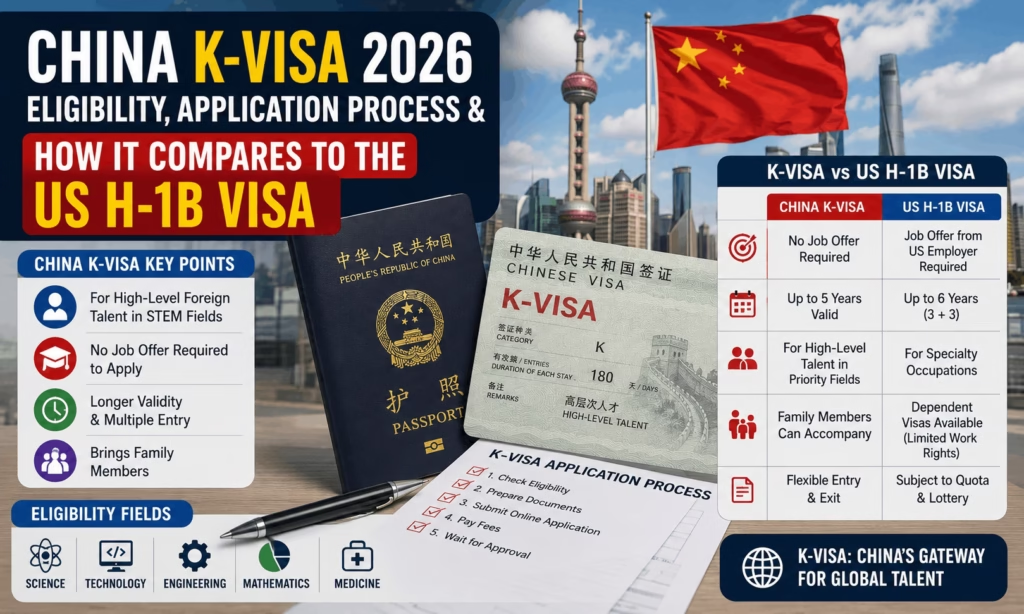
This self-sponsored structure is the single biggest difference between the China K-Visa vs H-1B visa debate — the US H-1B is entirely employer-driven, while the K-Visa lets qualified individuals enter independently and seek opportunities once inside the country.
USA Visa-Free Travel 2026: Check Eligible Countries and All Entry Rules
UK Travel Rule Change 2026: ETA Fees Increased by 25% – Full Details Inside
Age Criteria — What’s Confirmed vs What Isn’t
The enabling regulation itself does not fix a legal age limit; it only uses the term “young.” In practice:
- Several consulates are applying an 18–45 working range.
- Some missions and secondary legal advisories cite a narrower 18–35 guideline.
- Applicants outside these informal bands are advised to confirm directly with their nearest Chinese embassy or consulate, since interpretation currently varies by post.
China K-Visa vs US H-1B Visa: Full Comparison
| Feature | China K-Visa | US H-1B Visa |
|---|---|---|
| Job offer required | No | Yes, mandatory |
| Employer sponsorship | Not required | Required |
| New petition fee (2026) | Standard visa fee only | $100,000 (effective Sept 21, 2025, new petitions) |
| Entry type | Multi-entry | Employer-tied, cap-subject |
| Annual numerical cap | None announced | 65,000 regular + 20,000 advanced-degree cap |
| Business/startup rights | Permitted on the visa itself | Not permitted without separate authorization |
| Application basis | Self-sponsored, credential-based | Lottery-based, employer-filed |
| Target group | Young STEM graduates & researchers | Specialty-occupation workers broadly |
| Duration/validity | Not yet standardized nationally | Up to 3 years, extendable to 6 |
The comparison makes the strategic intent clear: China is positioning the K-Visa to capture early- and mid-career STEM talent that the US H-1B visa 2026 fee hike has priced out, while the US system continues to concentrate on senior, employer-sponsored specialists.
Social Security Estimator 2026: The Best Tool to Calculate Your Monthly Payment
How to Apply for the China K-Visa 2026?
- Confirm eligibility against the education or research criteria above.
- Prepare documents — degree certificates, transcripts, employment/research letters, passport, and passport-style photo.
- Register on the China Online Visa Application System and complete the electronic form.
- Select the K-Visa category and upload supporting documents for preliminary review.
- Book a consular appointment at the embassy or consulate covering your place of residence.
- Submit your passport and original documents in person; processing time depends on the mission and whether standard or expedited service is chosen.
- Track your application status through the online system using your application ID.
Official Links for the China K-Visa Application
| Official China Online Visa Application System (COVA): | https://consular.mfa.gov.cn/VISA/ |
| Official State Council/Government Announcement: | https://english.www.gov.cn/policies/latestreleases/ |
| Appointment Booking for Visa Submission (AVAS): | https://avas.mfa.gov.cn/ |
| Nearest Chinese Embassy/Consulate Visa Section: | Check the “Visa” section of your country’s Chinese embassy website for the K-Visa-specific checklist, since document lists can vary slightly by mission. |
Why China Introduced the K-Visa Now
Beijing’s timing is not incidental. The K-Visa decree came within weeks of Washington’s H-1B tightening and the UK narrowing its Global Talent route, and Chinese officials have directly referenced “global STEM talent competition” as the policy’s rationale. With domestic shortages in artificial intelligence, semiconductors, robotics, and biotechnology, China is using the K-Visa to widen its recruitment pool beyond the smaller, more senior slice of talent that programs like the H-1B or UK Global Talent visa target.
Benefits of the China K-Visa for Foreign Professionals
- No employer sponsorship needed to enter or apply
- Multi-entry validity, reducing repeated visa applications
- Business and startup rights bundled into a single visa
- Access to a fast-growing tech and research ecosystem
- Lower application friction compared with the US H-1B’s $100,000 fee and lottery uncertainty
Challenges and Open Questions
Despite the clearer 2026 picture, several practical details remain unresolved at the national level:
- No fixed visa duration has been standardized; validity currently appears to be set case-by-case by individual consular officers.
- Age criteria remain informal, varying by embassy rather than being fixed in law.
- Long-term residency and renewal pathways beyond the initial K-Visa stay are still being clarified.
- Domestic labor market concerns — some Chinese jobseekers worry the visa could increase competition in the tech sector, though state media frames it as a net innovation gain.
FAQs China K-Visa 2026
What is the China K-Visa?
The China K-Visa is a new ordinary visa category, effective October 1, 2025 under State Council Decree No. 814, created for young foreign STEM graduates, researchers, and educators to enter China without employer sponsorship.
Who is eligible for the China K-Visa 2026?
Applicants generally need a bachelor’s degree or higher in a STEM field, or an active teaching/research role in a related discipline. Age guidance informally ranges from 18–45 depending on the consulate.
Is a job offer required for the China K-Visa?
No. Unlike the US H-1B, the China K-Visa does not require a job offer, employer sponsorship, or a pre-approved work permit.
How is the China K-Visa different from the US H-1B visa?
The K-Visa is self-sponsored, multi-entry, and allows work, research, and business activity on one visa. The H-1B requires employer sponsorship, is lottery-capped, and now carries a $100,000 new-petition fee.
Can K-Visa holders start a business in China?
Yes. The K-Visa explicitly permits entrepreneurship and business activity alongside work, study, research, and exchange purposes.
Where do I officially apply for the China K-Visa?
Applications go through the China Online Visa Application System (COVA) at consular.mfa.gov.cn/VISA/, followed by an in-person appointment at your nearest Chinese embassy or consulate.
Is there an age limit for the China K-Visa?
There is no codified age ceiling in the decree itself; consulates are currently applying informal ranges (commonly cited as 18–45), so applicants should confirm directly with their nearest mission.
People Also Ask
Does China have a visa like the H-1B? Yes — the new K-Visa, launched October 2025, is widely described as China’s answer to the H-1B, though it is sponsor-free and not capped by an annual lottery.
Can Indian tech professionals apply for the China K-Visa? Yes, the K-Visa is open to eligible STEM professionals of any nationality, including Indian IT and engineering professionals, provided they meet the education or research criteria.
Is the China K-Visa easier to get than the H-1B? It has fewer procedural barriers — no employer sponsorship or lottery — but embassies still exercise discretion on eligibility, and several implementation details are not yet standardized nationally.
What jobs qualify for the China K-Visa? Roles and academic backgrounds in engineering, computer science, mathematics, physical sciences, life sciences, and related STEM research or teaching positions typically qualify.
Conclusion
The China K-Visa 2026 represents one of the clearest moves yet in the global competition for STEM talent, offering a sponsor-free, multi-entry alternative at a time when the US H-1B visa has become significantly more expensive and restrictive. While national-level gaps remain — particularly around standardized visa duration and formal age limits — the eligibility and application pathway are now well-documented enough for serious applicants to act on. Professionals evaluating a move should confirm the latest checklist with their nearest Chinese consulate before applying, since embassy-level guidance continues to evolve.