
Equifax Credit Score Settlement Deadline: If you applied for a mortgage, a car loan or a credit card in the spring of 2022 and Equifax was one of the bureaus your lender checked, there’s a decent chance you’ve seen an email or a postcard about a class action settlement lately. Maybe you deleted it. Maybe it’s sitting in your spam folder. Plenty of people assume these notices are scams, and to be fair, a lot of settlement-related junk does float around.
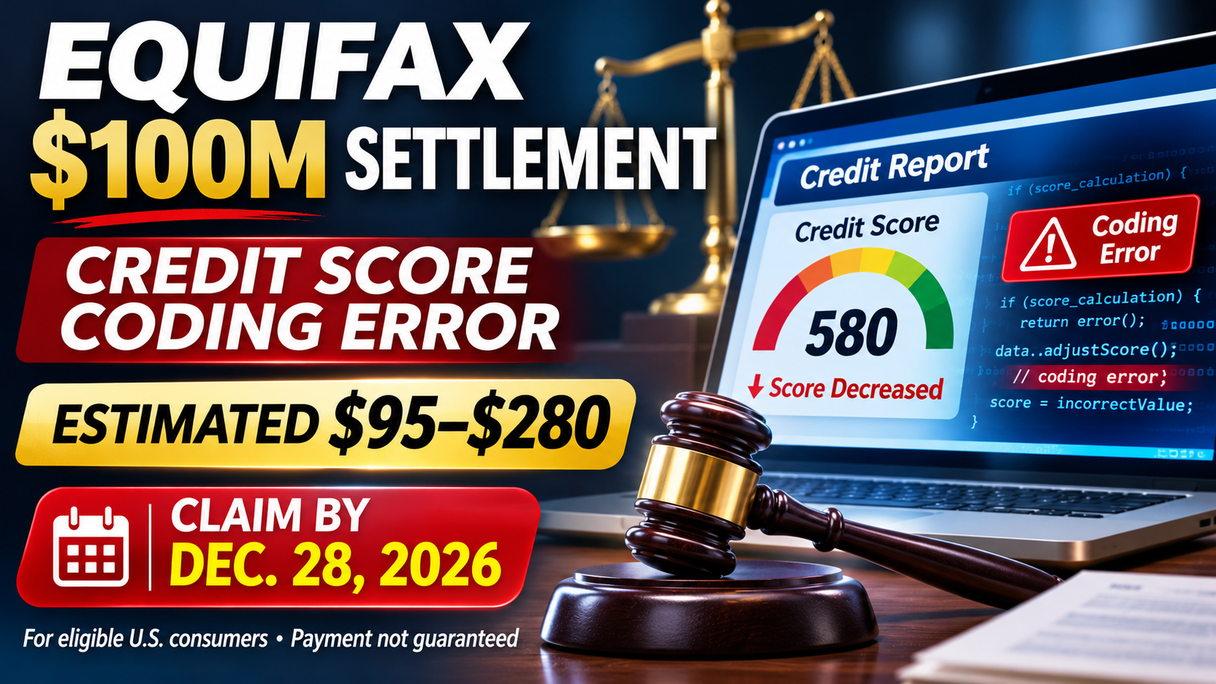
This one, though, is real. Equifax has agreed to pay $100 million to resolve a lawsuit over a computer coding problem that caused it to send wrong credit scores and credit data to lenders and other companies for about three weeks in 2022. Class members who file a valid claim by December 28, 2026 could get a payment, estimated at roughly $95 to $280. And if you’d rather not take part in the settlement at all, a separate and earlier deadline, November 27, is the one to watch.
Today is November 2, so the clock is running. Here’s in this article walkthrough of what happened, who qualifies, how much money is realistic, and how to file.
Highlight of Equifax Credit Score Settlement
Before getting into the details, here are the facts that matter most, pulled from the court-approved notice and the official settlement website:
- Case: In re Equifax Fair Credit Reporting Act Litigation, No. 1:22-cv-3072, U.S. District Court for the Northern District of Georgia (Judge Leigh Martin May)
- Settlement fund: $100 million, non-reversionary (any money left over doesn’t go back to Equifax)
- Who’s covered: People in the U.S. whose credit score or credit attribute Equifax reported to a third party between March 17 and April 8, 2022, and whose reported data differed because of the coding issue, according to Equifax’s own analysis
- Estimated payment: About $95 to $280 per person who files a valid claim, though the real number could be higher or lower
- Deadline to opt out or object: November 27, 2026
- Deadline to file a claim: December 28, 2026 (online, or mailed and postmarked by that date)
- Final approval hearing: January 22, 2027, at 2:00 p.m. in Atlanta
- Official website: EquifaxFairCreditReportingSettlement.com
- Phone: 1-888-808-1542
Nobody gets paid until the judge signs off on the deal at that January hearing, and any appeal would push things back further. More on timing below.
What actually went wrong in 2022
Equifax is one of the three big credit bureaus in the United States, along with Experian and TransUnion. When you apply for a loan, the lender typically pulls a credit report or a score from one or more of them and uses it to decide whether to approve you and what interest rate to offer.
According to the lawsuit, a coding error on one of Equifax’s servers, referred to in the court papers as the “OMS Issue,” caused some of the scores and credit attributes Equifax sent out to come out different from what they should have been. Credit attributes are the individual data points, such as how many accounts you have open or how much of your available credit you’re using, that lenders feed into their own decision models.
The notice describes the problem window as March 17 through April 8, 2022. You may see slightly different end dates in news coverage. Some articles and the plaintiffs’ lawyers’ press materials say April 6, and the New York Attorney General, who investigated the same error separately, described a three-week period that ended April 8. For purposes of the settlement, the notice language is what counts, and it says April 8.
Equifax publicly acknowledged the problem back in 2022. The company has said the underlying information in people’s credit files wasn’t changed, and that most scores didn’t move much. It has previously stated that fewer than 300,000 consumers saw a change of 25 points or more. The plaintiffs see it differently. They say the scoring errors hit around 4 million people and, for some of them, lowered scores enough to mean a denied application or a worse interest rate.
Equifax denies that it violated the Fair Credit Reporting Act, and the settlement is not an admission of wrongdoing. That’s standard language in class settlements, but it’s worth knowing so you don’t read this as a court finding that the company broke the law. No judge has decided that.
Cash App $15 Million Settlement Is Finally Paying Out: Who Qualifies and What to Expect
Retirees Could Lose Up to $18,400 in 2026: Why Social Security Cuts Are Being Warned About
How a 2022 glitch turned into a $100 million deal
The first lawsuit was filed in August 2022, and a number of related cases were later consolidated in federal court in Atlanta. The plaintiffs’ core argument was that the Fair Credit Reporting Act, or FCRA, requires credit bureaus to follow reasonable procedures to assure the maximum possible accuracy of the information they report, and that Equifax fell short. They also pointed to what they described as outdated systems and inadequate testing.
After nearly four years of litigation, the case settled. Court filings and counsel’s statements mention discovery and two in-person mediation sessions along the way. Equifax disclosed in its second-quarter 2026 financial filing that it had reached an agreement in principle in June to resolve the consolidated cases for $100 million, subject to court approval. The plaintiffs filed an unopposed motion for preliminary approval in August, and Judge May granted it on August 17, 2026.
Class counsel, including David Berger of Gibbs Mura, DiCello Levitt and Caplan Cobb, call it the largest class settlement ever reached under the FCRA. That’s their characterization, though it’s consistent across their announcements.
Separately, the New York Attorney General announced in January 2025 that Equifax would pay $725,000 to resolve the state’s own investigation into the same error, which the AG said affected more than 77,000 New Yorkers. That doesn’t stop a New Yorker from being a class member here.
Who can file a claim
This is where people get tripped up. Not everyone who applied for credit in spring 2022 is in the settlement class, and not everyone who has an Equifax file is either.
The class is defined narrowly. Based on the settlement documents, you’re a class member if all of the following are true:
- You’re an individual in the United States.
- Equifax reported a credit score or credit attribute about you to a third party between March 17 and April 8, 2022.
- That score or attribute was different from what it would have been without the coding issue.
- Equifax’s own analysis of the problem flagged the transaction as a “class transaction.”
That last point is the catch. Class membership isn’t something you self-certify by saying “I think my score was wrong back then.” It’s based on Equifax’s internal records of which reports were affected. Equifax, its affiliates, its officers and employees, and the judges on the case are excluded.
What that means in practice: if you had a credit check in that window but Equifax’s analysis shows your score or attributes weren’t altered, you’re not in the class, even though you applied for credit during those weeks. Several consumer finance outlets have made this point, and it matches the settlement notice. Applying for a loan in March 2022 doesn’t automatically qualify you.
How to tell if you’re affected
The practical test is whether you got a notice. The administrator, Verita Global, was ordered to send notices around September 29, 2026, by email or regular mail, based on Equifax’s records of who was affected. Each notice carries a Claim ID that starts with “EFX-” and a PIN.
If you got something like that, you’re in the class. A few tips:
- Check spam and promotions folders. Notices went out by email where Equifax had an address, and a lot of people never saw them.
- Look at your mail. If there was no usable email, the notice went by postal mail.
- Don’t have your Claim ID or PIN? The official website is the place to start. If you can’t find it, you can call the settlement hotline at 1-888-808-1542 or email info@EquifaxFairCreditReportingSettlement.com. I can’t tell you what the administrator will be able to do for a specific person who lost their notice, so ask them directly rather than assuming.
- Never got a notice? That generally suggests Equifax’s records don’t list you, but if you’re sure you were affected, ask the administrator.
A reminder email is planned for people who haven’t filed, about 60 days after the original notice. That lands around the end of November, too late to help if you’re weighing an opt-out.
So how much money are we talking about?
The headline is $100 million. The number that matters to you is smaller.
The settlement notice says class counsel will ask the court for attorneys’ fees of up to one-third of the fund, which is $33,333,333, plus up to $500,000 for expenses. Those requests need the judge’s approval, and the notice says class members have the right to object to the fees even if they like the settlement overall. Administration costs, the expense of sending notices and processing claims, come out of the fund too.
Whatever is left gets divided equally among everyone who files a valid, timely claim. The plaintiffs estimate that works out to roughly $95 to $280 per claimant, based on claim rates in comparable settlements. The official materials are careful to say it could come in higher or lower.
For a rough sense of scale: after the requested fees and expenses, about $66 million would be left before administration costs. At $280 a head that covers roughly 236,000 claimants; at $95, closer to 700,000. If more people file, each share shrinks. That’s why nobody can give you a firm figure until claims are counted.
There’s no proof-of-harm requirement for the standard claim, and the form is short: contact info, payment preference, signature. Everyone gets the same share, whether they lost thousands or never noticed a thing. That matters for the opt-out question below.
How to file your claim, step by step
You have two routes.
Online (the easier one):
- Go to the official settlement website, EquifaxFairCreditReportingSettlement.com. Type the address in yourself rather than clicking a link in a text or an unfamiliar email.
- Click the file-a-claim button.
- Enter the Claim ID (it starts with EFX-) and PIN from your notice.
- Confirm your contact details and choose how you’d like to be paid. Electronic payment or a prepaid card mailed to you are the options described in the notice.
- Sign electronically and submit. Save the confirmation.
By mail:
- Download and print the claim form from the website.
- Fill it out and sign it.
- Mail it to: Equifax FCRA Litigation, P.O. Box 301132, Los Angeles, CA 90030-1132.
- Make sure it’s postmarked by December 28, 2026.
If you go the mail route, don’t wait until the last week. Mail gets delayed, especially around the holidays, and a postmark after the 28th is the same as no claim.
One detail: the claim form never asks you to pay anything. If someone asks for a fee, it isn’t the real thing.
Newfoundland and Labrador Disability Benefit Payment Dates, Amount, Eligibility and How to Apply?
Extra $200 Social Security Payment: Is It Approved, Who Qualifies and When Could It Arrive?
Cash App Data Security Settlement 2026: Up to $2,500 for Approved Claims, Here’s What Happens Next
CVS Digital Privacy Settlement 2026: Who Qualifies and How to File Before November 16
Your three options, and what each one means
This part of the notice is worth reading slowly, because the choices have consequences.
1. File a claim. If the settlement is finally approved, you get a share of the money. In return, you give up the right to sue Equifax over the coding issue.
2. Do nothing. You get no money, and you’re still bound by the settlement if it’s approved. That means you can’t sue Equifax on your own over this problem later. For most people this is the worst outcome: no payment and no legal rights.
3. Opt out (exclude yourself). You get nothing from the settlement fund, but you keep the right to bring your own lawsuit against Equifax over the coding error. You’d have to submit your exclusion request by November 27, 2026, following the instructions on the settlement website.
You can also object to the settlement, the fee request, or the claims process, again by November 27. Objecting is different from opting out. You’d stay in the class and still be bound if the judge approves anyway. And if someone submits both an opt-out and an objection, the court order says they’re treated as having opted out and not objected.
Notice that November 27 is the Friday after Thanksgiving. It’s easy to let that one slip while you’re thinking about travel and turkey, so if there’s any chance you want to opt out or object, mark it now.
When would opting out make sense?
For the large majority of people, the answer is: it doesn’t. If the wrong score didn’t cost you anything you can point to, filing a claim is the straightforward move. Free money, no hassle.
The calculation is different if the error cost you something real and documented. Think of a mortgage, car loan or credit card application that was denied in late March or early April 2022, a loan you took at a noticeably higher interest rate than you’d otherwise have gotten, or a rental application that was turned down. In those situations, an individual lawsuit might theoretically be worth more than a $95 to $280 settlement share.
Under the FCRA, a consumer can sue for actual damages caused by a negligent violation, and for a willful violation can seek actual damages or statutory damages of $100 to $1,000, plus possible punitive damages. Both allow recovery of costs and attorney’s fees. But “might be worth more” is carrying a lot of weight there. Individual FCRA cases are hard. You’d need to show the score error, show that it caused your specific harm, and deal with a defense that, as noted above, argues most scores barely moved and that lenders weigh many other factors. Most people won’t want to take that on, and a lawyer’s evaluation of your documents is a much better guide than a news article.
There’s also a time limit. The FCRA generally requires lawsuits to be filed within two years of discovering the violation, and no later than five years after it occurred. For reports sent in March and April 2022, that five-year outer limit falls in March and April 2027. Whether the pending class action paused the clock for someone who opts out is a legal question I can’t answer for you, so don’t assume it did.
If you think this applies to you, gather what you’ve got: denial letters from that period, loan estimates and closing disclosures showing your rate, anything you received from Equifax or a lender about the coding problem, and any credit reports you saved. Then talk to a consumer protection attorney before November 27, not after. I’m not a lawyer, and nothing here is legal advice.
When will payments go out?
Not soon, unfortunately. The settlement has only been preliminarily approved. The judge will hold the final approval hearing on January 22, 2027, in Atlanta. At that hearing she’ll consider whether the deal is fair, reasonable and adequate, hear any objections, and decide how much to award class counsel in fees and expenses. If she approves it, there’s an appeal window, and payments typically wait until any appeals are resolved.
So the earliest checks could land is sometime after January 22, 2027, and realistically it could be several months later, or longer if someone appeals. There’s no official payment date yet, and anyone claiming otherwise is guessing. If the court doesn’t give final approval, no one gets paid under this agreement.
Filing your claim now doesn’t mean money arrives in your account next month. It means you’re in line.
Watch out for scams
Whenever a big settlement makes the news, scammers show up. A few red flags to keep in mind:
- Anyone asking you to pay a fee to file, speed up, or “secure” your payment. You never pay anything to file a claim.
- Unsolicited texts or calls saying you’re owed Equifax money and asking for your Social Security number, bank login or card number.
- Look-alike websites. The only official settlement site is EquifaxFairCreditReportingSettlement.com. Third-party sites sometimes rank high in search results, and while some are just informational, you should file at the official site only.
- Pressure to act today. The real deadlines are in November and December. Nobody legitimate needs your answer in an hour.
The notice you got should be the starting point. If you’re unsure whether an email is legitimate, don’t click anything in it. Go to the website directly or call the hotline number listed on the settlement site.
If you got a notice with an EFX- Claim ID and a PIN, you’re almost certainly in the class, and filing is quick. The claim takes a few minutes, costs nothing, and could get you somewhere between $95 and $280, with the caveat that the actual number won’t be known until claims are tallied and the court rules on fees. The deadline is December 28, 2026.
If you think the error cost you real money, or you simply don’t want to release your claims against Equifax, the date to circle is November 27, 2026, which is the cutoff to opt out or object. Don’t let that one get lost in the holiday week. And if you did nothing, you’d get no money and give up your right to sue. That’s the one choice almost nobody should make.
Final approval is scheduled for January 22, 2027. Dates and amounts can change, so for anything that matters, rely on your official notice and the settlement website rather than any summary, including this one.
This article is for general information and isn’t legal or financial advice. Details were drawn from the court-approved settlement notice, the court’s preliminary approval order, the official settlement website, class counsel’s public statements and news coverage as of November 2, 2026. The official settlement website blocked automated retrieval during research, so its contents were confirmed through the court documents and reporting that quote it. Check the website for the latest information. Official settlement website: Equifax FCRA Litigation
Did You Buy Generic Drugs? How to File a Sun and Taro Price Fixing Settlement Claim Before Nov. 9
22% Social Security Cut: What It Means for Your Monthly Check$
1600 Property Tax Credit 2026: Fact Check, Eligibility, Dates and How to Apply?
CalFresh Payment Schedule and Recertification: Deposit Dates, Renewal Steps and the New Work Rules