CalFresh Payment Schedule and Recertification: California households on food aid are heading into November with more changes than any month in years, and the CalFresh payment schedule and recertification rules are now tied together in a way they never were before. Maximum benefits rose on October 1, so a family of four can receive up to $1,023 a month, and a single adult up to $306. At the same time, the federal work rules passed in July 2025 are being checked at renewal since June 1, 2026, a waiver that protected Alpine County ends on October 31, and seven counties lose their waiver on November 1. A missed renewal date or an unreported change can now cost more than it used to. Most CalFresh deposits still land between the 1st and the 10th of the month, and the guide below lists every November date. We’ll be updating this article monthly.
If you only have a minute, here is what matters. Find the last digit of your case number, mark the date your money arrives, and then look at your renewal notice, because the deadline on that letter is the one that decides whether benefits continue in December. Households that file the CF 37 renewal form before the 15th day of the last month of their certification period are treated as timely, and anyone who misses the window gets a 30 day grace period to finish the process and receive prorated benefits. This guide explains the deposit dates, how renewal works step by step, who must meet work requirements, what changed for noncitizens and college students, and how to estimate your own benefit with the free calculator below. Every figure is labeled by source, and anything we could not confirm with an official notice is flagged so you know what to double check with your county.

CalFresh Latest News: What Changed This Fall
The biggest change is the money itself. USDA published its fiscal year 2027 cost of living memo on August 21, 2026, and the new amounts took effect on October 1, 2026. California uses the standard 48 state chart, so the maximum for one person is $306 and the maximum for four people is $1,023. Those are ceilings. Your real payment is the maximum minus 30 percent of your net income, so most households get less.
The second change is the work rule. Under the federal law known as H.R. 1, adults without children in the home must work, train or volunteer at least 20 hours a week to keep getting CalFresh beyond three months in a 36 month period. California started checking this at recertification on June 1, 2026. Reports about how many people are affected disagree. The Times of San Diego, in a story first published by The Center Square, says roughly 47,000 Californians could lose benefits starting this month, and it also reports that Assemblymember Alex Lee’s office expects about 562,000 people to lose access next year. The article does not explain the gap, so treat both numbers as estimates rather than official counts.
The third change is local. California has been using county waivers that pause the time limit in areas with high unemployment. The Alpine County waiver ends October 31, 2026, and seven counties will no longer be waived from November 1, 2026. Your county welfare department decides how this is applied to your case, so open your notice before assuming anything. The state also took action on October 26, 2026 to recognize more workforce programs as qualifying activity, which matters for anyone trying to meet the 20 hour test through training.
Two more changes sit in the background. Noncitizen eligibility narrowed on April 1, 2026, and the state now carries a larger share of the cost of running the program, which is why counties are pushing households to renew online instead of by mail.
| Key highlight | Detail |
|---|---|
| Maximum benefit, 1 person | $306 a month |
| Maximum benefit, 4 people | $1,023 a month |
| New amounts effective | October 1, 2026 |
| Amounts valid through | September 30, 2027 |
| Work rules checked at renewal since | June 1, 2026 |
| Alpine County waiver ends | October 31, 2026 |
| Seven counties lose waiver | November 1, 2026 |
| Noncitizen rules narrowed | April 1, 2026 |
CalFresh Payment Schedule for November 2026: When Will My Benefits Arrive?
California loads CalFresh benefits onto EBT cards across the first ten days of the month. In most counties the day depends on the last digit of your case number. A case number ending in 1 is paid on the 1st, a 2 on the 2nd, and so on up to 9 on the 9th, while a case number ending in 0 is paid on the 10th. These dates come from a published schedule that is widely repeated by news and benefits sites rather than from a single statewide CDSS page, so check your county notice or your EBT account if a deposit looks late.
November 2026 begins on a Sunday, which changes how the week looks. We could not confirm from an official source whether California moves a weekend deposit to a different day, so use the table below as the expected date and verify with your county if your money does not appear.
| Last digit of case number | Expected deposit date | Day of the week |
|---|---|---|
| 1 | November 1 | Sunday |
| 2 | November 2 | Monday |
| 3 | November 3 | Tuesday |
| 4 | November 4 | Wednesday |
| 5 | November 5 | Thursday |
| 6 | November 6 | Friday |
| 7 | November 7 | Saturday |
| 8 | November 8 | Sunday |
| 9 | November 9 | Monday |
| 0 | November 10 | Tuesday |
Veterans Day on November 11 and Thanksgiving on November 26 are state and federal holidays. County offices will be closed, but EBT balances do not depend on office hours, so a holiday does not delay money that has already been issued. Cash aid under CalWORKs follows a separate calendar and is generally paid in the first days of the month regardless of case number.
You can use the date finder in the calculator below to look up any other month. Choose the last digit of your case number and the month, and it shows the expected day.
CalFresh Payment Dates by Case Number: Year Ahead Pattern
The pattern does not change from month to month. Your digit decides your day, and only the weekday moves. If your case number ends in 5, you are paid on the 5th every month, even though the 5th lands on a Thursday in November, a Saturday in December 2026 and a Tuesday in January 2027. Your own history is the best check. Look at your last three deposits on the EBT account and confirm the day is the same.
If a new application is approved in the middle of a month, the first payment is prorated from the day you applied, and the county sends it as soon as the card is active. After that you move onto your case number schedule. Households approved through expedited service, which is for people with very little income and cash, get faster processing. Ask for it on the application, because the county has to screen you and cannot do it unless it is requested or the facts make it obvious.
How to Check Your CalFresh Balance and EBT Status?
You can see your balance and your last deposit in four places. The California EBT customer service line is 1-877-328-9677, and it is open every day. You can also use the ebtEDGE website or app, which shows your balance and transaction history after you create a login. BenefitsCal lets you review your case, upload documents and see notices, and your county office can confirm the date of your next deposit. Your card should be kept even in months with no payment, because the account stays active for future deposits as long as the case is open.
If a deposit is missing for more than two days after your date, check three things in this order: the last digit of your case number, whether the county has a pending notice about a change or an overdue report, and whether your certification period ended without a completed renewal. The last one is the most common reason.
| Task | Where to go |
|---|---|
| Check balance and deposits | ebtEDGE website or app, or 1-877-328-9677 |
| Log in, view notices, upload documents | BenefitsCal |
| Apply online | BenefitsCal or GetCalFresh |
| Official program information | CDSS CalFresh page |
| Find your county office | County social services or human services department |
How to Apply for CalFresh in California?
If you are not on CalFresh yet, the process is the same for every county. You can apply online through BenefitsCal or GetCalFresh, in person at a county office, by phone, by mail or by fax. GetCalFresh is run by a nonprofit and takes about ten minutes. BenefitsCal is the official state portal and also lets you manage your case later. Both send your application to your county.
Step one is the application itself. You only need your name, address and signature to start, and the filing date matters because your first payment is counted from it. Step two is the interview, which the county does by phone in most cases. Step three is verification, which means proof of income, rent, utilities, child care and identity. The county must give you at least 10 days to provide missing documents. Step four is the decision. If you are approved, an EBT card arrives by mail, and if you already have one, the benefits go on it.
Most people can qualify with a higher income than they expect. California uses broad eligibility rules, with a gross income limit of 200 percent of the federal poverty level, which is $2,660 a month for one person and $5,500 for four people, with a net income limit at 100 percent of poverty, which is $1,330 for one person and $2,750 for four. Households with an older adult or a disabled member can be tested differently. Immigration rules changed on April 1, 2026, so ask your county which members count.
| Household size | Gross monthly limit (200% FPL) | Net monthly limit (100% FPL) | Maximum benefit |
|---|---|---|---|
| 1 | $2,660 | $1,330 | $306 |
| 2 | $3,608 | $1,804 | $562 |
| 3 | $4,554 | $2,277 | $808 |
| 4 | $5,500 | $2,750 | $1,023 |
| 5 | $6,448 | $3,224 | $1,217 |
| 6 | $7,394 | $3,697 | $1,463 |
| 7 | $8,340 | $4,170 | $1,616 |
| 8 | $9,288 | $4,644 | $1,841 |
The gross limits above are calculated as twice the federal net limit for each size, and each additional person adds $948 to the gross limit and $474 to the net limit. Confirm the exact number with your county, because it can apply a different rule to your household.
CalFresh Processing Time: How Long Does an Application Take?
The county has 30 days to decide a standard application. The clock starts on the day your application is received, not on the day of the interview. If you qualify for expedited service, the county is supposed to act much faster. We did not verify the current state deadline for expedited cases against a CDSS notice, so ask the county for the timeline in writing if you apply that way.
If 30 days pass and you have heard nothing, call the county and ask for the status. If a county asks for documents, send them quickly, because a denial for missing verification can be reversed if the proof arrives within 30 days. Counties that use the federal verification waiver can deny a case if the household does not respond within 10 days of a written request, so do not wait. A denial for missing proof does not end your claim. Counties in the waiver must reopen the case, with benefits from the original application date, if verification arrives within 30 days.
| Step | Typical timing |
|---|---|
| Application filed | Day 1 |
| County interview | Usually within days of filing |
| Missing proof requested | At least 10 days to respond |
| Standard decision | Within 30 days |
| First payment | Prorated from the application date |
| Denial for missing proof can be reopened | Within 30 days |
CalFresh Recertification: How to Renew Your Benefits Step by Step
Every CalFresh household has a certification period, which is the stretch of months the county has approved you for. When it ends, you must recertify, which is the official word for renewal. Counties usually mail a renewal packet and notice before the period ends. The packet includes the CF 37 form, which is the annual recertification form, and a notice that says the due date. Do not rely on what a friend or an old article says, because your own notice is the only date that applies to you.
Here is the process from start to finish.
First, find your notice. It names your certification end date and the deadline for the CF 37. If you cannot find it, log in to BenefitsCal or call your county.
Second, complete the CF 37. Report income, rent, utilities, household members and any change since your last review. You can do it online in BenefitsCal, by mail, by fax, by phone or in person. Online filing creates a timestamp, which is useful proof.
Third, attend the interview. Counties schedule one at renewal, and it is almost always by phone. If you miss it, the county sends a Notice of Missed Interview, form CF 386. Call right away to reschedule, because you still have time to complete the process.
Fourth, send proof. Pay stubs, a rent receipt or lease, utility bills, child care receipts, medical bills for older or disabled members and proof of work activity if the work rule applies to you.
Fifth, wait for the decision notice. If you are approved, you get a new certification period and a new notice with your benefit amount. If you are denied, the notice tells you why and how to appeal.
CalFresh Recertification Deadline: When Is the CF 37 Due?
The rule of thumb is simple. A recertification filed before the 15th day of the last month of your certification period is considered timely. If you file after that, the county must still process the case, but it is considered untimely and benefits may be delayed. A renewal is considered delayed if it is not finished by the end of the last month of the period.
If the delay is the household’s fault and the process cannot be completed in the final month, the county denies the case at the end of the certification period. That is not the end of the road, because you have up to 30 days after the period ends to complete the process. If you do, the county withdraws the denial and pays prorated benefits from the date you completed the missing step. If you wait longer than 30 days, the county treats your CF 37 as a new application, and it cannot make you file a separate one.
If the delay is the county’s fault, the rule is different. The county must keep working the case and issue a full month of benefits for the first month of the new period as soon as it can.
| Situation | What happens |
|---|---|
| CF 37 filed before the 15th of the last month | Timely, benefits should continue without a gap |
| CF 37 filed after the 15th | Processed, but may be delayed |
| Renewal not finished by end of period, household’s fault | Denial, can be fixed within 30 days |
| Completed within 30 days after period ends | Prorated benefits from the date completed |
| More than 30 days after period ends | CF 37 treated as a new application |
| County caused the delay | Full month of benefits for first month of new period |
Always keep proof that you filed on time. A BenefitsCal confirmation, a fax receipt or a county date stamp is better than a phone call you cannot prove.
CalFresh Semi Annual Report: What Is the SAR 7?
Many households do not wait a full year for a check. They file a Semi Annual Report, called the SAR 7, around the sixth month of a 12 month period. It is a short form that asks about income and household changes. If you skip it, the county can stop your benefits, even though you have six months left in the period. The due date is printed on the form and the notice, so read it as soon as it arrives.
Households with an elderly or disabled member are sometimes on a longer cycle. Your notice shows which one you are on. If your income went up above the reporting level or a family member moved in or out, report it when it happens rather than waiting for the SAR 7.
CalFresh Work Requirements 2026: Who Has to Work 20 Hours?
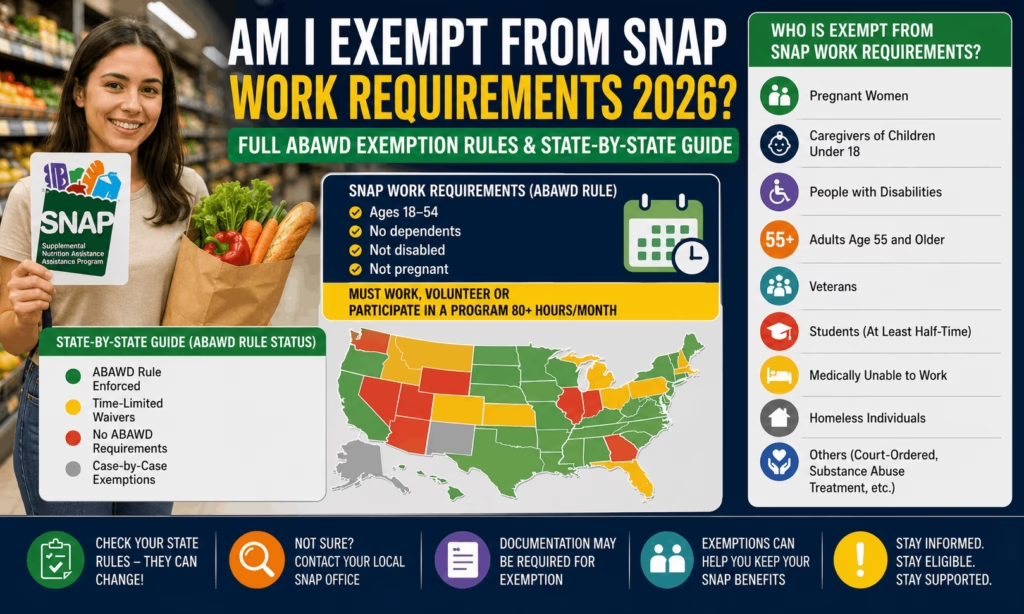
The work rule in the new federal law applies to people the government calls able bodied adults without dependents. Under H.R. 1, the rule now covers adults aged 18 through 64, and a parent is exempt only if a child under 14 lives in the home. Veterans, people who are homeless and former foster youth lost their automatic exemptions under the new law. People who are pregnant, medically unfit to work or caring for an incapacitated person can still be exempt, and the county has to ask about it.
The test is 20 hours a week, or 80 hours averaged over a month. Work, a state approved training program, school and volunteer hours can count. Without meeting it, an adult can get only three months of CalFresh in 36 months. California began applying this at recertification on June 1, 2026, which means your renewal is the moment the county looks at your hours.
County waivers are the exception. A county with weak job markets can ask for a waiver, which pauses the time limit. The Alpine County waiver ends October 31, and seven other counties lose their waivers on November 1. Look up your county before you assume you are protected, because waivers end and the county will not always call you first.
What to do if the rule applies to you: keep a simple monthly log, collect pay stubs or a signed letter from your supervisor or volunteer site, and report your hours at the interview. If you cannot reach 20 hours, ask whether you qualify for an exemption or a good cause reason before the three months run out.
CalFresh College Students: What Changed on October 9?
California announced a change to student eligibility on October 9, 2026. We could not open the full state announcement or a county notice before publishing, so we are not listing the dollar amount or the exact criteria here. Before you act, read the CDSS notice and ask your campus basic needs office. Students are normally tested on enrollment status, work hours or a state exemption such as an approved work study job, and the rules differ for students under 22 who live with their parents. If your college has a CalFresh outreach program, they can screen you for free.
CalFresh Noncitizen Eligibility: What Changed on April 1, 2026?
The federal law narrowed which noncitizens can receive CalFresh. After April 1, 2026, the eligible groups are mainly U.S. citizens, lawful permanent residents and a few other listed categories. Some refugees and asylees who could previously receive food aid no longer qualify under the federal program. The rules are complicated, and a household can have mixed status. In that case, an eligible child or adult can still get benefits even if another member cannot.
If you are worried that applying will affect your immigration case, ask a free legal aid group before you file. Many California legal aid offices answer these questions.
Free CalFresh Benefit Calculator (Oct 2026 to Sep 2027)
Estimate only. Uses official USDA FY 2027 figures for California and the 48 states.
What to Do If You Miss Your CalFresh Renewal
Missing the date is common and fixable. Act the same day you notice. File the CF 37 online or at the county office, and keep the receipt. If it has been less than 30 days since your certification period ended, ask the county to withdraw the denial and reopen the case. You should receive prorated benefits from the date you completed the process. If it has been more than 30 days, your form is treated as a new application, and the county should not make you start from zero with a separate form.
If your benefits stopped and you think the county made a mistake, you can ask for a state hearing. The notice that ends your benefits includes the deadline and the instructions. Asking for a hearing before the effective date of the notice can keep benefits going while the case is reviewed.
Common Reasons Benefits Stop or Go Down
Most problems come from paperwork rather than eligibility. The common ones are a missed interview, a missing SAR 7, a missing document, a change in income that was not reported, and a move without a new address on file. Work requirement cases are now a new reason, especially at renewal. Keep your phone number and address current in BenefitsCal, because a notice sent to an old address can start a 30 day clock you never saw.
Official Sources and Useful Links
| Resource | Link | Use |
|---|---|---|
| CDSS CalFresh program page | https://www.cdss.ca.gov/calfresh | Official program rules and notices |
| BenefitsCal | https://benefitscal.com | Apply, renew, upload documents, view notices |
| GetCalFresh | https://www.getcalfresh.org | Apply online in about ten minutes |
| CF 37 recertification form | https://www.cdss.ca.gov/cdssweb/entres/forms/English/cf37.pdf | Annual renewal form |
| California EBT (ebtEDGE) | https://www.ebtedge.com | Check balance and deposits |
| EBT customer service | 1-877-328-9677 | Card help and balance by phone |
| USDA SNAP cost of living adjustments | https://www.fns.usda.gov/snap/allotment/COLA | FY2027 amounts and limits |
| CalFresh recertification rules summary | https://calfresh.guide/failure-to-timely-complete-recertification/ | Timely filing and 30 day rules |
| Times of San Diego (via The Center Square) | https://timesofsandiego.com | Coverage of work rule estimates |
CalFresh FAQs
When will my CalFresh benefits be deposited in November 2026?
Most counties deposit by the last digit of your case number. A 1 is paid on November 1 and a 9 on November 9, while a 0 is paid on November 10. Check your county notice if you have any doubt.
How often do I have to recertify for CalFresh?
Most households recertify once a year with the CF 37, and many also file a SAR 7 around the sixth month. Your notice names the dates that apply to you.
What is the CalFresh recertification deadline?
As a rule, a CF 37 filed before the 15th day of the final month of your certification period is considered timely.
What happens if I miss my CalFresh recertification?
The county denies the case at the end of the period, but you have 30 days to finish the process and get prorated benefits. After 30 days, the form is treated as a new application.
Can I renew CalFresh online?
Yes. You can renew through BenefitsCal, and you can also use mail, fax, phone or an office visit.
Do I have to do an interview at recertification?
Yes. The county schedules an interview at renewal, and it is usually done by phone. If you miss it, call the county right away.
How much CalFresh can I get in 2026?
The maximum is $306 for one person and $1,023 for four, from October 1, 2026 to September 30, 2027. Your actual amount depends on your net income and deductions.
Does CalFresh have a work requirement?
Yes, for many adults aged 18 through 64 without children under 14 in the home. They must work, train or volunteer 20 hours a week to keep benefits past three months in 36.
Are there waivers for the work rule?
Some counties have waivers. The Alpine County waiver ends October 31, 2026, and seven counties lose theirs on November 1, 2026.
What day does CalFresh come out each month?
It depends on the last digit of your case number. The deposit is between the 1st and the 10th of the month. Case numbers ending in 0 are paid on the 10th.
How do I find my CalFresh case number?
It is on your approval and renewal notices and in your BenefitsCal account. Your county office can read it to you after confirming your identity.
How long does it take to get CalFresh after applying?
The county has 30 days to decide a standard case. Expedited cases are handled faster, so request it on your application.
What if my CalFresh renewal packet never arrived?
You can still renew. Log in to BenefitsCal, call your county or visit the office, and file the CF 37 before your certification period ends.
Conclusion
The CalFresh payment schedule and recertification steps are simple when you break them into three habits. Know your deposit day from the last digit of your case number. Read every county notice the day it arrives. File the CF 37 before the 15th day of the last month of your certification period. With the new benefit amounts in effect and the work rule now checked at renewal, a missed date can cost more than it used to. If you do slip, you have 30 days to fix it. If you are not on CalFresh yet, the calculator on this page can show whether it is worth applying. We will keep this guide current as counties and CDSS publish new notices.