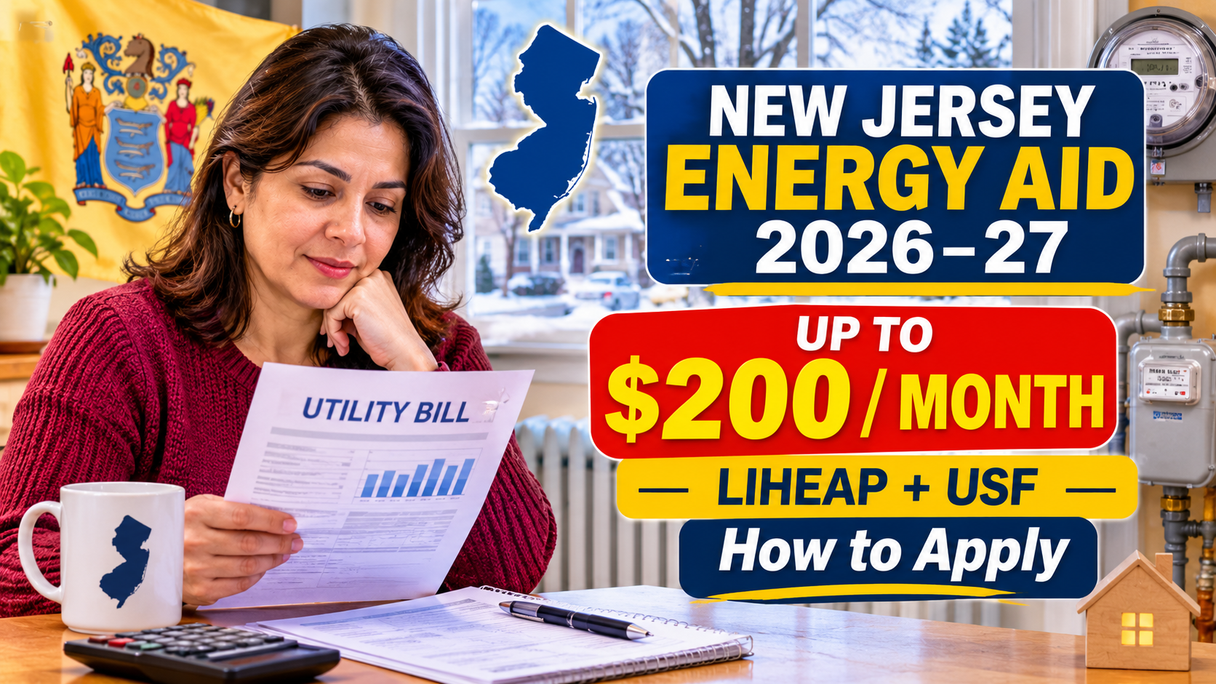
New Jersey LIHEAP 2026-27: It’s the third week of November, New Jersey’s Winter Termination Program started on the 15th, and the first real cold snap is never far off. If your gas, electric or oil bill is already making you wince, there’s help on the table. The state’s energy aid season opened October 1, and this year the monthly bill credits went up.
Two programs do most of the heavy lifting. The federal Low Income Home Energy Assistance Program (LIHEAP) sends a one-time lump sum toward your heating costs. The state’s Universal Service Fund (USF) takes money off your gas and electric bills every month. They share a single application, and you can collect from both at once.
This guide covers who qualifies, what the help is worth, how to apply, and what to do if you’re staring at a shutoff notice. Everything comes from the New Jersey Department of Community Affairs (DCA) and the Board of Public Utilities (BPU). Sources are listed at the end so you can check the details yourself.
LIHEAP and USF: 2 programs, one application
People mix these up constantly, so here’s the difference.
LIHEAP is paid for by the U.S. Department of Health and Human Services and run in New Jersey by DCA. It helps with heating costs whether you use natural gas, electricity, oil, propane, kerosene, coal or wood, and it covers households whose heat is built into the rent. Beyond the basic benefit, it offers emergency help, medically necessary cooling assistance, and heating system repair or replacement.
USF was created by the BPU and is also administered by DCA. It’s funded by a charge on New Jersey electric and gas bills. Instead of one payment, you get recurring monthly credits meant to keep your utility bills at a manageable share of your income.
Here’s what saves people time: the federal fiscal year 2027 LIHEAP application is also your USF application. Fill it out once and the state considers you for both.
The application window
Applications are open from October 1, 2026, through June 30, 2027, first come, first served, while funds last. LIHEAP is federal money, and the state handbook is clear that payments depend on it being available. So don’t assume you have until the last day of June. Applying in November or December is a much safer bet than February.
Who qualifies
Both programs use the same income test. Your household’s gross monthly income, meaning before taxes, must be at or below 60 percent of New Jersey’s State Median Income. DCA’s limits for October 1, 2026, through September 30, 2027:
| Household size | Monthly gross income | Annual gross income |
|---|---|---|
| 1 | $4,273 | $51,273 |
| 2 | $5,587 | $67,049 |
| 3 | $6,902 | $82,825 |
| 4 | $8,217 | $98,602 |
| 5 | $9,532 | $114,378 |
| 6 | $10,846 | $130,154 |
| 7 | $11,093 | $133,112 |
| 8 | $11,339 | $136,070 |
| 9 | $11,586 | $139,028 |
| 10 | $11,832 | $141,986 |
| 11 | $12,079 | $144,944 |
| 12 | $12,325 | $147,903 |
For households larger than twelve, add $246 a month for each additional person. Those limits are higher than a lot of people expect. A family of four earning just under $99,000 a year can qualify, so plenty of working households that never thought of themselves as low income are eligible. Last year’s single-person limit was about $4,167 a month, so the thresholds rose for 2026-27.
Savings and other assets don’t count against you. SNAP benefits, other energy assistance, veterans’ benefits (with proof) and Social Security paid to children under 18 are left out of the income calculation. You also need to be responsible for your heating bill, either by paying the utility or fuel dealer directly or because heat is part of your rent. For USF, there has to be a residential gas or electric account in a household member’s name. Even with qualifying income, the DCA handbook rules out:
- People in public housing or receiving rental assistance that covers heat, unless they pay their own heating costs directly to a supplier
- Households where someone outside the home pays the heating bill
- Residents of licensed medical facilities or drug and alcohol treatment centers
- Households made up entirely of students who are tax dependents of another household
Qualified non-citizens, such as lawful permanent residents, refugees and asylees, can receive benefits if they otherwise qualify. In a mixed-status household, a member who isn’t a qualified non-citizen is left out of the household count, and that person’s income above $500 a month is added to the household total.
What LIHEAP Pays
Your heating benefit isn’t a flat number. A matrix sets it using your income, household size, fuel type and region of the state, and the lowest-income, highest-need households get the most. New Jersey’s federal plan lists a minimum of $118 and a maximum of $1,278.
Where the money goes depends on how you heat:
- Gas or electric heat: the benefit goes straight to your utility.
- Oil, propane, kerosene, coal or wood: you get a two-party check made out to you and your supplier.
- Heat included in rent: you get a one-party check made out to you.
Some households receive LIHEAP without filing anything. People enrolled in SNAP, TANF or PAAD can be paid automatically using data the state already holds. If you don’t get an automatic payment, you’ll get a notice telling you where to apply, so don’t toss that letter.
There’s also cooling help, which sounds odd in November but rides on the same application. If a doctor certifies that someone in your home would be in medical danger without cooling, LIHEAP pays a one-time $300. You’ll need a signed, stamped note from a licensed practitioner or a Critical Care Certification form approved by your utility.
What changed with USF
The big news this season is on the USF side. In an October 30 announcement, the BPU said the program now provides:
- A minimum monthly credit of $20 each for gas and electric, up from $5
- A maximum of $200 a month for gas and electric combined, up from $180
The design goal is that you shouldn’t pay more than about 3 percent of household income on energy, up to that cap. DCA’s fact sheet says USF covers gas and non-heating electric costs above a set percentage of your income, depending on how you heat. Enrolling in USF also opens other doors. It gets you into LIHEAP and the USF-Fresh Start program, which helps forgive past-due energy debt, and it protects you from utility shutoffs in winter and summer.
The BPU also changed how utilities handle enrollment. The seven major gas and electric companies must now help first-time applicants and meet enrollment targets over three years. In year one they beat the target, signing up more than 8,000 first-time participants. Many held sign-up days at senior centers, payment offices and houses of worship. If paperwork feels like a chore, call your utility and ask what help it offers.
How to apply
- Check your income against the table above, using gross monthly income for everyone in the household.
- Apply online at www.nj.gov/dca/dcaid, or call 1-800-510-3102 to get an application mailed or to find a local agency. More information is at www.energyassistance.nj.gov.
- Ask for help if you need it. People 60 or older, or with disabilities, can apply by mail, and agencies provide home visits for people who can’t get out. Calling 211 is one way to request one.
- Submit your documents (below).
- Watch your mail. DCA sends a decision notice, and the state aims to decide within 60 days of a complete application. You can check status at the same 1-800 number.
Gather these before you start. An incomplete file is the most common reason applications stall:
- Names and Social Security numbers for everyone in the household
- Your current address
- A recent bill or contract showing who supplies your heat
- If you rent, a signed lease (first, second and last pages)
- Proof of income for every adult, such as pay stubs covering any four consecutive weeks in the last 60 days, or award letters for Social Security, pensions, unemployment or disability
- If you have no income, a signed zero-income declaration and a Monthly Household Expenses Form
If an application sits incomplete for 70 days, it’s denied and closed, and you’d have to start over. If you disagree with a decision or think your benefit is too low, you’re entitled to an administrative review or fair hearing, and the denial notice explains how to ask. DCA cut its network of local partner agencies from 31 to 20 at the start of last year’s cycle, so if you used a particular office before, confirm it’s still taking applications.
If your heat is about to be cut off
LIHEAP has an emergency track for households that are out of heat or close to it. That means you’re out of fuel and can’t afford more, or you pay for heat through your rent and received a shutoff notice. You need a LIHEAP application on file. This season’s rules provide:
- Up to $800 for an emergency fuel delivery or to restore or keep utility service. Reconnection fees are handled separately, up to $100.
- Up to $2,000 for emergency furnace repair or replacement if you own and live in the home. The agency must get written DCA approval before any work starts, so don’t hire a contractor first.
- Fast turnaround: eligible households get a resolution within 48 hours, or 18 hours if it’s life-threatening, such as an older adult or young child in the home.
Emergency money runs from December through June 30. Oil and propane help is available throughout that stretch, while gas and electric emergencies open after the winter shutoff protection ends on March 15.
Winter shutoff protections
From November 15 through March 15, the BPU’s Winter Termination Program protects residential gas and electric customers from disconnection. You have to call your utility during that window and ask to be enrolled, so don’t wait for them to do it. People receiving TANF, SNAP, LIHEAP, PAAD or USF are also covered.
Keep in mind that protection doesn’t erase what you owe. The bill keeps building, which is one more reason to get into USF and ask about Fresh Start if you’ve fallen behind. The state is also setting up a summer termination program for June 15 through August 31, though DCA says guidelines are still being worked out.
Other help worth knowing about
- Lifeline Utility Assistance. For low-income seniors and people with disabilities. Apply through NJSave at www.aging.nj.gov or call 1-800-792-9745.
- PAGE (Payment Assistance for Gas and Electric). Helps households facing disconnection. If you’re income-eligible for USF or LIHEAP, the state asks you to apply for those first.
- NJ SHARES. A nonprofit with its own energy grants, useful if you’re over the income limits.
- Comfort Partners and weatherization. Free energy assessments and upgrades like insulation, windows and doors. You can request weatherization on the same application. Renters need written landlord consent, and the home generally can’t have been weatherized in the past fifteen years.
Important Tip for winter’s energy bills
Apply early, and apply even if you’re not sure you qualify. The worst outcome is a denial you have the right to challenge. Respond quickly when an agency calls or writes, because missed letters cost people benefits. And watch for scams: the state doesn’t charge a fee to apply, so stick to the nj.gov sites and the 1-800-510-3102 number, and be wary of anyone promising guaranteed benefits for a price.
This winter’s energy bills will sting, but the safety net is real. LIHEAP can put as much as $1,278 toward your heat, USF can take up to $200 a month off your gas and electric bills with a floor four times higher than before, and the income limits are generous enough that many working families qualify. The application is open now. Gather your documents, apply online or call 1-800-510-3102, and get your name in the queue before the money runs thin.
Rules, benefit levels and deadlines can change, and your own benefit depends on your circumstances. Confirm details at www.energyassistance.nj.gov or by calling 1-800-510-3102.