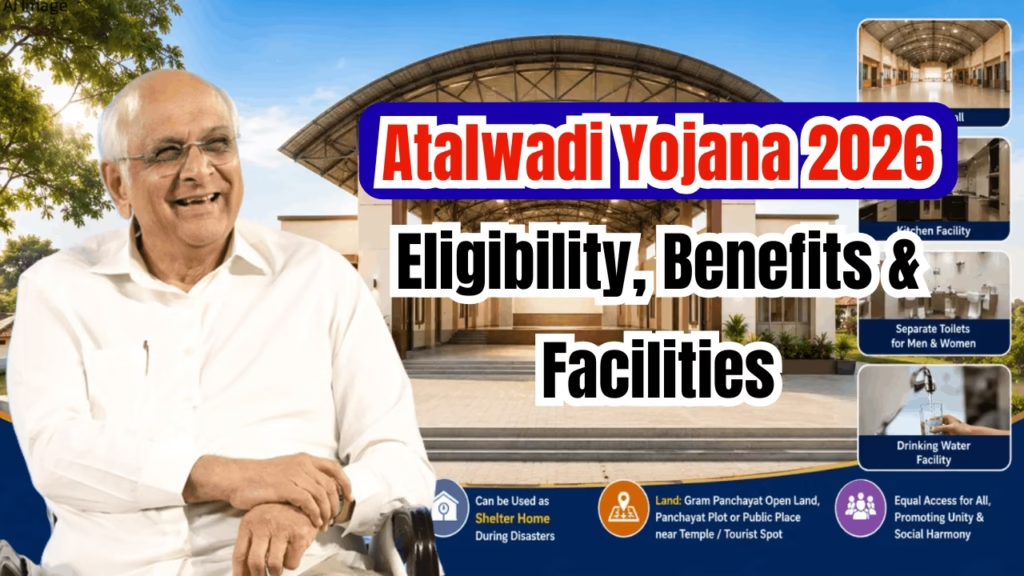
Atalwadi Yojana 2026: Gujarat, Chief Minister Shri Bhupendrabhai Patel has officially approved the new “Atalwadi Yojana”, a state-funded initiative aimed at providing modern community infrastructure to villagers across every corner of Gujarat. The approval was granted during the Gujarat State Cabinet meeting held on May 20, 2026, in Gandhinagar, and was formally announced to the public by Spokesperson Minister Shri Jitu Vaghani the following day. With a dedicated budget allocation of ₹60 crore for the current financial year, the Atalwadi Yojana represents one of the most tangible and community-driven welfare decisions to emerge from the Bhupendrabhai Patel government in recent months.
What Is the Atalwadi Yojana?
The Atalwadi Yojana Gujarat is a rural community hall construction scheme under which the state government will fund the construction of purpose-built, multi-purpose community venues — called “Atalwadis” — in villages across Gujarat. The primary objective of the scheme is to upgrade the facilities available to citizens residing in the remotest areas of the state, ensuring that even the most geographically isolated villages have access to quality, modern infrastructure for social, cultural, and emergency purposes.
The scheme directly addresses one of the most persistent and underreported problems in Gujarat’s rural economy: the absence of affordable, dignified, and well-equipped venues for social gatherings. Weddings, religious ceremonies, community meetings, and public functions in rural areas have historically required either the use of open grounds — exposed to weather — or the costly rental of venues in nearby towns, placing a significant financial burden on poor and middle-class families. The Atalwadi Yojana eliminates this burden by bringing a modern, well-equipped community hall directly into the village.
Atalwadi Yojana 2026 Overview
| Scheme name | Atalwadi Yojana |
| Approved by | CM Shri Bhupendrabhai Patel |
| Approval date | May 20, 2026 (State Cabinet meeting) |
| Announced by | Spokesperson Minister Shri Jitu Vaghani |
| Implementing department | Panchayati Raj and Rural Development |
| Budget allocation (FY 2025–26) | ₹60 crore |
| Eligible villages | Population above 2,000 |
| Atalwadi capacity | 500 persons per venue |
| Key facilities | Hall with arch-shed, kitchen, separate toilets, drinking water |
| Land source | Gram Panchayat open land, designated plots, public land near temples/tourist spots |
| Rental policy | Available at reasonable rates to all villagers |
| Emergency use | Functions as official Shelter Home during disasters, cyclones, floods |
| Discrimination policy | Open to all citizens equally — no caste, religion, or economic discrimination |
| Named after | Former PM Shri Atal Bihari Vajpayee |
Who Is the Atalwadi Yojana Named After?
The name “Atalwadi” is a tribute to Former Prime Minister of India, Shri Atal Bihari Vajpayee — one of the most respected and beloved leaders in Indian political history, and a towering figure in the Bharatiya Janata Party. Naming the scheme after Vajpayee reflects the Gujarat government’s commitment to honouring his legacy of development, inclusivity, and grassroots governance. Just as Vajpayee’s Pradhan Mantri Gram Sadak Yojana transformed India’s rural road network, the Atalwadi Yojana Gujarat aspires to transform the social infrastructure of rural Gujarat in his name.
Key Features of the Atalwadi Yojana 2026
Each Atalwadi community hall constructed under the scheme will be a purpose-designed, fully equipped venue meeting a specific infrastructure standard set by the Gujarat government. The confirmed features of every Atalwadi include:
- Seating capacity of 500 people — a large open hall with arch-shed covering capable of accommodating the community for weddings, festivals, public meetings, and other gatherings
- A fully functional kitchen — to enable the preparation and serving of food during social and religious functions held on the premises
- Separate toilet facilities for men and women — a critical hygiene and dignity feature, particularly for women and girls attending events at rural venues
- Clean drinking water supply — ensuring that attendees of any event have access to safe, potable water throughout
- Universal, non-discriminatory access — the benefits of every Atalwadi will be accessible to all citizens of the village equally, without any discrimination on the basis of caste, religion, or economic status, thereby actively fostering mutual cooperation and social harmony at the community level
The design is intended to be robust enough to serve its primary purpose as a community gathering space while also functioning as a critical piece of emergency infrastructure during natural disasters.
Atalwadi Yojana Eligibility 2026: Which Villages Will Benefit?
The Atalwadi Yojana eligibility criteria are straightforward and clearly defined. The scheme covers all villages in Gujarat with a population of more than 2,000. This threshold has been chosen to ensure that the initiative reaches a substantial and meaningful number of villages while focusing resources on communities large enough to sustain regular use of the facility.
Villages falling below the 2,000-population threshold are not included in the current phase of the scheme, though the government has not ruled out future expansion. Gujarat is home to thousands of villages across 33 districts and 248 talukas — a significant proportion of which cross the 2,000-population mark, meaning the scheme has the potential to benefit millions of rural Gujaratis in its initial phase alone.
Land Selection for Atalwadi Construction
A critically important aspect of the Atalwadi Yojana implementation is the process for selecting land on which the community halls will be constructed. The Gujarat government has specified three categories of land that will be prioritised:
- Open spaces belonging to the Gram Panchayat — land already under local government ownership, which eliminates the need for land acquisition and ensures the facility remains a public asset
- Plots designated by the Panchayat — where the Gram Panchayat identifies and formally designates a specific plot for this purpose
- Public lands near the main temple or tourist spots of the village — strategically locating the Atalwadi near existing points of community congregation to maximise accessibility and footfall
This Gram Panchayat-led land selection model is particularly significant. By embedding the Atalwadi within the existing landscape of community spaces — near temples and gathering points — the scheme ensures organic integration into village life rather than creating an isolated facility that villagers may not readily adopt.
Budget Allocation: ₹60 Crore for Atalwadi Yojana in 2026
The Gujarat state government has made a confirmed budget provision of ₹60 crore for the Atalwadi Yojana in the current financial year 2025–26. This allocation — announced alongside the scheme’s approval at the May 20 Cabinet meeting — is the initial tranche of funding that will drive the first wave of Atalwadi constructions across the state.
The ₹60 crore Atalwadi Yojana budget will be administered through the Panchayati Raj and Rural Development Department, which will oversee construction tendering, quality control, and monitoring across districts. Given that the scheme targets villages with over 2,000 population, and that Gujarat has a large number of such villages, the ₹60 crore initial allocation is expected to fund a significant first batch of Atalwadis, with subsequent budget rounds anticipated based on implementation progress and demand.
The government’s decision to create a dedicated budget line for the Atalwadi Yojana — rather than folding it into an existing scheme — signals its commitment to treating rural community infrastructure as a standalone priority.
Atalwadi as a Disaster Shelter Home
One of the most thoughtful and practically significant features of the Atalwadi Yojana Gujarat is its explicit design as dual-purpose infrastructure — serving as both a community venue during normal times and a Shelter Home during natural disasters, cyclones, or heavy rainfall.
Gujarat is one of India’s most disaster-prone states. The memory of the 2001 Bhuj earthquake, the annual threat of severe cyclonic storms along the Saurashtra and Kutch coastlines — including powerful storms in recent years — and the recurring devastation of heavy monsoon floods across southern and central Gujarat make resilient emergency infrastructure a genuine public safety need, not a theoretical luxury.
By constructing Atalwadis to a standard that allows them to serve as official shelter homes during emergencies, the Gujarat government is simultaneously solving two problems with one piece of infrastructure:
- In peacetime: A modern, affordable community gathering space that saves families money and provides dignity for social occasions
- In emergencies: A sturdy, centrally located shelter with water supply and toilet facilities where displaced villagers can safely take refuge
This climate-resilient community infrastructure approach positions the Atalwadi Yojana as a model for integrated rural development planning — an example of how welfare schemes can be designed to deliver multiple outcomes from a single investment.
Affordable Rental for Community Use: Financial Relief for Poor and Middle-Class Families
A cornerstone of the Atalwadi Yojana’s social impact is the provision that Atalwadis will be made available to villagers at reasonable rental rates — not at commercial rates that would exclude poor and middle-class families. This is a deliberate policy choice that reflects the scheme’s welfare orientation.
Currently, rural families in Gujarat who wish to host weddings, engagements, religious functions, or community events face two costly options: renting commercial banquet halls in nearby towns or cities — often at rates of ₹20,000 to ₹50,000 or more per event — or organising functions outdoors, exposed to weather and without proper sanitation. Both options impose financial stress or logistical inconvenience.
With an Atalwadi in their own village, families will be able to access a well-equipped 500-person venue at rates that reflect the public, non-commercial nature of the facility. The financial savings to village families over time — particularly for families with daughters approaching marriageable age, who face the prospect of expensive wedding functions — are expected to be meaningful and cumulative.
Social Harmony and Inclusive Access
The Gujarat government’s official statement on the Atalwadi Yojana makes a specific point of emphasising that “the benefits of Atalwadi will be accessible to all citizens of the village equally without any discrimination, thereby fostering mutual cooperation and social harmony.”
This is not incidental language. Gujarat, like many Indian states, has historically experienced social tensions along caste and community lines in rural areas — tensions that sometimes manifest in access to shared public spaces and venues for social functions. By making the Atalwadi explicitly available to all without discrimination, and by rooting it in Gram Panchayat management, the scheme positions the community hall as a shared civic space that can help break down social barriers and reinforce the principles of equality and community solidarity.
The Atalwadi, in this framing, is not merely a physical structure — it is intended as a social leveller: a space where the poorest family and the most prosperous household in the village share the same access to the same dignified facility.
CM Bhupendrabhai Patel’s Governance Vision
The Atalwadi Yojana fits squarely within Chief Minister Bhupendrabhai Patel’s broader governance philosophy of grassroots, people-centred development. Since assuming office as the 17th Chief Minister of Gujarat in September 2021 and being re-elected following the BJP’s decisive victory in the 2022 Gujarat Legislative Assembly elections, Patel has consistently prioritised welfare measures that directly improve the daily lives of citizens — particularly those in rural and semi-urban areas.
The Atalwadi Yojana joins a growing portfolio of Gujarat state welfare initiatives including the Karmayogi Swasthya Suraksha Yojana for government employees, the Laptop Sahay Yojana for students, the Gujarat AI Action Plan 2025–2030, and the PM Surya Ghar Yojana rollout at the state level. Together, these schemes reflect a Gujarat government that is attempting to balance high-technology economic aspiration with ground-level social welfare — and the Atalwadi Yojana represents its commitment to the latter.
Why the Atalwadi Yojana Matters for Rural Gujarat
In a state where nearly 55% of the population still lives in villages, and where the gap between urban and rural infrastructure remains wide despite Gujarat’s reputation as one of India’s most developed states, the Atalwadi Yojana represents a meaningful acknowledgement that rural communities deserve more than roads and electricity — they deserve spaces for dignity, celebration, and safety.
The scheme’s strength lies in its simplicity and universality: every village above 2,000 people gets the same facility, at public cost, owned by the Gram Panchayat, open to all. That formula — when implemented with integrity and quality — has the potential to transform not just the infrastructure of rural Gujarat, but the social fabric of its communities for generations to come.