
New $250 Trump Bill Plan: The proposed Trump $250 bill has generated widespread confusion since Treasury Secretary Scott Bessent displayed a mock-up of the design at a White House press briefing in May 2026, but the plan remains legally blocked for now. Under 31 U.S. Code Section 5114, only a deceased person’s portrait may appear on U.S. currency, meaning President Trump cannot legally appear on any denomination while he is alive unless Congress changes the law first. The vehicle for that change, H.R. 1761, the Donald J. Trump $250 Bill Act, was introduced by Rep. Joe Wilson (R-SC) in February 2025 and remains stuck in the House Financial Services Committee, with no hearing scheduled as of late July 2026, even though the Treasury Department has already prepared design prototypes in anticipation of possible passage.
This guide breaks down exactly what the $250 bill proposal would do, the specific federal law standing in its way, the current status of the legislation in Congress, and what Treasury officials have and haven’t confirmed about a Trump-branded bill. We’ll be updating this article monthly as H.R. 1761 moves, stalls, or changes in Congress. If you’ve seen the viral mock-up image of a $250 bill featuring Trump’s portrait and signature, the sections below explain what’s real, what’s proposed, and what still requires an act of Congress before it could ever become legal tender.
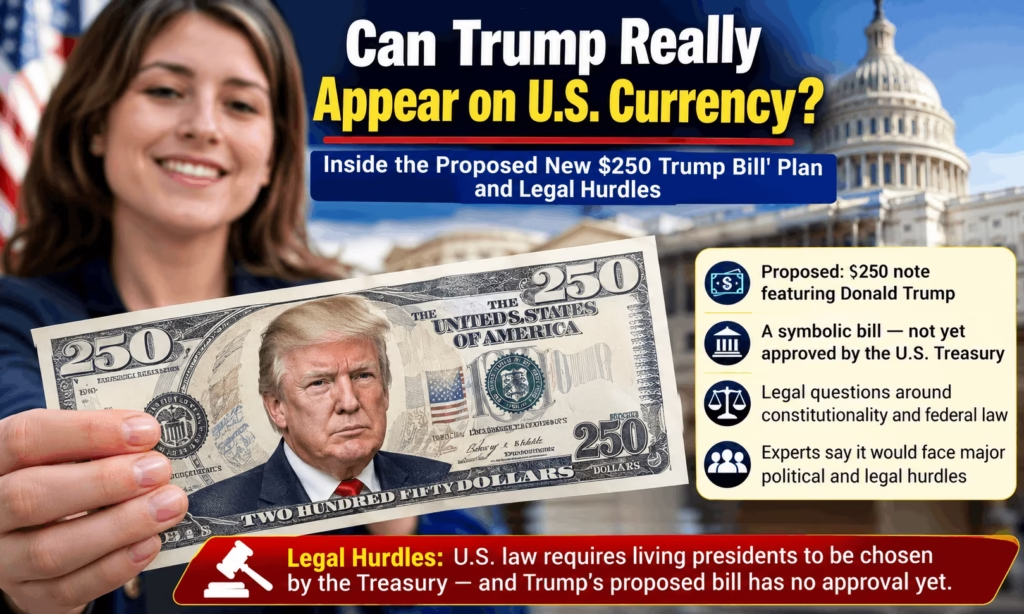
New $250 Trump Bill Plan Key Highlights
| Key Data Point | Detail |
|---|---|
| Proposed denomination | $250 bill (new, would not replace an existing denomination) |
| Bill name | Donald J. Trump $250 Bill Act (H.R. 1761) |
| Sponsor | Rep. Joe Wilson (R-SC) |
| Date introduced | February 27, 2025 |
| Referred to | House Committee on Financial Services |
| Cosponsors (as of Sept. 2025) | 13, all Republican |
| Committee hearing held? | No, as of late July 2026 |
| Senate companion bill? | None introduced |
| Legal barrier | 31 U.S. Code § 5114, bars living persons from currency portraits |
| Treasury official who displayed a mock-up | Secretary Scott Bessent, May 28, 2026 |
| Occasion cited for the proposal | U.S. Semiquincentennial (250th anniversary), July 4, 2026 |
| Separate related proposal | Trump-themed $1 coins and a commemorative gold coin |
What Is the Proposed $250 Trump Bill
The $250 bill is a proposed new U.S. currency denomination that does not currently exist in circulation, distinct from the standard $1, $5, $10, $20, $50, and $100 bills already in use. Under the proposal, the note would feature a portrait of President Donald Trump, along with his signature, timed to coincide with the 250th anniversary of American independence in 2026. Unlike a routine currency redesign, creating an entirely new denomination combined with a living president’s portrait represents a dual first: no sitting or living U.S. president has ever appeared on paper currency, and no new denomination has been introduced in decades.
The Legal Barrier: 31 U.S. Code Section 5114
The central obstacle to the Trump $250 bill is a specific federal statute: 31 U.S. Code Section 5114, which restricts U.S. currency and securities portraits to deceased individuals only. This is why every person currently depicted on U.S. paper currency, including Washington, Lincoln, Hamilton, Jackson, Grant, and Franklin, had already died before their portrait was adopted. Treasury Secretary Bessent acknowledged this directly at a White House briefing, stating that his department has two legal mandates for currency design: that no living person may appear on it, and that it must include the phrase “In God We Trust.” Without a change to this statute, no design decision by the Treasury Department alone can lawfully put a living president’s face on currency, regardless of any prepared mock-ups.
H.R. 1761: The Donald J. Trump $250 Bill Act Explained
H.R. 1761, formally introduced by Representative Joe Wilson of South Carolina on February 27, 2025, would accomplish two things simultaneously:
- Direct the Bureau of Engraving and Printing to design and print a new $250 Federal Reserve note featuring a portrait of Donald J. Trump
- Create a legal exemption to the existing living-person restriction, specifically allowing current and former U.S. presidents to appear on currency while still alive
The bill’s sponsor has publicly framed the proposal around two arguments: a practical case that inflation has eroded the purchasing power of existing denominations, making a higher note useful for carrying less physical cash, and a commemorative case tying the new bill to the nation’s 250th birthday. As introduced, the bill has not received any Democratic cosponsorship and has been characterized by outside legal analysts as facing a narrow and specific legislative path, since it requires both a new denomination and a direct statutory carve-out for living presidents.
How to Increase Your Social Security Benefits in 2026?
Social Security Changes 2026: New Rules, COLA Increase & What Changed This Year
Current Status of the Bill in Congress
As of late July 2026, H.R. 1761 remains pending in the House Committee on Financial Services, where it has sat since its referral in February 2025. Key status facts:
- The bill has not been scheduled for a committee hearing or markup
- It has accumulated 13 cosponsors, all Republican, as of September 2025
- No companion bill has been introduced in the Senate
- Reporting indicates the bill faced internal pushback from a Treasury appointee, who has since been reassigned, though this has not resulted in a scheduled hearing as of this writing
A bill must pass both the House and Senate in identical form and be signed by the president to become law. H.R. 1761 remains in the earliest procedural stage of that process, meaning the $250 bill cannot legally be printed or circulated based on current law.
What Treasury Has Actually Confirmed
Treasury Secretary Scott Bessent has confirmed that the department has been preparing design work in advance, describing it as standard practice for a proposal tied to active legislation, while explicitly stating the Treasury “will stick to the law” unless Congress passes the required change. Separately, reporting indicates that the U.S. Treasurer and a senior adviser requested design prototypes for the $250 bill even while the legislation remained stalled, and the Treasury has confirmed that the president’s signature will appear on paper currency as part of Semiquincentennial commemorations, a first for a sitting president, though this is distinct from placing his portrait on a bill. No official Treasury statement has confirmed a timeline for the $250 bill entering circulation, since that step still requires congressional action.
The Trump Coin Proposals: A Different Legal Path
Separate from the $250 bill, the Trump administration has pursued Trump-themed coins through a different and already-existing legal mechanism. The Circulating Collectible Coin Redesign Act of 2020 temporarily authorizes the Treasury Secretary to issue $1 coins with designs “emblematic of the United States semiquincentennial” for 2026, and the U.S. Commission of Fine Arts has separately approved a design for a commemorative 24-karat gold coin. Because this 2020 law provides specific statutory authority for $1 coin designs tied to the anniversary, the Treasury has treated it as sufficient legal basis for the coin proposals, unlike the $250 bill, which has no comparable existing statutory authority and depends entirely on H.R. 1761 or similar legislation passing.
Historical Precedent: Who Has Appeared on U.S. Currency
U.S. currency has historically featured only deceased public figures, predominantly former presidents, with Alexander Hamilton and Benjamin Franklin as the notable non-president exceptions. The $500, $1,000, $5,000, and $10,000 bills, all discontinued from production in 1969 though still technically legal tender, previously featured deceased historical figures such as William McKinley, Grover Cleveland, James Madison, and Salmon P. Chase. No new denomination has been introduced since the $2 bill’s modern design, and no proposal to feature a living president has previously advanced as far as H.R. 1761, even with its current status stalled in committee.
What Would Need to Happen for the Bill to Become Real
For the Trump $250 bill to become legal, several sequential steps would need to occur:
- House Financial Services Committee would need to schedule a hearing and advance the bill via markup
- The full House of Representatives would need to pass the bill
- A Senate companion bill would need to be introduced, since none currently exists
- The Senate would need to pass an identical version
- The President would need to sign the bill into law
- Only after enactment could the Bureau of Engraving and Printing legally begin production of a circulating $250 note
Each of these steps represents a substantial legislative hurdle, and as of this writing, the process has not advanced beyond the first stage.
VA Benefits July 2026: How Much Will Your Payment Increase?
CRA Benefit Payments July 2026 Dates, Amounts & Eligibility!
Official Resources and Links
| Resource | Purpose | Official Link |
|---|---|---|
| Congress.gov – H.R. 1761 | Official bill text, status, and summary | congress.gov |
| U.S. Department of the Treasury | Official statements on currency and commemorative designs | treasury.gov |
| Bureau of Engraving and Printing | Official currency production authority | bep.gov |
| GovTrack.us | Independent bill tracking and legislative history | govtrack.us |
| House Committee on Financial Services | Committee jurisdiction and hearing schedule | financialservices.house.gov |
FAQs
Is the $250 Trump bill real currency right now?
No. It remains a proposed denomination that requires congressional legislation to become legal tender. It is not currently in circulation or production.
Why can’t Trump legally appear on currency while he’s president?
Federal law, 31 U.S. Code Section 5114, restricts currency portraits to deceased individuals only. Since Trump is a living person, an act of Congress would be required to create an exception.
What is H.R. 1761?
It is the Donald J. Trump $250 Bill Act, introduced in February 2025, which would direct the Treasury to print a $250 note featuring Trump’s portrait and create a legal exception allowing living presidents to appear on currency.
Has Congress passed the $250 bill legislation?
No. As of late July 2026, the bill remains in the House Financial Services Committee with no hearing scheduled and no Senate companion bill introduced.
Has the Treasury Department already designed the $250 bill?
Reporting indicates the Treasury has prepared preliminary design prototypes in anticipation of possible legislation, but officials have stated they will not print the note unless Congress passes the required law.
Is the Trump coin the same as the $250 bill proposal?
No. The coin proposals rely on existing statutory authority under the Circulating Collectible Coin Redesign Act of 2020, while the $250 bill has no comparable existing legal basis and depends entirely on new legislation passing.
People Also Ask
Can a sitting U.S. president appear on money? Not under current law. Only deceased individuals may appear on U.S. currency, so a sitting or living president would require a specific legislative exception, as proposed under H.R. 1761.
What does the $250 bill look like? A publicly reported mock-up shows a design based on one of Trump’s presidential portraits, though no final design has been legally authorized or officially released for production.
Why is there a proposal for a $250 bill specifically? Supporters have cited the number as a symbolic reference to the 250th anniversary of the Declaration of Independence in 2026, alongside a practical argument about carrying fewer bills due to inflation.
Will the $250 bill actually go into circulation? That depends entirely on whether Congress passes H.R. 1761 or similar legislation. As of this writing, the bill has not advanced past committee referral.
Conclusion
The Trump $250 bill remains a proposal, not a printed reality, and current federal law explicitly blocks any living person, including a sitting president, from appearing on U.S. currency. While Treasury officials have confirmed preliminary design preparation and the underlying legislation, H.R. 1761, continues to sit in committee, the bill would need to clear the full House, gain a Senate companion, pass the Senate, and be signed into law before the Bureau of Engraving and Printing could legally produce it. Anyone encountering viral images or claims about the bill entering circulation should treat those claims as premature until Congress actually acts. This guide will continue to be updated monthly as the legislation’s status changes.
Also Read
Military Retirement Pay Raise 2026: How Much More Will Retirees Get?
R370 SRD Grant Extension Until March 2027: Official Update, Eligibility & Latest Budget Data
OBBBA Senior Deduction 2026: Up to $6,000 Tax Break for Retirees — Check If You Qualify
China K-Visa 2026 Eligibility, Application Process & How It Compares to the US H-1B Visa