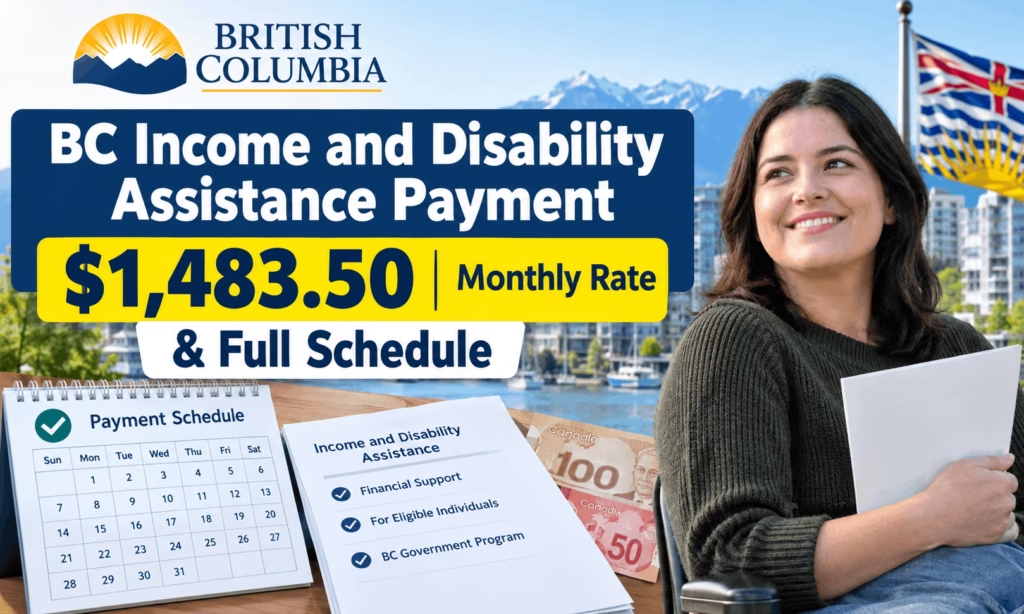
BC Income and Disability Assistance Payment: British Columbia’s disability assistance program currently provides up to $1,483.50 per month to a single person with the Persons with Disabilities (PWD) designation — and for couples, single parents, and larger families, the numbers change significantly. If you or someone in your household relies on this support, knowing exactly when the money lands and how the amount is calculated matters for rent, groceries, and medical costs that can’t wait.
This guide breaks down the current BC disability assistance payment amounts by household type, lays out the monthly payment schedule, explains who qualifies for the PWD designation, and walks through how to apply or check your status through the province’s My Self Serve portal. We’ll be updating this article monthly as new rates and payment dates are confirmed by the Ministry of Social Development and Poverty Reduction.
What Is BC Disability Assistance?
Disability assistance in British Columbia is a monthly income support program run by the Ministry of Social Development and Poverty Reduction (MSDPR). It’s separate from — and generally pays more than — regular income assistance, because it’s designed for people who have been formally approved for the PWD designation, meaning they have a severe, long-term physical or mental impairment that significantly restricts daily living activities.
The payment isn’t a flat number for everyone. It’s built from two main parts — a support allowance and a shelter allowance — and the total changes based on family size, marital status, and whether a spouse also holds the PWD designation.
Current BC Disability Assistance Rates by Household Type
| Household Type | Maximum Monthly Amount |
|---|---|
| Single person with PWD designation | $1,483.50 |
| Couple, both with PWD designation, no children | $2,662.00 |
| Single parent with PWD designation, one child | $1,828.50 |
| Couple, one spouse with PWD designation, one child | $2,433.50 |
| Person living in a Community Living BC (CLBC) funded residence | Up to $1,483.50 (of which roughly $841.13 goes to the service provider for basic living costs, leaving about $642.37 for personal expenses) |
These are the maximum amounts; the exact figure you receive can be reduced based on other income, assets, or living arrangements. Rates are reviewed periodically by the province, which is why it’s worth checking the official rate table linked below before budgeting around a specific figure.
BC Disability Assistance Payment Schedule
Payments are deposited roughly two weeks before the start of the benefit month, which is why the payment date for a given month often falls in the previous calendar month. Direct deposit is the fastest way to receive funds; cheques by mail typically arrive a few days later.
| Benefit Month | Payment Date |
|---|---|
| January | Mid-to-late December (prior year) |
| February | Mid-to-late January |
| March | Late February |
| April | Late March |
| May | Late April |
| June | Late May |
| July | Late June |
| August | Late July |
| September | Late August |
| October | Late September |
| November | Late October |
| December | Mid-to-late November |
ABLE Account Eligibility 2026: Who Qualifies Now, New Age Limit and Calculator
SNAP Benefits October 2026 Increase: New Amounts, Eligibility and Calculator
PROMISE Act Social Security Deadline: What the September 17 Trigger Actually Means for Your Benefits
Support Allowance vs. Shelter Allowance: How the Payment Is Built
Every BC disability assistance payment is made up of two separate pieces, and understanding the split matters because each one is calculated differently.
The support allowance covers day-to-day living costs — food, clothing, transportation, and other personal expenses. It’s a set amount based on family size and doesn’t change depending on where you live or how much rent you pay.
The shelter allowance is meant to help cover rent, mortgage payments, or utility costs, and it’s paid up to a maximum amount. If your actual housing costs are lower than the maximum shelter allowance, you generally only receive what you actually pay, not the full ceiling amount. This is why two single PWD recipients can sometimes receive slightly different totals even though the published maximum is the same $1,483.50 figure.
Income and Asset Rules That Affect Your Payment
Disability assistance is income- and asset-tested, meaning the amount you receive can be reduced — or your eligibility affected — based on what else you have coming in or saved up.
- Asset limits. People with PWD designation can generally hold more in assets than those on regular income assistance, since the province recognizes that disability-related costs are often higher and savings provide an important safety net.
- Annual earnings exemption. As of recent policy updates, a person with PWD designation can earn up to $16,200 per year in employment or self-employment income without it reducing their monthly disability assistance payment. This exemption is designed to let people test working without immediately losing benefits.
- Other income sources. Money from sources like the Canada Pension Plan (CPP), Employment Insurance (EI), or other government transfers is generally counted as income and can reduce your disability assistance payment dollar-for-dollar, though some deductions and exemptions apply depending on the source.
- Child support and certain benefits. Some payments, such as the Canada Child Benefit, are fully exempt and don’t affect your disability assistance amount.
Because these rules interact in different ways depending on personal circumstances, the Ministry’s My Self Serve portal is the most reliable place to see how a specific income source will affect your file.
Who Qualifies for PWD Disability Assistance in BC?
To receive PWD-level disability assistance, you generally need to meet both the standard income assistance rules and additional disability-specific criteria:
- Be at least 18 years old (you can begin the application process at 17.5)
- Have a severe physical or mental impairment expected to last more than two years
- Be significantly restricted in your ability to perform daily living activities
- Require help from another person, an assistive device, or an assistance animal to manage those activities
- Meet the income and asset limits set by the Ministry
- Be a resident of British Columbia
People with a confirmed intellectual disability who are between 17.5 and 19 can qualify through a simplified process without completing the full PWD application, using an existing psychological assessment instead of the full PWD paperwork.
PWD Designation vs. Regular Income Assistance
It’s worth understanding how the two programs differ, since a lot of applicants start on one before moving to the other:
- Regular income assistance is generally intended as short-term support and comes with expectations to look for work unless you’re exempt.
- Disability assistance (PWD) is designed for longer-term support. People with the PWD designation are not required to look for work, and they receive access to a broader range of health-related supplements than someone on regular income assistance.
- Payment amounts are typically higher under PWD than under regular income assistance, reflecting the added and ongoing costs that often come with a severe, long-term disability.
Most people apply for income assistance first, then apply for the PWD designation once they’re in the system, since the PWD application generally requires an existing or concurrent income assistance file.
How to Apply for BC Disability Assistance
- Start (or already be receiving) income assistance. PWD applications are generally processed alongside an existing or new income assistance file.
- Create a My Self Serve (MySS) account and BCeID at myselfserve.gov.bc.ca.
- Complete the PWD Application Form (HR2883) — this includes a self-report, a medical report from a physician or nurse practitioner, and an assessor report on daily living activities.
- Submit the application online, by mail, by fax, or in person at a local Service BC office.
- Wait for the Ministry’s review. If approved, you’ll get a confirmation letter and be added to the payment schedule.
2027 Social Security Benefits Changes: COLA Increase, Possible Cuts, and New Bills
Processing Time
PWD applications can take several weeks to a few months to process, largely because the medical and assessor reports need to be completed by a qualified health professional before submission. Incomplete applications are the most common cause of delay, so it helps to book your medical appointment early and double-check every section before submitting.
A few things that tend to speed up processing:
- Booking your medical appointment for the Medical Report section as early as possible, since physicians and nurse practitioners often have waitlists of their own
- Making sure the Daily Living Activities Report clearly describes how the impairment restricts everyday tasks, not just the medical diagnosis itself
- Submitting all three sections (self-report, medical report, assessor report) together rather than piecemeal
- Keeping a copy of everything you submit, along with the date and method of submission
If the Ministry needs more information, they’ll typically request it in writing, and responding promptly helps avoid the file being closed for inactivity.
Supplements Available Alongside Disability Assistance
Beyond the base monthly payment, people on disability assistance may qualify for additional supplements to help with costs that go beyond regular living expenses. These generally require pre-approval before you make a purchase or book a service, which you can arrange by calling the Ministry or visiting a local office.
- Health supplement — money toward a monthly nutritional supplement for people with a severe medical condition causing chronic, progressive health deterioration or symptoms of wasting
- Medical equipment and devices — support for items like wheelchairs, hearing aids, or other assistive devices that aren’t covered elsewhere
- Transportation supplements — help getting to medical appointments when no other transportation is available
- Dental and optical supplements — limited coverage for basic dental work and eyewear
- Employment-related supplements — support for costs tied to starting or maintaining a job, for those who choose to work
Because eligibility for supplements depends on individual circumstances and documentation, it’s best to confirm what you qualify for directly with the Ministry before making any purchase, since retroactive reimbursement isn’t guaranteed.
What Happens If You’re Denied — The Appeal Process
Not every PWD application is approved on the first try, and a denial isn’t necessarily the final word. If your application for disability assistance is turned down, you generally have two options:
- Request a reconsideration. This means asking the Ministry to review the original decision, often alongside additional medical documentation or clarification that wasn’t part of the initial submission.
- Appeal to the Employment and Assistance Appeal Tribunal. If the reconsideration decision still isn’t in your favor, you can take the matter to an independent tribunal for a formal review.
There are strict timelines for both steps, so it’s important to act quickly once you receive a decision letter. Advocacy organizations, including Disability Alliance BC, offer free help sheets and, in some cases, direct advocacy support for people going through the reconsideration or appeal process.
Working While on Disability Assistance
One common misconception is that taking a job automatically ends disability assistance. In practice, the province allows PWD recipients to work and earn income up to the annual earnings exemption without any reduction to their monthly payment. Income earned above that threshold is typically deducted from the following month’s assistance, rather than cutting off support outright. This structure is intended to reduce the disincentive to work that a strict cutoff would otherwise create, letting people build employment income gradually without immediately losing their support.
How BC Disability Assistance Compares to the Federal Canada Disability Benefit
It’s easy to confuse BC’s provincial disability assistance with the newer Canada Disability Benefit (CDB), but they’re separate programs run by different levels of government:
| BC Disability Assistance (PWD) | Canada Disability Benefit | |
|---|---|---|
| Administered by | BC Ministry of Social Development and Poverty Reduction | Service Canada (federal) |
| Type of program | Provincial income assistance | Federal supplementary benefit |
| Eligibility basis | PWD designation, income and asset tests | Disability Tax Credit eligibility, adjusted family net income |
| Can you receive both? | Yes, eligible individuals can receive both | Yes, eligible individuals can receive both |
Because the two programs use different eligibility criteria, being approved for one doesn’t automatically qualify you for the other — each requires its own separate application.
Why Disability Assistance Rates Change Over Time
BC’s disability assistance rates aren’t static; they’ve been adjusted periodically as the cost of living has shifted and as advocacy groups have pushed for increases. Disability advocacy organizations, including the Disability Alliance BC, have long argued that the shelter and support components have not kept pace with actual housing and living costs in much of the province, and provincial audits have previously flagged concerns about whether current rates are enough to meet recipients’ basic needs. This is part of why it’s worth checking the official rate table each time you’re budgeting rather than relying on a number you saw a while back — even modest annual increases can shift your monthly total.
Practical Tips for Managing Life on Disability Assistance
- Set your rent and bills to align with your deposit date where possible, since payments typically land about two weeks before the benefit month begins.
- Keep your contact and banking information current in My Self Serve — a bounced direct deposit can delay your payment by days or weeks.
- Track pre-approved supplements separately from your regular monthly payment, since they’re issued under different rules and sometimes on a different timeline.
- Report income changes promptly. Under-reporting income, even accidentally, can lead to overpayment issues that the Ministry will later ask you to repay.
- Reach out to an advocate early if you’re struggling with an application or a denial — organizations like Disability Alliance BC offer free help sheets and, in some regions, direct one-on-one support.
BC Disability Assistance Payment Calculator
DISABILITY ASSISTANCE · BRITISH COLUMBIA
BC Disability Assistance Payment Calculator
Estimate your maximum monthly disability assistance amount based on household type. This is an estimate only — your actual amount depends on income, assets, and living arrangement, as assessed by the Ministry of Social Development and Poverty Reduction.
ESTIMATED MAXIMUM MONTHLY PAYMENT
$1,483.50
Figures reflect published BC disability assistance maximums for single, couple, and single-parent households. Rates are periodically adjusted by the province — always confirm your exact amount through your My Self Serve account before relying on this estimate for budgeting.
OFFICIAL RESOURCES
- My Self Serve — apply, check status, manage your file
- Official disability assistance rates page
- PWD Application Form (HR2883)
- Ministry phone line: 1-866-866-0800
Official BC Disability Assistance Resources
| Resource | Link |
|---|---|
| My Self Serve (apply, check status, manage your file) | myselfserve.gov.bc.ca |
| Official disability assistance rates page | www2.gov.bc.ca — “On disability assistance” |
| PWD Application Form (HR2883) | www2.gov.bc.ca/PWDApp |
| Disability Assistance Rate Table | www2.gov.bc.ca — BCEA Rate Tables |
| Ministry phone line | 1-866-866-0800 |
CPP OAS GIS Payment Amounts: September 25 Deposit, October Increase and Free Calculator
FAQs
How much is BC disability assistance for a single person?
A single person with the PWD designation can receive up to $1,483.50 per month, made up of a support allowance and a shelter allowance.
When are BC disability assistance payments deposited?
Payments are typically deposited by direct deposit about two weeks before the start of the benefit month. Cheque payments arrive a few days after that.
Can I work while receiving disability assistance in BC?
Yes. People with PWD designation can work and earn income up to an annual earnings exemption limit without losing their benefits, though earnings above that threshold can reduce the monthly payment.
How long does a PWD application take to process?
Processing generally takes several weeks to a few months, depending on how quickly the medical and assessor reports are completed and how complete the application is when submitted.
Is disability assistance the same as the Canada Disability Benefit?
No. BC disability assistance is a provincial program run by the Ministry of Social Development and Poverty Reduction. The Canada Disability Benefit is a separate federal payment administered by Service Canada, and eligible individuals may receive both.
What happens if my disability assistance application is denied?
You can request a reconsideration or file a formal appeal, and you’re allowed to submit additional supporting documentation during that process.
Do I need to look for work while receiving PWD disability assistance?
No. Unlike regular income assistance, people with the PWD designation are not required to search for work, though they’re free to work if they choose, up to the annual earnings exemption.
How much can I earn before it affects my disability assistance payment?
People with PWD designation can currently earn up to $16,200 per year in employment or self-employment income without any reduction to their monthly disability assistance payment.
What’s the difference between the support allowance and the shelter allowance?
The support allowance is a fixed amount for day-to-day living costs based on family size, while the shelter allowance helps cover rent or housing costs up to a set maximum, and you generally only receive what you actually spend on housing, up to that cap.
Can I get both BC disability assistance and the Canada Disability Benefit?
Yes. They’re separate programs run by the provincial and federal governments, and eligible individuals can receive both at the same time, though each requires its own application.
Who do I contact if my disability assistance payment doesn’t arrive on time?
Call the Ministry of Social Development and Poverty Reduction at 1-866-866-0800, or check the status of your file directly through your My Self Serve account.
Conclusion
The $1,483.50 BC disability assistance payment is the baseline for a single person with PWD designation, but actual amounts vary widely by family size and living situation. Because rates and payment dates are periodically adjusted, the safest approach is to treat the figures above as a starting point and confirm your specific payment date and amount directly through My Self Serve or by calling the Ministry. We’ll be updating this article monthly as new information becomes available.
Social Security 2027 COLA: Latest Estimate, Official Date and Calculator
SNAP Benefits Increase: New FY2027 Maximum Amounts & Free Calculator
2027 Social Security COLA Date, Increase Estimate & Free Payment Calculator