The Canada canned vegetable tariff is one of the most searched trade topics in the country right now, and it directly affects grocery shelves. On June 19, 2026, the federal government imposed a 10 percent surtax on global imports of canned vegetables, a provisional safeguard measure meant to protect Canadian growers and processors from what officials describe as a surge of trade-diverted imports. Finance Minister Francois-Philippe Champagne confirmed the measure applies to the landed value of a wide range of canned vegetables, including corn, peas, green beans, mixed vegetables, and several types of beans and chickpeas. The tariff took effect immediately and can stay in place for up to 200 days while the Canadian International Trade Tribunal finishes a separate, broader safeguard inquiry into both frozen and canned vegetable imports. This guide breaks down exactly what is taxed, which countries are excluded, why the measure was introduced, and what the upcoming Tribunal decision could mean for grocery prices. We’ll be updating this article monthly as the Department of Finance and the Tribunal release new information.
What makes this tariff more complicated than the headline number suggests is the exemption list. Canned vegetables from the United States, Mexico, Israel, Chile, and developing countries are excluded entirely, which means the measure actually lands most heavily on imports from countries like those in the European Union and parts of Asia that fall outside Canada’s existing trade agreements. The bigger question on everyone’s mind right now is what happens on September 9, 2026, when the Canadian International Trade Tribunal is expected to conclude its formal inquiry and recommend whether this temporary surtax should become a longer-term measure. Statistics Canada import data already shows the scale of the shift driving this decision, with canned vegetable imports rising sharply from countries such as Thailand, Turkey, and Peru over the past two years. Below, we cover the full list of affected products, the exemption rules, the timeline behind this decision, and where to find official updates as the Tribunal’s ruling approaches.
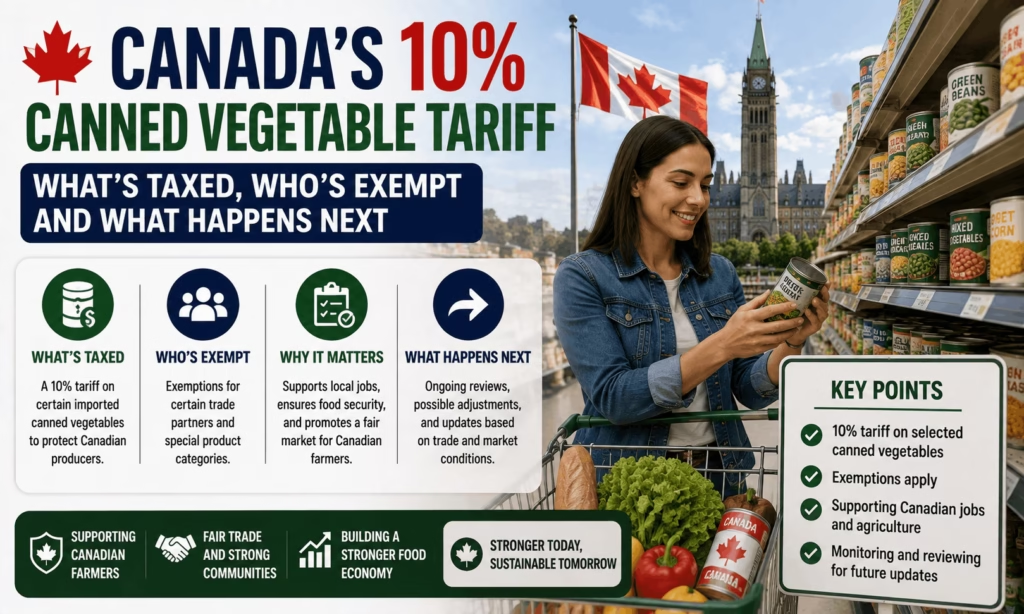
Canada’s canned vegetable tariff is a 10 percent provisional surtax on global imports of canned vegetables, announced by the Department of Finance on June 19, 2026, and effective the same day. It followed a formal safeguard inquiry the government asked the Canadian International Trade Tribunal to launch back in March 2026, after the Canadian Association of Vegetable Growers and Processors requested action. The surtax excludes the United States, Mexico, Israel, Chile, and developing countries under Canada’s existing trade obligations, and it is scheduled to last a maximum of 200 days unless the Tribunal’s findings, due by September 9, 2026, lead to a different long-term outcome.
What Is the Canada Canned Vegetable Tariff?
The Canada canned vegetable tariff is formally described as a provisional safeguard measure, a type of temporary import tax that countries are permitted to use under World Trade Organization rules when a sudden surge in imports threatens to seriously harm a domestic industry. In this case, the Department of Finance says increased volumes of low-priced canned vegetable imports have created immediate challenges for Canadian vegetable processors, and the 10 percent surtax is meant to act as a bridge measure while the Canadian International Trade Tribunal completes its full investigation.
Unlike a permanent tariff, a provisional safeguard measure is time-limited by design. It applies automatically at the border on the landed value of covered goods, meaning importers pay the extra 10 percent on top of existing duties when the goods clear Canadian customs.
No SSI Payment in August 2026: SSI August 2026 “no payment” confusion Fact-Checked
State-by-State SNAP Food Ban 2026: What’s Banned, Status Update
Arkansas SNAP Junk Food Ban 2026: What’s Banned, Court Update, EBT Rules & Latest Status
Canada Canned Vegetable Tariff Key Highlights
| Detail | Information |
|---|---|
| Measure Type | Provisional safeguard surtax |
| Tariff Rate | 10 percent on landed value |
| Effective Date | June 19, 2026 |
| Maximum Duration | 200 days from the effective date |
| Announcing Minister | Francois-Philippe Champagne, Minister of Finance and National Revenue |
| Requested By | Canadian Association of Vegetable Growers and Processors |
| Safeguard Inquiry Launched | March 13, 2026 (Order in Council) |
| Tribunal Hearing Date | June 15, 2026 |
| Tribunal Final Report Due | September 9, 2026 |
| Exempt Countries | United States, Mexico, Israel, Chile, and developing countries |
| Covered Products | Canned corn, peas, green beans, wax beans, mixed vegetables, white, black, red and pinto beans, and chickpeas |
| Administering Bodies | Department of Finance Canada and the Canadian International Trade Tribunal (CITT) |
Which Canned Vegetables Are Covered
The provisional surtax applies to a defined list of canned vegetable products. Based on the Department of Finance’s announcement, the following are subject to the 10 percent tariff when imported from a non-exempt country:
- Canned corn
- Canned peas
- Canned green beans and wax beans
- Canned mixes of peas and carrots
- Canned mixed vegetables
- Canned white, black, red, and pinto beans
- Canned chickpeas
The broader Tribunal inquiry, which is separate from the provisional surtax, also covers frozen vegetable products in the same categories, along with different preparation and packaging formats such as retail, foodservice, industrial, and bulk packs, and preparation styles including whole, cut, sliced, diced, and seasoned. Certain goods are excluded from the scope of the inquiry entirely, including fresh or dried vegetables and ready-to-eat meals where vegetables are combined with grains, meats, pasta, or sauces in a way that vegetables are not the primary ingredient.
Which Countries Are Exempt
This is the part of the story that has caused the most public confusion, since a “global tariff” headline can make it sound like every imported can is affected equally. In accordance with Canada’s international trade obligations, the following are excluded from the surtax:
- The United States
- Mexico
- Israel
- Chile
- All developing countries, as classified under Canada’s trade rules
Because of these exclusions, the tariff functions in practice as a more targeted measure than the “10 percent global tariff” headline suggests. It applies most heavily to canned vegetable exports from countries such as those in the European Union and parts of Asia that do not fall under any of Canada’s existing free trade agreements or developing-country classifications.
Why Canada Imposed This Tariff
The story behind this measure goes back several months before the June 19 announcement. In February 2026, the newly registered Canadian Association of Vegetable Growers and Processors met with Finance Canada and the Prime Minister’s Office to raise concerns about a wave of low-priced canned vegetable imports disrupting the domestic market. On March 13, 2026, Minister Champagne formally directed the Canadian International Trade Tribunal to open a safeguard inquiry into both frozen and canned vegetable imports, giving the Tribunal 180 days to determine whether the import surge was causing, or threatening to cause, serious injury to Canadian producers.
According to Statistics Canada data reported by The Globe and Mail, canned vegetable imports climbed from around 21 million dollars in May 2024 to roughly 25 million dollars in April 2026, a 23 percent increase. Imports from specific countries rose even more sharply over the same period, including a 179 percent increase from Thailand, a 159 percent increase from Turkey, and an 85 percent increase from Peru. A Finance Canada official told Global News the department conducted its own internal assessment, including consultations with Canadian producers, before deciding the provisional surtax was necessary while the Tribunal’s slower, formal inquiry continued in parallel.
Some trade lawyers have called the timing of the provisional measure unusual, since safeguard tariffs are typically applied at the start of an investigation rather than partway through it, closer to the investigation’s conclusion. Retailers have also raised concerns about the process, with one industry association executive describing it as an unpredictable departure from how these measures are normally rolled out.
Missouri SNAP Food Ban Delayed: What’s Banned & Latest Status
Hawaii SNAP Soda Ban Delayed to 2027: What Will Be Banned & Status
Florida SNAP Junk Food Ban 2026: What’s Banned, Court Update, EBT Rules & Latest Status
Nevada SNAP Food Ban: What’s Banned & Start Date Explained
Timeline: How This Tariff Came Together
| Date | Event |
|---|---|
| January 20, 2026 | Canadian Association of Vegetable Growers and Processors registers as a non-profit |
| February 2026 | The Association’s representatives meet with Finance Canada and the Prime Minister’s Office |
| March 13, 2026 | Minister Champagne directs the Canadian International Trade Tribunal to launch a safeguard inquiry via Order in Council |
| March 16, 2026 | CITT issues its formal Notice of Commencement of the safeguard inquiry |
| April 2, 2026 | Deadline for interested parties to file Notices of Participation with the Tribunal |
| April 13, 2026 | Case management conference held |
| June 15, 2026 | Tribunal holds its public hearing, with expert testimony on likely consumer price effects |
| June 19, 2026 | Provisional 10 percent surtax announced and takes effect immediately |
| September 9, 2026 | Tribunal’s 180-day deadline to issue its final report and recommendations |
Latest Update: The September 9 Tribunal Ruling
This is the development everyone is watching right now. While the 10 percent surtax has already been in effect since June 19, it remains a provisional measure tied to the outcome of the Canadian International Trade Tribunal’s broader safeguard inquiry, which is scheduled to conclude by September 9, 2026.
If the Tribunal issues an affirmative injury finding, meaning it agrees that the surge in imports has caused or threatens to cause serious injury to Canadian vegetable processors, it will recommend an appropriate remedy to the government. That remedy could take the form of a continued surtax, a tariff-rate quota, or another safeguard mechanism, and the final decision on whether to adopt the Tribunal’s recommendation rests with the Minister of Finance. If the Tribunal instead issues a negative injury finding, the provisional surtax is set to cease applying as of the date of that finding, meaning the tariff could end before its full 200-day window runs out.
The Tribunal has also been directed to weigh the impact of any recommended remedy on food affordability and security for Canadian households, not just on the domestic vegetable processing industry. This means the final report expected on or before September 9 will need to balance producer protection against the risk of pushing grocery prices higher for consumers already dealing with an unusually turbulent year for food costs. Because this decision is still pending, this article will be reviewed and updated as soon as the Tribunal releases its findings.
Impact on Prices and Consumers
Testimony at the Tribunal’s June 15 public hearing included expert evidence suggesting that a safeguard measure would likely raise the cost of imported canned goods for Canadian consumers. Because canned vegetables are a pantry staple for many households, and because the tariff applies to a wide range of everyday products like corn, peas, beans, and mixed vegetables, any sustained price increase could be felt broadly at the grocery store, particularly for private-label and imported store brands that tend to source from non-exempt countries.
At the same time, the exemption for the United States, Mexico, Israel, Chile, and developing countries means a large share of Canada’s canned vegetable supply, including products sourced from its largest trading partners, is not affected by the surtax at all. Shoppers looking to avoid any price impact can check product labeling for country of origin, since goods from exempt countries should not carry the additional 10 percent cost passed on by importers.
Official Sources and Useful Links
| Resource | Purpose | Official Link |
|---|---|---|
| Department of Finance Canada | Official tariff announcement and policy updates | canada.ca/en/department-finance |
| Canadian International Trade Tribunal (CITT) | Safeguard inquiry status, hearing records, final report | citt-tcce.gc.ca |
| Canada Border Services Agency (CBSA) | Customs notices and tariff classification guidance | cbsa-asfc.gc.ca |
| CBSA Customs Notices | Specific notice covering the canned vegetable surtax | cbsa-asfc.gc.ca (Customs Notices section) |
| Statistics Canada | Import and trade data referenced in the safeguard inquiry | statcan.gc.ca |
FAQs on the Canada Canned Vegetable Tariff
- When did the Canada canned vegetable tariff take effect? It took effect on June 19, 2026, immediately after the Department of Finance’s announcement.
- What is the tariff rate on canned vegetables in Canada? The provisional surtax is 10 percent, applied to the landed value of covered canned vegetable imports.
- Which countries are exempt from the canned vegetable tariff? The United States, Mexico, Israel, Chile, and developing countries are excluded under Canada’s existing international trade obligations.
- Which canned vegetables are affected by the tariff? Canned corn, peas, green beans, wax beans, mixed vegetables, several types of beans, and chickpeas are covered.
- How long will the tariff last? It can remain in place for a maximum of 200 days from June 19, 2026, unless the Canadian International Trade Tribunal’s findings, due by September 9, 2026, change the outcome sooner.
- Why did Canada impose this tariff? The government says a surge of low-priced canned vegetable imports, particularly from countries like Thailand, Turkey, and Peru, was disproportionately harming Canadian vegetable growers and processors.
- Will canned vegetable prices go up because of this tariff? Expert testimony presented to the Tribunal suggested prices for affected imported canned goods are likely to rise, though products from exempt countries should not be affected.
- What happens after the Tribunal’s September 9 report? If the Tribunal finds serious injury to Canadian producers, it will recommend a remedy that the Minister of Finance can choose to implement. If it finds no injury, the provisional surtax ends as of that finding.
People Also Ask
Is this a tariff or a surtax? The Government of Canada refers to it officially as a provisional safeguard surtax, a type of temporary trade measure distinct from a permanent tariff, though the terms are often used interchangeably in news coverage.
Does this tariff apply to fresh or frozen vegetables too? The 10 percent surtax currently applies only to canned vegetables. Frozen vegetables are part of the broader Tribunal safeguard inquiry but are not currently subject to the provisional surtax itself.
Who requested this safeguard measure? The Canadian Association of Vegetable Growers and Processors formally requested the safeguard inquiry, which the government directed the Canadian International Trade Tribunal to carry out.
Which countries are driving the import surge behind this tariff? Statistics Canada data cited in reporting on the decision shows the sharpest import increases coming from Thailand, Turkey, and Peru between May 2024 and April 2026.
Could this tariff become permanent? It could evolve into a longer-term measure if the Tribunal’s September 9 findings recommend one and the Minister of Finance chooses to adopt that recommendation, though the current 10 percent surtax itself is designed to be temporary.
Conclusion
Canada’s canned vegetable tariff is a 10 percent provisional safeguard surtax that took effect on June 19, 2026, targeting a defined list of canned vegetable imports while excluding the United States, Mexico, Israel, Chile, and developing countries. The measure is directly tied to a broader safeguard inquiry the Canadian International Trade Tribunal launched in March 2026, and its future now hinges on the Tribunal’s final report, expected by September 9, 2026. Depending on that outcome, the surtax could end early, continue as is, or be replaced by a longer-term remedy recommended to the Minister of Finance. Canadian consumers and importers should watch for that ruling closely, since it will determine whether this remains a short-lived measure or the start of a longer-term shift in how Canada treats canned vegetable imports. Given how much is still pending, this article will continue to be reviewed and updated monthly with the latest Tribunal findings and any changes to the tariff itself.
$2000 Stimulus Payment 2026 Fact-Check: Is It Really Coming?
SNAP Enrollment Decline 2026: Latest USDA Data, Causes & State-by-State Breakdown