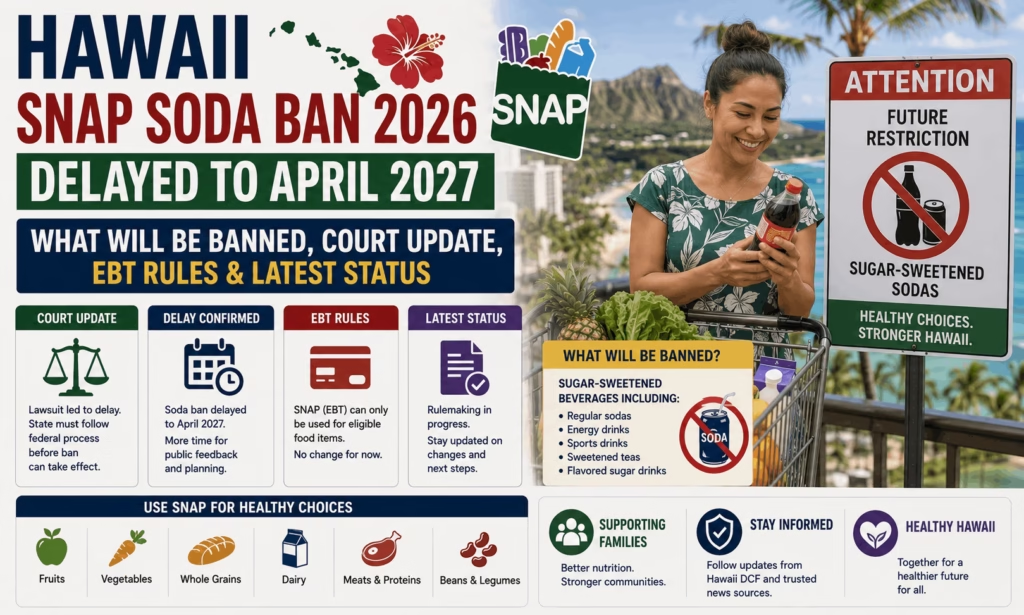
Hawaii SNAP Soda Ban Delayed to 2027: Hawaii’s plan to stop SNAP benefits from paying for soft drinks was supposed to start on August 1, 2026. It did not. USDA approved Hawaii’s request to push the start to April 1, 2027, and that is still the date on USDA’s tracker as of its October 30, 2026 update. Until then, SNAP households in Hawaii can use their EBT cards the way they always have.
This guide on Hawaii SNAP Soda Ban explains what exactly will be banned, why the date moved, where the plan stands legally, and what Hawaii SNAP households should know about their payments right now.
Quick Facts: Hawaii SNAP Soft Drink Restriction
| Item | Current status |
| Restriction in effect today? | No. Nothing is restricted yet |
| Target start date | April 1, 2027 (moved from August 1, 2026) |
| What will be restricted | “Soft drinks” only (defined below). No candy or snack restriction |
| Approval period after delay | April 1, 2027 to March 31, 2029 |
| Who is covered | All SNAP households in Hawaii; no opt-out |
| Original USDA approval | December 10, 2025 |
| Delay approved by USDA | June 15, 2026 |
| Covered by the June 22, 2026 court ruling? | No. That ruling covered five other states |
| November 2026 deposit days | 3rd (last names A to I) or 5th (J to Z) |
Why the Hawaii SNAP Ban Was Delayed?
Hawaii DHS first asked USDA for the waiver on October 10, 2025, and USDA approved it on December 10, 2025, effective August 1, 2026. On May 27, 2026, DHS asked to move the date to April 1, 2027. USDA approved that change on June 15, 2026.
USDA’s approval letter gives the reasons in plain terms. The extra time lets the state engage and prepare retailers. It also lets DHS balance its staffing amid other key priorities, including an ongoing disaster response after severe storms in March and April 2026, and the upcoming replacement of its SNAP eligibility system. The letter also states that all other terms and conditions of the December 2025 approval remain in effect, which means the restriction itself was not changed, only its timing.
The Honolulu Star-Advertiser’s Kokua Line column reported the same reasons on June 25, 2026, and noted that critics had questioned how consistently the waiver defines a soft drink.
What Will Be Banned? (The Official Definition)
The exact wording comes from USDA’s December 10, 2025 approval letter. Hawaii’s waiver excludes “soft drinks,” defined as any nonalcoholic beverage that is made with carbonated water and is sweetened with more than 10 grams of sugar per serving.
The same document says soft drinks do not include a beverage that:
- contains milk or milk products,
- contains soy, rice or other milk substitutes, or
- is more than 50 percent vegetable or fruit juice by volume.
A few practical points follow from the official text:
- Only beverages are targeted. Unlike several other states, Hawaii’s waiver does not restrict candy, energy drinks as a separate category, or prepared desserts. USDA’s tracker summarizes it simply as restricting purchase of soft drinks.
- Existing federal rules stay the same. The state did not seek to change items already excluded from SNAP, such as alcohol, tobacco and hot ready-to-eat foods. It also made no change to the programs that let certain groups buy prepared meals at places like senior centers, domestic violence centers, substance-misuse centers and homeless shelters.
- No product list was found. The definition is based on product attributes (carbonation and sugar per serving) rather than a named list of brands. In an interview published by a natural-foods trade outlet, a Hawaii grocer described this as a challenge, saying its team was asking the state for clarity on a product list so retailers can apply the rule consistently. In the sources reviewed for this article, no official DHS product list was found. Check DHS before relying on any brand-by-brand list you see online.
Because the official definition is built on carbonated water plus more than 10 grams of sugar, whether a particular drink counts depends on its label. This article does not claim that any specific product is or is not covered, because DHS has not published such a list in the sources reviewed.
Archdiocese of New York Settlement: $800 Million Deal for About 1,300 Clergy Abuse Survivors
Timeline: How Hawaii’s Waiver Reached 2027?
| Date | Event |
| October 10, 2025 | Hawaii DHS formally requests the waiver |
| December 10, 2025 | USDA approves; two-year project effective August 1, 2026 |
| March and April 2026 | Severe storms trigger disaster response in Hawaii |
| May 27, 2026 | DHS asks to move the start date to April 1, 2027 |
| June 15, 2026 | USDA approves the new date; approval runs April 1, 2027 to March 31, 2029 |
| June 22, 2026 | Federal court vacates waivers in five other states (not Hawaii) |
| August 1, 2026 | Original start date passes with no restriction |
| September 15, 2026 | USDA publishes a Federal Register notice inviting public comment on Hawaii’s project |
| October 15, 2026 | Comment period closes |
| October 30, 2026 | USDA tracker still lists Hawaii at April 1, 2027 |
| April 1, 2027 | Scheduled start |
Is Hawaii Affected by the Court Ruling on SNAP Food Bans?
No, not directly. On June 22, 2026, the U.S. District Court for the District of Columbia, in Aragon et al. v. Rollins et al., vacated USDA’s approvals for Colorado, Iowa, Nebraska, Tennessee and West Virginia. The plaintiffs were SNAP recipients in those five states. The court found that USDA exceeded its statutory authority and did not follow required notice procedures.
Hawaii’s approval was not part of that case. A law-firm analysis of the decision stated that waivers in other states are not directly affected but may face similar statutory and procedural challenges. USDA appealed the ruling on August 20, 2026, in the D.C. Circuit, and a notice of appeal does not by itself reinstate the vacated waivers.
Two things are worth watching for Hawaii:
- The notice-and-comment step. USDA’s Federal Register notice on Hawaii’s project was published September 15, 2026, and comments were accepted through October 15, 2026. The notice says USDA will take appropriate action as necessary in response to comments. USDA published similar notices for many other states during the same period, according to the links on its tracker. No official outcome for Hawaii’s notice had been posted on the pages reviewed as of October 30, 2026.
- The appeal and any new lawsuits. The appeal outcome could influence how other states’ waivers are treated, but no official source reviewed says Hawaii’s date or terms have changed.
A common mix-up: some summaries describe the ruling as covering “five states, including Hawaii.” The ruling’s named states do not include Hawaii.
What the Delay Means for Your EBT Card Today?
Before April 1, 2027, Hawaii SNAP households can buy any federally SNAP-eligible food or drink, including soft drinks. The usual federal exclusions still apply: alcohol, tobacco, vitamins and supplements, hot ready-to-eat foods, and non-food items.
When the restriction starts, it is expected to apply statewide at SNAP-authorized retailers, including online. USDA’s terms say retailers are responsible for compliance with third-party e-commerce platforms. USDA’s letter also says out-of-state transactions will not be used as a primary indicator of fraud or negatively affect a household’s eligibility.
Why this matters for families: Hawaii Appleseed, an advocacy group, warned when the waiver was approved that retailers would need to reprogram registers and online systems and retrain staff, and that some might leave the SNAP program. Supporters, including USDA, argue that removing soda from SNAP supports nutrition goals. This is a contested policy, and the sources above reflect both views.
Hawaii SNAP Payment Schedule: November 2026
Hawaii DHS’s official EBT page says benefits are available based on the first letter of the client’s last name: A to I on the 3rd calendar day of the month, and J to Z on the 5th calendar day. Some third-party sites list a case-number system for Hawaii; the DHS page uses last names, so this article follows DHS.
| Last name begins with | November 2026 deposit day |
| A to I | Tuesday, November 3 |
| J to Z | Thursday, November 5 |
New FY2027 Benefit Amounts: Hawaii’s Maximums Went Down
USDA’s FY2027 cost-of-living memo, dated August 21, 2026, took effect October 1, 2026. Most of the country saw maximum benefits rise. Hawaii is the exception: its maximum allotments fell. The memo states that the maximum allotment for a family of four in Hawaii will decrease to $1,655.
| Household size | FY2026 maximum | FY2027 maximum (from Oct. 1, 2026) |
| 1 person | $506 | $496 |
| 2 people | $929 | $910 |
| 3 people | $1,334 | $1,307 |
| 4 people | $1,689 | $1,655 |
| 5 people | $2,010 | $1,969 |
| 6 people | $2,415 | $2,367 |
| 7 people | $2,668 | $2,615 |
| 8 people | $3,040 | $2,979 |
Other FY2027 figures for Hawaii: the minimum benefit for one- and two-person households is $40 per month, and the asset limit in the USDA memo is $3,000 for most households and $4,750 for households with a member age 60 or older or disabled. These amounts are ceilings. A household’s actual benefit generally equals the maximum for its size minus 30 percent of its net monthly income.
Storm-Related Replacement Benefits
Payments in Hawaii were also affected by storms this year. After Tropical Cyclone Lala in August 2026, DHS issued an automated mass replacement of 45 percent of August benefits in federally approved areas (Hawaii Island, Oahu and West Maui, per local reporting). After Hurricane Lowell, USDA approved a 60 percent automated replacement for affected Kauai households, issued September 17.
DHS extended the written-statement deadlines for additional replacement requests to September 23 (Lala) and September 28 (Lowell). Those deadlines have passed. USDA’s Hawaii disaster page lists more recent approvals, so households affected by later storms should check that page and DHS for current deadlines.
What to Watch Before April 1, 2027?
- Retailer guidance: Look for DHS notices to stores and households, including any product guidance.
- USDA’s response to the Federal Register comments on Hawaii’s project.
- The D.C. Circuit appeal in the five-state case.
- Another date change: target dates have moved before, and a state or USDA could move them again.
- System changes: DHS has said it is replacing its SNAP eligibility system, which could affect timing.
Official Sources and Links
| Source | What It Covers | Official Link |
| USDA FNA – Hawaii SNAP Food Restriction Waiver | Approval letter and June 15, 2026 date change | Open Official USDA Page |
| USDA FNA – SNAP Food Restriction Waivers Tracker | All states and Hawaii implementation date | Open USDA Waiver Tracker |
| USDA Approval Letter – December 10, 2025 | Soft drink definition, terms and conditions | Download Official PDF |
| USDA Modification Approval – June 15, 2026 | April 1, 2027 implementation date and reasons | Download Official PDF |
| USDA FNA – Hawaii Request for Comments | Public comment notice, September 15, 2026 | Open Official Notice |
| Federal Register – September 15, 2026 | Official Hawaii SNAP demonstration project notice | Read Federal Register Notice |
| USDA FNA – FY2027 SNAP COLA | Hawaii maximum and minimum SNAP benefits | Open COLA Information |
| USDA FY2027 COLA Memo – August 21, 2026 | Hawaii benefit changes and asset limits | Download Official PDF |
| Hawaii DHS – SNAP Program | State SNAP program information | Open Hawaii DHS SNAP Page |
| Hawaii DHS – EBT Program | EBT card and benefit payment information | Open Hawaii EBT Page |
| Hawaii DHS – September 16, 2026 Release | Storm replacement deadlines and Kauai mass replacement approval | Read DHS Announcement |
| USDA FNA – Hawaii Disaster Nutrition Assistance | Disaster SNAP approvals and updates | Open USDA Disaster Assistance |
Hawaii SNAP Soda Ban Delayed – Frequently Asked Questions
Is the Hawaii SNAP soda ban in effect now?
No. The start was moved from August 1, 2026 to April 1, 2027, and nothing is restricted today.
Why was the Hawaii SNAP soft drink restriction delayed?
USDA’s approval letter cites more time for retailer preparation and a need for DHS to balance staffing amid storm response and a coming eligibility-system replacement.
What exactly will be banned?
Soft drinks, defined as nonalcoholic beverages made with carbonated water and sweetened with more than 10 grams of sugar per serving. Drinks with milk, milk substitutes, or more than 50 percent fruit or vegetable juice are excluded from the definition.
Will candy or chips be banned in Hawaii?
Not under this waiver. It covers soft drinks only.
Did the June 2026 court ruling block Hawaii’s waiver?
No. The ruling vacated waivers in Colorado, Iowa, Nebraska, Tennessee and West Virginia. Hawaii was not part of that case.
Could the April 1, 2027 date change again?
Possibly. Target dates on USDA’s tracker have moved before, and legal and administrative developments could affect them. As of October 30, 2026, USDA lists April 1, 2027.
Can I still buy soda with SNAP in Hawaii today?
Yes, if it is a federally SNAP-eligible item. Always check your state’s current rules before the restriction starts.
When do Hawaii SNAP benefits arrive in November 2026?
Per DHS, on the 3rd for last names A to I and the 5th for J to Z.
Did Hawaii’s SNAP benefit amounts change?
Yes. FY2027 maximums took effect October 1, 2026 and are lower in Hawaii. A family of four’s maximum is $1,655, down from $1,689.
Where can I comment on or follow the waiver?
USDA’s Federal Register notice comment period closed October 15, 2026. Follow the USDA tracker and DHS SNAP page for updates.
Also Read :-
Average Social Security Check in January 2027: $2,170 (Retired Worker)
$2200 One-Time Direct Payment 2026: Fact Check, Eligibility and How to Check Real Payments
2027 VA Disability COLA Increase: How Much Could Benefits Rise Under the Latest Projection