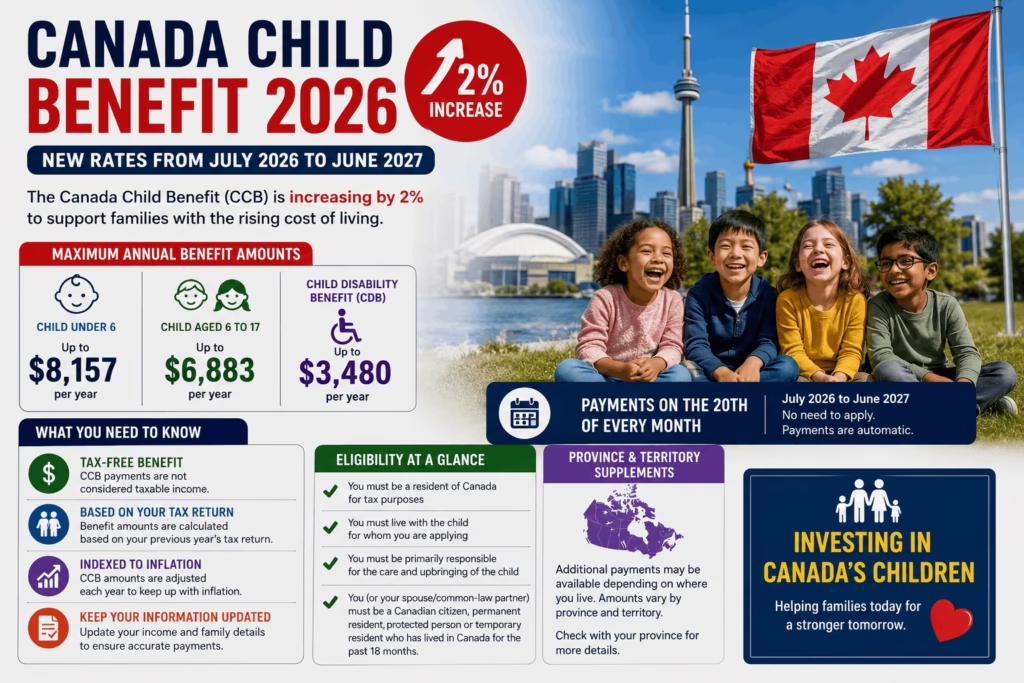
Canada Child Benefit 2026 Increased by 2%: Millions of Canadian families are seeing bigger deposits land in their bank accounts this month, as the Canada Child Benefit 2026 officially increased starting with the July 20, 2026 payment. The Canada Revenue Agency (CRA) confirmed a 2% indexation increase for the 2026-27 benefit year — smaller than the 2.7% bump families saw in July 2025, reflecting cooling inflation, but still a meaningful boost. The new maximum annual Canada Child Benefit now stands at $8,157 per child under age 6 (up $160 from $7,997) and $6,883 per child aged 6 to 17 (up $135 from $6,748), working out to roughly $679.75 and $573.58 per month respectively for families receiving the full maximum benefit.
What most coverage misses is that your total deposit depends heavily on which province or territory you live in — the federal CCB is identical nationwide, but 11 of 13 provinces and territories layer their own additional child benefit directly into the same monthly payment, and the gap between the most and least generous province exceeds $6,100 per year for an identical two-child family. This guide breaks down the complete Canada Child Benefit 2026 increase, the exact income thresholds and reduction rates, the July 2026 payment calendar, and a full province-by-province breakdown of every provincial and territorial top-up so you know precisely what to expect in your account. We’ll be updating this article monthly as new CRA and provincial benefit data is released.
Canada Child Benefit 2026 Key Highlights
| Detail | Information |
|---|---|
| Benefit Year | July 2026 – June 2027 |
| Indexation Increase | 2% |
| Maximum Annual Amount (Under 6) | $8,157 ($679.75/month) |
| Maximum Annual Amount (Age 6–17) | $6,883 ($573.58/month) |
| Based On | 2025 adjusted family net income (AFNI) |
| First Income Threshold | $38,237 |
| Second Income Threshold | $82,847 |
| Child Disability Benefit (CDB) Max | $3,480/year (up from $3,411) |
| First Increased Payment Date | July 20, 2026 |
| Administered By | Canada Revenue Agency (CRA) |
| Widest Provincial Top-Up Gap | $6,100+/year (Quebec vs. Saskatchewan/Manitoba, 2-child family) |
| Official Portal | canada.ca/en/revenue-agency |
| CRA My Account Login | canada.ca/my-cra-account |
| CCB Helpline | 1-800-387-1193 |
Why the Canada Child Benefit Increased in 2026
The CRA has indexed most federal benefits and credits to inflation annually since 2018, using changes in the Consumer Price Index (CPI) to adjust payment amounts at the start of each new benefit year. For the CCB specifically, this adjustment always takes effect on July 1, coinciding with the start of a new 12-month benefit period running through the following June. For the 2026-27 benefit year, the CRA confirmed a 2% increase — a smaller adjustment than the 2.7% seen in July 2025, reflecting a cooling of inflation over the past year, but still a real, guaranteed rise in purchasing power for families raising children.
How Much More Will Your Family Receive?
| Family Situation | 2025-26 Annual Amount | 2026-27 Annual Amount | Increase |
|---|---|---|---|
| One child under 6 (max benefit) | $7,997 | $8,157 | +$160 |
| One child aged 6–17 (max benefit) | $6,748 | $6,883 | +$135 |
| Two children under 6 (max benefit) | $15,994 | $16,314 | +$320 |
| One child under 6 + one aged 6–17 | $14,745 | $15,040 | +$295 |
Real-world example (New Brunswick, per CRA’s own July 2026 release): A family with one child aged 5 and one child aged 9, with an adjusted net family income of $65,000, will receive approximately $11,430 for the 2026-27 benefit year — nearly $400 more than they received in 2025-26.
CCB Income Thresholds and Reduction Rates
Your CCB amount depends entirely on your 2025 adjusted family net income (AFNI), since payments are recalculated every July using the prior year’s tax return.
- AFNI under $38,237: You receive the full maximum amount for each child — no reduction applies.
- AFNI between $38,237 and $82,847 (Phase 1): Your benefit is reduced by a percentage of income over $38,237, with the exact rate depending on your number of children.
- AFNI above $82,847 (Phase 2): A further, steeper reduction applies to income above this second threshold.
Worked example: A family earning $50,000 with one child under six receives approximately $7,333.59 annually ($611.13/month) after the Phase 1 reduction is applied — still a substantial benefit well below the maximum-entitlement threshold.
Canada Child Benefit Payment Full Schedule 2026-27
| # | Month | Payment Date | Day of Week | Benefit Year Status |
|---|---|---|---|---|
| 1 | July 2026 | July 20 | Monday | ✅ First increased payment (new 2026-27 rates begin) |
| 2 | August 2026 | August 20 | Thursday | Regular monthly payment |
| 3 | September 2026 | September 18 | Friday | Regular monthly payment |
| 4 | October 2026 | October 20 | Tuesday | Regular monthly payment |
| 5 | November 2026 | November 20 | Friday | Regular monthly payment |
| 6 | December 2026 | December 11 | Friday | Adjusted for holiday season |
| 7 | January 2027 | ~January 20* | — | Start of next calendar year (same 2026-27 benefit rates) |
| 8 | February 2027 | ~February 20* | — | Same 2026-27 benefit rates |
| 9 | March 2027 | ~March 20* | — | Same 2026-27 benefit rates |
| 10 | April 2027 | ~April 20* | — | Same 2026-27 benefit rates |
| 11 | May 2027 | ~May 20* | — | Same 2026-27 benefit rates |
| 12 | June 2027 | ~June 20* | — | Final payment of 2026-27 benefit year |
*Dates for January–June 2027 are projected based on the CRA’s standard “20th of the month” pattern and will shift to the nearest business day if the 20th falls on a weekend or federal holiday; confirm exact dates closer to each month via CRA My Account.
Payment Method & Amount Summary
| Detail | Information |
|---|---|
| Payment Method | Direct deposit (preferred) or mailed cheque |
| Direct Deposit Timing | Funds typically available same day as payment date |
| Cheque Delivery Timing | Allow 5–10 additional business days |
| Combined With | Provincial/territorial top-up (where applicable) + Child Disability Benefit (if eligible) |
| Lump-Sum Threshold | If total annual entitlement is under $240, paid as one lump sum in July instead of monthly |
| Missed Payment Wait Time | Wait 5 business days after scheduled date before contacting CRA |
| CRA Contact for Missing Payment | 1-800-387-1193 |
| Home Page | https://govtschemes.org/ |
Important quirk: If your total CCB entitlement for the entire 2026-27 benefit year is less than $240, the CRA will not issue small monthly payments — instead, they deposit the entire annual amount as a single lump sum in July.
Child Disability Benefit (CDB): Also Increased
Families caring for a child under 18 with a “severe and prolonged impairment in physical or mental functions” who qualifies for the Disability Tax Credit (DTC) receive the Child Disability Benefit on top of their standard CCB. For 2026-27, the CDB maximum rose to $3,480 per year (up $69 from $3,411), or roughly $290 extra per month, combined automatically with your regular CCB deposit. Like the main CCB, the CDB is tax-free, indexed annually to inflation, and subject to the same income-based reduction once family income exceeds $82,847.
Court Ruling Alert: Tax Court Exposes a 25-Year Eligibility Gap in the CCB
A significant Tax Court of Canada ruling — Mohamed v. Canada, 2026 TCC 72, decided in May 2026 and reported by CBC News in June — has exposed a long-standing gap in Canada Child Benefit eligibility rules that every separated or divorced parent with uncertain immigration status needs to know about.
What happened: Abdiweli Mohamed, a Somali-born father raising two Canadian citizen children under age five in Winnipeg, previously received CCB payments of $1,236.50/month because his then-wife was a Canadian citizen. After the couple separated, Mohamed became the children’s full-time, sole caregiver — but lost his CCB eligibility entirely, because the benefit’s rules depend on the parent’s own formal immigration status, not on the children’s citizenship or the parent’s actual caregiving role.
The legal problem: Mohamed cannot be deported — the government has acknowledged returning him to Somalia would endanger his life — but he also does not hold any of the specific statuses the Income Tax Act requires for CCB eligibility: he is not a Canadian citizen, permanent resident, temporary resident, or a formally recognized “protected person.” He exists in a recognized immigration “limbo” category that Parliament’s CCB framework simply never anticipated.
The court’s finding: The Tax Court “reluctantly” ruled against Mohamed, with the presiding judge explicitly acknowledging the outcome was unfair and describing the situation as a crack in the legal system that has gone unaddressed for roughly 25 years. The court held that, however sympathetic the facts, it lacked the authority to extend CCB eligibility beyond the categories Parliament expressly defined — sympathy for the taxpayer cannot override strict statutory language under the Income Tax Act.
Why this matters for other families: This ruling doesn’t change anyone’s current CCB entitlement, but it confirms — through a binding tax court precedent — that parents who separate from a Canadian citizen spouse and don’t independently hold qualifying immigration status can lose CCB eligibility entirely, even while raising Canadian citizen children full-time and even when the government itself has confirmed they cannot be removed from the country. Family law and immigration lawyers are now flagging this as a critical planning consideration for separating couples where one parent’s status was previously tied to the marriage. The ruling also referenced the Supreme Court’s earlier Quebec v. Kanyinda decision on refugee claimants and daycare subsidies, which some advocates argue could open the door to a future Charter-based challenge specifically targeting this CCB eligibility gap — though no such case had been filed as of this update.
What affected parents should do: If your CCB eligibility is tied to a spouse’s citizenship or status and you’re separating or divorcing, consult an immigration lawyer before your marital status changes with the CRA — your own independent immigration status will determine whether your CCB payments continue.
Province-by-Province Canada Child Benefit Top-Ups (2026)
This is the section most CCB coverage leaves out entirely. The federal CCB amount is identical everywhere in Canada — but 11 of 13 provinces and territories pay an additional top-up, calculated and deposited automatically alongside your federal payment as a single combined deposit (with a few exceptions noted below). Here is the complete breakdown for a family with two children at full entitlement:
| Province/Territory | Provincial/Territorial Top-Up (2 Children) | Payment Frequency | Notes |
|---|---|---|---|
| Quebec | ~$511.33/month | Quarterly (July, Oct, Jan, April) | Family Allowance via Retraite Québec, separate from CRA; minimum $1,221/child/year never phases out; single-parent families get up to $1,077/year more, plus $127/child school-supplies supplement |
| Newfoundland & Labrador | ~$321/month | Combined with CCB | Additional $150/month early childhood nutrition supplement for eligible young children |
| Ontario | ~$288/month (up to $146.66/month per child) | Combined with CCB | Ontario Child Benefit, fully funded by the province |
| Nova Scotia | Up to $127.08/month per child (1st child); $63.54/month for 2nd+ child if AFNI $26,000–$34,000 | Combined with CCB | Fully funded by Nova Scotia |
| British Columbia | Up to $145.83/month for first child (rate varies by child) | Combined with CCB | Additional $500/year supplement for low-income single-parent families |
| Alberta | $2,311 (1 child) to $5,882 (4+ children) annually | Quarterly (Aug, Nov, Feb, May) — separate from CCB deposit | Alberta Child and Family Benefit (ACFB); base + working component; thresholds at $28,116 and $47,115 |
| New Brunswick | Provincial top-up combined with CCB | Combined with CCB | Fully funded by New Brunswick |
| Prince Edward Island | Provincial top-up combined with CCB | Combined with CCB | Fully funded by PEI |
| Yukon | $78.08/month per child ($156.16 for 2 children) | Combined with CCB | Reduces above $35,000 AFNI |
| Northwest Territories | Provincial top-up combined with CCB | Combined with CCB | Fully funded by the Northwest Territories |
| Nunavut | $29/month per child | Combined with CCB | Reduces above $22,065 AFNI |
| Saskatchewan | $0 | — | No standalone provincial child benefit program |
| Manitoba | $0 | — | No standalone provincial child benefit program |
Key takeaway: For an identical two-child family at full entitlement, the provincial layer alone creates a gap of roughly $6,100 per year between Quebec (the most generous) and Saskatchewan or Manitoba (which offer no top-up at all). Quebec’s advantage is especially durable because its $1,221-per-child minimum never phases out, regardless of how high family income climbs — unlike every other provincial program listed above.
Special Notes by Province
- Alberta’s ACFB pays quarterly, not monthly — don’t be alarmed if your provincial top-up doesn’t arrive alongside every single CCB deposit; it lands separately in August, November, February, and May.
- Quebec’s Family Allowance is administered entirely separately by Retraite Québec, not the CRA — Quebec residents should check Retraite Québec’s own portal, not CRA My Account, for provincial payment details.
- Manitoba and Saskatchewan residents rely entirely on the federal CCB amount — there is currently no supplementary provincial program to layer on top.
- If a CCB-eligible child passes away on or after January 1, 2026, the recipient may continue receiving CCB — and the related provincial programs in Alberta, British Columbia, New Brunswick, Nova Scotia, Nunavut, Ontario, PEI, and Yukon — for 6 additional months, or until the date the child would have turned 18.
Why Your July Deposit May Look Different Than Expected
Several federal and provincial benefits reset on nearly the same July 2026 schedule, which can make your combined deposit confusing if you’re not expecting it:
- The CCB and any provincial top-up (like the Ontario Child Benefit) reset together every July based on your 2025 tax return.
- The GST/HST credit — now transitioning toward the Canada Groceries and Essentials Benefit — also moved to the 2025 tax-return cycle starting with the July 3, 2026 payment, a different date than the CCB’s July 20 reset.
- If your CCB, provincial top-up, and GST/HST credit all changed in the same general period, this clustering is expected — each program independently resets to your latest income data around the same time of year.
Eligibility Requirements for the Canada Child Benefit
To qualify for the CCB, you must meet all of the following:
- Live with a child under 18 and be primarily responsible for their care and upbringing.
- Be a Canadian citizen, permanent resident, protected person, or a temporary resident who has lived in Canada for the previous 18 months.
- You (and your spouse or common-law partner, if applicable) must have filed a Canadian tax return for the previous year — even if you had no income.
How to Apply for the Canada Child Benefit 2026?
- Automated birth registration — the fastest method; most provincial vital statistics offices offer this, automatically forwarding your information to the CRA when you register your newborn’s birth.
- Online through CRA My Account — navigate to the “Benefits and Credits” section and submit your application digitally with any required supporting documents.
- By mail using Form RC66 — complete the Canada Child Benefits Application and mail it to your local CRA tax centre along with proof of the child’s birth and your residency status.
Official Resources
| CRA Official Website | canada.ca/en/revenue-agency |
| CRA My Account (Login/Registration) | canada.ca/my-cra-account |
| Check CCB Payment Amounts by Province | canada.ca (search “How much you can get – Canada Child Benefit”) |
| CCB General Enquiries | 1-800-387-1193 |
| Yukon, NWT, and Nunavut Enquiries | 1-866-426-1527 |
| Quebec Family Allowance (Retraite Québec) | retraitequebec.gouv.qc.ca |
FAQs
How much is the Canada Child Benefit in 2026?
Up to $8,157 per year ($679.75/month) for each child under 6, and up to $6,883 per year ($573.58/month) for each child aged 6 to 17, before any provincial top-up is added.
When does the increased CCB payment start?
The increased amount took effect with the July 20, 2026 payment, marking the start of the new 2026-27 benefit year.
Is the Canada Child Benefit taxable?
No. The CCB is completely tax-free — it does not appear as income on your tax return and is never clawed back the way Old Age Security can be.
Which province has the highest child benefit top-up?
Quebec, with a Family Allowance top-up that reaches approximately $511.33/month for a two-child family, well ahead of second-place Newfoundland and Labrador.
Which provinces have no additional child benefit top-up?
Saskatchewan and Manitoba currently offer no standalone provincial child benefit program, so families there receive only the federal CCB amount.
How is my CCB amount calculated?
Based on your adjusted family net income (AFNI) from the previous tax year (2025 for the current benefit year) and the number and ages of your children, with reductions applying above $38,237 and further above $82,847.
Do I need to reapply for the CCB every year?
No — as long as you continue filing your tax return on time every year (even with no income), your CCB is automatically recalculated each July without a new application.
People Also Ask
Does only one parent receive the CCB, or do both parents get it?
Only one parent receives the CCB per household — typically the parent who is “primarily responsible” for the child’s day-to-day care, usually the mother in a two-parent household unless the couple indicates otherwise. In shared custody, both parents can each receive 50% of what they’d get if they had full custody.
What happens to the Canada Child Benefit when my child turns 18?
CCB payments stop the month after your child’s 18th birthday. There’s no partial-month payment beyond that point, so plan your finances accordingly around your child’s birth month.
Can newcomers, permanent residents, or temporary residents get the Canada Child Benefit?
Yes — permanent residents, protected persons, and temporary residents who have lived in Canada for the previous 18 months are all eligible, provided they meet the other CCB requirements, including filing a Canadian tax return. Undocumented individuals without one of these formal statuses generally do not qualify, as confirmed by the Mohamed v. Canada ruling discussed above.
Is the Canada Child Benefit the same as the GST/HST credit?
No — they’re separate programs with different eligibility rules, payment amounts, and (as of 2026) different reset dates. The CCB resets July 20 based on 2025 income; the GST/HST credit reset July 3, 2026, also based on 2025 income, but the two are calculated and administered independently even though both come from the CRA.
Why did my CCB payment suddenly stop or decrease?
The most common reasons are: your child turned 18, your marital status changed and wasn’t reported, your family income rose significantly on your latest tax return, you or your spouse didn’t file taxes on time, or your immigration/residency status changed. Log into CRA My Account to see the specific reason listed for your case.
Can I get retroactive CCB payments if I apply late?
Yes — the CRA can generally issue retroactive CCB payments for up to 11 months before the month you apply, provided you meet all eligibility requirements for those months and have filed the relevant tax returns.
Does shared custody affect how much CCB I receive?
Yes. In a shared custody arrangement (roughly equal time with each parent), the CRA splits the CCB equally, with each parent receiving 50% of the amount they would get if they had full custody — each parent must apply separately to receive their share.