Millions of Canadian retirees, people living with disabilities, and surviving spouses are watching their bank accounts this week as the CPP payment September 2026 arrives on Friday, September 25, 2026. This deposit closes out the July to September quarter and lands at the same rate that has applied since the 2.0 percent annual increase took effect back in January. For anyone who depends on the Canada Pension Plan to cover rent, groceries, or medication, knowing the exact date and amount is not a small detail. It is the difference between a smooth month and a scramble.
Service Canada issues CPP, Old Age Security, and the Guaranteed Income Supplement on the same day every month, and September is no exception. The CPP deposit date September 2026 falls on the 25th, a Friday, which means direct deposit recipients should see the funds in their account first thing that morning, while cheque recipients may need a few extra business days depending on Canada Post delivery in their area. Below is everything currently confirmed about this payment, the remaining 2026 schedule, who qualifies, how much people are actually receiving, and how to apply if you have not started your pension yet. We’ll be updating this article monthly as Service Canada releases new figures and confirms upcoming payment dates.
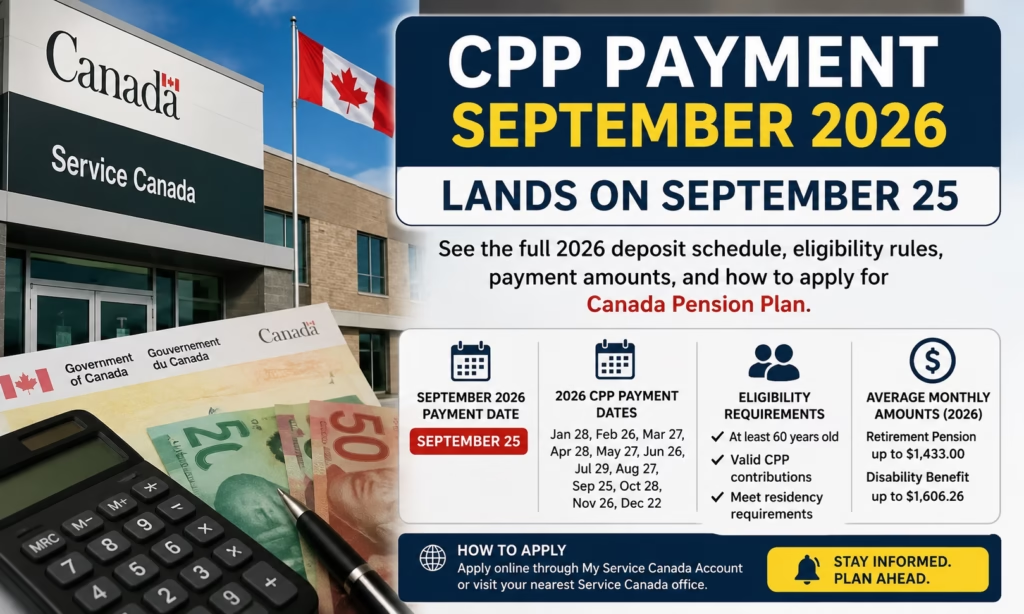
CPP Payment September 2026
| Detail | Information |
|---|---|
| Payment date | Friday, September 25, 2026 |
| Program | Canada Pension Plan (CPP), issued alongside OAS and GIS |
| 2026 annual increase | 2.0 percent, applied starting January 2026 |
| Maximum retirement pension at 65 | $1,507.65 per month |
| Average new retirement pension (age 65) | $925.35 per month |
| Payment method | Direct deposit or cheque |
| Administered by | Service Canada |
| Next payment after September | October 28, 2026 |
CPP Payment Dates 2026: Full Schedule
The CPP payment schedule 2026 is built around the third-to-last business day of each month, adjusted for weekends and statutory holidays. Once you know one date, the rest of the year becomes predictable, which is exactly why so many retirees keep a printed copy taped to the fridge. Here is the complete list of confirmed 2026 deposit dates.
| Month | 2026 Payment Date |
|---|---|
| January | Wednesday, January 28 |
| February | Wednesday, February 25 |
| March | Friday, March 27 |
| April | Tuesday, April 28 |
| May | Wednesday, May 27 |
| June | Friday, June 26 |
| July | Wednesday, July 29 |
| August | Thursday, August 27 |
| September | Friday, September 25 |
| October | Wednesday, October 28 |
| November | Thursday, November 26 |
| December | Tuesday, December 22 |
Notice that December arrives earlier than usual, on December 22 instead of the last week of the month. Service Canada moves the December deposit forward every year so that seniors and beneficiaries have their funds in hand before the holiday season, rather than waiting until after Christmas.
It is worth repeating that this same calendar covers every type of CPP benefit, not just the standard retirement pension. The CPP disability benefit, CPP survivor’s pension, CPP children’s benefit, CPP death benefit, and CPP post-retirement benefit are all deposited on these identical dates. If you happen to receive more than one of these benefits at once, for example a retirement pension combined with a survivor’s pension, they arrive together as a single deposit, which is why the number on your bank statement might not match any single rate you have seen quoted online.
TPS Somalia Termination: Work Permits No Longer Valid After August 14 Deadline
Meta Safety Changes on Instagram and Facebook: What Teens and Parents Need to Know Right Now
How Much Is the CPP Payment in September 2026
This is where a lot of confusion shows up online, including headlines that reference a flat number like $1,508 as though every recipient gets that exact amount. In reality, CPP is not a fixed universal payment the way some people assume. The amount you personally receive depends entirely on how much you contributed during your working years, how many years you contributed, and the age at which you decided to start collecting.
The maximum CPP payment 2026 for someone starting their retirement pension at age 65 is $1,507.65 per month, a figure set after the 2.0 percent indexation adjustment that took effect with the January 2026 payment. That maximum is reserved for people who contributed at or above the year’s maximum pensionable earnings for at least 39 years, which is a relatively small share of recipients. The average CPP payment 2026 for someone newly starting their pension at 65, as of January 2026, sits at $925.35 per month, a far more realistic figure for the typical retiree.
| CPP Benefit Type | Average Monthly Amount (New Beneficiaries) | Maximum Monthly Amount (2026) |
|---|---|---|
| Retirement pension, age 65 | $925.35 | $1,507.65 |
| Post-retirement benefit, age 65 | $11.93 | $54.69 |
| Disability benefit | $1,210.86 | $1,741.20 |
| Post-retirement disability benefit | $610.46 | $610.46 |
| Survivor’s pension, under 65 | $545.71 | $803.54 |
| Survivor’s pension, 65 and older | $334.24 | $904.59 |
| Children’s benefit (disabled or deceased contributor) | $307.81 | $307.81 |
| Death benefit (one-time payment) | $2,572.00 | $2,500.00 |
| Combined survivor and retirement pension, age 65 | $1,140.69 | $1,531.56 |
| Combined survivor’s pension and disability benefit | $1,324.04 | $1,756.14 |
A few things stand out in that table. First, the disability benefit is built from two parts, a flat basic monthly amount of $610.46 in 2026, plus an additional amount tied to your own contribution history. Second, if you delay starting your retirement pension past 65, your monthly amount keeps climbing, since CPP increases by 0.7 percent for every month you wait, up to age 70. Someone who waits the full five years receives up to 42 percent more than they would have gotten at 65. On the other end, starting as early as 60 permanently reduces your monthly amount, by roughly 0.6 percent for every month before your 65th birthday.
Why CPP Went Up in 2026
CPP amounts are adjusted once a year, every January, based on changes to the Consumer Price Index over the prior twelve months. For 2026, that indexation worked out to a 2.0 percent increase, which is why anyone already receiving CPP saw a slightly larger deposit starting with the January 28 payment, and that same higher rate has carried through every payment since, including this September’s deposit. Unlike Old Age Security, which is reviewed and adjusted every three months, CPP only moves once a year, so the amount on your September statement will be identical to what you received in January, assuming nothing else about your personal situation changed.
If your deposit did shift at some point during the year despite CPP only adjusting in January, the cause is almost always something other than indexation. Common reasons include a change in tax withheld at source, the start of a new combined benefit such as a survivor’s pension being added to an existing retirement pension, or a correction following a reassessment.
Who Is Eligible for CPP in 2026
CPP eligibility 2026 rules have not changed from prior years, and the requirements remain straightforward on paper, even if the calculations behind your specific amount are complex.
To qualify for the CPP retirement pension, you generally need to meet these conditions.
- You must be at least 60 years old.
- You must have made at least one valid contribution to the Canada Pension Plan during your working years, whether through employment or self-employment income.
- Contributions are based on your earnings between the Year’s Basic Exemption and the Year’s Maximum Pensionable Earnings, which for 2026 sits around $74,600, with a second, higher earnings ceiling of $85,000 for additional enhanced contributions.
There is no minimum number of years you must have contributed to qualify for some payment, though your total contribution history directly determines how much you receive. People with a short or interrupted work history, including time spent raising children or dealing with a disability, may be eligible for provisions that exclude certain low-earning periods from the calculation, which can raise their final monthly amount.
For CPP disability benefits specifically, eligibility is stricter. Applicants must have contributed to CPP in four of the last six years, or three of the last six years if they have contributed for at least 25 years total, and must have a severe and prolonged disability that prevents them from regularly working at any job.
Survivor’s pensions go to the legal spouse or common law partner of a deceased contributor, provided the deceased made sufficient CPP contributions during their lifetime. The amount a survivor receives depends on their own age, whether they are also disabled, and whether they are already collecting their own CPP retirement pension.
How to Apply for CPP
If you have not started your pension yet and want to be ready for a future payment cycle, applying early matters, since CPP is not automatic the way OAS eventually becomes for some seniors. Here is the general process.
- Decide when you want your pension to start. You can apply up to 12 months before the date you want payments to begin.
- Gather your Social Insurance Number, banking details for direct deposit, and, if applicable, your marital status information.
- Apply online through your My Service Canada Account, which is the fastest route, or complete a paper application (form ISP1000) and mail it to Service Canada if you prefer not to apply digitally.
- Submit any supporting documents Service Canada requests, particularly if you are applying for a disability benefit, since medical documentation is required.
- Wait for a decision letter confirming your monthly amount and start date.
CPP Application Processing Time
Processing time is one of the most common questions from first-time applicants. Online applications submitted through My Service Canada Account are generally processed faster than paper applications, since digital submissions skip mailing delays and are routed directly into the system. Paper applications can take considerably longer, particularly during high-volume periods early in the calendar year when many people apply after turning 65. Applicants who need their pension to start on a specific date should apply well in advance of that date rather than waiting until the month they turn eligible, since a late application does not always guarantee payment will start exactly when requested.
What to Do If Your CPP Payment Does Not Arrive
If the CPP payment September 2026 deposit does not show up in your account on September 25, Service Canada recommends the following steps before contacting them directly.
- Wait one to two business days, since bank processing schedules can vary even when Service Canada releases funds on time.
- Confirm your direct deposit banking information is current through My Service Canada Account, since outdated details are one of the most common causes of a delayed or missing payment.
- Check whether you recently moved or changed banks without updating your file.
- If two business days pass with no deposit, contact Service Canada directly to investigate.
Cheque recipients should build in extra time before assuming something is wrong, since Canada Post delivery adds several additional days on top of the official payment date, and that gap can be longer in rural or remote areas.
CPP Payment Dates for the Rest of 2026
After the September 25 deposit, three payments remain on the 2026 calendar. The October CPP payment lands on October 28, followed by the November CPP payment on November 26, and finally the December CPP payment, deliberately moved up to December 22 so funds are available before the holidays. Each of these payments will reflect the same 2.0 percent annual increase that has applied all year, since the next indexation adjustment will not take effect until January 2027, with that figure to be confirmed by the federal government later this year.
Official CPP Resources and Links
| Resource | Purpose | Official Link |
|---|---|---|
| CPP payment dates | View and confirm the full 2026 schedule | canada.ca/en/services/benefits/publicpensions/cpp/cpp-benefit/payment-dates.html |
| My Service Canada Account login | Check your application status, update banking details, view your statement | canada.ca/en/employment-social-development/services/my-account.html |
| Apply for CPP retirement pension | Start or manage your CPP application | canada.ca/en/services/benefits/publicpensions/cpp/cpp-retirement-pension/apply.html |
| CPP payment amounts | See current average and maximum monthly figures | canada.ca/en/services/benefits/publicpensions/cpp/payment-amounts.html |
| CPP disability benefit | Eligibility and how much you could receive | canada.ca/en/services/benefits/publicpensions/cpp-disability-benefit/benefit-amount.html |
FAQs
When is the CPP payment date for September 2026?
The CPP payment for September 2026 is scheduled for Friday, September 25, 2026, the same date OAS and GIS are deposited.
How much is the maximum CPP payment in 2026?
The maximum monthly CPP retirement pension for someone starting at age 65 in 2026 is $1,507.65. Very few recipients actually receive this full amount, since it requires close to 39 years of maximum contributions.
What is the average CPP payment in 2026?
The average CPP retirement pension for new beneficiaries starting at age 65, as of January 2026, is $925.35 per month.
Is the CPP payment increasing in 2026?
Yes, CPP increased by 2.0 percent starting with the January 2026 payment, based on changes in the Consumer Price Index over the previous year. That same rate continues through every 2026 payment, including September.
Do CPP and OAS arrive on the same day?
Yes, in 2026 CPP, OAS, and GIS are all issued on the same 12 dates throughout the year, since Service Canada runs all three programs through one shared payment calendar.
What happens if I don’t receive my CPP payment on the scheduled date?
Wait one to two business days for bank processing, confirm your direct deposit details are up to date through My Service Canada Account, and contact Service Canada if the payment still has not arrived.
Can I still apply for CPP if I am already past 65?
Yes, there is no upper age limit that prevents you from applying, though delaying your application means delaying your payments. You can apply for CPP at any point up to age 70, and your monthly amount continues to increase the longer you wait to start.
How long does it take to process a CPP application?
Online applications through My Service Canada Account are typically processed faster than paper applications. Processing time can vary depending on application volume, so applying well before your desired start date is recommended.
Does everyone get the same CPP amount?
No. Your CPP payment is based entirely on your individual contribution history, including how many years you contributed and how much you earned during those years. There is no flat universal amount.
What is the next CPP payment date after September 2026?
The next scheduled CPP payment after September 25, 2026 is October 28, 2026, followed by November 26 and December 22 to close out the year.
Conclusion
The CPP payment September 2026, landing on Friday, September 25, continues to reflect the 2.0 percent increase that took effect back in January, meaning there is no rate change to worry about this month, only the usual reminder to confirm your direct deposit details are current. Whether you are collecting the average retirement pension of $925.35, sitting closer to the maximum of $1,507.65, or receiving a disability, survivor’s, or combined benefit, the underlying calendar and eligibility rules remain consistent for the rest of the year. With October, November, and a shifted December payment still to come, keeping the full 2026 schedule on hand is the simplest way to plan monthly budgets without guesswork. Anyone who has not yet applied should start the process early through My Service Canada Account, since processing time and your chosen start date directly affect when your first deposit arrives.
Indian Student Applications to US Colleges Fall 15% Amid Visa Uncertainty: What the New Data Shows