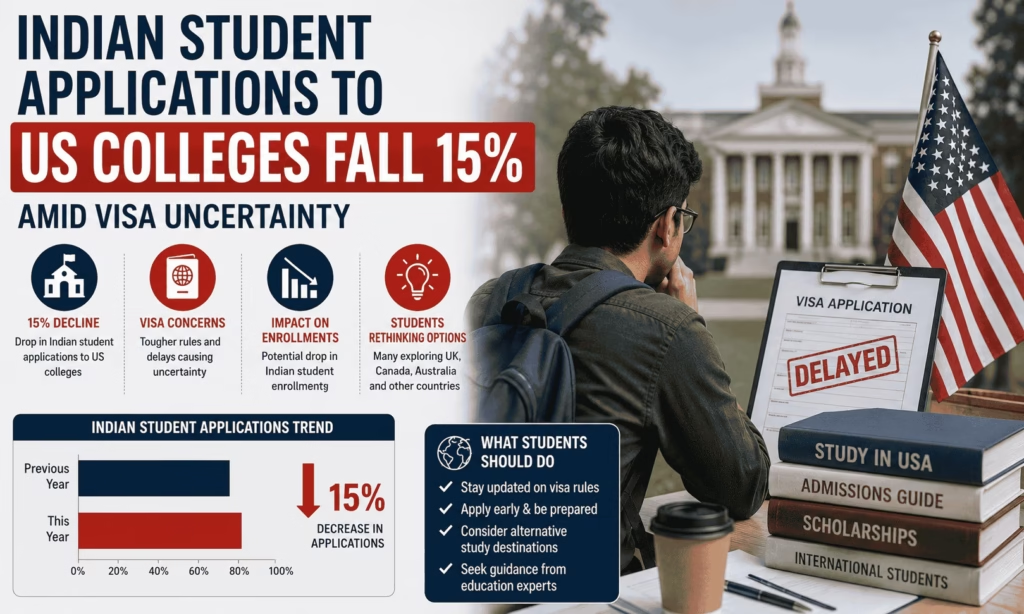
Indian student applications to US colleges have dropped by 15 percent in the 2025-26 admission cycle compared to the previous year, according to a new report released by the Common App, a non-profit platform used by more than 1,100 American colleges and universities. The decline comes at a time when overall undergraduate application volume for the 2026-27 academic year has actually risen across the board, which makes the India-specific slide even more striking. International applicants as a whole fell 10 percent through March 1, the steepest year-on-year drop the Common App has ever recorded since it began tracking this data. Since India has consistently been the single largest source of international students heading to the United States, this 15 percent fall carries outsized weight for US campuses, for Indian families planning to spend lakhs of rupees on foreign education, and for the American economy that leans on international tuition dollars. We’ll be updating this article monthly as new enrollment, visa and policy data becomes available.
The timing of this decline is not a coincidence. It follows months of tightening immigration policy out of Washington, including a newly finalized rule that ends the decades-old “duration of status” system for F-1 student visas and replaces it with a hard four-year cap, alongside a proposed 100,000 dollar fee tied to the Optional Practical Training (OPT) programme that lets international graduates work in the US after finishing their degree. Indian applicants, many of whom plan multi-year programs, especially STEM and PhD tracks, are now weighing whether the traditional US dream is still worth the financial and legal risk. Education consultants across Delhi, Mumbai, Hyderabad and Chandigarh report a visible shift in client conversations this year, with more families actively comparing Canada, the UK, Germany and Australia as safer bets.
Latest Data: How Big Is the Drop in Indian Student Applications?
The numbers released this week paint a clear picture of a cooling pipeline between India and US campuses. According to the Common App report, which represents applications submitted through March 1 for the 2026-27 undergraduate cycle, international applicants overall fell 10 percent, the sharpest single-year decline on record for the platform. Within that broader number, applicants from India specifically fell 15 percent, a steeper drop than the international average, confirming that Indian students are pulling back faster than their peers from other countries.
This is not an isolated data point. A separate study by NAFSA, the Association of International Educators, working alongside research firm JB International, projected that stricter visa rules and continued policy uncertainty could result in up to 110,000 fewer international student enrollments across US colleges and universities in Fall 2026. That report estimated total international student enrollment fell from roughly 11.69 lakh in 2025-26 to about 10.57 lakh this year, a decline of more than a lakh students in a single admission cycle.
Key Highlights: Indian Student Applications to US Colleges (2025-26 Data)
| Data Point | Figure | Source |
|---|---|---|
| Decline in Indian applicants to US colleges | 15 percent | Common App report, 2025-26 |
| Overall international applicant decline | 10 percent (steepest on record) | Common App report |
| Projected fewer international enrollments, Fall 2026 | Up to 1.1 lakh students | NAFSA and JB International |
| International student enrollment, Fall 2025-26 | Approximately 11.69 lakh | NAFSA and JB International |
| International student enrollment, current year | Approximately 10.57 lakh | NAFSA and JB International |
| Indian students enrolled in US, 2024-25 academic year | Over 3.63 lakh | Common App and Open Doors data |
| Economic contribution of international students, Fall 2025-26 | USD 41.77 billion | Common App report |
| Projected economic contribution, 2026-27 | USD 38.37 billion | Common App report |
| New F-1 visa fixed admission rule effective date | September 15, 2026 | US Department of Homeland Security |
| Maximum stay under new F-1 rule | 4 years, or program length, whichever is shorter | DHS final rule, July 2026 |
| Post-completion grace period under new rule | Reduced from 60 days to 30 days | DHS final rule |
| Proposed OPT fee for foreign graduates | USD 100,000 (under consideration) | US government proposal |
Why Are Fewer Indian Students Applying to US Colleges?
The short answer is uncertainty, and it is showing up at nearly every stage of the visa and enrollment pipeline. Indian families who once treated a US degree as the default aspirational choice are now running a much longer cost-benefit calculation before committing. Several overlapping factors are driving this year’s Indian student applications decline.
$1250 New Jersey Child Tax Credit: State Budget Delivers 25% Boost for Families With Young Children
H-1B Visa Fee 2026: DHS Proposes New $103,265 Charge After Losing in Court
The End of Duration of Status and the New 4-Year Cap
On July 16, 2026, the US Department of Homeland Security finalized a rule that eliminates the long-standing “duration of status” framework for F-1 and J-1 visa holders. Under the old system, a student admitted on an F-1 visa could remain in the United States for as long as their program required, provided they stayed enrolled and maintained good standing, even if a PhD stretched to six or seven years. Under the new rule, which takes effect September 15, 2026, students instead receive a fixed “Admit Until Date” on their I-94 record, capped at four years or the length of their program, whichever is shorter. Anyone who needs more time, which includes most doctoral candidates and many dual-degree students, must now file a formal Extension of Stay application with USCIS, a process that comes with added paperwork, biometric requirements and processing delays.
The rule also shortens the post-completion grace period from 60 days to 30 days, giving graduates far less breathing room to transfer schools, change visa status or begin OPT employment after finishing coursework. For a country like India, where a large share of outbound students pursue graduate and doctoral programs specifically because of the flexibility the old system offered, this single change has reshaped how risky a long-term US commitment now feels.
The Proposed 100,000 Dollar OPT Fee
Alongside the visa overhaul, the US government is separately considering a steep fee, reportedly up to 100,000 dollars, for foreign students who want to use the Optional Practical Training programme to gain work experience in the US after graduation. OPT has historically been one of the strongest pulls for Indian STEM students, since it offers a legal pathway to work in the US for up to three years post-degree, often as a bridge toward an H-1B visa. A fee at that scale would put OPT out of reach for the vast majority of middle-class Indian applicants, effectively erasing one of the biggest financial justifications for choosing an expensive US degree over a cheaper alternative in Canada or Europe.
Broader H-1B and Immigration Tightening
The visa squeeze is not limited to students. Indian professionals have long relied heavily on the H-1B programme, and continued uncertainty around that pathway is feeding directly into how Indian families think about undergraduate and graduate study decisions today. If the long-term route from student visa to work visa to permanent residency looks less reliable, the entire value proposition of a US degree weakens, regardless of how strong the university itself is academically.
Cost and Currency Pressure
Even before this year’s visa changes, the price of a US education had already climbed sharply for Indian families paying in rupees. Combine a weaker rupee, rising tuition and living costs, and now added legal risk and extension fees, and the total cost of a four-year US degree has become harder to justify for families that previously stretched their budgets specifically for the post-study work opportunity that OPT provided.
Where Are Indian Students Going Instead?
Education counselors say the drop in Indian student applications to US colleges is not simply a pause, it is a redirection. Canada, the United Kingdom, Germany, Ireland and Australia are all seeing renewed interest from Indian applicants who want a Western degree without the same level of visa unpredictability, even though several of these countries have tightened their own international student caps in recent years. Continental Europe, particularly Germany and the Netherlands, is drawing interest for low or no-tuition public universities combined with clearer post-study work rights. For Indian STEM applicants specifically, some are also reconsidering strong domestic options such as the IITs, IIITs and top private universities, especially given the added cost and uncertainty now attached to the US route.
SNAP State Cost-Share 2027: The New Rule That Could Force States to Pay Billions in Food Benefits
Impact on US Universities and the Wider Economy
International students, and Indian students in particular, are not just a source of academic diversity for US campuses, they are a significant revenue stream. The Common App report notes that international students contributed 41.77 billion dollars to the local economy in Fall 2025-26, a figure projected to fall to 38.37 billion dollars in 2026-27 if current trends hold. That is a decline of more than 3 billion dollars in a single projected cycle, money that flows into tuition, campus housing, local businesses and part-time employment in college towns across the country.
India alone sent over 3.63 lakh students to the US in the 2024-25 academic year, making it the largest single source of international students, ahead of China. A sustained 15 percent drop, if it continues into future cycles, would directly hit enrollment numbers, graduate teaching assistant pipelines in STEM departments, and the broader financial model that many mid-sized American universities depend on. University administrators, particularly at public research universities with large graduate programs, have already flagged concern about smaller incoming cohorts for Fall 2026 and Fall 2027.
How This Affects Applicants: What Indian Students Should Know Right Now
For students currently applying or already enrolled, the practical questions center on timing, paperwork and cost. Anyone planning to start a US program in Fall 2026 or later should build the new four-year cap and 30-day grace period directly into their academic and financial planning, rather than assuming the old open-ended timeline still applies.
Processing Time and Key Dates to Track
The new fixed admission period rule was published in the Federal Register on July 17, 2026, and takes effect September 15, 2026. It applies not only to new arrivals but also to students already inside the United States on F-1 or J-1 status, whose stay will now be capped from the effective date rather than continuing indefinitely under the old duration of status framework. Students in programs expected to run past September 2030 will need to file an Extension of Stay with USCIS before their authorized period ends, and USCIS processing times for extension applications are expected to lengthen as more students file simultaneously once the rule takes hold. Applicants should treat any extension filing as a multi-month process and avoid waiting until the final weeks of their authorized stay.
How to Apply and What Documentation Matters
Prospective applicants should continue applying through the standard Common App or individual university portals as usual, but should pay close attention to updated I-20 forms, which will now reflect a specific program end date rather than an open D/S notation. Current students should confirm with their school’s Designated School Official (DSO) exactly what end date will appear on their new I-94 record after September 15, 2026, and should keep copies of every SEVIS and visa document in case an extension filing becomes necessary later. Families evaluating US offers this cycle are increasingly asking universities directly about typical program completion timelines, OPT eligibility, and whether the institution has any guidance on the proposed OPT fee, since that single policy could change the entire financial calculation for a STEM masters or PhD offer.
Payment and Fee Schedule Considerations
Beyond tuition, applicants now need to budget for potential Extension of Stay filing fees, which have historically ranged between 420 and 470 dollars per application under similar USCIS filings, along with biometric appointment costs where required. If the proposed 100,000 dollar OPT fee is finalized in its current form, it would represent an entirely new and substantial line item that most applicants have never had to plan for, and students should watch for official confirmation before assuming OPT remains financially viable as part of their US study plan.
Official US Government and Visa Resources
| Resource | Purpose | Official Link |
|---|---|---|
| US Department of Homeland Security | Official rule text and policy updates on F-1 and J-1 visa changes | https://www.dhs.gov |
| US Citizenship and Immigration Services (USCIS) | Extension of Stay filing, Form I-539, status updates | https://www.uscis.gov |
| US Department of State, Bureau of Consular Affairs | Student visa (F-1, J-1) application and interview scheduling | https://travel.state.gov |
| Study in the States (SEVP) | SEVIS records, school transfer and status maintenance guidance | https://studyinthestates.dhs.gov |
| Common App | Undergraduate application portal and reported application data | https://www.commonapp.org |
| NAFSA: Association of International Educators | Enrollment research and policy analysis | https://www.nafsa.org |
| Institute of International Education, Open Doors Report | Annual international student enrollment statistics | https://opendoorsdata.org |
Applicants and current students should always verify visa rules, fees and processing times directly on these official government portals, since immigration policy in this area is changing on a near-monthly basis in 2026.
FAQs
Why did Indian student applications to US colleges fall 15 percent?
Indian student applications to US colleges fell 15 percent mainly due to the new F-1 visa rule that ends duration of status and caps stays at four years, combined with a proposed 100,000 dollar OPT fee and broader uncertainty around H-1B and long-term immigration pathways.
Is it still safe for Indian students to apply to US universities in 2026?
Yes, applying remains legally safe, but students need to factor in the new four-year admission cap, the shorter 30-day grace period, and the possibility of an OPT fee before committing, especially for long doctoral or dual-degree programs.
What is the new F-1 visa rule that took effect in 2026?
The new rule, finalized by the Department of Homeland Security on July 16, 2026 and effective September 15, 2026, replaces open-ended duration of status admission with a fixed period capped at four years, requiring an Extension of Stay application for longer programs.
Will the 100,000 dollar OPT fee actually be implemented?
As of August 2026, the OPT fee remains a proposal under consideration and has not been formally finalized, so applicants should monitor official USCIS and Department of Homeland Security announcements before assuming it will apply to their program.
Which countries are Indian students choosing instead of the US?
Many Indian students are now applying more actively to Canada, the United Kingdom, Germany, Ireland and Australia, along with reconsidering strong domestic options, as alternatives to the increasingly uncertain US visa environment.
How many Indian students are currently studying in the US?
India remains the largest source of international students in the US, with more than 3.63 lakh Indian students enrolled during the 2024-25 academic year, even as new applications for 2025-26 have declined.
What should current F-1 visa holders do before September 15, 2026?
Current F-1 and J-1 visa holders should confirm their new admit-until date with their school’s international student office, review their program’s expected completion date, and prepare an Extension of Stay filing early if their program runs past the four-year cap.
Conclusion
The 15 percent fall in Indian student applications to US colleges is one of the clearest signals yet that America’s decades-long dominance as the top destination for Indian higher education is no longer guaranteed. A combination of the new four-year F-1 visa cap, a shortened grace period, and the looming threat of a six-figure OPT fee has pushed many Indian families toward a more cautious, diversified approach to studying abroad. US universities are already feeling the financial impact, with international student contributions to the economy projected to drop by roughly 3.4 billion dollars in the coming academic year. For prospective and current students, the practical takeaway is straightforward: track official DHS and USCIS updates closely, plan around the September 15, 2026 rule change, and factor visa risk into every US application decision this cycle. This article will be reviewed and updated monthly as new enrollment figures, visa rule clarifications and OPT fee decisions are released.