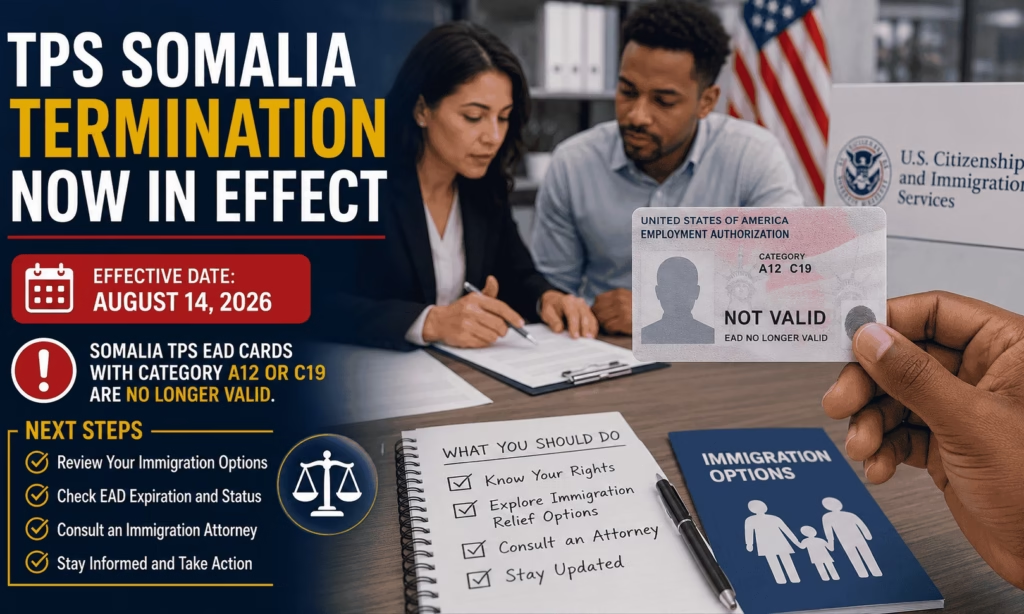
TPS Somalia Termination: Temporary Protected Status for Somalia officially ended on August 14, 2026, and every EAD card issued under that designation stopped being valid the same day. U.S. Citizenship and Immigration Services confirmed the termination in an alert posted the same day, closing out a legal fight that had kept Somali TPS holders protected since a federal court stepped in back in March. The announcement affects roughly 700 to 2,500 Somali nationals depending on the source cited, all of whom now need another form of legal status or risk losing their ability to work and remain in the country. We’ll be updating this article monthly as USCIS releases further guidance or as ongoing litigation develops.
For Somali TPS holders and the employers who hired them, this is not a warning about something coming. It already happened. Employment Authorization Documents, known as EAD cards, carrying category codes A12 or C19 and issued under Somalia’s TPS designation are no longer valid for proving work authorization, and employers are required to reverify affected employees’ status. Anyone still working off a Somalia TPS-based EAD without another legal basis for employment is now out of status. Here is a complete breakdown of what happened, why it happened now, what it means for EAD cards, and what affected individuals and employers need to do next.
What Just Happened With Somalia’s TPS Designation?
On August 14, 2026, USCIS posted an official alert confirming that the Temporary Protected Status designation for Somalia is terminated, effective that date. The alert states plainly that Forms I-766, Employment Authorization Documents, issued to TPS Somalia beneficiaries under category A12 or C19 are no longer valid. This guidance replaced an earlier update from August 12, which had extended those same EADs on a limited basis while litigation played out.
The termination traces back to a January 14, 2026 notice in the Federal Register, in which then-Secretary of Homeland Security Kristi Noem determined that Somalia no longer met the statutory conditions required for a TPS designation. That notice originally set a termination date of March 17, 2026. Before that date arrived, the U.S. District Court for the District of Massachusetts issued a stay in the case African Communities Together et al. v. Noem et al., keeping protections and EAD validity in place while the litigation continued. That stay held for roughly five months.
TPS Somalia Termination Key Highlights
| Item | Detail |
|---|---|
| TPS Somalia termination effective date | August 14, 2026 |
| Governing USCIS alert | Termination of Temporary Protected Status for Somalia (Release: Aug. 14, 2026) |
| Original termination notice | 91 Fed. Reg. 1547, published January 14, 2026 |
| Original scheduled termination date | March 17, 2026 |
| Court that lifted the stay | U.S. District Court for the District of Massachusetts, Judge Allison D. Burroughs |
| Underlying Supreme Court precedent | Mullin v. Doe, 609 U.S. ___ (2026), decided June 25, 2026 |
| Affected EAD categories | A12 and C19 |
| Estimated Somali TPS beneficiaries | Approximately 700 to 2,500, depending on source |
| Employer obligation | Reverify affected employees; cannot continue employing without valid work authorization |
| Underlying court case | African Communities Together et al. v. Noem et al., No. 26-cv-11201 (D. Mass.) |
Why the Stay Was Lifted Now?
The direct trigger for this month’s termination was a June 25, 2026 U.S. Supreme Court decision in Mullin v. Doe, a case that dealt with a similar TPS termination dispute involving Haiti and Syria. In that ruling, the Supreme Court sided with the Trump administration’s authority to proceed with TPS terminations, a decision that USCIS has since described as directly affecting the outcome of pending TPS litigation for other countries, including Somalia.
Following that Supreme Court precedent, Judge Burroughs in the Massachusetts district court lifted the stay that had been protecting Somalia TPS holders since March. Court records show that ruling came down on August 14, 2026, the same day USCIS issued its termination alert. The judge’s order did not direct the removal or deportation of any individual Somali national. It removed the legal basis that had kept TPS status and its associated EAD validity in effect, which is a different and narrower action than an immediate deportation order.
CRS Score Distribution 2026: 5 Trends Shaping the Next Express Entry Draw
New Canada LMIA Rules August 2026: What Employers and Foreign Workers Need to Know
What This Means for EAD Cards Right Now?
The most immediate and practical consequence of this termination is that Employment Authorization Documents tied to Somalia’s TPS designation, specifically those bearing category code A12 or C19, are no longer valid proof of the right to work in the United States. This applies regardless of the expiration date printed on the card itself, since the underlying legal status that made the card valid has now ended.
Employers who have Somali TPS beneficiaries on staff are required to reverify these employees’ work authorization. Federal guidance is direct on this point: an employer may not continue employing an individual who cannot provide proof of valid employment authorization through some other means. That means a Somali national whose only basis for legal work authorization was the terminated TPS designation is now considered to lack valid work authorization, unless that person holds another qualifying immigration status or a separate, still-valid EAD issued under a different category.
What Somali TPS Holders Should Do Next?
Anyone whose only legal status in the United States was Somalia TPS is now, as of August 14, 2026, without that protection and without valid work authorization tied to it. Advocacy organizations and immigration attorneys have consistently urged affected individuals to take several concrete steps rather than wait for further updates.
First, retain every TPS-related document, including the terminated EAD, prior approval notices, and any Form I-797 or I-797C notices, since these records matter for any future legal filing or status determination. Second, consult with a qualified immigration attorney or an accredited nonprofit legal service provider to determine whether another immigration pathway applies, such as asylum, a family-based petition, or another form of relief the individual may already be eligible for but has not yet pursued. Third, avoid relying on informal guidance found in social media or unofficial forums, since TPS litigation has moved quickly over the past year and outdated information can lead to serious legal mistakes.
Individuals without another lawful status following this termination are, according to USCIS’s own published guidance, considered to have lost their work authorization and may face removal proceedings if they remain in the country without pursuing an alternative legal status.
How to Apply for Alternative Status?
- Schedule a consultation with an immigration attorney or a Department of Justice-recognized nonprofit legal services organization as soon as possible, since eligibility windows for alternative relief can be time-sensitive.
- Gather every immigration document connected to your case, including your terminated EAD, TPS approval notices, passport, and any prior immigration filings, before your consultation.
- Ask specifically whether you qualify for asylum, withholding of removal, protection under the Convention Against Torture, a family-based immigrant petition, or any employment-based pathway you may not have previously explored.
- If you are in active removal proceedings or receive a Notice to Appear, respond within the stated deadlines and seek legal representation immediately rather than missing a hearing date.
- Employers with affected employees should coordinate directly with company immigration counsel or HR compliance staff to handle Form I-9 reverification correctly and avoid both unlawful termination and unlawful continued employment of someone without valid work authorization.
Processing Time and What Comes Next
There is no processing time associated with the termination itself since it is already in effect, but affected individuals pursuing an alternative immigration status should expect standard USCIS processing timelines for whatever application they file next, which vary significantly by category. Asylum applications, family-based petitions, and other forms of relief each carry different current processing times that applicants should confirm directly with USCIS or their attorney rather than relying on general estimates, since these figures shift based on caseload and change periodically.
Litigation around this termination may not be fully over. The underlying case, African Communities Together et al. v. Noem et al., reportedly includes separate constitutional claims beyond the initial challenge, meaning further legal developments are possible even though the immediate stay has been lifted. Somali TPS holders and their attorneys should continue monitoring official USCIS alerts for any updates tied to this specific case number.
Employer Compliance and Payment Considerations
For employers, this termination carries direct payroll and compliance consequences rather than a payment schedule in the traditional sense. Any employee whose Form I-9 documentation relied on a Somalia TPS EAD under category A12 or C19 must be reverified. If the employee cannot present another valid document establishing continued work authorization, federal law requires the employer to end that employment relationship rather than continue payroll for someone without valid authorization. Employers using E-Verify should also confirm that their system reflects the updated status rather than an outdated TPS-based verification, since continuing to rely on an expired authorization code can create compliance exposure during a future audit.
Official Resources and Status Check Links
| Resource | Purpose | Official Link |
|---|---|---|
| USCIS Termination Alert (Aug. 14, 2026) | Official confirmation of the termination and EAD guidance | uscis.gov/i-9-central/form-i-9-related-news/termination-of-temporary-protected-status-for-somalia-release-aug-14-2026 |
| USCIS TPS Somalia Page | Official designated-country status page | uscis.gov/humanitarian/temporary-protected-status/temporary-protected-status-designated-country-somalia |
| USCIS Temporary Protected Status Overview | General TPS program information for all designated countries | uscis.gov/humanitarian/temporary-protected-status |
| E-Verify TPS Somalia Updates | Employer guidance on verification and Form I-9 procedures | e-verify.gov/about-e-verify/whats-new |
| USCIS Explore My Options | Tool for identifying alternative immigration pathways | uscis.gov (Explore My Options page) |
| Federal Register Notice, 91 Fed. Reg. 1547 | Original January 2026 termination notice | federalregister.gov |
| Find Legal Help | Directory of accredited nonprofit immigration legal services | uscis.gov (Find Legal Services page) |
A Brief History of Somalia’s TPS Designation
Somalia has held Temporary Protected Status longer than almost any other designated country, a fact that makes this termination especially significant for the community affected. The designation was first granted in 1991 amid the country’s civil war and has been continuously extended and redesignated more than two dozen times since then, according to congressional correspondence on the matter. The most recent extension and redesignation, issued in July 2024, ran through September 18, 2024, and was set to remain in effect for 18 months, carrying the designation to March 17, 2026, before this year’s termination proceedings began.
That long history matters because many Somali TPS holders have lived, worked, and raised families in the United States for years, if not decades, under this status. Minnesota in particular is home to one of the largest Somali diasporas in the country, and members of the state’s congressional delegation publicly objected to the termination when it was first announced in January, calling it a departure from decades of bipartisan humanitarian policy toward the Somali community. That political and community context has not changed the legal outcome, but it explains why this particular termination has drawn more sustained public attention than some other TPS actions this year.
The Full Litigation Timeline
Understanding how this case moved from a scheduled March termination to an August 14 effective date requires walking through the sequence of events. DHS published its termination notice in the Federal Register on January 14, 2026, setting an effective date of March 17, 2026. Before that date arrived, plaintiffs filed suit in African Communities Together et al. v. Noem et al. in the U.S. District Court for the District of Massachusetts, arguing among other things that the termination reflected racial animus and violated Fifth Amendment protections.
On March 13, 2026, the district court issued a stay blocking the termination from taking effect, which kept Somalia TPS status and its associated EAD validity in place for beneficiaries. USCIS repeatedly reissued guidance over the following months, in March, May, July, and again in July, each time confirming the stay remained active and that EADs originally set to expire on dates including March 17, 2023, September 17, 2024, and March 17, 2026, continued to be extended under the court order.
That changed after the Supreme Court ruled on June 25, 2026, in the unrelated but legally similar case Mullin v. Doe, which involved TPS terminations for Haiti and Syria. In a 6-3 decision, the Court held that federal law generally bars judicial review of TPS designation and termination decisions made by the Department of Homeland Security. That precedent effectively removed the legal foundation supporting the stay in the Somalia case. On August 12, 2026, USCIS issued interim guidance still describing the EADs as extended, but just two days later, on August 14, 2026, Judge Burroughs formally lifted the stay in light of the Supreme Court’s ruling, and USCIS issued its termination guidance the same day.
Indian Student Applications to US Colleges Fall 15% Amid Visa Uncertainty: What the New Data Shows
Common Mistakes to Avoid After a TPS Termination
Immigration attorneys who have handled prior TPS terminations for countries such as Haiti, Venezuela, and Honduras point to a handful of recurring mistakes that affected individuals make in the weeks immediately following an announcement like this one. The first is assuming that a printed expiration date on an EAD card still controls, even after a formal termination notice. As this guidance makes clear, the card’s printed date is no longer the relevant factor once the underlying TPS designation itself has ended.
The second common mistake is delaying a legal consultation while waiting to see whether the termination gets challenged again in court. While further litigation in this case remains possible, waiting without taking any action can close off options that have their own independent deadlines, such as certain asylum filing windows tied to when someone first became aware of a threat to their safety if returned home. The third mistake is relying on informal community networks or social media posts for legal guidance rather than confirming information directly against official USCIS alerts or a licensed attorney, since TPS-related guidance has changed multiple times over the past several months and outdated advice can lead someone to miss a filing deadline or misunderstand their current status.
Finally, some individuals mistakenly believe that having other family members with valid immigration status in the United states automatically extends protection to them. It does not. Each individual’s immigration status is assessed independently, and a Somali TPS holder whose status has terminated needs their own qualifying basis for remaining in the country, regardless of a spouse’s, parent’s, or child’s separate immigration status.
FAQs
Are Somalia TPS EAD cards still valid for employment?
No. Forms I-766 issued under category A12 or C19 to TPS Somalia beneficiaries are no longer valid proof of work authorization, regardless of the expiration date printed on the card.
What should I do if I only have Somalia TPS status?
Consult an immigration attorney or accredited nonprofit legal service provider immediately to determine whether you qualify for another form of relief, such as asylum or a family-based petition, since remaining without any legal status creates removal risk.
Can my employer still employ me if my only work authorization was through Somalia TPS?
No. Federal law requires employers to reverify work authorization and prohibits continuing to employ someone who cannot present valid proof of authorization after a TPS termination like this one.
Why did the termination happen now instead of in March 2026?
A federal court stay had kept Somalia TPS protections in place since March 2026. That stay was lifted on August 14, 2026, following the Supreme Court’s June 25, 2026 decision in Mullin v. Doe, which limited judicial review of TPS termination decisions.
Does this termination affect Somali nationals with a different immigration status?
No. This termination only affects individuals whose legal status and work authorization depended specifically on the Somalia TPS designation. Somali nationals with another valid immigration status are not affected by this action.
Is there any pending legal challenge that could change this outcome?
The underlying case, African Communities Together et al. v. Noem et al., may still include separate constitutional claims proceeding in court, so further developments remain possible even though the immediate stay has been lifted.
People Also Ask
How many people are affected by the Somalia TPS termination?
Estimates vary by source, ranging from approximately 700 to a few thousand Somali nationals who held TPS status, with some reporting citing figures closer to 2,500.
What does Mullin v. Doe mean for other TPS countries?
The Supreme Court’s decision in Mullin v. Doe restricts judicial review of TPS designation and termination decisions made by the Department of Homeland Security, a precedent that has already affected pending termination cases for countries including Somalia, Burma, South Sudan, and Syria.
Can a Somali TPS holder reapply for TPS after termination?
No new TPS registration is available once a country’s designation has been terminated, since the underlying designation itself has ended rather than merely an individual’s application.
What is the difference between an EAD category A12 and C19?
Both are code designations the USCIS uses on Form I-766 to indicate the specific legal basis for work authorization; in this case, both categories reflect authorization tied specifically to the Somalia TPS designation, and both are affected equally by this termination.
Conclusion
The termination of Temporary Protected Status for Somalia is no longer a pending decision. It took effect on August 14, 2026, and every EAD card tied to that designation stopped serving as valid proof of work authorization the same day. For the several hundred to few thousand Somali nationals who relied on this status, and for the employers who hired them in good faith under valid TPS-based documentation, the priority now is figuring out what comes next rather than waiting for the situation to resolve itself. Individuals should move quickly to consult qualified immigration counsel about alternative pathways, and employers should handle reverification carefully and promptly to stay compliant with federal employment law. Given that litigation around this case may still be ongoing, anyone affected should continue checking official USCIS channels directly rather than relying on secondhand summaries for updates.